family
🌕 Mailbox to the Moon
It all started with a blue mailbox that wasn’t supposed to be there. It stood crookedly at the end of the cul-de-sac, right where the neighborhood path curved into the woods. No street number, no postal mark, no name—just a faded moon sticker peeling from the side like a forgotten dream.
By Pir Ashfaq Ahmadabout a year ago in Fiction
How to Open Up to a Big Sister
1. Understanding the Distance: Acknowledge the Pain Without Judgement Growing up without the presence or support of a big sister can leave emotional gaps that are difficult to articulate. Older siblings often carry symbolic weight—they are protectors, guides, and sometimes even role models. When that expectation is unmet, it leads to confusion, resentment, or a silent longing for connection. Before you can open up to her, it's important to first explore your own feelings about the past. Were you hurt because she didn’t come to your school events? Did you feel alone during family crises because she seemed emotionally or physically absent? Understanding the specifics of your experience, rather than burying the emotion, is a vital step toward meaningful communication. It’s also crucial to recognize that her absence may not have been intentional. Perhaps she was going through personal struggles of her own—dealing with mental health issues, academic pressures, or family expectations that took her away from her younger siblings emotionally. Or maybe she simply wasn’t mature enough at the time to handle the role she was meant to play. This does not erase your pain, but it does open the door to a more balanced perspective. By removing the weight of harsh judgment, you allow yourself the chance to approach her not with blame, but with the desire to heal. This shift in mindset sets the stage for a more productive and empathetic conversation. 2. Preparing Emotionally: Define Your Intentions and Set Boundaries Before initiating the conversation with your sister, it helps to reflect deeply on what you hope to achieve by opening up. Do you want closure about the past? Are you hoping to rebuild a stronger bond moving forward? Or do you simply need to express feelings that have been bottled up for too long? Being clear with yourself will give your conversation focus and help avoid veering into territory that could reopen old wounds without resolution. It's also essential to prepare for the possibility that your sister may not respond the way you want her to. She may feel guilty, become defensive, or even deny your experience. Preparing yourself for these reactions allows you to stay grounded and avoid being blindsided. Equally important is setting emotional boundaries. Make a conscious decision about what you're willing to share and what you’d rather keep private. You don’t have to bare your soul all at once. Vulnerability is not about dumping years of pain in one go—it’s about opening the door just enough to let the light in. Perhaps start by discussing a single incident or a general feeling you’ve carried with you, and observe how she responds. If she shows openness, kindness, or even regret, you can gradually reveal more. If not, you’ve still taken an important step in honoring your truth. Either way, by clarifying your intentions and limits, you’ll approach the conversation with more confidence and emotional safety. 3. Choosing the Right Setting and Language: Start Soft, Stay Honest The timing and environment in which you open up to your sister can make a significant difference. Avoid doing it during a rushed moment, family gathering, or high-stress event. Choose a neutral, quiet setting where both of you can be physically comfortable and emotionally present. A walk in a park, a calm café, or a private chat over video call—whatever feels safest for you both. Begin the conversation gently. Start by expressing appreciation for the chance to talk, or even acknowledge that it’s not an easy topic for either of you. Using soft, non-accusatory language helps lower her defenses and encourages her to listen more attentively. Use “I” statements rather than “you” statements to express your emotions. Instead of saying, “You were never there for me,” try saying, “I often felt alone growing up, and I struggled with not having you around.” This shift in language places the emphasis on your experience rather than casting blame. The goal here is not to guilt her into an apology, but to invite her into your world—a world she may not have realized she was absent from. Also, be patient with pauses, silence, or emotional responses. Opening up is not a monologue—it’s an emotional dance. Allow her to process what you’re saying, and give her the chance to respond in her own way and time. 4. Dealing with Responses: Embracing Disappointment, Hope, or Reconnection Your sister’s response can range from heartfelt understanding to complete denial. She may apologize with sincerity, offering insights into her own struggles and perhaps expressing regret for her absence. This outcome, while ideal, is not guaranteed. She might respond with defensiveness, saying things like, “You’re overreacting,” or, “I didn’t even know you felt that way.” If that happens, it can feel like your emotional vulnerability was wasted, but it’s important to remember that people can only meet you as deeply as they’ve met themselves. Her inability to accept your feelings doesn’t invalidate them. If her response is dismissive or cold, you are still in control of how you choose to heal. You may need to grieve the relationship you hoped to have with her. This is a valid and necessary part of the process. Closure doesn’t always come through resolution—it often comes from recognition. If, however, your sister is open to further conversation, or expresses a desire to reconnect, then you’ve both been gifted a chance to rebuild a relationship that was once fractured. This will take time, effort, and continuous honesty. Perhaps you can begin with small, consistent steps—shared activities, text messages, or just learning more about each other’s present lives. Reconnection after emotional distance is never immediate, but it is possible with mutual care and patience. 5. Moving Forward: Healing as a Personal and Shared Journey Whether or not your sister responds the way you hoped, opening up is a powerful step toward healing. It reflects courage, emotional maturity, and a willingness to confront pain rather than suppress it. Healing is never linear—it comes in waves. Some days you may feel lighter, having voiced your truth; other days, old wounds may sting anew. Be gentle with yourself during this process. Seek additional emotional support if needed—therapy, journaling, or conversations with trusted friends can help you navigate the aftershocks of vulnerability. If a new relationship with your sister begins to bloom, celebrate the small wins. Every moment of shared laughter, every message exchanged, is a step toward a bond that didn’t exist before. And if that relationship remains distant, know that you’ve done your part in extending an olive branch. Opening up isn’t about changing the past—it’s about making peace with it. You’re not just reaching out to her—you’re reaching inward, reclaiming your narrative, and choosing to live authentically. Regardless of how she responds, your journey toward healing and self-expression is already a powerful act of transformation.
By Dipayan Biswasabout a year ago in Fiction
The True Story of Sam. Runner-Up in You Were Never Really Here Challenge.
I met him the summer I turned seven. Down by the creek where I used to play on my grandparent's farm. He waited behind the toolshed. He told me his name was Sam, and he told me that like he wasn’t sure it still was.
By Tim Carmichaelabout a year ago in Fiction
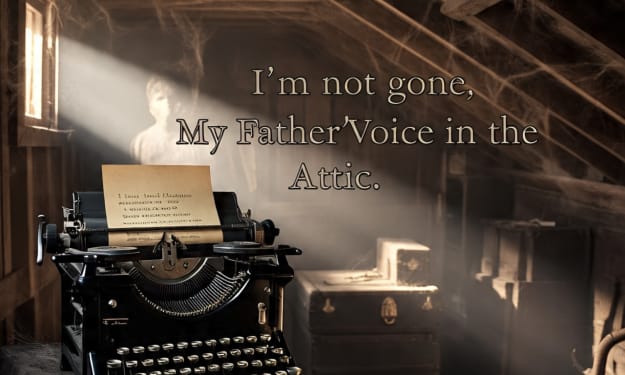
My Father's Voice in the Attic.
It started with a voice—soft, unmistakable, and impossibly familiar. I was alone in the house, brushing dust from old photo albums in the parlor, when I heard it. A low murmur floated down from the attic, like a conversation overheard through a wall. My heart stuttered. It had been three years since my father passed away. The funeral was quiet, somber—just as he would have wanted. He was a private man, a writer of some small renown in his day, and he’d lived most of his final years holed up in this very house, surrounded by papers and silence. Now that Mom had moved into a smaller place, it fell on me to sort through everything. The house still smelled faintly of pipe smoke and ink. I told myself I imagined it. The wind maybe, or the moan of the old beams settling under the June heat. I went back to organizing the old letters. Then I heard it again. This time, clearer: “Anna…” My name. I froze. My father’s voice. Raspy, deep, unmistakable. He used to call my name that way when I was little, when he found me buried under a pile of books in the corner of the study, or when I’d fallen asleep on the sofa while he wrote late into the night. I stood, grabbed the flashlight, and made my way up the creaky stairs. The attic door groaned on its hinges as I pulled it open. The warm air hit me like a wave, thick with dust and old paper. “Dad?” I called, feeling ridiculous. Nothing. The attic looked the same as always—stacked boxes, a few old paintings, yellowed newspaper clippings of his book reviews pinned to the rafters. And then I noticed it: the typewriter. His old black Remington sat in the middle of the attic floor. I was sure it hadn’t been there before. Slowly, I approached. A single sheet of paper was fed into the carriage. On it, one line typed in the faded ink of a ribbon long expired: “I'm not gone, Anna.” My hands trembled. The key bars were cold to the touch, unmoving. I looked around, heart thumping. Dust clung to every surface, undisturbed. No footprints but mine. I backed away, closed the attic door behind me, and didn’t sleep that night. --- The next day, curiosity won over fear. I returned with gloves, a mask, and determination. If someone was playing tricks on me, I needed to know. I searched the attic thoroughly. No speakers, no electronics. No prankster hiding in the boxes. But the typewriter? It had more pages. One each day. Each with a new line in his voice, his phrasing, the kind of poetic insight only my father could produce. “You always understood the silence between words.” “There are stories I never told you, Anna.” “You are the final chapter I never got to write.” It became a ritual. Each morning I climbed into the attic and read what he’d left behind. And then came the day the typewriter stopped. The last page sat there with a single sentence: “Look beneath the floorboards.” My breath caught. I hesitated. But something deeper than fear pushed me forward. I pried up the floorboards near the typewriter, coughing as dust billowed around me. There, wrapped in oilskin and bound with string, was a manuscript. The title page read: "For Anna – The Story of Us" It was a memoir—his memoir. A deeply personal, beautiful, and painfully honest chronicle of his life, his regrets, and his love for me and Mom. Things he never said aloud. Stories he never shared. I read through the night, tears soaking the final pages. --- When the publisher saw the manuscript, they wept too. “It’s his masterpiece,” they said. “A voice from beyond.” But I knew better. It wasn’t a ghost story. It was love—my father’s final act of connection. Somehow, some way, he had waited until I was ready to hear it. And now, whenever I sit quietly, I sometimes hear the clack of old typewriter keys, echoing faintly from the attic above.
By Azmat Roman ✨about a year ago in Fiction
Where the Sky Held Its Breath
The clouds sat heavy on the horizon, glowing gold and bruised violet in the falling light. The wind had gone still. Even the insects had quieted. Martha stood near the back of the wagon, hands resting on the worn wooden frame. Her arms ached, not just from the day’s travel, but from the child wrapped tight against her chest, dozing, as if the miles had never touched him. They had made camp late. The wheel had cracked on one of the wagons ahead, and half the train had waited while the men repaired it with rope and borrowed wood. The tents were pitched quickly, the fires lit in silence. No one laughed tonight. Martha didn’t speak much anymore. There was no one left to talk to. Her husband had died on the second week of the journey—fever, they said. She had buried him in a shallow grave off the side of the trail, covered the spot with stones, and walked on. Two nights later, she found the baby. Or rather, heard him. The crying came from a canvas bundle near the remains of an abandoned cart, left half-burned at the edge of the grasslands. The others had passed it by without stopping. Martha had not. The child was wrapped in linen, bloodied and wailing, his mother lying cold beside him. No one knew how long they had been there. The wolves hadn’t come yet. So Martha had picked him up. No one argued. The wagon behind her creaked as the wind shifted. She turned toward the hills and watched the storm build, far off in the distance. The trail would be mud by morning. “Hungry again, are you?” she murmured, feeling the child stir. She had no milk. That had stopped days ago. Her body had long since stopped bleeding, long since stopped preparing for the child she lost two winters past. But other women still had enough to spare. She would walk, every night, from fire to fire. Always the same question, asked with quiet resolve. “Will you nurse him?” And they always did. Without hesitation. Tired women, sore and sunburnt, still opened their arms. Not for her. For him. He was growing. Thighs thickening. Eyes sharpening. He watched things now — the flapping of canvas, the flicker of flame, the motion of passing wagons. And sometimes he smiled. Martha hadn’t known it was possible for a smile to wound. She stepped away from the wagon and walked slowly toward one of the nearer tents. Smoke drifted up from a small fire. A woman sat beside it, rocking gently, feeding a child of her own. Martha hesitated, just a moment. Then: “Ma’am… mine hasn’t eaten since morning.” The woman looked up, eyes weary but warm. She shifted, freeing one arm. “Come sit.” Martha lowered herself carefully to the earth. Her knees cracked as she moved, her skirts brushing the grass. The stranger took the boy without question, cradling him to her breast like he belonged there. Silence passed between them as the baby latched, as the sun bled away behind the wagon line. “You his kin?” the woman asked quietly. “No,” Martha said. Then, after a pause: “But I’m all he’s got.” The woman nodded. “Then that’s enough.” For a moment, the weight of everything fell away. The trail. The dust. The graves left behind. There was only this: the sound of nursing. The whisper of wind in the grass. Two women, and a child who did not yet know what it meant to be alone. Martha stared into the fire and let herself breathe. Tomorrow, there would be more walking. More hunger. More sky pressing down on their backs. But tonight, there was milk. There was warmth. And there was one more mile behind them. --- Thank you for reading. Inspired by the resilience of women who carried more than just their own burdens across the vast American trail.
By Waqif Khanabout a year ago in Fiction
Children’s Joyful Celebrations in the New Year. AI-Generated.
When the New Year came, the whole town was full of lights, colors, and happiness. The streets were decorated with small shining lights, and the windows of homes had beautiful paper stars. The air was cold, but the hearts of the people were warm. Everyone was ready to say goodbye to the old year and welcome the new one with hope.
By Bilal Mohammadiabout a year ago in Fiction
I Found Out My Brother Wasn’t My Real Brother
We grew up as brothers. Same house. Same school. Same bunk bed. My older brother, Adil, was always the calm one. The responsible one. He looked out for me, helped me with homework, taught me how to fight back against bullies, and gave me advice I didn’t always ask for but secretly needed. If someone had asked me who I trusted most in the world, my answer would have been instant: Adil.
By Umar Faraz Gulabout a year ago in Fiction
The Light in Our Window
Every house on Maple Street had a story. Some were loud, some whispered. Ours flickered like the porch light we kept on through every season, through every silence. That light was my mother’s idea. “Leave it on,” she said one evening, when I was barely tall enough to reach the switch. “Just in case your brother finds his way back.” I was ten then. My older brother, Jonah, had left three months earlier. Or maybe “stormed out” was more accurate. One loud fight with our father, one slammed door, and the rhythm of our family collapsed like a dropped plate. For months, Jonah’s absence was an echo that followed us everywhere. Dad filled the silence with work, longer hours and heavier sighs. Mom wore her hope like armor, always baking too much, setting one extra plate at dinner, folding laundry that wasn’t there. I stopped talking about Jonah after a while. It hurt too much. And yet every night, as dusk crept in, I’d flick that switch and watch our porch light glow. A lighthouse, she called it. “So he knows we’re still here.” At thirteen, I began to understand that love doesn’t always speak in words. It lingers in small things—the way Mom folded his old sweatshirt and placed it on his bed, or how she never erased his name from the mailbox. She never begged him to come home, never sent angry letters. Just that soft, stubborn light in the window. The summer I turned sixteen, everything changed again. It was the summer of power outages and thunderstorms. One evening, the rain was coming down so hard it erased the sky. I sat on the floor with a flashlight, pretending to read but really just thinking about how long it had been since Jonah left. Three years. A whole lifetime. Mom was in the kitchen, kneading dough by candlelight. Dad was late again. We lived in a house full of half-conversations. Then, a knock. It was faint, and the rain almost swallowed it. I stood still. Maybe I imagined it. Another knock, this time firmer. I opened the door. He was soaked to the bone, hair longer, face thinner. Jonah. We stared at each other for a long time, not speaking. He looked older, like life had worn down some of the sharpness in him. But his eyes—they were the same. My brother’s eyes. “Hey,” he said, his voice catching. I wanted to cry, to scream, to punch him and hug him all at once. Instead, I stepped back and let him in. Mom didn’t say anything. She just wiped her hands and wrapped him in her arms like she’d been practicing every day since he left. I thought Dad might fall apart when he saw him. But he didn’t. He just stood there, jaw tight, eyes wet. Then he walked away. It wasn’t perfect. Not even close. The days that followed were quiet but full. Jonah stayed in his old room. We ate dinner together, like strangers learning how to be family again. He didn’t explain much, just said he’d needed space. Said he hadn’t realized how much space he’d created. One night, I found him sitting by the porch, staring at the light. “You kept it on,” he said. “Yeah. Every night.” He nodded. “I saw it. A few times. Before tonight.” I looked at him, confused. “I drove by. Twice, maybe three times. I couldn’t come in. I was...ashamed.” We sat in silence. “Do you hate me?” he asked. “No,” I whispered. “I missed you. That’s all.” He smiled, sad and soft. “I missed you too.” Jonah and Dad didn’t talk much. They existed near each other, but never quite together. I watched them circle, two planets waiting for gravity to pull them back. It finally happened one evening in the garage. I was grabbing a flashlight when I heard voices—low, tense. “You think I didn’t care?” Jonah said. “You walked out!” Dad snapped. “You didn’t even look back.” “I was eighteen, angry, and I felt like I couldn’t breathe in this house!” “You think I didn’t feel that way too?” Dad’s voice cracked. Then silence. A minute passed. Two. I thought maybe they’d left. Then I heard something I hadn’t heard in years. Crying. Not loud, not showy. Just soft, exhausted sobbing—from both of them. I backed away, quietly. When they came in later, they didn’t say anything. But Dad put his hand on Jonah’s shoulder. And Jonah didn’t flinch. That fall, Jonah moved back into town. Not in our house, but nearby. He got a job at the local hardware store. Said he liked fixing things. Said it gave him peace. Our family wasn’t whole in the way it once was. But it was healing. And sometimes healing looks like burnt toast and awkward silences and long walks where no one talks but everyone listens. The porch light stayed on, even after he returned. Not because we were waiting anymore. But because it had become part of us—an emblem of hope, of family love that waits without demanding, forgives without forgetting. Years later, I found myself standing in front of that same house, holding my own child. Jonah stood beside me, older now, silver touching his temples. Dad had passed the year before. Mom had moved in with me, but the house stayed in the family. The porch light flicked on as the sun dipped low. “Still works,” Jonah said. I nodded. “You ever think about how much it meant?” He didn’t answer right away. Then, “It saved me.” I looked down at my daughter, her eyes wide with wonder. “Tell her,” he said. “Tell her the story.” And so I did. About the boy who left, and the light that never stopped waiting. About a mother’s quiet hope, a sister’s stubborn love, a father’s unspoken grief. About how families break, and mend, and grow stronger in the cracks. Author’s Note: Family isn’t always perfect. It stretches, it breaks, it rebuilds. But real love doesn’t disappear. It waits in the quiet moments, in the light left on, in the simple act of staying when it’s hard. This story is for anyone who’s still waiting, still hoping, still healing. You’re not alone.
By Julia Christaabout a year ago in Fiction
Berry Blue Beasts
Blueberries, a healthy way to keep one in shape and a delicious treat, but in this case it tells of a beast in blue. In Alaska where blueberries can be found, they have been known to cover the ground in huge mats that many creatures find absolutely irresistible. On this day, there is a creature has decided to pay a visit to their blueberries fields and enjoy the fruits before him. He is an Alaskan caribou and a large one at that. With giant antlers over his head covered in velvet that are as tall as a twelve year old and robust enough to rip apart any tree that stands in his way, he is a beast to behold. In his prime, he can shake off just about any challenger, but not all odds are desirable when food is the prize.
By Toby Hewardabout a year ago in Fiction
The Mystery Of The Floating Containers
The Old Amber Forest Grove, nestled deep within the tall Canadian Rockies, was a place of whispering pines, beautiful babbling brooks, and a peculiar brand of chaos. It was home to a community of animals as diverse as the wildflowers dotting its lush green meadows, and where the unexpected was, well, to be expected. But even for the Old Amber Forest Grove, the sight of several large, brightly colored containers of different sizes bobbing down the usually serene stream was decidedly out of the ordinary.
By Toby Hewardabout a year ago in Fiction