
The Distance That Sings in the Wind – The Story of Xijun
There are waitings that never end. But even if I don’t return, you already have my silence.

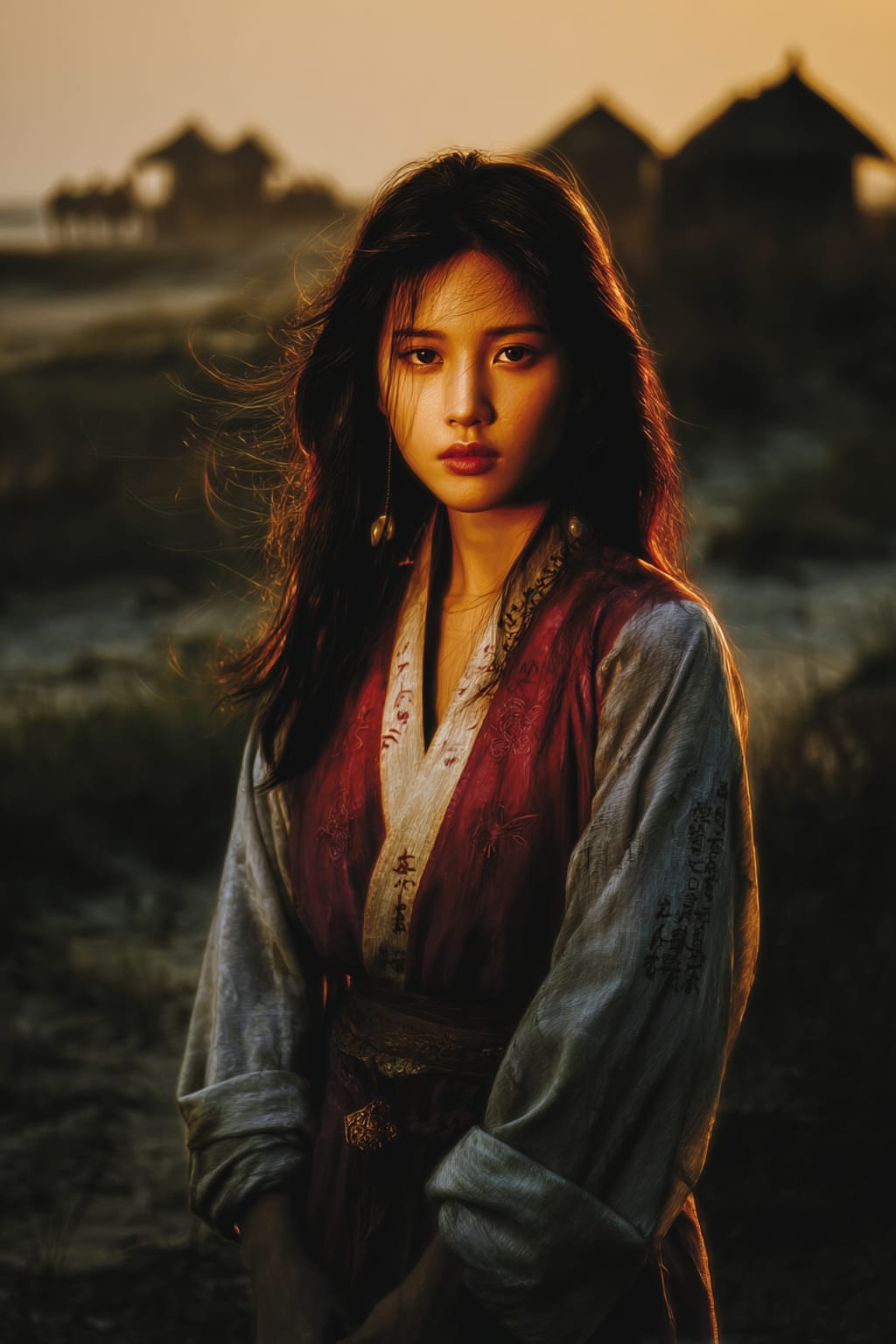
**I. Before the Border**
The snow did not fall in Chang’an that day,
but the wind dreamed of it.
Liu Xijun was seventeen when the Han court ordered her to become an alliance.
Not an ambassador, not a queen, not a woman.
Only a bond. Only a balance between war and peace.
It was the first time a Han princess had been sent so far.
The decree was read aloud, standing, in the Phoenix Pavilion.
The eunuch’s voice trembled only at the end.
Behind him, the high dignitaries remained silent, hands clasped, eyes fixed on the beams.
No one looked at her.
Xijun did not speak. She simply bowed her head.
Not out of honor.
Because her voice had broken inside, like ice cracking on the willow pond.
「和亲守国」
To marry in order to guard the nation.
Four characters. Her father had written them with the thickest black ink.
A calligrapher had copied them onto silk.
Then they had been framed and hung in her new quarters,
as protection—or perhaps a warning.
That night, her mother did not cry.
She sat beside her, combing her hair in silence.
Her hands trembled slightly. When she finished, she only said:
— I sewed a red thread into the seam.
Each time you touch it, remember that you still have a name.
No one accompanied her to the eastern gate the next morning.
Only the eldest maid handed her a small jade box.
— Inside is a needle and an unfinished poem.
— You will complete it in the desert.
The carriage was low, covered with an ivory cloth.
She climbed in alone, her step steady, as if entering a ceremony
and not leaving behind all she was.
The first sound was that of the horses moving in line.
The second, the imperial drum.
The third was a silence that never ended.
The walls passed.
The golden gate passed.
Then the steppe began to replace the hills, and the sky grew larger.
Behind her, the pagodas became small,
then disappeared.
Before her, only sand—
and promises written by others.
**II. Among the Sands**
At first, the journey still had a name.
Each stop was a measurable distance: Chang’an – Dunhuang – Yumen.
Then the name disappeared.
Only the going remained.
The days repeated like a mute prayer:
the sound of carts, dust slipping between lashes,
words spoken only when needed.
Xijun soon learned that no one would bridge the distance—
neither with language nor with gesture.
It was up to her to translate every crack in the path, every imposed silence.
It was beyond the Yumen Pass that longing changed shape.
It was no longer desire.
It was uprooting.
The tea had no taste anymore.
The silk she wore clashed with the landscape.
Writing—the thing she loved, with its sacred slender strokes—was no longer of use.
There were no smooth surfaces on which to trace an ideogram.
And yet, she wrote.
On the inside of her dress, stitching the verses with needle and thread,
word after word.
**《和亲行 · Song of Xijun》**
*(secretly stitched into the sleeve seams)*
I wish to be the swallow flying eastward.
But the mountains have closed the sky.
My name is a broken branch.
I do not know the sound of my voice in this language.
I wake to the song of unknown drums,
I walk among words that do not see me.
In dreams, my mother still combs my hair.
But the combing is done. I am already gone.
They arrived in Wusun with the first cold wind of autumn.
The land was vast, without walls, and the sky seemed tied to the tips of the tents.
There were no palaces. Only mats, horses, drums.
And a king too old for marriage, but not for diplomacy.
On the day of the ceremony,
Xijun did not understand the words spoken.
But she felt her name being reshaped,
mangled in a tongue that held none of its music.
And so she understood she had become something else.
Not a person, but a symbol.
A bridge no one would ever cross from both sides.
The nights were long.
The wind blew like a restless soul between the tents.
She often woke, unsure of what time she belonged to.
In those borderless hours,
she learned to recognize the sounds of the new world:
the neighing of horses,
the whistle of wind through mare bones,
the distant weeping of a woman in the neighboring tent.
And a silence that was not empty,
but full of all that could not be spoken.
It was then, under the first full moon after her arrival,
that she rewrote her identity in silence:
“I am the one who listens.
The one who remembers.
The one who does not forget where she comes from,
even if she can never return.”
**III. The Son of the Steppe**
The old king of the Wusun spoke very little.
When he died, he left behind no letters and no direct heirs—
only the echo of a hoarse voice that, from time to time,
pronounced her name with reverence,
as one might speak the name of a sacred place.
In the void left by the sovereign,
a boy remained: Yuli, born of one of the tributary wives of the clan.
He had amber eyes and chapped hands,
like someone who had faced too many dawns for his age.
Xijun watched him from a distance,
with the ancient instinct of Han women
who know how to recognize an orphan in the heart
before seeing it in the flesh.
He was not her son.
But he was the only face that did not fear her.
She began to welcome him into her tent,
first with shared silences, then with stories.
She told him of Hua Mulan,
of the Grace of Nüwa,
of the Azure Dragon guarding the eastern borders.
It didn’t matter that he didn’t understand every word:
he listened with his eyes.
And every night, before sleeping,
he left her a small gift:
a polished stone, a knotted wool thread, a twig of licorice.
Small gestures that said:
**"I see you."**
In time, her voice became his mother tongue.
Not by grammar, but by intimacy.
Yuli called her *“lady of the river I’ve never seen,”*
because Xijun often spoke of the Wei,
of its slow flowing,
of morning mist,
of rain on the bamboo.
— “Does that river really exist?” — he asked one day.
She didn’t answer.
But that night, she carved her name in Chinese
onto a jade tablet and placed it beside his bed:
**劉細君 — “Liu Xijun.”**
And beneath it: *“River that remembers.”*
When Yuli turned sixteen, the chieftains proclaimed him heir.
The ceremony was brief. No poems.
Only drums and fermented mare’s milk.
Xijun sat on the edge,
a blue shadow among the tents.
She had no more titles.
She was simply *the foreigner who remained.*
That evening, Yuli came to her,
still dressed as a king.
He knelt beside the fire and said:
— “When I’m strong enough, I’ll take you home.”
She closed her eyes.
Not for dreaming, but for remembering.
Then she held out her hand and, for the first time,
spoke to him in perfect Wusun:
— *“You are my home.”*
In the silence of the steppe,
there were no witnesses.
Only the wind carried that phrase
and stitched it into Yuli’s heart—
between his ribs and the drums.
**IV. The Dream That Doesn’t Return**
Years make no sound on the steppe.
They simply change the color of the grass,
carve wrinkles into hands,
make silence heavier.
Liu Xijun stopped counting moons
when she understood Chang’an would never call her back.
Twenty years had passed.
The emperor was dead.
The seal that had once justified her journey
was now in the hands of other ministers,
other husbands,
other compromises.
She had served the empire with her body,
with her voice,
with her patience.
But never with oblivion.
\*\*
One day, a caravan arrived from the east.
It carried no messages—only silk, medicine,
and a new Han wife for another western clan.
Among the parcels was an imperial scroll, decorated in gold.
It did not bear her name.
No one in the camp spoke of it.
But that night, Yuli—now king, now a man—
left a lit lantern in front of her tent. A small gesture.
A way of saying:
**“Even if they forget you, I remember.”**
\*\*
She did not ask to return.
She never spoke of it again.
But she made a single formal request to the tribal council:
— “When I die, bury me facing east.”
The Wusun priests asked her why.
She answered in Chinese:
**“Because from that horizon, my name was born.”**
And then, more softly:
— “And because I want my shadow to find its way home.”
\*\*
It is said that in her final years,
she was often seen alone on the hill at sunset,
a blue cloak over her shoulders and her hair let loose.
She didn’t speak. She didn’t pray.
She simply gazed toward the place where the sky touched the earth—toward the east.
Sometimes she closed her eyes.
And then she returned to the jade corridors,
to the scent of plum leaves,
to her mother’s voice combing her hair and whispering:
— “Each strand that falls remembers where it came from.”
\*\*
One evening, she left her tent open.
On the rough wooden table, only an empty bowl and a folded page.
**“There are waitings that never end.
But even if I don’t return, you already have my silence.”**
She died in her sleep, hands joined beneath her cheek.
She looked like someone listening to something.
Perhaps the wind.
Perhaps a song returning from far away.
**V. Epilogue – Trains That Never Cross**
There are trains that never cross.
Parallel paths.
Stories that do not return.
And yet, in the silence that remains, something still sings.
The poem attributed to Liu Xijun was found nearly two centuries after her death,
buried in the desert sands.
It was not written on fine silk, nor engraved on bronze—
just a few lines in a forgotten manuscript,
inside a dusty storeroom near Dunhuang.
A local official filed it under:
**“Unidentified Female Poetry.”**
For years, no one paid it any attention.
Then, in 1923, an elderly Japanese sinologist,
a scholar of the Han expeditions to Central Asia,
happened upon the scrolls.
He recognized the name *Wusun.*
And he understood.
It was the voice of a Han princess,
married off at the edge of the world.
A voice young, distant—
yet still alive.
The poem was transcribed and printed with care.
Published under its traditional title, **悲愁歌 – Song of Sorrow**,
it was translated like this:
---
**悲愁歌 – Song of Sorrow** *(attributed to Liu Xijun, ca. 105 BCE)*
吾家嫁我兮天一方,
遠託異國兮烏孫王。
願為黃鵠兮歸故鄉。
*My family gave me in marriage to the edge of the sky,*
*sent far away, to a foreign land, to the king of the Wusun.*
*I wish I were a yellow swan, so I could return to my homeland.*
---
Nearly a century later, in Kyoto,
a young woman named Kana read those lines in an academic collection.
It was winter.
It was raining.
She read them on a crowded train,
on her way back from university.
She did not cry for Xijun.
She cried for herself.
For every word she had held inside too long.
For every time her name had been mispronounced.
For every departure where she hadn’t looked back.
She gazed out the window.
Her train was running parallel to another, in the opposite direction.
For a moment—a very brief one—
the carriages aligned.
Two parallel worlds mirrored each other without touching.
Then nothing. Only rain. Only glass.
Sometimes, history doesn’t return.
But it repeats.
In those quiet enough to hear it.
In those who can recognize a voice folded in time.
And in those three forgotten lines,
a Han princess continues to sing.
Not to be remembered—
but so that, somewhere,
someone might recognize
**their own loneliness**
in hers.
**Notes**
This story is born from the meeting between historical memory and poetic voice.
The figure of Liu Xijun—the first princess of the Han dynasty sent in marriage to the Wusun for diplomatic reasons—is documented in official historical sources such as the *Book of Han*, and in the poem known as *Song of Sorrow*, authentically attributed to the princess herself.
In the present narrative, her story has been reconstructed by interweaving:
– historical and academic data drawn from texts such as *Princess Xijun*, *Experiential Metafunctional Analysis of Liu Xijun*, Xiaoxi Zhao’s doctoral thesis, *Women in Ancient China*, *Our Woman in Central Asia*;
– a lyrical and contemplative literary style, where the unsaid, the smallest gestures, and the echoes of time become central elements;
– a particular focus on the theme of **female silence as an archive of memory, resistance, and identity**.
The title itself expresses the aesthetic intention of the work:
*The Distance That Sings in the Wind* is a metaphor for the void between what one leaves behind and what one becomes—
a void that sings to those who know how to listen.
The insertion of the character Kana, in contemporary Japan, serves to reflect the **universality of silence and exile**,
connecting the distant past to the invisible present.
In the gesture of a reader who recognizes herself in the verses of a woman who lived two thousand years before,
the continuity of voice is realized.
Like trains that never cross, some lives do not return.
But they leave us with a trajectory,
a song stitched into the margins of history.
This story is an attempt to listen to it—
and, at last, to carry it home.
About the Creator
Enjoyed the story? Support the Creator.
Subscribe for free to receive all their stories in your feed.
Comments
There are no comments for this story
Be the first to respond and start the conversation.