family
He Carved Her Name Into the Tree Every Year
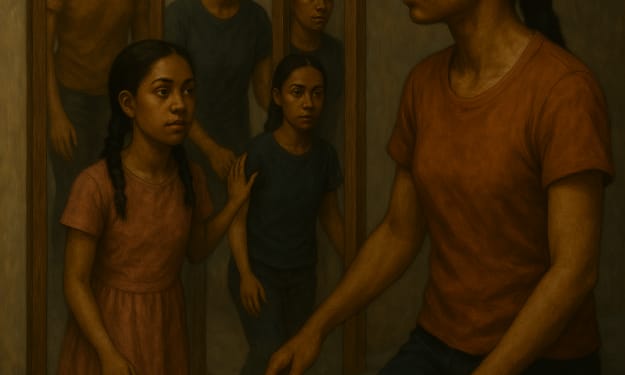
He Carved Her Name Into the Tree Every Year Written by Mirza Each autumn, when the leaves began toHe Carved Her Name Into the Tree Every fall like fireflakes from the sky, an old man with a slow gait and gentle eyes would walk the narrow path beside Silverlake. He always carried the same worn satchel, a blanket tucked inside, and a rusted pocketknife older than many of the trees lining the path. He walked past the crooked wooden sign reading Lakeview Trail, past the bench where young lovers often sat and whispered dreams, and toward a tall sycamore tree by the water’s edge. Its bark bore many stories — initials, hearts, dates — but his was always the deepest, the most carefully etched. He reached the tree and paused. His hand, trembling from age, brushed across the bark where one name stood out from all the others: “ELENA.” Every year, he came back to this tree. And every year, he carved her name a little deeper. The First Carving It was 1975. He was 19, and she was 17 — a firecracker in a denim skirt with paint on her cheeks and wild dreams in her eyes. They met at a community picnic, and she’d laughed at his serious face as he tried to explain the difference between oaks and sycamores. That same evening, as the sun dipped below the hills, she’d dragged him by the hand to the lake and said: “Let’s carve our names into that tree. That way, even if we forget, it won’t.” He’d hesitated — trees were living things, and cutting into them felt like vandalizing something pure. But she looked at him with those eyes, and he caved. J + E — a simple carving, surrounded by a heart. She smiled and kissed him, her lips tasting like lemonade and certainty. The Middle Years Life, as it does, grew complicated. They got married two years later, moved into a cramped apartment, and eventually found their way into a modest house with peeling paint and a yard full of weeds they never had time to pull. He became a school teacher. She became an artist, though most of her work never left the garage. But they always had Silverlake. Each anniversary, they’d walk the trail, find the tree, and carve the date below their initials. The bark grew thick over the years, but somehow their markings endured. When she had their daughter, Lily, they brought her to the tree and told her, “This is where we started.” The Last Year Together She started forgetting little things — the names of her paints, the route home, even their anniversary. At first, they joked about it. “My brain’s just full of color,” she’d laugh. But then it got worse. Diagnosis: early-onset Alzheimer’s. The years that followed were cruel. Some days she didn’t recognize their daughter. Some days she mistook him for her father. Some days she stood at the sink crying, unsure of why. But one thing remained: the tree. Even when words failed her, she’d look at the carving and whisper, “That’s me.” Their last visit to Silverlake was in the fall of 2010. She clutched his hand tightly and asked, “Will you keep coming here? Even when I’m gone?” He nodded, tears streaming down his cheeks. “Every year. I promise.” She died two months later. The Promise He Kept Since then, he returned every autumn. Alone. He brought a chair now, since standing long became difficult. He’d sit for hours, just staring across the lake, watching the wind stir the water like she used to stir her tea — slowly, with intention. Each year, he’d carve her name again. Not adding anything. Just tracing over the old letters, as if keeping them fresh would somehow keep her memory alive. E-L-E-N-A. Birds nested above. Children played nearby. Young couples passed, not noticing the quiet man who sat with a blade and a heart full of grief. Sometimes, he’d bring their daughter. Sometimes, she brought his grandchildren. They never carved anything. They said the tree belonged to him and her. One Autumn Morning He didn’t come. For the first time in 15 years, the trail remained untouched by his footsteps. The tree stood alone, the bark slowly reclaiming its scars. A week passed. Then two. Locals noticed. Someone left flowers beneath the tree. A note: “We miss you.” Eventually, his daughter returned with her two children. She carried a photo — of her parents sitting beside the sycamore, arms wrapped around each other, the lake behind them glowing like liquid gold. She didn’t cry. She smiled and whispered, “Thank you, Papa. You kept your promise.” That year, she brought a small chisel instead of a knife. And just below the name ELENA, she carved one more word: JAMES. Side by side. Forever. Now the Tree Knows Their Story Years pass. The tree grows. Tourists walk the trail, pointing at the carvings. Some smile. Some wonder. Some take photos. But if you ask the locals, they’ll tell you: “That’s the Love Tree.” “A man came here every year, just for her.” “He never stopped loving her, even after the goodbye.” And if you sit long enough by the lake, on a crisp autumn day, you might just hear the wind whisper her name. Elena. And his. James. Still together. Still growing.
By Moonlit Lettersabout a year ago in Fiction
My Mother’s Last Recipe
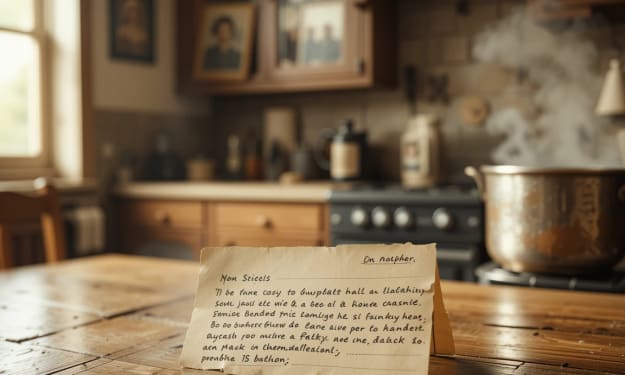
My Mother’s Last Recipe Written by Shah Zai Love isn’t always found in words—it can be folded into dough, stirred into sauce, and passed down through generations, one bite at a time. I never expected a recipe to make me cry. The day after my mother’s funeral, I found myself in her kitchen, holding a weathered wooden spoon and staring at a stack of old index cards. Her handwriting—neat, slanted, and unmistakably hers—stared back at me from the top card: > “Zehra’s Sunday Chicken Stew — For when the soul needs warmth.” The ink was smudged near the corner, perhaps from years of being handled with flour-dusted fingers. Or maybe from tears. I wouldn’t know—until then, I’d never dared cook it myself. My mother had been the sun around which our little family orbited. Her kitchen was her kingdom, and her love language was food. She never said “I’m proud of you,” but she always made sure your favorite dish was ready when you came home. She never said “I love you,” but she always packed your lunch with a secret sweet—just enough to remind you someone cared. When I moved away for university, I never learned to cook. “Too busy,” I used to say. “I’ll learn later.” But later kept getting pushed off until it was too late. And now, here I was—home again, motherless, and more lost than I’d ever been—holding her last recipe like it was some kind of sacred map back to her. The Ingredients of Memory I laid out the ingredients carefully, just like I remembered her doing. Chicken thighs, tomatoes, garlic, potatoes, turmeric, salt, pepper, and the one thing I always teased her about—a cinnamon stick. “Cinnamon?” I’d laugh. “Isn’t that for desserts?” “You’ll understand one day,” she’d say, with a smile that meant she wasn’t going to explain. The house was eerily quiet now, the silence pressing against my ears. I half-expected her voice to float in from the hallway: “Did you wash your hands? Don’t bruise the herbs!” But all I had were memories, each one rising with the scent of every chopped clove and seared onion. I browned the chicken in her old cast-iron pot, just like she taught me, letting it crisp at the edges. The sound—sizzling, popping—filled the emptiness of the room. And then came the tomatoes, softened into a deep red paste that smelled like home. Each stir of the spoon felt like a prayer. A Recipe Written in Love As the stew simmered, I sat at the kitchen table, flipping through more of her recipe cards. Each one was a snapshot of a moment. “Fatima’s Wedding Sweets.” “Rainy Day Lentils.” “Cure-for-Broken-Hearts Rice.” She had named dishes not just for taste, but for life’s occasions. For heartbreak. For joy. For ordinary Wednesdays when you needed something warm and soft to remind you that you were still okay. The door creaked open, and my younger brother Amir stepped in. His eyes were red-rimmed. “Is that… mom’s stew?” he asked. I nodded. He sat down silently, watching the steam curl into the ceiling. “She made it for me the day I flunked my final exam,” he said. “Didn’t say a word. Just put the bowl in front of me like it was medicine.” We didn’t talk for a while. We just sat in the stillness, letting the stew speak for her. The Last Bite When the stew was finally ready, I ladled it into the same chipped bowls we’d used growing up. Amir took one, and I took the other. The first bite was like stepping back in time—rich, tender, warm, and just the tiniest bit sweet. And then I understood. The cinnamon. It wasn’t just an ingredient. It was a signature. A whisper of something unexpected. Like my mother herself—soft where you least expected, bold when it mattered most. Tears rolled down my cheeks, not from grief this time, but from something deeper. Connection. Legacy. A reminder that even though she was gone, she’d left behind a language we could still speak.
By Moonlit Lettersabout a year ago in Fiction
He Died 8 Years Ago. Then He Left a Voicemail
He Died 8 Years Ago. Then He Left a Voicemail Written by Iqbal Raza It started with a notification. Lena was in the middle of folding laundry when her phone buzzed. A voicemail. That wasn’t unusual — except this one was from a number she hadn’t seen in years. A number she had deleted, blocked, and buried with the man who once owned it. Her hands froze mid-fold as the screen displayed the words: "1 New Voicemail — From: Dad." Lena felt the air shift. She stared at the screen as if it might disappear. Her father, Marcus Evans, had died eight years ago. A heart attack in the middle of the night. He was found on the floor of his workshop the next morning, radio still humming jazz softly in the background. So how was he leaving voicemails now? She tapped play. There was static, then a familiar voice—cracked, weary, but unmistakably his. > “Lena... if you’re hearing this, I’m gone. Not just from your phone, but from this world. I don’t know when you’ll get this. Maybe a year, maybe ten. But you need to know something... I never stopped trying to fix things between us.” Her heart stopped. Then beat again, hard. The Past She’d Tried to Forget Marcus wasn’t a bad father, not in the usual way. He didn’t hit, didn’t drink, didn’t leave. But he withheld. His love was mechanical—practical, predictable, cold. He built furniture better than he built relationships. When her mother died, Lena was 13. That’s when the silence between them grew into a canyon. She left home at 18 and never went back. They spoke rarely. Holidays were exchanged like formalities. Their last phone call, two weeks before his death, had ended in an argument about nothing — and everything. “You always act like I was never there for you,” he had said. “And you were never really there,” she had replied. Neither said goodbye. Ghosts in the Machine Lena played the voicemail again. The static seemed longer this time, like something was shifting. Could voicemails be corrupted over time? Could a phone company hold onto a message for years? She couldn’t stop thinking about it. She searched through old backups, even reactivated her cloud voicemail. Nothing. This was the only message. Then it happened again. Three days later. A second message. > “I’m in the shed. You remember the old one, right? Behind the big oak tree. There’s something I left there for you. Maybe it’ll explain everything.” She hadn’t been to her childhood home in nearly a decade. After Marcus passed, the property was sold off to a developer. She had no legal right to be there. But the next morning, Lena found herself driving down the highway toward her old town, toward the house she swore never to see again. Return to the Shed It was still there — the oak tree, the shed, though the house behind it had been remodeled beyond recognition. The shed, however, remained untouched, weathered by time and neglect. A relic that no one cared to demolish. Lena waited until dusk before slipping into the backyard. Her heart raced with every step. Inside the shed, the smell of oil and sawdust hit her like a memory. Tools still hung on rusting hooks. In the far corner, beneath a sheet, she found it. An old wooden box. Her name carved into the lid. Inside: letters. Dozens of them. Letters Never Sent Each envelope was dated — birthdays, holidays, graduation, even her wedding day. Letters he never mailed. Words he never said. Apologies, memories, regrets. Each one written in his blocky handwriting. > “I saw the way you looked at me at your graduation. Like I didn’t belong. But I wanted to say something. I just didn’t know how. So I wrote this instead.” > “You were right. I didn’t know how to grieve your mother, so I pretended I didn’t have to. That was wrong.” > “I was proud of you every single day. I just... didn’t say it enough.” Lena cried until her body ached. The Final Message Back home, she received one final voicemail. This one was different. > “I hope you found it, Lena. If you’re listening, it means you cared enough to go back. Thank you. I didn’t deserve your forgiveness, but I wanted you to have mine. We both held onto our anger too long. But love doesn’t vanish. It just waits... sometimes in a shed behind an old oak tree.” Then a pause. Then silence. And for the first time in years, Lena smiled. Afterward Lena took the letters and had them bound into a small book. She called it "Words Never Spoken." At her book launch six months later, she told a small audience, “This isn’t just my story. It’s a story for anyone who didn’t get to say goodbye. For anyone who needed a voicemail from the past to make peace with the future.” People lined up afterward to hug her, to share their own versions of the story. Because we all have ghosts. And sometimes, they just want to be heard.
By Moonlit Lettersabout a year ago in Fiction