family
He Died 8 Years Ago. Then He Left a Voicemail
He Died 8 Years Ago. Then He Left a Voicemail Written by Iqbal Raza It started with a notification. Lena was in the middle of folding laundry when her phone buzzed. A voicemail. That wasn’t unusual — except this one was from a number she hadn’t seen in years. A number she had deleted, blocked, and buried with the man who once owned it. Her hands froze mid-fold as the screen displayed the words: "1 New Voicemail — From: Dad." Lena felt the air shift. She stared at the screen as if it might disappear. Her father, Marcus Evans, had died eight years ago. A heart attack in the middle of the night. He was found on the floor of his workshop the next morning, radio still humming jazz softly in the background. So how was he leaving voicemails now? She tapped play. There was static, then a familiar voice—cracked, weary, but unmistakably his. > “Lena... if you’re hearing this, I’m gone. Not just from your phone, but from this world. I don’t know when you’ll get this. Maybe a year, maybe ten. But you need to know something... I never stopped trying to fix things between us.” Her heart stopped. Then beat again, hard. The Past She’d Tried to Forget Marcus wasn’t a bad father, not in the usual way. He didn’t hit, didn’t drink, didn’t leave. But he withheld. His love was mechanical—practical, predictable, cold. He built furniture better than he built relationships. When her mother died, Lena was 13. That’s when the silence between them grew into a canyon. She left home at 18 and never went back. They spoke rarely. Holidays were exchanged like formalities. Their last phone call, two weeks before his death, had ended in an argument about nothing — and everything. “You always act like I was never there for you,” he had said. “And you were never really there,” she had replied. Neither said goodbye. Ghosts in the Machine Lena played the voicemail again. The static seemed longer this time, like something was shifting. Could voicemails be corrupted over time? Could a phone company hold onto a message for years? She couldn’t stop thinking about it. She searched through old backups, even reactivated her cloud voicemail. Nothing. This was the only message. Then it happened again. Three days later. A second message. > “I’m in the shed. You remember the old one, right? Behind the big oak tree. There’s something I left there for you. Maybe it’ll explain everything.” She hadn’t been to her childhood home in nearly a decade. After Marcus passed, the property was sold off to a developer. She had no legal right to be there. But the next morning, Lena found herself driving down the highway toward her old town, toward the house she swore never to see again. Return to the Shed It was still there — the oak tree, the shed, though the house behind it had been remodeled beyond recognition. The shed, however, remained untouched, weathered by time and neglect. A relic that no one cared to demolish. Lena waited until dusk before slipping into the backyard. Her heart raced with every step. Inside the shed, the smell of oil and sawdust hit her like a memory. Tools still hung on rusting hooks. In the far corner, beneath a sheet, she found it. An old wooden box. Her name carved into the lid. Inside: letters. Dozens of them. Letters Never Sent Each envelope was dated — birthdays, holidays, graduation, even her wedding day. Letters he never mailed. Words he never said. Apologies, memories, regrets. Each one written in his blocky handwriting. > “I saw the way you looked at me at your graduation. Like I didn’t belong. But I wanted to say something. I just didn’t know how. So I wrote this instead.” > “You were right. I didn’t know how to grieve your mother, so I pretended I didn’t have to. That was wrong.” > “I was proud of you every single day. I just... didn’t say it enough.” Lena cried until her body ached. The Final Message Back home, she received one final voicemail. This one was different. > “I hope you found it, Lena. If you’re listening, it means you cared enough to go back. Thank you. I didn’t deserve your forgiveness, but I wanted you to have mine. We both held onto our anger too long. But love doesn’t vanish. It just waits... sometimes in a shed behind an old oak tree.” Then a pause. Then silence. And for the first time in years, Lena smiled. Afterward Lena took the letters and had them bound into a small book. She called it "Words Never Spoken." At her book launch six months later, she told a small audience, “This isn’t just my story. It’s a story for anyone who didn’t get to say goodbye. For anyone who needed a voicemail from the past to make peace with the future.” People lined up afterward to hug her, to share their own versions of the story. Because we all have ghosts. And sometimes, they just want to be heard.
By Moonlit Lettersabout a year ago in Fiction
A Look at Life. Top Story - July 2025.
Jesse's mom always knew he was odd. He was in fact, "different" from the other small children that gathered in the courtyard play area. That's why they shunned him. But it was strange to her that it never seemed to bother her little blond-headed boy. He was in a world of his own most of the time and probably hadn't noticed their mocking of him. They called him four eyes because of the thick glasses he wore with the head strap to keep them secure. But maybe he hadn't heard their nips because he wore hearing aids in both ears. Even Jesse's mother, Brittany thought he appeared more like a ninety-year old man than a a five year old.
By Shirley Belkabout a year ago in Fiction
Not Him. Not Now. . Runner-Up in The Summer That Wasn’t Challenge. Top Story - July 2025.
This was meant to be the summer of progress. New systems, new structure, new home, new routine. A new rhythm to life for all of us. A proper house this time, one that came with more than one bedroom for the four of us, a solid roof, floorboards that didn't screech under pressure. It was supposed to be a summer of painting walls and building garden beds. We had planned to flourish this season.
By Autumn Stewabout a year ago in Fiction
A Father's Eyes, A Daughter's Heart
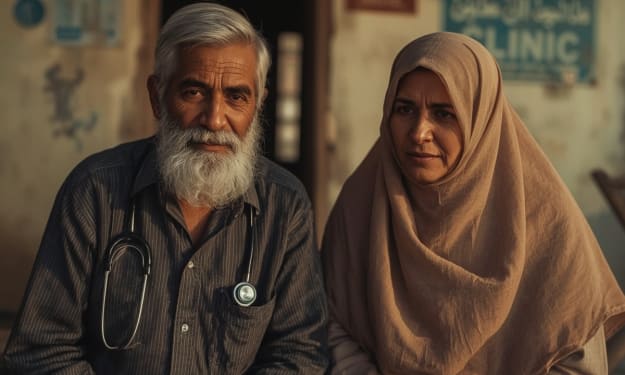
By Ikhtisham Hayat The hospital corridor smelled like antiseptic and worry. Dr. Mariam Khan adjusted her stethoscope as she left Room 203, her mind still caught up in the fragile heartbeat of the old man she had just examined. The rhythm was irregular — like life itself. She walked briskly to the lounge where her father sat, waiting with that same gentle smile he’d worn since her childhood. His beard was whiter now, and his eyes — once sharp and commanding — had grown soft with age. But the love in them hadn’t faded. "Finished for today?" he asked, standing slowly. She nodded, “Long day, Baba. I had to tell a daughter her mother wouldn’t survive the night.” His face sank, but he didn’t respond with words. He simply touched her shoulder, steady and warm. Twenty years earlier Eight-year-old Mariam clutched her broken toy stethoscope, watching her father stitch up a neighbor's hand under the dim light of their village clinic. There was no electricity, no modern equipment — only her father's calm voice, and his eyes, focused and kind. "You’re not afraid of blood?" he asked her as she peeked behind the door. "No. It just looks... sad." He chuckled. "You see with your heart, little doctor. That’s good. Never lose that." Back in the present As they walked out into the parking lot, the late summer wind brushed Mariam’s coat, and her mind wandered. “Baba,” she said, starting the car, “Do you ever regret not leaving the village to work in a city hospital?” He looked out the window, smiling. “No. A village needs doctors too. I delivered your best friend in a candle-lit room. I gave medicines to children whose parents couldn’t read the labels. I saved lives with nothing but a stethoscope and prayers. Why would I regret that?” She admired him. Always had. But sometimes she felt guilty for leaving. “I used to wish for more,” she whispered. “More machines. More knowledge. More chances.” Her father turned, his voice steady. “You got those chances. And you used them well. But never forget, Mariam — the best doctor is not the one with the best tools, but the one with the kindest eyes.” Mariam remembered the night she received her scholarship to medical school. Everyone in the village had come to congratulate her, bringing sweets and gifts they couldn’t afford. But her father — her quiet, strong Baba — had said only one thing: “Go. Learn everything. But don’t forget who you are.” And she hadn’t. Not really. But in the chase for degrees, success, and hospital titles, the little girl who saw sadness in blood had become the woman who read heart monitors more than hearts. Two weeks later, her father was rushed into the ER. Collapsed while praying. Severe chest pain. Oxygen dropping. Mariam’s world spun. She wasn't just a doctor now — she was a daughter fighting against death, trying to keep her anchor from slipping away. The cardiologist on duty gently took her aside, “We’ll do everything we can. But his heart is weak. Age has caught up.” She stood outside the ICU, helpless. The roles had reversed. She was the child again, watching him fight pain in silence. The next morning, he opened his eyes — dim but alive. “Did you... fix me?” he joked. She broke into tears. “No. You fixed me.” In the weeks that followed, Mariam brought him home and cared for him like he once did for her. Every pill, every meal, every blanket tucked with precision — she gave him back the love he had planted all her life. One evening, he asked her to take him to their old village. Against medical advice, she did. They sat on the clinic steps, now run by another young doctor. “This place,” he said, eyes shimmering, “taught me how to heal. Not just wounds... but people.” Mariam leaned against his shoulder, like she did when she was ten. “I used to think I became a doctor because of you,” she whispered. “But now I know... I became me because of you.” A few months later, he passed quietly in his sleep, a soft smile still on his face. Mariam didn’t cry at the funeral — not immediately. But when she returned to the clinic, now modernized with lights and machines, she saw his old wooden chair in the corner — still untouched. And then the tears came. Today, Mariam teaches young doctors. She tells them of modern treatments, new protocols, advanced imaging. But every semester, she ends her lecture with a photo. An old village man, with kind eyes and a stethoscope worn from use. “This,” she tells them, “is the man who taught me how to be a doctor — with nothing but his eyes and a heart too big for this world.” Because some wisdom doesn’t come from books... It comes from a father’s eyes, and stays in a daughter’s heart.
By Ikhtisham Hayatabout a year ago in Fiction
The Umbrella Without Rain
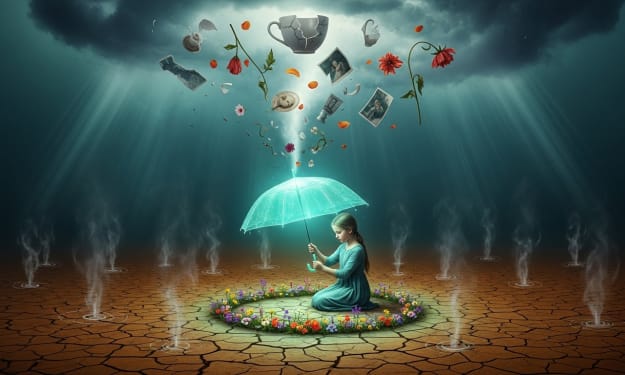
Part 1: The Inheritance of Dry Tears The umbrella arrived the day Elara’s grandmother vanished. Not died—vanished. One moment, Nana Rosa sat knitting beneath her favorite pear tree; the next, only her indigo shawl remained, wrapped around a long velvet box.
By Habibullahabout a year ago in Fiction
She Loved Me in Every Lifetime Except This One
A Love That Spanned Centuries I don’t remember exactly when I realized it but from a young age, I felt a strange sense of déjà vu around certain people and places. Like I’d been here before. Like I’d lived this life... or another... many times. But the one thing that always returned to me, clearer than anything else, was her.
By Farooq Hashmiabout a year ago in Fiction