family
She Danced Every Morning at 6 AM
She Danced Every Morning at 6 AM Written by Raza Iqbal At precisely 6:00 AM every morning, just as the first golden strands of sunlight broke through the tall windows of apartment 4B, she danced. To the casual observer, it was nothing out of the ordinary — an elderly woman moving gracefully to music only she could hear. But to those who paid attention, it was something else entirely. Something sacred. Something that made you stop whatever you were doing and just… watch. She lived in a corner unit of the old brick building on Montclair Street. A neighborhood that had seen its share of change — coffee shops replacing bookstores, condos where gardens used to grow — but she remained unchanged. A relic in a modern world. Her name was Eleanor Hart. But the neighbors just called her Miss Ellie. Some mornings, she danced in a flowing white nightgown. Other times, she wore a silk robe that caught the light like moonbeams on water. Her movements were soft, but deliberate. Her face calm, but filled with something deeper — remembrance, maybe. Or longing. She never opened her windows. Never looked down at the street. She simply danced in silence, as though honoring a promise made long ago. My name is Jonah. I moved into the building two years ago — third floor, apartment 3A, just below Miss Ellie. I first noticed her on a Sunday morning while drinking coffee on my fire escape. The world was quiet except for the low hum of the city, and then, there she was. Arms lifted toward the sky, bare feet on worn hardwood, twirling slowly with eyes closed. It became my ritual. Wake up early. Watch Miss Ellie dance. At first, it felt like spying, but there was nothing invasive about it. Watching her felt like a privilege — like being let into a secret world. I never told anyone. It was mine to witness and mine alone. Until one morning, she didn’t dance. I waited, mug in hand, staring up at her dark window. No movement. No light. No silhouette. I assumed she had overslept. Or maybe she was away. But when the second day came and her apartment remained still, an unease crept in. On the third day, I asked the building manager if she was okay. “Miss Ellie?” he said, eyes softening. “She passed away… three nights ago. Peacefully. In her sleep.” It felt like someone had pulled the ground from under me. I never spoke to her, never heard her voice, yet her absence struck like a blow to the chest. The street felt quieter. The mornings colder. A week later, I found an envelope taped to my door. It was handwritten in delicate cursive: “To Jonah, the boy on the fire escape.” My hands trembled as I opened it. > Dear Jonah, > You didn’t think I didn’t notice you, did you? > Every morning for the last two years, there you were — sitting with your coffee, watching me dance like a ghost. I almost laughed the first time I saw you. But then I grew fond of it. Your quiet presence. The way you never interrupted the moment. > I was dancing for someone. His name was Harold. My husband. He died 20 years ago to the day I started dancing. > We were dancers once, in our youth. We met at a jazz club in Paris in 1958. He twirled me under strings of golden lights, and I fell in love before the song ended. Every morning, we danced in our living room before work. Always at 6:00 AM. It was our way of saying: “I choose you again today.” > When he passed, I thought I would break. But then, on a whim, I danced. Alone. At 6:00 AM. And somehow, I felt him there with me. So I did it the next day. And the next. > Some might say it’s silly. But love doesn’t vanish just because a body does. > You watched me without judgment. Without pity. That meant more than you’ll ever know. > So I want to ask you for a favor. > Dance. Not for me. Not for Harold. But for yourself. Dance when you’re lost. Dance when you’re full of joy. Dance when the world makes no sense. > Life is too short to keep your feet still. > Thank you, Jonah. > With love, > Miss Ellie I cried. Not the kind of tears that fall in silence, but the kind that erupt from somewhere deep and long-buried. I never knew what she meant to me until that letter. And I never knew how much I needed to hear those words. So I danced. The next morning, at 6:00 AM, I moved the furniture in my living room and let the music play. Old jazz from the 1950s. The kind she would’ve loved. I didn’t know the steps. Didn’t need to. I just moved — arms open, heart wide. And maybe it was my imagination, or maybe it was something else… but for a fleeting second, I felt her there. Smiling. Watching.
By Moonlit Lettersabout a year ago in Fiction
The Summer That Changed Everything
I looked at the ring on my finger. It was small, but that didn't matter to me. It was hot outside, but the sun was shining and the birds were singing despite the storm I felt in my heart. He had postponed the wedding...again. This time it was because he didn't like the venue we had picked out. He said that it felt more like my mother had picked out the venue. It was true that my mother had helped with quite a bit concerning the wedding. After all, I'm only 19 years old, and she knows more about weddings and social gatherings than I do, but this feels like a sign to me. I mean, how many times can one have something come up with planning a wedding and it not be a sign? The first time, it was the pastor who canceled. Then, my fiancé postponed it because he thought we didn't have enough money in the bank, and now this. I know we're young, but I love him with all my heart, and we've been together almost 5 years already. I want to be married, have children, and be settled. After all, that is what I've been taught and raised to do my entire life. When you are a girl and you live in the Deep South, you're expected to grow up, get married, and have babies right out of high school. I felt so uncertain now and sick to my stomach, so I turned out the lights and tried to get some sleep. It was a restless sleep; I tossed and turned all night. What did I want to do with my life right now if not marry the love of my life? I could go to college. I was planning on doing that anyway, as I want to be a teacher. However, if I weren't getting married, I could live the full college experience. That would please my mother and my stepfather. I could travel, maybe. I could go wherever I want to, and then I wouldn't have to face all these people asking me why I'm not married yet. The questions and assumptions are relentless in a small town. I could stay here with my grandma for a while longer and try to figure things out. Yes, that sounds like a good idea. Before I knew it, a couple of weeks had passed, a couple of boring weeks. I worked at my uncle's grocery store, where I had to answer questions about why my June wedding hadn't happened yet, and it was almost July. Why did this wedding keep getting postponed? I kept getting comments about how I didn't need to be married anyway because I was too young, or the opposite end of the spectrum, that I better hurry and get married before that boy runs off. I had spent most of my life with a controlling mother who nothing was ever good enough for and then this small town life where you had to live up to these impossible standards. I just wanted to find my way, be myself in this world instead of having someone tell me who I was supposed to be. I wanted to make my own decisions, and I was mad because I wanted my fiancé to be the first decision. He was supposed to be my "suck it" to everyone. This summer was not turning out the way it should have. My fiancé and I were still together, but I am starting to realize that he's not going to be my "suck it" to everyone. He's not going to be my "I'm going to do what I want and you can't stop me." And after some thought, maybe that's okay because after all, maybe that's not such a good reason to get married after all. I mean, I do love him, too, of course, but mostly, I wanted to get married this young to prove to everyone that we could make it. Then, one day, a recruiter from the Army Reserves came into my Uncle's grocery store. Sure, I'd seen several in my senior year of high school, but this one was different. This was a woman, and she looked like a badass in her uniform. She was in her dress uniform, which she called her "dress greens," and I was struck by the way she carried herself and the hard lines on her face that gave way to softness as she handed a child back his candy he had dropped while she waited in line. I felt like living with my mother growing up; I had already been through a war of sorts, and it struck me that this would be another way to stick it to people and do something that women usually didn't do. Also, a way to find myself, perhaps? I helped her to her car with her groceries, even though she didn't need it, and I talked her ear off with questions for the next 15 minutes. She was in her early 30s, as it turned out, and had been to Iraq. She caught some shrapnel from an IED and had to be put on a light-duty job, so she was a recruiter. She explained to me how I could get my college degree while serving in the military, and the military would pay for it. She handed me her card and told me if I had any questions to call her. When I spoke to my fiancé that night, he told me how he had thought about joining the military too. He didn't know if it'd be the right move for him, though. After some coaxing, I convinced him, and the next day we went to the recruiter's office together. The same recruiter that I'd seen the day before was there. She was honest about the hardships she'd seen, how hard it was to carry all the equipment on your back through the heat, then she shared how much the Army had given her a sense of purpose and a way to find herself outside of her family. As she put it, when you aren't allowed to have anything and you're left to start anew with just your military comrades, you learn not only your strength but what you're made of inside. When you are in certain situations and you respond, you learn a new thing about yourself every time. Whether good or bad, you learn. I didn't need to hear anymore. I signed the papers, and my fiancé followed suit. We walked out of that recruiter's office with a brand new future in our sights. On the way back home, riding in the passenger seat, I looked at my engagement ring once more. I didn't know when or if we would still be getting married, but somehow that didn't matter so much anymore. I was about to put myself to the test in ways I had never imagined before, and I would always love him no matter what.
By Lindsey Altomabout a year ago in Fiction
A Lesson in Nobility and Betrayal
Once upon a time, in a vast and scorching desert, the chief of a noble tribe rode alone on his majestic horse. The sun beat down relentlessly, and the silence of the desert was broken only by the sound of hooves crunching on sand. This was a journey the chief had undertaken many times, a silent meditation in the heart of the wilderness. But on this day, fate had a lesson in store—one that would test not only his strength, but his wisdom and character.
By Ahmad shahabout a year ago in Fiction
The Day Google Maps Led Me to a Place That Doesn’t Exist
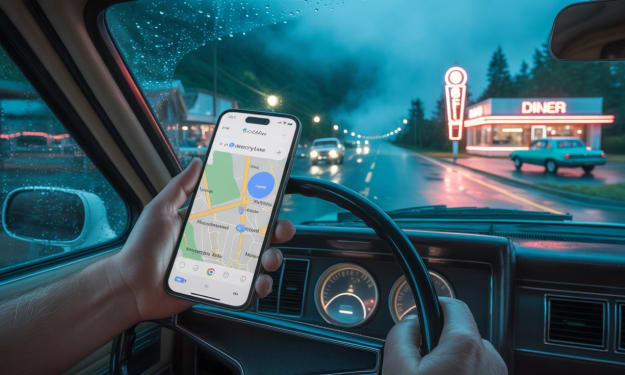
1. The Wrong Turn That Changed Everything Maya hated driving to new clients. That’s why she trusted Google Maps. But when the robotic voice chirped "Turn left onto Memory Lane" in the middle of rural Vermont farm country, she knew something was wrong.
By Habibullahabout a year ago in Fiction
The Summer the Lake Dried Up
That summer was supposed to be the last perfect one. The one before college, before scatterings and jobs and becoming different people in different cities. It was supposed to be days at the lake, bonfires with marshmallows that never fully melted, and laughter that echoed across the still water long after midnight.
By Junaid Shahid about a year ago in Fiction
The Lighthouse Keeper’s Journal
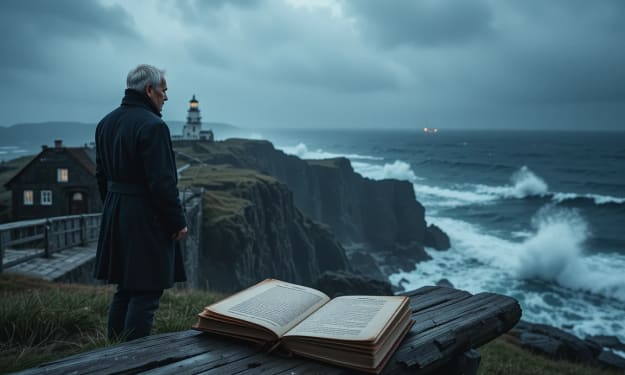
The Lighthouse Keeper’s Journal Written by Shah Zeb The lighthouse stood like a forgotten relic at the edge of the world. Perched high on the weather-beaten cliffs of the Scottish coast, it had long ceased to guide ships. Satellite navigation and modern systems had made it obsolete. Yet inside its stone shell, the light still turned, maintained by one man whose presence was as old and steady as the sea spray. Ewan Fraser, seventy-three, had been the lighthouse keeper for nearly five decades. He refused to leave even when the government decommissioned the facility. He argued, perhaps foolishly, that the ocean still remembered the light—and so did the souls of those who had once passed beneath it. Every morning, he brewed tea in a dented kettle and wrote in his journal—a thick, leather-bound book with a broken spine and pages yellowing like sea maps. The entries were rarely about the weather or lighthouse mechanics. They were letters, unsent, written to a woman named Isla. June 6, 1995 The light flickered last night. I thought of you again, of course. I always do when storms come. Remember how we stood in the lantern room and watched the sea fight the sky? You were never afraid. You said storms made you feel alive. It was the calm that frightened you. Isla had been Ewan’s wife—if only for six months. They were married under a gray sky, with seagulls as their choir and waves as their witness. She was an artist, with fire in her voice and salt in her spirit. She painted the sea not as it was, but as it felt. Six months after their wedding, Isla vanished in a boating accident. No body. No goodbye. Just her paint-streaked scarf found on a washed-up piece of driftwood. He had no one else. No children. No close family. The town slowly forgot about Ewan, except the postmaster who still delivered parcels once a month. Inside were canned goods, paper, pens, and batteries. Always the same. And a small, quiet hope that maybe one day something else would come. Then, one October evening, as the fog thickened like wool and the waves slapped rocks like angry fists, Ewan heard it—a knock. Not the wind. Not the groan of old wood. But a knock. Heart pounding, he opened the iron door. A girl stood there. Soaked. Pale. No older than seventeen. "I'm looking for my mother," she said. “She used to live here.” Ewan blinked. “What’s her name?” "Isla." Her name was Cora. Her voice shook when she spoke, not from cold, but from hesitation. She carried an old photo—one of Isla, covered in paint, laughing on the lighthouse steps. The same photo Ewan had tucked into his journal. Except this one had writing on the back. To my daughter, should you ever find this. Start with the light. They sat by the fire, a pot of stew between them. She told him her story in pieces, like a broken bottle being slowly glued back together. Isla had survived the accident. Rescued by a passing trawler. But a head injury had taken her memory. She was taken in by a woman on the Isle of Skye, where she worked as a seamstress, never knowing who she truly was. Until her final days, when fragments returned. Names. Places. A face she had once loved. She died two years ago, Cora said. “But before she passed,” Cora added, eyes bright with pain and wonder, “she told me: 'If you ever want to know where you come from, go to the place where the sea meets the light.' So I did.” Ewan didn’t speak. His hands shook too hard to hold his cup. Instead, he opened the journal. Flipped to the first page. Handed it to her. Each word, each entry, was a letter to Isla. Cora read until morning. She stayed three days. Helped him oil the light. Took photos of the cliffs. They didn’t talk much, but when they did, it was as if silence had become a language of its own—passed down between those who have lost and those who remain. On the last day, she asked, “Why did you stay?” He looked toward the horizon, where the sea kissed the sky. “Because she might come back. And someone had to keep the light on.” January 14, 2020 She came, Isla. Our daughter. She’s kind. Brave. Just like you. I told her everything. The light, the cliffs, the stories. She carries your fire. I think... I think you sent her. When Cora left, she took a small canvas with her—one of Isla’s old sea paintings, faded but still beautiful. She promised to return every year on the same day. Ewan didn’t ask for it, but it filled something in him that had been hollow for twenty years. Three years later, Cora came back with a son. His name was Fraser. He ran up the stairs of the lighthouse as if the place had always belonged to him. April 2, 2024 I am tired, Isla. But I’m not lonely anymore. The light’s still turning. And I think... when it stops, it won’t matter. Because you sent me one last message, through her. And it reached me. That night, as the wind howled and the tide rose, the light blinked its steady rhythm—one last heartbeat for the ships and souls it guided. By morning, Ewan was gone. The journal sat on the desk, closed, a final message on the last page: Keep the light turning. Cora did. Every year. And now her son does. Because some lights never truly go out.
By Moonlit Lettersabout a year ago in Fiction
"Crimson Tide: The Day the Ocean Took Kyle"
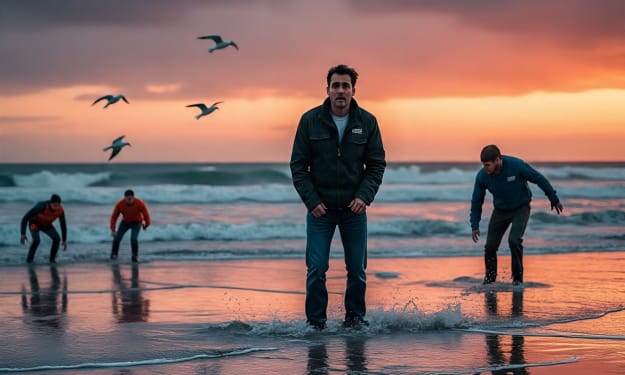
beef jerky, maple bourbon flavored, and offered it to his son. Kyle snuffed the gesture and moaned in annoyance. He hated jerky, all flavors, and his father knew that. He had no choice. He was going to have to wait to eat. “Can I at least go in the water?” Kyle said. “As long as you stay in sight. With waves like those, the current will be strong.” “I’ll stay close.” Chase noticed his son brush off the warning. “I mean it Kyle. No wandering. And don’t go out too far.” As he watched the sunburnt spine of his son jog towards the water, a familiar voice rang in his ear. “Great spot babe,” Erica said. Surprised to see his wife so soon, Chase stumbled up out of his chair to greet her. “Kyle picked it out. He had to fight off a couple of angry seagulls to get it though. Tough kid.” Looking behind his wife, expecting to see his daughter, he saw other children that did not belong to him. As he was about to ask his wife where Zoey was, he heard a young girl scream from the water’s edge. Instinctively knowing the tone of his only daughter’s voice, Chase frantically scanned the area until he located her position and what she, and now others, were all horrifically screaming at. Thrashing beyond the cresting waves, chaos ensued. The incoming currents stained the golden sand a deep burgundy, and lifeguard whistles echoed across the entire beach. His eyes studied the faces of all of the retreating swimmers, yet none of them were of Kyle. Fighting through the frenzy, Erica ran to retrieve Zoey. Frozen in fear, an elderly man, with his hand pointing towards the ocean, spoke gently to Chase. “I think that’s your boybeef jerky, maple bourbon flavored, and offered it to his son. Kyle snuffed the gesture and moaned in annoyance. He hated jerky, all flavors, and his father knew that. He had no choice. He was going to have to wait to eat.
By Saeed Ullah about a year ago in Fiction
One Last Ride: The Taxi Driver’s Secret
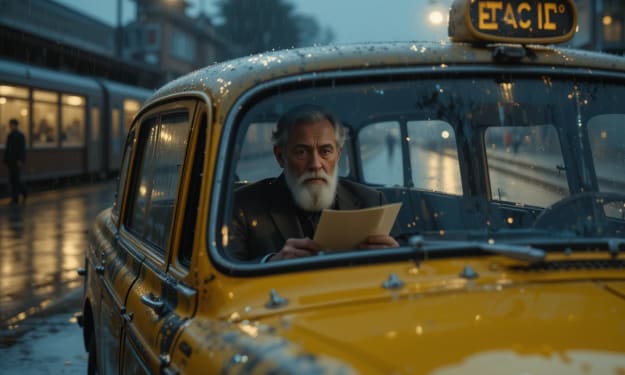
One Last Ride: The Taxi Driver’s Secret Written by Mirza Nobody knew his full name—everyone just called him “Baba Taxi.” For more than thirty years, Baba Taxi drove the streets of Lahore, weaving through its dust, chaos, and colors. His old yellow-and-black cab was a familiar sight—scratched, dented, but somehow proud. His back slightly hunched, white beard trimmed, and smile always kind, Baba was the silent companion of countless passengers. To the world, he was just another aging driver. But behind the wheel, Baba held a secret, one he never revealed in a word but lived in every journey he took. He wasn’t just driving people from point A to point B. He was looking for someone. Every evening before ending his shift, Baba would drive to the railway station and wait near the exit gate. For twenty years, he would sit silently, eyes scanning the faces as passengers disembarked. Some looked at him curiously, some asked for a ride, and many just passed by. But none were the face he was looking for. People joked that Baba was obsessed with the station. Some drivers whispered he was waiting for a lost love, others said he was senile. Baba never explained. Then, one rainy Thursday in July, everything changed. A young woman named Meher flagged down Baba's taxi near Liberty Market. Her eyes were red from crying. She clutched a backpack and held a folded letter in her hand. “Railway Station,” she said quietly. Baba glanced at her in the rear-view mirror. Something in her expression—something broken yet familiar—caught his attention. The silence in the cab was heavy, except for the hum of the engine and occasional splashes from puddles. Baba didn't ask questions. He never did. But as they neared the station, she broke the silence. “My mother used to tell me a story,” Meher said suddenly, voice cracking. “About a taxi driver who used to take her to college every day. She said he never charged her a rupee. Just asked her to promise him something.” Baba's hands stiffened slightly on the steering wheel. “She said he made her promise that one day, when she had a daughter, she'd tell her about him. About his kindness. About how he saved her life one night when she almost ran away from home after a fight with her parents.” The girl smiled faintly through tears. “She never told me his name. Just called him ‘Baba Taxi.’” The car stopped. Meher opened the letter and held it toward him. “She passed away last month. Cancer. But she left this... for you.” Baba’s fingers trembled as he took the letter. Dear Baba Taxi, If Meher finds you, it means she listened. I never forgot that ride. You talked me out of leaving home that night. You said I would regret losing my family, and you were right. Because of you, I went home and reconciled with my parents. Because of you, I stayed. I married, I raised my daughter, and I lived a full life. If you're reading this, please take care of her. Like you did with me. Just this once. She’s lost right now. She needs you. With all my heart, Zoya. Baba’s eyes glistened. It had been her. For all these years, he'd returned to that station, hoping. Not to find her again, but to return a photo he’d found under the backseat the night she almost ran away. A photo of her and her parents. He kept it, in case one day, someone came looking. Baba reached into the glove compartment and pulled out a small, creased photo. Meher gasped. “That’s... my nani and nana,” she whispered. He handed it to her with the gentleness of a grandfather. For a few moments, silence wrapped the cab like a blanket. The rain outside had softened to a drizzle. “You’ll stay with me tonight,” Baba said quietly. Meher nodded. For the first time in weeks, she felt safe. Epilogue Meher did stay. She spent a few nights at Baba’s small home. He cooked daal and parathas, told her old tales of Lahore, of love lost and found, of how every rider in his taxi left a story behind. She shared stories of her mother, listened to songs from Baba’s dusty cassette tapes, and slowly, something inside her began to heal. A few weeks later, Meher left for Islamabad, where she had been accepted into an arts program. But she promised to call every week—and she did. Baba didn’t wait at the railway station after that night. He didn’t need to anymore. He had finally completed the ride he’d waited a lifetime for.
By Moonlit Lettersabout a year ago in Fiction
The Birthday Gift She Left for Every Year After Her Death
The Birthday Gift She Left for Every Year After Her Death Written by Mirza Written by Mirza My mother passed away on a cold Tuesday morning in November—two days before my 17th birthday. She was 48. It was breast cancer. She fought like hell. And then one day, the fight was over. Grief didn’t hit me all at once. It came in slow, painful waves. At first, I felt like I was walking through a fog, and then came the crashing silence in the kitchen, the empty seat at the table, the sound of my dad crying behind closed doors. But what I didn’t know was that my mother had left something behind—something that would reach across years of silence and fill my birthdays with a love I thought I’d lost forever. The First Birthday I didn't want a cake. I didn’t want to celebrate. But my father came into my room on my birthday morning holding a small, white envelope. His eyes were red, but he smiled the kind of smile you give when you’re trying not to cry. “This was left for you,” he said, and handed me the envelope. In my mother’s handwriting, it said: "For Maddie. Birthday #17." Inside was a letter. Not a long one, but long enough to shatter the wall I’d built around my heart. It was written months before she died. > "Happy 17th, sweetheart. I wish I could see your face today. I know you're hurting, and I know the world feels unfair right now. But I want you to know that even though I won’t be with you physically, I’m with you in every moment. I’m so proud of you. Go do something kind for yourself today—eat your favorite cake. I love you, forever. —Mom" I sobbed. My dad sat beside me, holding my hand like I was five again. That letter brought her back for a moment, and for the first time since she died, I smiled through my tears. A Tradition Beyond the Grave Every year after that, another letter came. On my 18th birthday: > "Happy 18th, my grown-up girl. You’ll make mistakes. It’s okay. Be gentle with yourself." On my 19th birthday: > "I hope college is treating you well. Or whatever you're doing. I’m proud, no matter what path you choose." On my 21st birthday: > "Don’t drink too much! But have fun. Today is about joy, and you deserve all of it." Each letter came with a small gift: a necklace I’d seen in her drawer when I was younger, a favorite scarf she used to wear, a photo of us at the beach with a note that simply read, “My sunshine.” I later learned she’d spent months writing and packaging these gifts with my aunt. There were 30 letters in total. Thirty years of love, sealed in envelopes and stored in a cedar box in my aunt’s attic, ready to be handed over one by one. The Letter That Changed Everything When I turned 25, life was a mess. I’d just gone through a painful breakup. I’d lost my job. I was living back home with my dad, feeling like a failure. That birthday morning, I didn’t want a letter. I didn’t feel like reading anything from a mother who had never seen me as the adult mess I’d become. But I opened it anyway. > “Maddie, I know this year may be hard. I have no idea what you’ll be facing when you read this. But I want to tell you something I wish someone had told me when I was your age: You are allowed to fall apart. You are allowed to not have it all figured out. The world won’t always be kind, but you must be kind to yourself. That is how you survive the storm. You’re stronger than you think. And if today you don’t believe that—believe in me, believing in you.” I cried so hard, I forgot what I was upset about. She didn’t even know what I was going through, but somehow, she did. It felt like she was still guiding me, still reminding me how to stand when all I wanted to do was fall. A Gift That Keeps Giving On my 30th birthday, I found a second note tucked inside the usual envelope. > “If you’re reading this, and if you’ve found happiness—then this is the year I want you to pay it forward. Give someone else a reason to smile on their birthday. A letter. A hug. A cupcake. Anything. And tell them, it’s from someone who knows birthdays can be hard sometimes.” That year, I baked cupcakes and brought them to a local shelter. I slipped little notes into each one: > “You are loved. You matter. Someone is thinking of you today.” It changed something inside me. Her gift was no longer just for me. It was alive in others, too. The Final Letter (But Not Really) On my 31st birthday, the letter felt heavier. The handwriting looked shakier. > “Maddie, This is the last one I wrote. I don’t know where life has taken you, but I hope it’s beautiful. I hope you’re still laughing at things that don’t matter and crying over things that do. I hope you’ve found love—not just romantic, but the kind you find in friendships and quiet mornings and books you don’t want to end. I hope you’ve become the woman you were always meant to be. And if you ever forget who you are— Just close your eyes. And remember this: You were loved so fiercely, by someone who would have carved thirty more letters if she had the time. Happy Birthday, my heart. I’ll always be with you.” I didn’t feel sadness that day. I felt full. I felt seen. The Legacy Now, I write letters too. To my own daughter. She’s five. She loves coloring and asking big questions about the moon and why cats don’t talk. I don’t know how long I’ll be around. None of us do. But I know one thing for sure— Love doesn’t end with the body. It lingers in ink, in paper, in little acts of kindness passed from one hand to the next. And somewhere, in a quiet cedar box at the back of my closet, there are envelopes. Sealed. Stamped. Waiting.
By Moonlit Lettersabout a year ago in Fiction