family
The 2025 Kamchatka Megathrust Earthquake: A Wake‑Up Call Across the Pacific
The 2025 Kamchatka Megathrust Earthquake: A Wake‑Up Call Across the Pacific On July 30, 2025, a massive magnitude 8.8 earthquake shook the remote waters off Russia’s Kamchatka Peninsula, marking one of the strongest temblors recorded in modern times. Here’s a comprehensive breakdown of its causes, impacts, aftermath, and what it reveals about global preparedness. --- 🌍 Geology and Magnitude The quake originated 119 km (74 mi) east-southeast of Petropavlovsk‑Kamchatsky, at a shallow depth of around 20 km (12 mi). It occurred along a megathrust fault where the Pacific Plate subducts beneath the North American Plate, part of the notorious Ring of Fire. With magnitude 8.8, it ties as one of the top six strongest earthquakes ever recorded, alongside the 2010 Chile and 1906 Ecuador–Colombia quakes. --- 🌊 Tsunami Response and Wave Behavior The shallow depth amplified tsunami risk. Warnings were issued across the Pacific Ocean, including Japan, Hawaii, California, Chile, Ecuador, Peru, Taiwan, New Zealand, and French Polynesia. In Kamchatka and the Kuril Islands, tsunami waves reached heights of 3–5 meters. Hawaii saw waves up to 1.7–1.8 meters, prompting evacuations before warnings were downgraded. In Japan, coastal tsunamis peaked around 1.3 meters, and precautionary evacuations included nearly 2 million residents, notably around Fukushima. In French Polynesia’s Marquesas Islands and the Galapagos, waves approached 2.5–4 meters, triggering localized evacuations. --- 🏘️ Damage, Impact & Human Story No fatalities were reported in Russia, though some injuries and minor structural damage—a kindergarten collapse in Petropavlovsk‑Kamchatsky among them—were observed. Remarkably, a team of surgeons continued an ongoing operation amid the quake’s tremors in a Kamchatka oncology center—later hailed as “heroes in white coats.” Satellite imagery showed damage to a naval submarine base, including a damaged pier at Russia’s Rybachiy base, raising questions about impacts to nuclear-armed Borei-class submarines. --- 🧪 Why the Disaster Was Less Catastrophic Than Feared The immediate forested and sparsely populated terrain reduced potential casualties. The Pacific Tsunami Warning Center (PTWC) and Russia’s own tsunami alert system worked swiftly to issue evacuation orders across the Pacific. Though initially feared to generate massive waves, the tsunamis were moderate—strong, but not catastrophic in most regions. Coastal topography and underwater terrain played a role in dampening wave energy as they traveled. --- 📊 Historical Context This event echoes the 1952 Severo-Kurilsk earthquake, a magnitude ~9.0 quake that caused a tsunami up to 18 meters high and killed over 2,300 people. It also aligns with other devastating seismic events in the region’s history and underscores recurrent risk zones along the Kuril–Kamchatka trench. --- 🔍 Lessons Learned and Future Preparedness The global response—especially in emergency alerts and mass evacuations—demonstrated a milestone in international disaster coordination. Over 3 million people evacuated across the Pacific. Experts emphasize that while modern detection systems worked, underfunding and gaps in regions like the Atlantic or Indian Oceans pose risks. The event highlights the need for ongoing investment in early-warning infrastructure, public education, and resilient infrastructure planning. --- 📝 Summary Table Aspect Details Date & Time July 30, 2025, ~11:24 PETT (UTC‑11) Magnitude & Depth Mw 8.8, ~20 km shallow depth Epicenter Location ~119 km ESE of Petropavlovsk‑Kamchatsky Tsunami Heights 3–5 m (Kamchatka), 1.7 m (Hawaii), 1.3 m (Japan) Fatalities None reported so far Notable Impacts Damaged port & nursery; medical team heroics Aftershocks & Eruption Ongoing seismic activity; volcano Klyuchevskoy erupted Historic Rank Tied for 6th strongest quake ever recorded Preparedness Score High (due to fast warnings & evacuations) --- 🧠 Expert Commentary Experts from institutions like USGS and Pacific Tsunami Warning Center emphasize how megathrust quakes at shallow depths disproportionately heighten tsunami risk. Yet, when fast‐acting warning systems are in place, damage can be minimized. According to The Guardian, evacuations saved countless lives across Japan, Chile, and California—even without the feared scale of wave heights actually occurring. --- ✅ Powerful Reminder: Global Awareness Saves Lives Despite its remote location, this event had massive global implications. It reinforces that coastal communities are interconnected, and no region is immune to failures or successes in disaster preparedness. With powerful geotectonic zones across the Pacific, and emerging seismic risk in other oceans, the Kamchatka quake serves as a reminder to take seismic threats—and warning systems—very seriously. ---
By youssef mohammedabout a year ago in Fiction
The Woman Who Lived in Room 27
The Woman Who Lived in Room 27 Written by Mirza Room 27 wasn’t luxurious. It didn’t have a sea view or silk curtains. The paint peeled a little at the corners, the bed creaked when you rolled over, and the window stuck halfway when you tried to open it. But it was hers. The front desk clerk, Tony, didn’t ask many questions when she arrived seven years ago. She wore a burgundy coat with a torn hem and carried one suitcase, the kind with faded stickers from other places—Italy, Morocco, maybe Greece. Her name, written in crisp black ink on the registration form, was Clara Matthews. She paid a week’s stay in advance at the small coastal inn. Then she stayed the next week. And the next. Eventually, Tony stopped asking if she needed help with her bags. She wasn’t rude. Just… distant. She came and went quietly, walked along the beach in the early mornings, and returned before sundown. She always had a notebook in hand, sometimes a stack of old letters tied in ribbon. She ate the same thing from the café downstairs—black coffee, two eggs, toast no butter. The locals whispered about her. “Maybe she’s a widow.” “No, a writer. They’re all strange.” “She’s hiding. Bet she’s running from something—or someone.” Children made ghost stories about her: The Woman in Room 27, who talks to no one and writes secrets to the dead. But Clara never reacted. She just nodded politely, smiled when necessary, and climbed the creaky stairs to Room 27. Room 27 had no secrets. Or perhaps it had too many. Inside, her life was small and neat. A wooden suitcase at the foot of the bed. A shelf of secondhand books, mostly poetry and old travel journals. A painting of a sailboat she bought from the art market and hung crooked above the bed. A single photograph—sepia-toned—of a young man in a military uniform. His face worn from time and thumbprints. Clara would talk to the photograph some nights. “You would’ve liked it here, Daniel,” she whispered. “The waves sound like the letters you used to write.” On her desk, letters—hundreds—lay bundled in blue ribbon. Some sealed. Some opened and read too many times. Every day, she wrote one more. “Dear Daniel,” each began. “Today, I watched the tide come in. It reminded me of you…” One stormy winter, Tony finally asked her, “You ever plan on leaving, Miss Matthews?” She looked up from her tea. “No,” she said simply. “This is my last stop.” Tony respected her answer. He stopped asking. But every time the room needed painting or the roof leaked, he made sure hers was repaired first. And every year, she still paid her rent on time. In cash. Never with a card. Then one spring morning, Room 27 was silent. No scent of tea from beneath the door. No footprints along the beach. No polite nod at breakfast. Tony waited till noon. Then he knocked. No answer. Inside, Clara Matthews lay in her chair, facing the window, a letter clutched in her hand. She had passed as quietly as she lived.
By Moonlit Lettersabout a year ago in Fiction
Every Sunday at 4 PM, He Waited for Her—Even After She Died
Every Sunday at 4 PM, He Waited for Her—Even After She Died Written by Raza Iqbal The bench on the corner of Maple and 3rd wasn’t special—not to anyone else. Worn wood, a few cracks, and an old iron frame. It faced the tiny flower shop that had been closed since spring, and beside it stood a coffee cart that had seen better years. But to Harold, that bench was a sacred place. Every Sunday at 4 PM, he sat there—rain or shine, wind or snow. He wore the same old gray sweater, the same polished shoes she loved. He brought two cups of coffee—black with a single sugar in the second one. Her cup. The city around him rushed. Children played. Teenagers skateboarded. Workers passed by with bags of groceries and worries in their eyes. But Harold sat still, eyes fixed on the street, waiting. He'd been waiting for seven years. Her name was Margaret. Maggie, to him. They had met in 1964 at the town library. She was reading Wuthering Heights. He was reaching for the same copy. Their hands touched. Her smile reached her eyes. He stuttered something about Brontë, and she corrected his pronunciation gently. They married two years later. For fifty years, they lived quietly but beautifully—Sunday mornings in bed, handwritten notes stuck to the fridge, laughter over burned toast, dancing in the kitchen to jazz. And every Sunday at 4 PM, they sat on that bench with coffee and watched the city pass. It was Maggie’s idea. “Let’s have a little moment just for us,” she said. “Every Sunday. No matter what. That way, life never pulls us too far apart.” They never missed it. Not once. Until the spring of 2016. Cancer doesn't wait, even for love. Maggie had been sick quietly. She kept the pain away from Harold for as long as she could. But by the time he knew, the doctors were speaking in weeks, not years. Her final Sunday came with a weak smile and trembling hands. She sipped her coffee slowly. “Don’t stop coming here,” she whispered. “Even if I’m not with you.” “I won’t,” he had said, barely managing the words. And he didn’t. The neighbors thought it was sweet at first. A beautiful gesture. A symbol of love. Then the years passed. Children grew. The coffee cart changed owners twice. Seasons rolled by like a carousel, but Harold kept coming. Some thought he was senile. Others believed he had lost his mind entirely. But if you asked him, he'd say, “I just like our conversations.” You see, Harold talked to her. Not out loud. But in the quiet of his thoughts, where her voice still echoed. Sometimes he imagined her telling him about heaven. Other times, he just told her about his week. Once, in the second year after her death, a young woman sat beside him on the bench. She was crying. Heartbreak, he guessed. He handed her the cup meant for Maggie. “She won’t mind,” he said softly. “She’d want someone else to feel warm today.” The woman blinked through tears. “Who’s ‘she’?” “My wife.” “Where is she?” He smiled gently. “Still here, just quieter now.” On what would have been their 58th anniversary, Harold brought tulips instead of coffee. Maggie’s favorite. He didn’t cry. He just smiled at the bench beside him. “Remember when you spilled hot coffee all over that banker who kept talking on his phone? You said, ‘Oops, sorry, the universe wants you to shut up.’” He chuckled. “God, you were brilliant.” A gust of wind rustled the trees, and he closed his eyes, pretending it was her brushing past. Time stopped on that bench. One Sunday, he didn’t show up at 4 PM. The coffee cart man, Ravi, who had inherited the cart from his father, noticed. So did the florist’s daughter, who passed the bench every day on her way to work. By 4:30 PM, they were whispering. “He’s never late.” “Maybe he’s just sick?” Ravi walked across the street and placed a single coffee cup on the bench. Black, with one sugar. But Harold never returned. Three days later, an obituary was printed in the local paper. Harold Thomas Willoughby. Age 87. Devoted husband to Margaret. Passed peacefully in his sleep, July 18. Survived by love. The following Sunday, something unexpected happened. At 4 PM sharp, the bench wasn’t empty. A middle-aged couple sat there, holding hands, each with a cup of coffee. Then the next week, an elderly woman and her grandson. After that, a teen with a notebook. They’d heard the story. They’d read the obituary. Word had spread online—a man who waited for his wife for seven years, on the same bench, at the same time. Soon, the city renamed the bench: “Harold & Maggie’s Bench — For Love That Waits.” It became a ritual for many. People showed up with stories, with heartbreaks, with hopes. They sipped coffee. They remembered someone. Or no one. Some said they felt peace there. Others swore they could hear jazz in the wind. But one thing was certain: Every Sunday at 4 PM, the bench was never empty. Because love—true love—doesn’t vanish. It waits. It remembers. It sits in silence, beside a paper cup, watching the world pass by—still hoping.
By Moonlit Lettersabout a year ago in Fiction
I Don't Know What I Did Last Summer. Runner-Up in The Summer That Wasn’t Challenge.
I sat with my pencil poised over the piece of blank paper and stared blankly at the words written on the chalkboard. “Write two paragraphs about what you did this past summer.”
By Mary K Brackettabout a year ago in Fiction
Under the Crimson Sky
By Nadeem Shah The sky bled red the evening I returned to Raven Hollow. I hadn’t been back in twelve years—not since the night everything I believed in was shattered. The roads felt narrower, the trees darker, like the whole town was holding its breath, waiting for me to remember what I’d tried so hard to forget.
By Nadeem Shah about a year ago in Fiction
Boar
Ugh. Walking into that flat was like stepping back in time, and not in a good way. I knocked, politely, and got no answer. He's an old guy by now, so maybe he didn't hear me? I knocked louder, and raised my voice. Why did I do that? I was telling myself, it won't be him, anyway, but I must have thought it might be, to keep trying. Guess I have to think that every time, right? Or there's no point. So there was nothing special about this one. Crummy little flat, older guy, living on his own, by the seems of it. Could be him, right? Could be my Da. I wanted it to be him. I wanted some part of my search to be over. I wanted success. Wanted to talk about Ma. Be a step closer to finding my baby brother. I didn't want it to be him. Didn't want to have come from... this. Bang, bang, bang, on the door, determined to get this over with. Get an answer one way or another... "Bloody well come in, will you, you stupid woman!" This yelling, halfway between peevish and gruff, came from the bowels of the place. And "bowels" is the right word because it was shitty. The door was grubby and peeling. There was a faint stink of fried fish, with an overlay of damp, and hints of piss. Right as I was curling up my nose at the smell, the memory of that fat social worker slammed into my mind. The judgement dripping off her, the way she wrinkled her nose. I ironed the expression off my face and raised my fist to knock again. A stumping and muttering told me my host was coming to the door. Little chains rattled, singing his paranoia. As if anyone would want to get in there. As if the stench didn't do a fine job of keeping people away. Belligerent, he threw the door wide and stood there glaring at me. His eyes looked watery and blank, and his vest was saggy and stained. "Well?" he demanded. "Aren't you going to come in, then?" I stepped over the threshold, and the smell and gloom hit me full force. The decades shrivelled away like a crisp packet in the microwave. Leaving me freshly exposed like a peeled shrimp. I could have been a skinny little kid again. Always hungry, always sick. "You should be a woman," the old man grumbled. I wasn't sure what to say to that. We sat in the kitchen and I tried to explain why I was there, but he just stared at me as if he was waiting for something. Or he got angry. I couldn't figure out what he was angry about. I think he was saying some things only in his head, so I was missing chunks of it. He didn't offer me anything. I remembered all the people who had offered me tea or juice. The kind woman with the dented tin of biscuits. He sat there, on a rickety chair, as if he was a king on a throne. I felt as if he expected me to serve him. I wondered if I should, if it might make him warm up to me and answer my questions. Or would it just offend him more? When he muttered about "queers" I held my temper this time. Remembering that young man in the pub, who could have been my brother... and now I'd never know. "Would you mind if if I used your bathroom? " I asked. He shrugged and grunted, and made no move from his chair. I didn't go to the bathroom. With a furtive step, I nosed into the place he probably spent most of his waking time. Threadbare carpet and armchair, both green. The sort that fades easily to a dull brown in the memory. An ancient TV, a mantelpiece over an ancient gas fire. My heart quickened when I saw the pictures on the mantel. This was it. This was him. That was me. Us. Ma. He was so vague and forgetful, I didn't even go into the bathroom and pull the flush. I walked right back into the kitchen, determined, now, to make him recognise me. "Da?" I said, "Da, I know it's you. I need to talk to you. It's important." He "humphed " again, a bit of spit flying from his lip, his eyes pale and cold. "Don't be daft, boy," he said. "I'm not... I haven't got..." He trailed off into muttering for a few moments, and then raised his voice, whiny like a child. "Am I minding him, am I? Oh, shit, and I don't know where he is..." I was put in mind of a radio being tuned in and out, landing on different stations, or giving static. "D'you think that Shona will know where he is? Skinny lad. Dark hair. Mammy's boy. But I can't lose him! Oh, she'll be so mad..." "Da!" I said it a little louder this time, put my hands on his shoulders. "Da! Look at me. It's me. Isaiah. Your boy. I'm here." "What? Who..." His face was slack for a moment - static again - and then he roared to life, knocking my arms away and shouting. Face flushed, eyes bulging. "You try that inside!" he was yelling, "You'll learn!" His shirt sleeves slipped up his wrists, and I glimpsed the tattoos there. Maybe I should leave and come back another day? I'll make a plan. Avoid setting him off. Get him to remember me. Somehow. My resolve crumbled. Does he even know he has another son? How can he even tell me anything about him at all? His yelling had dissolved into a sneer. "Wipe your face," he told me. "Bunch of pansies," he added. The front door slammed behind me.
By L.C. Schäferabout a year ago in Fiction
Hungry River. Top Story - August 2025.
My name is Zayden. I am three years old, and I enjoy climbing on things. My mom and dad got separated when I was two. My parents are trying to get back together again, and now I have a baby brother named Zion. My mom was young; she had me when she was just 18, a high school graduate.
By Mariann Carrollabout a year ago in Fiction
The Man Who Wrote His Goodby
The Man Who Wrote His Goodby Every morning since she turned thirty, Nina Alvarez followed the same quiet ritual — brewed coffee, gentle jazz, and the city paper spread across her small kitchen table, once owned by her mother. It was her way of feeling anchored in a world that often spun too fast.
By Enric Millyabout a year ago in Fiction
My Roof Doesn't Leak Anymore, But I Still Miss the Rain
My Roof Doesn't Leak Anymore, But I Still Miss the Rain Written by Raza Iqbal ul, but the kind that makes you search for something you didn’t realize you’d miss. There was no dripping sound in the bucket by the stove. No wet corner in the back bedroom. No mildew scent clinging to the edges of the old floral curtain. Just dry air, new paint, and too much quiet. Maria wrapped her fingers around the mug of tea and walked barefoot across polished wooden floors. It had taken her 12 years to get here. Twelve years of working double shifts at the diner, patching leaks with old tarps, and tucking her children in under quilts she stitched from their baby clothes because she couldn't afford to keep the heating on all night. The old house had been a mess—cracks in the walls, a leaky roof that groaned under every monsoon, and windows that whistled when the wind got mean. But it had been theirs. Scarred, broken, weathered—but theirs. And now? Now the faucet worked without a fight. The lights came on without flickering. And the roof didn’t leak. But something inside her felt hollow. When her daughter Sofia had been ten, she once asked, “Mama, why does it always rain in our house even when it’s not raining outside?” They had laughed. Or tried to. Maria had looked up at the ceiling where the brown stain was starting to widen. “Because our roof loves water too much,” she had said. Sofia didn’t understand back then. Maybe she still didn’t. Now at eighteen, she had her own room with a door that shut properly. No need to stuff socks in the frame to keep the cold wind out. Her laughter echoed in this new house with light walls and clean carpets. She danced to music on Bluetooth speakers and posted videos to apps Maria didn’t understand. She had moved on like young people do. Like they’re supposed to. But Maria couldn’t stop thinking about the rain. She remembered how it used to begin. A soft patter. Then a steady rhythm. Then the drops that breached the roof would begin to fall inside—on the stove, the floor, the worn-out sofa. Buckets would come out. Towels, too. She used to curse it. Curse the rain. Curse the ceiling. But after the kids went to bed, she’d sit near the leaking spot in the living room, the bucket catching each drop like a metronome. Sometimes it soothed her, like a song only she could hear. In that sound was struggle—but also strength. Proof she had survived another day. The roof didn't keep her safe. She kept them safe. In this new house, there were no leaks. But there were also no signs of survival. No cracks that told stories. No floorboards that creaked with age. Everything was perfect. Almost too perfect. Maria walked outside onto the small back porch, where soft rain was beginning to fall. It was different here. The rain didn’t sneak in—it stayed politely outside. It tapped gently on the glass, not angrily on the roof. She missed that angry rain. The kind that demanded attention. The kind that made you hustle, scramble, live. The neighbor, Mrs. Peterson, waved from her own back porch. “Lovely weather, isn’t it?” she called out. Maria nodded politely. “Yes… peaceful.” Peaceful. That was the word everyone used when they visited the new house. “It’s so peaceful here.” “What a peaceful neighborhood.” “You must feel so at peace now.” But Maria didn’t feel peace. She felt absence. That night, she rummaged through one of the moving boxes she hadn’t unpacked yet. It was labeled Misc. She found a torn photo album with peeling pages. Inside, pictures of her kids in worn-out jackets, standing ankle-deep in muddy puddles outside the old house. Smiling. One photo caught her eye—Sofia at age five, in pink rain boots, dancing on the water-drenched patio as the sky cried above her. She remembered Sofia had said that day, “Mama, the rain is hugging me!” Maria had laughed then. She hadn’t done much laughing lately. The next morning, the rain came again. She didn’t make tea. She didn’t turn on the lights. She just stood by the window and watched it pour. Then she did something she hadn’t done in years. She stepped outside. No umbrella. No boots. Just her bare feet and the open sky. She walked to the edge of the porch and stretched her arms wide. The rain soaked her hair, her clothes, her skin. And then it happened. She cried. Not because she was sad. But because she remembered. She remembered what it meant to keep going when the roof leaks and the paycheck doesn’t stretch. She remembered what it meant to dry the floor while humming lullabies. To turn suffering into routine. To turn hardship into hope. She missed that version of herself. Not because she wanted to suffer again—but because that woman was alive in a way this polished, safe, clean version was still learning to be. Sofia came outside, startled. “Mama! Are you okay? You’re—soaked!” Maria looked at her and smiled, water running down her face. “I’m okay, mija. I just needed to feel it one more time.” Sofia looked confused, then slowly stepped into the rain too. “Like old times?” Maria nodded. “Like old times.” They stood together in silence. The rain poured, the earth softened, and the sky didn’t ask for permission to cry. And for the first time in a long while, Maria felt home.
By Moonlit Lettersabout a year ago in Fiction
The Ring Found in the Rain
The Ring Found in the Rain Written by Mirza The rain came suddenly that afternoon, not as a drizzle but a storm—thick, urgent, and uninvited. Anna stood under the rusted awning of the old antique shop, watching the street blur like a smeared watercolor painting. The world had gone gray, and yet, she felt oddly at peace. She hadn’t planned on being in that part of town. Her feet had wandered, like they always did on heavy days. It was the third anniversary of the day she called off her engagement to Thomas. He had given her the ring on a foggy morning in autumn. It wasn’t flashy or big—just a simple silver band with a tiny sapphire in the center. “It reminded me of your eyes,” he had said. He wasn’t poetic, but that day, it was enough. And then came the unraveling: long silences, the feeling of distance, and one final argument about a future neither could fully articulate. Anna had removed the ring during a thunderstorm, just like this one. She had thrown it—into a drain, onto the street—she wasn’t sure. All she knew was that it was gone, like the version of her who had believed love would be easy. Now, three years later, she turned to enter the antique shop—not for shelter, but something else. Maybe memories. Maybe healing. Inside, the air was warm, scented with dust and lemon oil. Shelves groaned under forgotten objects. Trinkets, clocks, old postcards, faded books. The storekeeper, a thin man with a gray mustache and cardigan full of lint, gave her a polite nod and returned to polishing a brass compass.
By Moonlit Lettersabout a year ago in Fiction
She Read His Obituary Before He Died
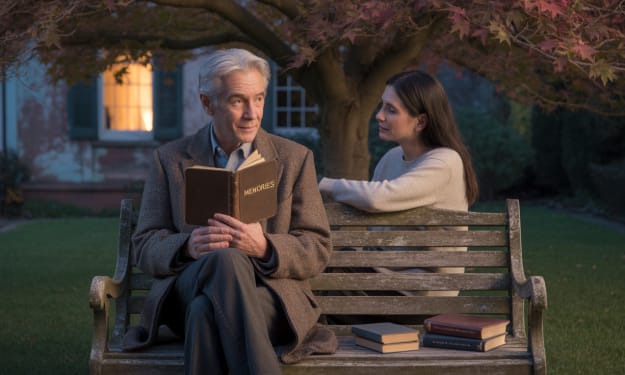
She Read His Obituary Before He Died Written by Muskan Maya had always started her mornings the same way since she turned 30 — strong coffee, soft music, and the local newspaper spread across the small wooden kitchen table her grandmother once owned. It was her ritual, grounding her in a world that sometimes felt too fast, too loud, and too fleeting. But nothing in the pages ever prepared her for what she saw that Wednesday morning. “Dr. Jonathan Hale, 68, passed peacefully on Tuesday evening. A revered linguistics professor and poet, Jonathan spent his final years quietly, often spotted in the garden of his family estate, book in hand…” Maya stopped reading. Her throat tightened. She blinked once. Twice. No. Her heart refused to believe what her eyes read. Jonathan Hale was not dead. He couldn’t be. He was alive just yesterday. She knew this because she had seen him — with her own eyes — walking down the cobbled path near the university’s old fountain. His steps were slow, sure, his coat too large for his frame but familiar. She had almost called out his name. Almost. Instead, she had stood still, silent, as he passed. And now he was dead? She folded the newspaper slowly, like she feared it might scream if handled wrong. Her hands trembled. Her coffee had gone cold. There had always been something mysterious about Jonathan Hale. When she took his poetry class ten years ago, she had been mesmerized by his presence — tall, quiet, eyes like fading ink, and a voice that carried sadness like it was a song. He rarely smiled, but when he did, it was like winter sun—brief, beautiful, and almost apologetic. Maya was one of his favorite students, though he never said it aloud. He showed it in smaller ways — a poem returned with more notes than others, a rare compliment scrawled in the margins, and once, a hand-written letter praising a piece she wrote about time and loss. And then, one day, he vanished. He stopped teaching. His office was emptied without notice. Rumors whispered that his wife had passed and that grief had consumed him whole. Others said he simply decided the world had taught him enough sorrow. No one knew for sure. But Maya never stopped wondering. And now she held his obituary in her hands. The final line read: “He leaves behind no children, but countless students who carry his words.” A tear fell onto the printed page, smearing the ink. That evening, against her better judgment, Maya made her way to the estate listed in the obituary. She didn’t know what she hoped to find. Closure? A final goodbye? Perhaps a glimpse of the garden where he spent his last days? The house stood just as she imagined — regal but tired, its paint faded and windows large and knowing. The front door was slightly ajar. Her heart pounded as she stepped in. “Hello?” she called softly. Silence answered. She walked past the threshold, following the faint scent of old paper and lavender. The living room was lined with books, and in the corner sat a record player, spinning nothing but static. Then, from the garden, she heard a soft cough. Maya froze. She stepped outside slowly. There he was. Jonathan Hale. Alive. Alive. Sitting on a worn bench beneath a cherry blossom tree, a book in hand. He looked older, thinner, but unmistakably himself. She gasped audibly. He looked up. Their eyes met. A pause. Then he smiled — faint, knowing. “Miss Rivera,” he said, voice softer than she remembered, but still laced with poetic rhythm. “You read it, didn’t you?” “The obituary?” she whispered. “I… I don’t understand…” He patted the bench beside him. She sat, breathless, confused, and heart racing. “I wrote it,” he said plainly. “Months ago.” “Why?” “To see who still remembered me. To know if I mattered.” “That’s—crazy. It’s… cruel.” He nodded. “Yes. But solitude does strange things to a man.” She looked at him. “You’re not forgotten. You never were.” He turned to her, and for the first time in a decade, she saw something break in his eyes. Not sadness. Not madness. Just a deep, echoing loneliness. “I just wanted one person to come,” he said. “You got one,” Maya said softly. They sat there for hours, talking about poems and pain, memory and time. The stars came out, unapologetically bright. When she left, he gave her a small notebook — filled with poems he never published. “For when I’m really gone,” he said. Three months later, the real obituary came. This time, there was no mistake. But she wasn’t mourning anymore. She was remembering. And through the ink of his words, he lived.
By Moonlit Lettersabout a year ago in Fiction