family
The Lighthouse Keeper’s Garden
The Lighthouse Keeper’s Garden Lessons Carved by Wind and Sea On the ragged edge of the world, where cliffs met the restless sea, stood the old Breakers’ Light, its stone tower defiant against the wind’s ceaseless song. Its beam sliced through the mist, a quiet promise to ships lost in the dark. At its base, improbably, a garden thrived—wildflowers in defiant bursts of crimson, violet, and gold, rooted in soil that knew only salt and storm. On a stone bench nearby, a journal lay open, its pages worn, holding pressed petals like secrets kept safe.
By Shohel Ranaabout a year ago in Fiction
A Rose at Dusk
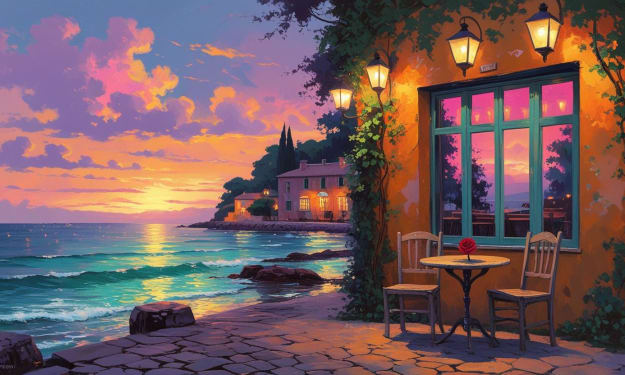
A Love Story Woven by the Sea The village of Marinelle was a whisper of a place, tucked between the cliffs and the sea, where time seemed to pause in the glow of dusk. Cobblestone streets wound like old promises, leading to a café called L’Étoile, its ivy-clad walls kissed by the salt of the tide. Every evening, as the sun dipped low, painting the sky in shades of apricot and lavender, the café’s lanterns flickered to life, casting a warmth that felt like an embrace.
By Shohel Ranaabout a year ago in Fiction
Whinberries. Top Story - August 2025.
I still remember how he looked, hunched over the wireless, late on that Sunday morning. It's my most abiding memory of him. His shirt, the mended one with blue stripes, was open at the cuffs and rolled back to his elbows, showing his sturdy, brown forearms. Mostly, we could only see the back of his head, he was so intent on teasing a signal from that radio. His hair was coal-black, and as neatly combed as if we'd been to church (we hadn't). When he turned to snap at Mother to stop her "bloody clattering" we could see how hard he bit on the pipe sticking out the side of his mouth, and the concentrated scowl over his eyes. That's how I remember him, and the memory brings me dread, even now. The memory of that morning is even worse, I think, than the fear the night before... * It was the last weekend before school started again. Saturday was mild and dry. The clouds felt heavy and low, but only for the grownups. They were too far away for the children to be bothered by them. Nerves pinched at Joanie. She'd prefer to stay at home and read. "Nonsense," her mother said. "Plenty of time for books soon. School starting this week! So! Get out in the fresh air. Get some colour in your cheeks. Ned will mind you -" here she shot a look at him, hard enough to send a lesser boy stumbling backwards, "won't you, Ned." "Course," Ned said, and that was that. * It was a nice day, even Joanie had to admit. Not too hot, nor too chilly. It was a bit exciting and fun to be off by themselves. In charge of how fast they went (she scuttled to keep up) and when they ate lunch (the hard cheese sandwiches were gone inside an hour.) "Here," Ned wiped the crumbs from his mouth and handed the lunch tin to Joanie. His hand was sweaty. Joanie wiped hers on her dress, and scuttled some more, the tin banging against her leg. She hadn't been hungry, not really, but she had a feeling if she didn't eat her share, Ned would finish it off himself, no matter how cross it made her. Ned scooped up a likely looking stick from the path and craned his neck to look up into a nearby apple tree. "Ned, no!" Joanie panted. "Mam said we're to get whinberries. Not apples." "Shut up," Ned was careless about his manners without an adult on hand to remind him. As far as he was concerned, little sisters were annoying and didn't count. "It's probably someone's tree," Joanie fretted. "We'll be in trouble." "You're always such a fraidy-cat." "Am not." "Shut up, then, and help me get these apples." He flailed the stick, and grinned in triumph when it connected and an apple sailed to the ground. "See?" he said. Easy! Look, I'll get another... You collect them, go on. Put them in the tin." "But the tin is for berries." Joanie looked doubtful. Apples were much bigger than whinberries. "Won't hardly be any berries, anyway," Ned swung the stick again. "All the good ones are gone. You'll see. It'll just be the shrivelled ones covered in dog widdle that no one wants. You should have come with us last time, there were loads." Joanie said nothing, but felt sure she hadn't missed much. She wondered if she could skip the pie tomorrow, and just have the custard. It was just like Ned, she thought peevishly, to ruin the best part of Sunday dinner. He was looking red in the face now with exertion and frustration. After his early success, the apples were proving hard to knock out of the tree. "Maybe try getting those smaller ones up there," Joanie pointed. "There's not much room left in the tin anyway." "Good thinking," said Ned, magnanimous for once. His fresh targets were much higher. He tried throwing the stick instead of waving it. Joanie found her own stick and joined in. The tin lay forgotten on the grass. The sun peeped out from the clouds. It was a rare and amicable moment. Joanie managed to hit three apples, although they hadn't fallen from the tree. Ned had been impressed. Joanie beamed. Ned set up a points system and scratched a tally on the stone wall. A man's voice, angry and yelling, made them both jump halfway out of their skins. "Hey! What do you think you're playing at! Hey!!" Ned and Joanie ran. They flew down the path and kept going, sure that the angry owner of the apple tree was right behind them. Pink faced and panting, Joanie asked, "Do you think he got a good look at us?" "At you, probably. You don't run very fast. They'll probably call you the snail when you start school. Or Moanie Joanie." Joanie had been trying hard not to think of that. Dread twisted her insides. Ned rolled his eyes. "Oh, don't start whining again. Come on. Did you get the tin?" Joanie went even pinker. *
By L.C. Schäferabout a year ago in Fiction
Parlay and Desecration
As our lips danced and wrestled and our tongues formed the frontal assault into enemy territory, it felt as if we had been locked in a heated, passionate battle for hours. The cold, harsh reality that existed outside of her plump pinks and my smaller, firmer mouth was that it had merely been minutes.
By Paul Stewartabout a year ago in Fiction