Fable
When Robots Dream
The idea of robots dreaming may sound like science fiction, but as artificial intelligence (AI) advances, questions about machine consciousness and the nature of AI experiences become increasingly relevant. What would it mean for a robot or AI system to "dream"? Can machines have subconscious processes, emotions, or even desires? Exploring these questions invites us to rethink what consciousness means—not only for humans but for the technology we create.
By Muhammad Asimabout a year ago in Fiction
The Road Paved with Effort
In a quiet village nestled between two low-lying hills lived a young man named Arjun. The village of Dharampur was known more for its peaceful farmlands than for any ambition that sparked beyond its green borders. Most people were content with simple lives, tending to crops and animals, but Arjun was different. From a young age, he dreamed of becoming an engineer and building machines that would help his village flourish. His family was poor. His father tilled a small piece of land and earned barely enough to feed the five members of the family. Arjun's mother sold vegetables in the market to supplement their income. Yet, despite the hardship, the family stood together with unwavering hope in Arjun's dreams. Arjun’s school had limited facilities—no computer lab, few textbooks, and broken benches—but he made the most of it. He would borrow books from the village library and study late into the night under a dim kerosene lamp. Often, when his friends played outside, Arjun would be hunched over a notebook, solving math problems or copying diagrams from old science magazines. Villagers often mocked him. “Why do you waste your time studying so much?” some would say. “It’s not like you’ll ever leave Dharampur.” But Arjun never let their words get to him. He believed in something they couldn’t see—possibility. He knew that hard work was the only bridge between his dreams and reality. When the results of his high school board exams were announced, Arjun had topped not just his school, but the entire district. His teachers were proud, and for the first time, the villagers looked at him with admiration rather than doubt. With that achievement, Arjun applied for scholarships to study engineering at a reputed college in the city. His father sold a portion of their land to afford the train fare and the initial admission fees. Tears welled up in Arjun’s eyes when he realized the sacrifices his family had made. That day, he made a silent vow to himself: I will not let their sacrifice go in vain. City life was overwhelming at first. Skyscrapers, traffic, and the fast-paced life were all new to Arjun. In his college, most students came from wealthy backgrounds, spoke fluent English, and owned laptops—things Arjun had never even touched before. But he refused to be intimidated. He took on part-time jobs—sweeping in a bookstore, delivering newspapers, and later tutoring high school students—to earn enough for food, books, and to send a little back home. He woke up at 5 a.m. every day, worked until 8 a.m., attended classes until 4 p.m., and worked again in the evenings. At night, while others relaxed or partied, Arjun studied in silence. There were times he doubted himself, especially when he failed to understand complex subjects. But instead of giving up, he would find extra material, ask professors, watch online tutorials in internet cafés, and keep pushing. He never blamed his background, never made excuses. He just worked. By the end of his third year, Arjun’s efforts began to bear fruit. He won a state-level science competition by designing a low-cost water purifier using easily available materials. The model was so innovative that a local NGO approached him to help implement it in nearby drought-prone villages. That moment changed everything. Arjun’s work gained media attention. He was invited to conferences, offered internships, and began networking with professionals in the field. But even with this newfound recognition, Arjun remained grounded, still helping his roommates with their studies, still working part-time to ease the burden on his family. In his final year, he secured a fully funded internship with an international tech company. When placement season arrived, Arjun was among the first to get a job offer—at a package that was ten times what his father earned in a year. When he returned to Dharampur after graduation, the entire village welcomed him like a hero. The same people who once mocked him now brought sweets and garlands, proudly telling others how “they always knew he’d succeed.” Arjun just smiled, never rubbing his success in anyone’s face. With his first paycheck, he rebuilt his parents’ house, bought his mother a new vegetable cart, and got solar panels installed so the family would never again have to rely on a dim lamp. Later, he launched a small learning center in the village, equipped with books, computers, and internet access—resources he never had growing up. Today, Arjun is a successful engineer, working on sustainable technology to help rural communities. But more importantly, he’s a symbol of what persistence, focus, and unshakable belief can achieve. He often visits schools to share his story with young students. His message is always simple but powerful: “Talent is nothing without effort. And effort, when consistent and fueled by purpose, always leads to success.” Dear Reader, Arjun’s journey is not a fantasy—it’s real, and stories like his exist all around us, waiting to be written. But here’s the truth: success doesn’t come from shortcuts or wishes. It comes from late nights, early mornings, sacrifices, and staying committed even when no one else believes in you. So now I ask you: What are you working hard for? Are you giving your best every day to make it happen? Success is waiting—but only for those who are brave enough to sweat for it.
By Julia Christaabout a year ago in Fiction
Trapped in Time
They say time is a river, but I’ve learned the hard way that it’s more like a maze—one you can get lost in forever. My name is Elen Tavor, and I was a junior temporal engineer aboard the Aion—a vessel designed not to travel through space, but through time itself. My job was to monitor the stability of our chronometric drive, ensuring the timelines we pierced didn’t fold in on us. The mission was supposed to be a simple diagnostic hop to the year 2307, a one-week scan, and then home. But something went wrong.
By Muhammad Asimabout a year ago in Fiction
The House on Sycamore Hill
They told me the house on Sycamore Hill had a history, but no one ever told me what kind. Not in detail. The locals spoke of it the way people mention bad weather—unavoidable and better not dwelled upon. It stood at the end of a winding road just past the tree line, its paint peeled in long strips like curling parchment, windows fogged from the inside as if the house itself were holding its breath. I wasn’t looking for trouble, just quiet. After years of working a dead-end job and living in a city that never gave me space to think, I inherited the place from a distant aunt I never knew. It felt like a strange gift from someone who had once seen me from afar and decided I deserved something of my own. So I moved in, ready to start over. Or so I thought.
By Muhammad Asimabout a year ago in Fiction
10 Years of Marriage Equality
A Decade of Love and Progress Where were you on June 26, 2015? For me, it was a normal day at work. But that day changed history—it was the day same-sex marriage became legal across all 50 states in the U.S. We celebrated love, equality, and a hard-won victory for the LGBTQ+ community, activists, and everyone who believes in justice.
By Shafi Ullah Darweshabout a year ago in Fiction
The Vole and the Vulture. Content Warning.
There was once a vole, who lost everything. One afternoon, he was telling his litter of young a story about a bird who could teach rodents how to fly when a terrible rumble passed through their den. The four of them looked at him with shocked eyes, frozen in fear.
By ThatWriterWomanabout a year ago in Fiction
Loyalty in the Venom: A Scorpion’s Story
The Beginning In the middle of a vast, unforgiving desert where the sun burned the sands by day and the winds howled cold by night, lived a small scorpion named Sim. He was young, curious, and had just begun to understand his strange place in the world.
By Atif jamal about a year ago in Fiction
Arrow Storm
Send the sun!!!!! It wasn’t something many in the town had heard thunder from their Kings lips. Not in this lifetime, or the next, or the one before last. Centuries had passed and King Leonel was growing war-hungry, nearing his two-hundred-and-fifty-third birthday. She should have been here to celebrate.
By K.H. Obergfollabout a year ago in Fiction
The mirror of the second chances
A cold breeze danced through the cracks of the abandoned cottage as Maya brushed dust from the old mirror. It had been years since anyone had set foot inside. The house belonged to her grandmother, a woman known in the village for strange tales and stranger antiques. Now, after her passing, Maya had returned—not to reclaim her inheritance, but to find a part of herself that she'd lost along the way. Life in the city had hardened Maya. A decade spent chasing corporate success left her emotionally numb. Promotions, parties, paychecks—none of it filled the hollowness she carried. Worse, she had cut ties with her parents and abandoned her younger brother after a family feud. She never forgave them. Or herself. The mirror stood taller than Maya, with a bronze frame curled in vines and mythical beasts. Its glass shimmered unnaturally, even in shadow. Her grandmother once told her, “This mirror doesn’t just reflect what you are. It shows what you could be—if you dare to look deeper.” Maya scoffed then. Now, her skepticism was tinged with curiosity. She looked into the mirror… and blinked. The reflection wasn’t right. The woman staring back had the same face, same brown eyes, same tired expression—but something was different. Behind the mirrored version of Maya stood a boy. Her brother, Arman. He was twelve again, standing in the doorway of her old bedroom, holding a paper boat they made together before things fell apart. Maya gasped and stepped back. The reflection remained unchanged. She turned to check behind her. Nothing. No boy. Just silence. “Great. I’m hallucinating now,” she muttered. But something inside her stirred—a memory long buried. That paper boat was the last gift she ever gave him, before the fight, before the slamming doors and bitter silence. She stared at the mirror again. This time, she saw her younger self and her brother laughing in the backyard, making snow angels. The image faded, and a new one appeared: her mother crying in the kitchen, the day Maya left without saying goodbye. Tears welled up in her eyes. “I didn’t mean to leave forever,” she whispered to no one. A soft whisper echoed from the mirror. “Then go back.” Maya stumbled backward, her heart pounding. The room seemed to shift, the air thick with emotion. The mirror pulsed faintly like a heartbeat. Her hands trembled. “I can’t,” she said aloud. “It’s been too long. They’ve probably moved on.” But deep down, she knew that was just an excuse. The truth was simpler and scarier: she was ashamed. Ashamed of the words she said. Ashamed of the years she stayed silent. Ashamed that she waited until her grandmother died to come back. The mirror flickered again. Now it showed an older Maya, sitting in a sunny garden surrounded by children. Her brother was there too—grown up, smiling, forgiving. “Is this… possible?” she whispered. The mirror said nothing. --- The Next Morning Maya awoke on the dusty couch, the memory of the mirror vivid in her mind. She made a decision. She drove straight to the village where her parents still lived. Her hands shook on the steering wheel. She rehearsed apologies in her head—each one sounding too small for the years they had lost. As she neared the gate, she saw her mother outside, watering the plants. Time had aged her gracefully, but sorrow clung to her shoulders. “Mama?” Maya called softly. Her mother turned. The watering can dropped. “Maya…” she whispered. For a moment, neither moved. Then her mother ran, and Maya found herself wrapped in the kind of hug that melted ten years of pain in a single breath. “I thought we lost you,” her mother sobbed. “I was lost,” Maya replied, “but I want to come home. If you’ll have me.” Inside, her father sat stunned. Arman, now twenty-five, leaned against the wall, arms folded, unsure how to react. “You left,” he said bluntly. “For ten years.” Maya nodded. “I know. And I was wrong.” Silence hung heavy. Then he walked over and hugged her. Tight. “I kept the boat,” he whispered. That night, they sat together over tea, laughing through tears, sharing stories of the years they missed. It wasn’t perfect, but it was a start. --- Months Later Maya moved back to the village, renovated her grandmother’s cottage, and turned it into a small counseling center. People from nearby towns visited, drawn by the warmth she radiated—a warmth she rediscovered through healing. And the mirror? It remained in her room. Every so often, she’d stand before it, and see versions of herself—some joyful, some broken. But she no longer feared them. She understood now: the mirror never showed what was, only what could be. And for Maya, that made all the difference.
By Shehzad khanabout a year ago in Fiction
The Girl Who Remembered Everything
I met her when we were both nine. She sat alone under the jacaranda tree behind the school library, her fingers tracing invisible patterns in the dirt. Her name was Hana. She had hair like wet ink and eyes the color of dusk just before it surrendered to night. No one talked to her, and she didn’t seem to mind. I only approached her because I’d lost my lunch. Literally — it had vanished. My banana was gone, my sandwich was flattened under my math book, and my juice box had exploded. I was a mess of crumbs and juice stains, and she must have noticed, because without a word, she slid half her apple toward me. “You don’t talk much,” I said between bites. She blinked. “I remember too much.” It was a strange thing to say, but we were kids. Everything was strange. We became friends, the kind that don’t need explanations. I’d talk and she’d listen, eyes always watching, not with judgment but with quiet understanding. She never forgot anything. Not birthdays, not bad grades, not the way Mrs. Farris once called me "hopeless" in front of the class. Hana stored it all, like her mind was a glass jar collecting time itself. By high school, her memory was legend. People would test her. “What color was Principal Donahue’s tie on the last day of seventh grade?” “Paisley. Blue and gold.” “How many times has Benji thrown up in class?” “Three. Once after chicken nuggets, twice after gym.” She never smiled when she answered. It wasn’t a party trick to her. It was a weight. One day, I asked her what the worst thing was that she remembered. We were sitting on her porch. Summer was melting the edges of the sky, and cicadas screamed in the trees. She didn’t look at me when she spoke. “My dad’s hands.” I waited. Sometimes silence was her way of choosing words carefully. “I was six. He held my mom’s wrist too tight. Pulled her so hard she hit the counter and cracked a tooth. There was blood in the sink. He looked at me like I didn’t exist. But I remember it. Every detail. The smell of garlic from the dinner she’d cooked. The sound the plate made when it shattered. Her crying. I was too scared to move. I still hear it, sometimes.” I didn’t know what to say. I just held her hand, and she didn’t let go. In college, we drifted. Different cities. Different majors. I heard she took up neuroscience. I wondered if she was trying to fix the very thing that made her different. We reconnected at 27. She had started a blog, anonymously, sharing stories—others’ and her own—under the title The Memory Keeper. She never named names, never gave herself away, but I recognized her voice instantly. One post stopped me cold. It was about a boy who used to sit beside her under a jacaranda tree. “He was my only friend,” she wrote. “He made forgetting feel less necessary. But I never told him that. I was afraid I’d ruin it by remembering it too much.” I called her that night. “I read it,” I said. She didn’t ask which one. She knew. She laughed, soft and short. “I hoped you would.” And just like that, we became us again. But time, it turns out, doesn’t care about friendships or love stories or even memory. Time just moves. When Hana got sick, it was cruelly ironic. A rare neurological disorder. One that didn’t just threaten her body — it came for her mind. Piece by piece, her memories were slipping away. “It’s funny,” she whispered once, when I visited her in the hospice. “Most people want to remember more. I wanted to remember less. Now I’m afraid I won’t remember you.” She was fading, but her eyes were still the color of dusk. “You don’t have to remember me,” I said. “I’ll remember you.” I do. Every day. I remember her handwriting — small and slanted. The way she twirled pens in her fingers. How she knew facts she wished she could forget, and how she carried them like invisible bruises. I remember that she once told me: “Some memories are blessings. Others are burdens dressed in silence.” Hana remembered everything, until she couldn’t. So now, I remember for her.Start writing...
By Muhammad Siyab about a year ago in Fiction
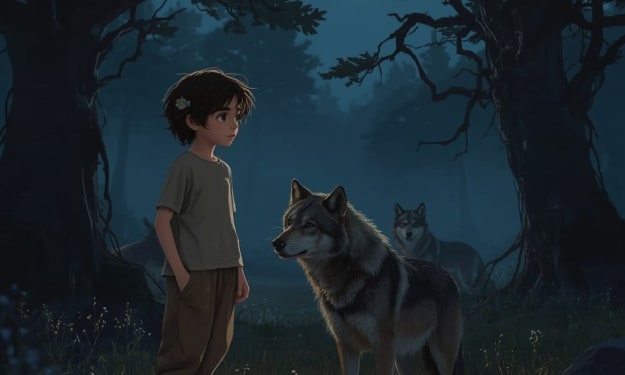
The Boy Who Spoke to Wolves
The villagers said Elias was strange. He never cried when he scraped his knees or fell from trees. He didn’t speak until he was five, and even then, only in murmurs that drifted more like growls than words. His mother, a quiet woman who stitched dreams into fabric, said he was born on a winter’s full moon with eyes the color of ash and stormclouds. They lived on the edge of the forest—the one people feared, with trees older than time and whispers that danced between the leaves. At night, the howls would begin. Some were sharp and lonely, others low and threatening. But Elias didn’t hide beneath his blanket like the other children. He listened. And one night, he answered. He was ten the first time it happened. The village dogs had barked frantically at the tree line, their noses twitching, their tails stiff with warning. Elias walked calmly past them, barefoot in the snow, toward the forest. “Elias!” his mother had shouted. “Where are you going?” He didn’t reply. He only looked back once, his pale face glowing in the moonlight. Then he disappeared into the woods. They found him the next morning asleep between two giant wolves—one black as midnight, the other silver as starlight. His body was warm, untouched by the cold. His mother wept with relief, but the villagers whispered of curses and beasts. From that day on, the forest called him often. He would vanish for hours, sometimes days, always returning with wildflowers in his hair or a smear of berries on his cheek. The wolves never harmed him. In fact, they guarded him. And slowly, Elias began to change. He walked with quiet grace, barely disturbing the earth. He no longer flinched at thunder or the sharpness of people’s tongues. When angry men shouted at him to stay away, he only blinked, his expression unreadable, as if he was listening to something they could not hear. Because he was. Elias could understand the wolves. He heard them not in words, but in feelings, rhythms, and symbols only his heart could translate. They told him stories—of the old forest, of ancient battles, of hunger and harmony. They spoke of balance, of life before fences and fear. And in return, Elias spoke back—not with his voice, but through presence, stillness, and instinct. One day, when Elias was twelve, a drought came. The crops withered, and animals began to wander dangerously close to the village. One of the farmers found a half-eaten goat and swore it was wolves. Fear spread like fire. The villagers gathered with torches and iron traps, marching toward the forest. Elias stood in their path. “Move, boy,” barked the butcher. “They didn’t take your goat,” Elias said calmly. “How would you know?” another man sneered. “Because I asked them.” A heavy silence followed. “You’re mad,” spat someone. But Elias didn’t move. Instead, a single howl pierced the sky, followed by another. Then, from the forest shadows, a dozen wolves emerged. They did not snarl. They did not attack. They stood silently beside Elias, eyes glowing like moons. “They are not the monsters,” Elias whispered. “We are, when we forget how to listen.” That night, the villagers laid down their weapons. The forest remained untouched. And though they still didn’t understand Elias, they began to respect him. Years passed. Elias grew taller, stronger, his hair wild like the wind, his eyes soft with secrets. He became a protector—of forest and field, of the quiet magic between worlds. Children brought him questions; the sick brought him hope. They called him “The Wolf Whisperer,” though he never claimed the name. He simply smiled and vanished again into the trees, his figure melting into the dusk beside silver fur and steady pawprints. And if you ever wander too far into the woods and the night feels like it’s holding its breath, don’t be afraid. Just listen. You might hear a boy’s voice—low and kind—carrying through the trees. Speaking not to tame the wild, But to remind it it’s never alone.
By Muhammad Siyab about a year ago in Fiction