Fable
Searching For Ali
Oh Ali, I'm stuck. This morning I feel your hand at play. Uncertainty fuels my intention, my goal. It's been a good lead up. The morning news was not unsettling. Food is appropriate. Only one coffee. A pleasant phone call. The sun is shining. I've done all that is necessary. But here I am again. All I need is to turn that key. To sound off verbally. "The door is locked". To remember that fact, and to walk away. And to walk away. To walk away..
By Scott Catheryabout a year ago in Fiction
When the Sky Opened
The sky had always been a constant presence—endless, predictable, a backdrop to the rhythm of everyday life. But one ordinary afternoon, everything changed. When the sky opened, it wasn’t just a meteorological phenomenon; it was a profound event that reshaped a community, altered lives, and stirred the deepest questions about our place in the universe.
By Muhammad Asimabout a year ago in Fiction
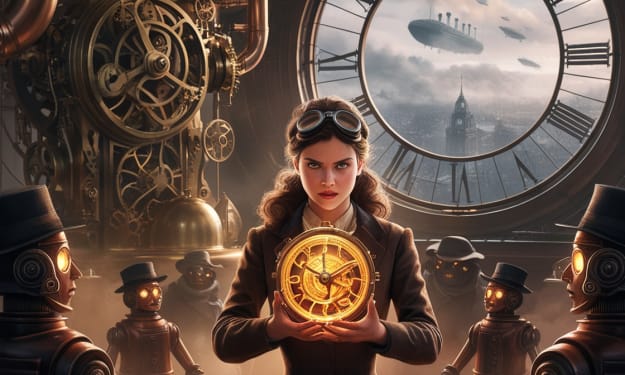
The Clockmaker’s Secret: A Steampunk Adventure
In the mist-shrouded streets of New Babbage, where copper pipes twist like serpents across soot-blackened walls and clockwork machines hum in eternal motion, a secret lies hidden — a secret that could change the world. This is the setting for The Clockmaker’s Secret, a thrilling steampunk adventure story that weaves mystery, invention, and rebellion into an unforgettable narrative.
By Muhammad Asimabout a year ago in Fiction
Silent Island — Prisoner of Truth
The year is 1954. A violent storm brews over the Atlantic as U.S. Marshal Edward “Teddy” Daniels and his new partner Chuck Aule arrive at a remote island. Their destination? Ashecliffe Hospital, an ominous facility housing the criminally insane.
By Ameer Gullabout a year ago in Fiction
The Cabin of Silence. Runner-Up in The Summer That Wasn’t Challenge.
The train stopped at a platform barely long enough for two carriages. There was no café, no sound except the chirping of crickets in the morning haze. Clara stepped off, dragging her dented suitcase behind her. Her phone showed no new messages. Just the date: July 7.
By Alain SUPPINIabout a year ago in Fiction
"Collateral" is now in pre production.
Recently I received comments on social media from a former colleague who was interested in how I was funding production for Collateral. I had intended to shoot it with iPhone, very barebones, and save the heavy production costs for post editing with special effects for the finale.
By Scott Catheryabout a year ago in Fiction
You were never really here
Early in the morning Gallopatrot might appear in a waking dream. Although never really here, Gallopatrot never really leaves. Gallopatrot is more than a ghost or a memory. Sometimes Gallopatrot disappears like sugar crystals in water, or the smell of perfume, or quarter-hourly chimes of a grandfather clock or the pain from wars that occur every day. Perhaps sensory fatigue or habituation caused by repeated exposure leads to a decrease in response to the stimulus of the dragon's presence. Yet Gallopatrot is the stuff of legends that lingers long after an era is gone.
By Katherine D. Grahamabout a year ago in Fiction
The House That Changed Its Doors
The house on Ash Fern Road had been empty for 47 years. Ivyith no history on record? That’s not a bargain, it’s a warning.” Meredith laughed it off. Ghost stories didn’t pay the bills. This house, however, had four bedrooms, a library, a garden, and space for her son, Noah, to play. It was perfect. At least in the daylight. The first door moved on the third night. Meredith awoke at 2:43 a.m. to get a glass of water. She turned left from her bedroom, as always, toward the kitchen. Instead, she stepped into a narrow hallway filled with shelves. Books. Floor to ceiling. She blinked, confused. It was the library. But that should’ve been two rooms over. Shrugging it off, she figured she had turned the wrong way in her groggy state. She didn’t mention it. The next night, the bathroom wasn’t behind the blue door anymore. It was a brick wall. Noah woke her at 3:12 a.m., tugging at her sleeve. “Mommy, my door changed.” “Go back to sleep,” she whispered. “I saw a new one. It was red. I think it was watching me.” By the end of the first week, Meredith wasn’t sure where anything was anymore. The house seemed to breathe in its sleep, shifting its bones when no one was looking. The kitchen swapped with the study. The front door disappeared one night and returned in the attic the next morning. Some doors vanished entirely, replaced by smooth walls or empty archways. She tried to draw a floor plan. It changed every night. The only constant was Noah’s room—it never moved. The door was always green. Always at the top of the stairs. Always open, as if the house respected the boy more than the mother. Or feared him. Desperate, Meredith installed cameras. But each morning the footage was static between midnight and dawn. Her phone showed nothing. The electrical readings blinked and crackled like Morse code from another world. Still, she stayed. Because nowhere else would take them. And because, deep down, some part of her was fascinated. One night, she left sticky notes on every door. “This was the kitchen.” “This leads to laundry.” “DO NOT OPEN AFTER MIDNIGHT.” In the morning, the notes were rearranged, but one had something written beneath it. Scrawled in tiny, perfect cursive: “You are the stranger here. Not us.” Noah became quieter. He began talking to the house. “Goodnight, East Wing,” he would say, placing a toy car by a new door. “You did good today.” Once, Meredith found him whispering into the keyhole of a door with no knob. “What are you doing?” “I’m telling it my dream so it knows where not to take us.” “Who told you that?” He looked up, eyes wide. “The house.” On the 23rd day, the mirror in the hallway showed a door that didn’t exist behind her. When she turned around, it was there. A tall, narrow wooden door with iron hinges and a black handle shaped like an open eye. Something about it felt… final. She didn’t open it. That night, Noah disappeared. She searched the whole house—every room, every door, even the attic with its damp beams and dusty rafters. She screamed until her voice cracked. The house stayed silent. Then, around 4 a.m., she opened what used to be the coat closet. Noah was inside. Asleep. Wrapped in blankets that weren’t theirs. “They were kind,” he said. “They just wanted to meet me.” “Who?” “The doors.” Meredith decided to leave the next day. But there was no front door anymore. Only 13 others. All different colors. All closed. She tried them all. Some opened into old rooms. Some opened into nothing—just black space, like falling without end. One opened into a copy of her childhood bedroom. Another showed her standing on the other side, older, crying. She closed that one quickly. By the 40th day, she gave up. They had food. The house made sure of that. It grew things in the garden overnight—fruits she couldn’t name, vegetables shaped like spirals. The water was always clean. The air smelled of books and earth. She started to wonder: Was it really a house? Or a being? A creature of doors and choices and passageways? Noah began drawing the doors. Pages and pages of them. Each had a name. “The Listening Door.” “The Door of Sighs.” “The Door That Remembers.” Meredith asked if he was afraid. He said no. “They’re just lonely,” he explained. “They used to go everywhere. But then the world forgot about them.” She didn’t understand. “Mom,” he said gently, “this isn’t a haunted house. It’s a house that got lost.” On the 61st night, the iron-hinged door returned. The one shaped like an eye. It was in her bedroom now. This time, it was open. A note lay on her bed. “You may leave. But not unchanged.” She stepped forward. Noah beside her. The house didn’t creak or groan. It just... waited. She held her son’s hand and stepped through. The sunlight on the other side was warmer than she remembered. They stood in front of the house. But it was older now. Crumbling. As if decades had passed. The road was overgrown. The world was… quieter. She pulled Noah into her arms, heart pounding. “Are we home?” she whispered. He looked around. “No,” he said. “But maybe they are.” Author's Note: Some houses are built to be lived in. Others are built to remember, to hide, or to wait. This one… waited for someone who would understand its doors.
By Atta Ullahabout a year ago in Fiction
The Last Bookstore on Earth
They say the world ended not with a bang, but with a quiet deletion. Not a meteor, not a nuclear war—but data corruption. The Internet collapsed first, taking with it every server, every digital library, every record, every identity. It was the Great Blackout of 2140, the moment the Age of Information became the Age of Amnesia. In the years that followed, cities crumbled, currencies vanished, and governments dissolved. But hidden among the ruins, one strange relic remained untouched—The Last Bookstore on Earth.
By Muhammad Asimabout a year ago in Fiction
Letters to the Moon
In a world where the stars had vanished and the sky was nothing but a curtain of static black, people stopped looking up. The moon was the last celestial body left, flickering faintly above the poisoned skyline like a dying ember in a burnt-out fireplace. No one believed it could still hear us. No one but me—and her. This is not just a love story. It's a dystopian romance story wrapped in fading memories, forbidden hope, and the fragile weight of handwritten letters sent to a place no one could reach.
By Muhammad Asimabout a year ago in Fiction