Fable
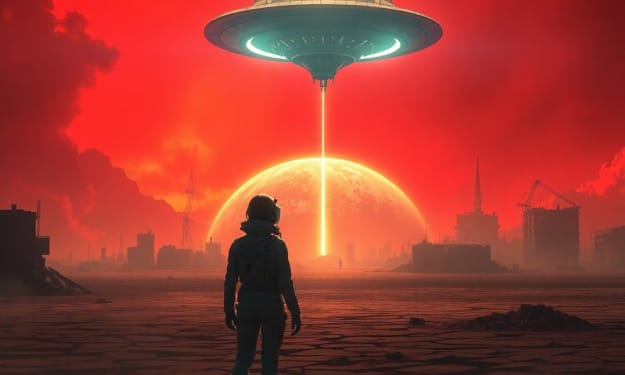
The Last Message from Earth
The year was 2145. Earth had been declared uninhabitable for over three decades. Climate collapse, nuclear skirmishes, and viral pandemics had rendered the blue marble a toxic wasteland. Humanity, or what was left of it, had scattered among the stars — colonizing Mars, floating cities on Titan, and sprawling mining colonies across the Kuiper Belt.
By Soul Pagesabout a year ago in Fiction
The Letter I Was Never Meant to Read
By Nadeem Shah I found the letter by accident. Tucked inside the back of my mother’s worn-out recipe book, behind a page smudged with gravy stains and faint ink scribbles about nutmeg, was an envelope that didn’t belong. It was brittle, yellowed with age, and sealed with a faded wax stamp I didn’t recognize.
By Nadeem Shah about a year ago in Fiction
The Girl Who Grew A Forest Inside Her
Once, not so very long ago, there was a girl who grew a forest inside her. She was not born with it. Not exactly. At first, she was like other children—soft, open, curious. But life, as it does, began to press on her. Small losses. Sharp words. The kind of loneliness that doesn't show. The kind of silence that fills a room. The world asked her to be small, to take up less space, to smile when she didn't want to. And slowly, little by little, she began to fold inward.
By Alain SUPPINIabout a year ago in Fiction
Kindness Tastes Like Lemon Tea. AI-Generated.
I never liked tea. Not the bitter green kind, not the herbal kind my mom kept insisting would help me “balance out,” and definitely not the flowery ones that tasted like wilted garden petals. But I drank it anyway—every day at 4:15—for nearly four months, sitting at a round table by a window in Mrs. Calloway’s faded yellow kitchen.
By waseem khanabout a year ago in Fiction
The Mirror Room🕯️. AI-Generated.
After her grandmother's death, Clara inherited an old Victorian house. It stood silent and dust-laden, the air thick with forgotten memories. But one room was unlike the rest—small, square, and lined wall-to-wall with mirrors. Her grandmother called it the Reflection Room.
By ElaheMindStoriesabout a year ago in Fiction
Manu was punished for lying
Dear children! In a distant forest, there lived a group of cats. They all had a deep friendship. All the cats used to play together and even go out to eat together. The winter season had begun and the cold outside was getting worse. In such a situation, the cats found it impossible to leave the house, but they had to go out to fill their stomachs.
By Echoes of Lifeabout a year ago in Fiction
The Letter I Was Never Meant to Read
By Nadeem Shah It was tucked inside the back of an old shoebox—between brittle birthday cards and a black-and-white photo of a woman I didn’t recognize. I wasn’t supposed to find it. But fate has a cruel way of revealing things when you’re least prepared.
By Nadeem Shah about a year ago in Fiction
The 2025 Kamchatka Megathrust Earthquake: A Wake‑Up Call Across the Pacific
The 2025 Kamchatka Megathrust Earthquake: A Wake‑Up Call Across the Pacific On July 30, 2025, a massive magnitude 8.8 earthquake shook the remote waters off Russia’s Kamchatka Peninsula, marking one of the strongest temblors recorded in modern times. Here’s a comprehensive breakdown of its causes, impacts, aftermath, and what it reveals about global preparedness. --- 🌍 Geology and Magnitude The quake originated 119 km (74 mi) east-southeast of Petropavlovsk‑Kamchatsky, at a shallow depth of around 20 km (12 mi). It occurred along a megathrust fault where the Pacific Plate subducts beneath the North American Plate, part of the notorious Ring of Fire. With magnitude 8.8, it ties as one of the top six strongest earthquakes ever recorded, alongside the 2010 Chile and 1906 Ecuador–Colombia quakes. --- 🌊 Tsunami Response and Wave Behavior The shallow depth amplified tsunami risk. Warnings were issued across the Pacific Ocean, including Japan, Hawaii, California, Chile, Ecuador, Peru, Taiwan, New Zealand, and French Polynesia. In Kamchatka and the Kuril Islands, tsunami waves reached heights of 3–5 meters. Hawaii saw waves up to 1.7–1.8 meters, prompting evacuations before warnings were downgraded. In Japan, coastal tsunamis peaked around 1.3 meters, and precautionary evacuations included nearly 2 million residents, notably around Fukushima. In French Polynesia’s Marquesas Islands and the Galapagos, waves approached 2.5–4 meters, triggering localized evacuations. --- 🏘️ Damage, Impact & Human Story No fatalities were reported in Russia, though some injuries and minor structural damage—a kindergarten collapse in Petropavlovsk‑Kamchatsky among them—were observed. Remarkably, a team of surgeons continued an ongoing operation amid the quake’s tremors in a Kamchatka oncology center—later hailed as “heroes in white coats.” Satellite imagery showed damage to a naval submarine base, including a damaged pier at Russia’s Rybachiy base, raising questions about impacts to nuclear-armed Borei-class submarines. --- 🧪 Why the Disaster Was Less Catastrophic Than Feared The immediate forested and sparsely populated terrain reduced potential casualties. The Pacific Tsunami Warning Center (PTWC) and Russia’s own tsunami alert system worked swiftly to issue evacuation orders across the Pacific. Though initially feared to generate massive waves, the tsunamis were moderate—strong, but not catastrophic in most regions. Coastal topography and underwater terrain played a role in dampening wave energy as they traveled. --- 📊 Historical Context This event echoes the 1952 Severo-Kurilsk earthquake, a magnitude ~9.0 quake that caused a tsunami up to 18 meters high and killed over 2,300 people. It also aligns with other devastating seismic events in the region’s history and underscores recurrent risk zones along the Kuril–Kamchatka trench. --- 🔍 Lessons Learned and Future Preparedness The global response—especially in emergency alerts and mass evacuations—demonstrated a milestone in international disaster coordination. Over 3 million people evacuated across the Pacific. Experts emphasize that while modern detection systems worked, underfunding and gaps in regions like the Atlantic or Indian Oceans pose risks. The event highlights the need for ongoing investment in early-warning infrastructure, public education, and resilient infrastructure planning. --- 📝 Summary Table Aspect Details Date & Time July 30, 2025, ~11:24 PETT (UTC‑11) Magnitude & Depth Mw 8.8, ~20 km shallow depth Epicenter Location ~119 km ESE of Petropavlovsk‑Kamchatsky Tsunami Heights 3–5 m (Kamchatka), 1.7 m (Hawaii), 1.3 m (Japan) Fatalities None reported so far Notable Impacts Damaged port & nursery; medical team heroics Aftershocks & Eruption Ongoing seismic activity; volcano Klyuchevskoy erupted Historic Rank Tied for 6th strongest quake ever recorded Preparedness Score High (due to fast warnings & evacuations) --- 🧠 Expert Commentary Experts from institutions like USGS and Pacific Tsunami Warning Center emphasize how megathrust quakes at shallow depths disproportionately heighten tsunami risk. Yet, when fast‐acting warning systems are in place, damage can be minimized. According to The Guardian, evacuations saved countless lives across Japan, Chile, and California—even without the feared scale of wave heights actually occurring. --- ✅ Powerful Reminder: Global Awareness Saves Lives Despite its remote location, this event had massive global implications. It reinforces that coastal communities are interconnected, and no region is immune to failures or successes in disaster preparedness. With powerful geotectonic zones across the Pacific, and emerging seismic risk in other oceans, the Kamchatka quake serves as a reminder to take seismic threats—and warning systems—very seriously. ---
By youssef mohammedabout a year ago in Fiction