Excerpt
from death into life
In the cycles of life, we often encounter moments that feel like the end—times when personal tragedies, loss, or deep despair seem to signal an irreversible conclusion. However, it is in these very moments that some of the most powerful stories of transformation and rebirth unfold. The theme of "from death into life" resonates deeply across cultures, religions, and personal experiences, symbolizing the journey of emerging from suffering and hardship into a renewed sense of purpose, strength, and understanding. The idea of resurrection, not just in a literal sense but as a metaphor for personal growth, has inspired countless stories, poems, and philosophies. This journey of death and rebirth is not just about overcoming external obstacles, but also about internal transformation—the death of old beliefs, identities, and behaviors, and the rebirth of new wisdom, compassion, and clarity. Let’s explore how this theme plays out in different aspects of life, from personal reinvention to spiritual renewal. The Concept of 'Death' in the Journey of Transformation Before we discuss the potential for life after death, it’s essential to first understand what "death" symbolizes in the context of transformation. It doesn’t necessarily refer to the end of life, but rather to the endings and transitions we face at various stages—whether they are personal losses, the death of relationships, the dissolution of dreams, or moments when we feel utterly defeated. In personal growth, death can take the form of: The End of Old Patterns: Habits, thoughts, and behaviors that no longer serve us may need to die for personal transformation to occur. The Collapse of Identity: Sometimes, our sense of self based on external validation or societal expectations needs to fall apart so that we can reconnect with our authentic selves. Loss and Grief: Whether it's the death of a loved one or the loss of a job, these painful experiences can often force us to reevaluate what really matters, leading to profound internal shifts. At these points, life may seem hopeless, and the darkness of loss can overshadow everything. But it is precisely in these moments that the potential for rebirth begins to take root. From Personal Struggles to Empowerment Many individuals who have faced major challenges in their lives often speak of experiencing a deep personal transformation—"from death into life." These individuals transform hardship into strength, loss into wisdom, and pain into purpose. Stories of recovery from illness, addiction, or deep emotional scars demonstrate the incredible resilience of the human spirit. For example, consider the story of Elizabeth Smart, who was abducted at the age of 14 and held captive for nine months. The trauma she endured was unspeakable, yet after her rescue, she turned her pain into a powerful message of hope, advocating for missing children and those who have experienced trauma. Elizabeth's story illustrates how personal tragedy, though harrowing, can lead to a profound new mission in life—a form of rebirth, where the 'death' of her old life gave way to the 'life' of a fearless advocate and survivor. Similarly, Nelson Mandela's life embodies the idea of moving from death into life. Imprisoned for 27 years, Mandela could have emerged bitter and broken. Instead, he used his time in confinement to reflect, learn, and refine his vision of a unified South Africa. His release from prison was not the end of his journey, but the beginning of a new chapter, one in which he would lead a nation toward peace and reconciliation. The Role of Spiritual Rebirth Across spiritual traditions, the concept of death and rebirth is central to the human experience. In Christianity, the resurrection of Jesus Christ represents the ultimate transformation from death to life, symbolizing hope, renewal, and the promise of eternal life. Similarly, in Hinduism, the cycle of samsara—the continuous cycle of birth, death, and rebirth—represents the soul's journey toward ultimate liberation and enlightenment. Spiritual rebirth is not always about a dramatic moment like resurrection but can happen gradually. Many people experience what could be termed a spiritual "death"—a crisis of faith, a period of deep questioning, or a loss of connection to their higher self. Yet, these moments often lead to profound spiritual growth. For example, someone who has gone through a dark night of the soul, marked by disillusionment and despair, may emerge with a renewed sense of purpose, clarity, and peace, having rediscovered their connection to their spirituality. The teachings of Buddhism also emphasize personal transformation through suffering. The Buddha’s life illustrates that through the acceptance of suffering, one can transcend it, leading to enlightenment—a life free from attachments and inner turmoil. It is a form of spiritual death and rebirth, where old views of self and life give way to profound liberation. The Metaphor of Nature: From Winter to Spring Nature offers a powerful metaphor for the concept of death and rebirth. Every year, the world goes through cycles of death and renewal: trees shed their leaves in autumn, seemingly dying as winter approaches, only to bloom again in the spring. In many ways, our own personal journeys mirror this cycle. We experience seasons of hardship and struggle, much like the cold and barren winter, only to emerge stronger and more vibrant when the “spring” of personal growth and new opportunities arrives. This metaphor can be applied to nearly every area of life. Relationships can go through cycles of growth, stagnation, and renewal. Careers can experience moments of decline, only to rise again with a new direction and purpose. Even on a societal level, periods of upheaval and destruction are often followed by periods of reinvention and progress. How Can We Move from Death Into Life? The process of transformation, or moving from death into life, is not easy—it requires intentional action, self-reflection, and courage. Here are a few ways to facilitate this process: Embrace Vulnerability: Transformation often begins with being vulnerable enough to face our own fears, insecurities, and limitations. This is a painful but essential part of personal growth. Let Go of the Past: To move forward, sometimes we need to let go of old beliefs, relationships, or identities that are no longer serving us. This "death" can feel devastating, but it creates space for new life to emerge. Seek Support: Whether through therapy, mentorship, or community, seeking support from others can provide the guidance and encouragement needed to transform. No one should have to go through the journey of rebirth alone. Practice Patience and Resilience: Transformation takes time. It’s a gradual process of rebuilding and reclaiming oneself after loss. Patience and resilience are key to navigating this journey. Find Purpose in Pain: Reframing our struggles as opportunities for growth and learning can turn pain into power. By finding meaning in our suffering, we can transform it into the fuel for our rebirth. Conclusion: The Endless Cycle of Rebirth From death into life is not a one-time event but a recurring theme throughout our lives. It is the story of every moment when we emerge from the darkness of loss, fear, or confusion, only to find the light of new opportunities, strength, and clarity. Whether in the personal experiences of survivors, the spiritual journeys of individuals, or the endless cycles of nature, this theme resonates deeply within the human experience. Just as the earth experiences renewal after each winter, so too can we all experience rebirth after every loss, failure, or crisis.
By Ayesha Lashari8 months ago in Fiction
Tea Time
Like every morning, Ester watched as trembling hands lifted the robin’s egg blue teapot and poured the amber liquid into a matching teacup. Louis’ hands were wrinkled, weathered, calloused from years of work. She still loved holding those hands across the small kitchen table as they talked. She remembered doing it for fifty years, the hands had changed but they felt the same. It was a good day when she could think back over the years. It was better in the mornings. The fog of sleep when she woke up lifted and she remembered his name, but in a couple hours it wasn’t guaranteed.
By Raine Fielder8 months ago in Fiction
Fires of Adversity
Kathryn, Princess of Thuirene, rose early to enjoy the sunrise in peaceful solitude. As much solitude as a member of the royal family ever got, anyway. She’d have little enough of that in the coming days, that every moment without someone demanding her attention was a gift to be savoured.
By Natasja Rose8 months ago in Fiction
No Signal
The first thing Lorelei noticed was the sound. Not silence — she had expected silence — but a roaring, ceaseless, all-consuming noise. The surf. It came from every direction, a white static that swallowed everything else, and for a long, disoriented moment she thought she had gone deaf and the world had filled the gap with its own voice.
By Parsley Rose 9 months ago in Fiction
The Cosmic Trio
All around, spring was in full bloom but nothing would ever happen in Myra’s life. She used to work at Cocquiro’s, a Mexican boutique restaurant that many would vie to work. The following year Myra was to get promoted to be the manager and the year after she planned to start her own business. That’s when her life would truly begin. That’s what she would think to herself and dream about becoming a Sous chef 🧑🍳 one day. But fate had written a different story for her. Of lately, she started noticing a strange phenomena. She would drop things unexpectedly here and there. Upon retrieving things from the floor—coincidentally, her eyes would meet a particular customer sitting at the table nearby. This happened one two many times. “Is it an entropy?” thought Myra, momentarily. But somehow, the day’s work would get her very busy and she brushed aside all those fleeting thoughts.
By Madhu Goteti 9 months ago in Fiction
Where The Forest Laughs
This is a supernatural American folk Horror about blood thirsty little creatures that bite. Two New York detectives follow the blood stained evidence of a murder case deep into American mythology, legend, folklore, and blood thirsty little creatures--THAT BITE!!!
By Edward Smith9 months ago in Fiction
Doomsday Clock: Why the World Is Closer Than Ever to Global Catastrophe
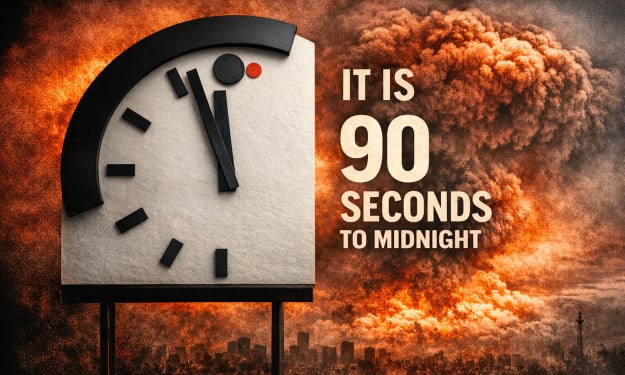
Doomsday Clock: Why the World Is Closer Than Ever to Global Catastrophe The **Doomsday Clock** is a powerful symbolic representation of how close humanity is to a self-inflicted global disaster. Created to communicate complex scientific and geopolitical risks in a simple visual form, the clock has become a widely recognized indicator of global instability. Midnight on the clock represents total catastrophe, while the movement of its hands reflects expert assessments of existential threats facing the world. Today, the Doomsday Clock stands closer to midnight than at any point in history, raising serious concerns about the direction humanity is heading and the decisions shaping its future. --- ## What Is the Doomsday Clock? The Doomsday Clock is not a real clock and does not predict an exact moment of destruction. Instead, it is a metaphor designed to show how dangerous the current global situation is. The closer the clock is to midnight, the higher the perceived risk of a catastrophic event that could threaten human civilization. It was originally focused on nuclear weapons, but over time its scope expanded to include climate change, emerging technologies, biological threats, cyber risks, and the breakdown of international cooperation. The clock serves as a warning system intended to spark public awareness and political action. --- ## Who Decides the Time on the Doomsday Clock? The time on the Doomsday Clock is set by a group of scientists, security experts, and policy specialists. Each year, they evaluate global conditions and assess how human actions are increasing or decreasing the risk of catastrophe. Their decision is based on multiple factors rather than a single event. These include military tensions, nuclear arsenals, environmental trends, technological developments, and the strength of global institutions designed to manage risk. The clock is adjusted only when experts believe the overall danger level has significantly changed. --- ## Why Is the Doomsday Clock So Close to Midnight Now? The current setting reflects a convergence of serious global threats. Nuclear tensions between major powers have increased, with armed conflicts and aggressive rhetoric raising fears of escalation. At the same time, progress on nuclear disarmament has slowed, and some long-standing safeguards have weakened. Climate change is another major driver. Rising global temperatures, extreme weather events, and slow international responses have amplified concerns about irreversible environmental damage. Scientists warn that delayed action could trigger long-term consequences for food security, water resources, and global stability. Emerging technologies also play a growing role. Artificial intelligence, cyber weapons, and biotechnology are advancing faster than global rules and ethical frameworks. Without proper oversight, these tools could increase instability, misinformation, and unintended harm. --- ## Has the Doomsday Clock Ever Been This Close Before? The Doomsday Clock has moved back and forth over the decades, reflecting changing global conditions. During the Cold War, it came dangerously close to midnight due to nuclear weapons testing and superpower rivalry. At other times, diplomatic progress and arms reduction agreements allowed the clock to move farther away. However, the current setting is the closest the clock has ever been to midnight. Unlike earlier periods dominated by a single threat, today’s risk landscape is shaped by multiple overlapping crises happening at the same time, making the situation more complex and harder to control. --- ## What Does the Doomsday Clock Mean for Ordinary People? While the clock is aimed at world leaders and policymakers, its message is also meant for the public. It highlights how everyday political choices, energy use, technological development, and public awareness can influence global outcomes. The clock reminds people that global risks are interconnected. Nuclear conflict, climate change, and technological misuse do not exist in isolation. Addressing one threat often requires cooperation and progress across many areas. --- ## Is the Doomsday Clock Just Fear-Based Symbolism? Some critics argue that the Doomsday Clock is overly dramatic or simplistic. They claim it may create unnecessary fear rather than constructive solutions. However, supporters see it as an effective communication tool that translates complex expert analysis into a clear and urgent message. The clock is not meant to predict the end of the world. Its purpose is to encourage responsibility, cooperation, and informed decision-making before irreversible damage occurs. --- ## Can the Doomsday Clock Be Moved Back? Yes, the clock can move away from midnight if global conditions improve. History shows that international cooperation, arms control agreements, environmental action, and responsible governance can reduce global risk. Reducing nuclear stockpiles, accelerating climate solutions, regulating emerging technologies, and strengthening global institutions are all actions that could push the clock back. The future is not fixed, and human choices remain the most important factor. --- ## Why the Doomsday Clock Still Matters Today The Doomsday Clock remains relevant because it reflects the reality that human survival depends on collective action. It is a reminder that progress, technology, and power come with responsibility. As the clock edges closer to midnight, its message becomes clearer: the greatest threats to humanity are created by human decisions, and only human cooperation can prevent disaster.
By America today 9 months ago in Fiction