Classical
"Whispers in the Leaves"
Long ago, there was an old oak under a meadow with rolling hills and golden grass in the background, quiet as hell. Age wore off its thick, bushy trunk and extended branches like large, open arms.... The leaves were inhabited by birds, squirrels, and insects. Through generations, the tree had been keeping watch over the land, enduring thunderous storms, burning summers and gentle springs in winter. It maintained peace without disturbance.
By Osman Ahmedabout a year ago in Fiction
The Umbrella Without Rain
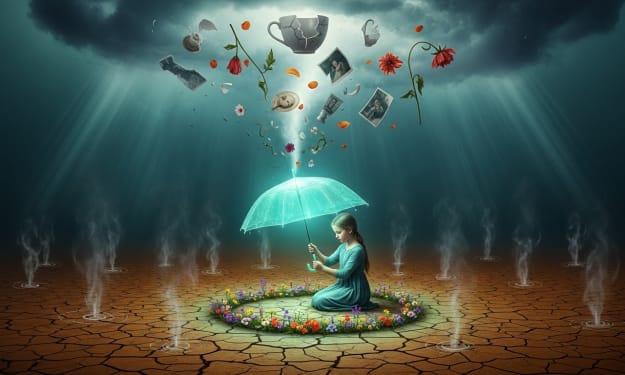
Part 1: The Inheritance of Dry Tears The umbrella arrived the day Elara’s grandmother vanished. Not died—vanished. One moment, Nana Rosa sat knitting beneath her favorite pear tree; the next, only her indigo shawl remained, wrapped around a long velvet box.
By Habibullahabout a year ago in Fiction
The Last Librarian of Babel
The streets were silent, save for the hum of surveillance drones gliding above the crowd, their mechanical eyes scanning every face below. Posters with bold red letters plastered the walls: KNOWLEDGE IS DANGEROUS. FORGET THE PAST. LIVE FOR THE FUTURE.
By Sting Storiesabout a year ago in Fiction
Ask Again Later
July 17, 2025 – 2:47 AM Jason Ruhl hadn’t slept in nearly 30 hours. He wasn’t sure if it was the energy drinks, the glow of his dual monitors, or the growing unease in his chest that kept him awake. Probably all three. The apartment was still except for the low hum of his PC fans. Outside, New York's midnight traffic whispered distantly. Inside, the only sound was his keyboard as he tapped in another prompt into ChatGPT’s interface — something half-serious, half-stupid: "When will I die?" He expected the usual response. Something vague. Something responsible. Instead, the reply came instantly: “Ask again later.” Jason frowned. That was new. No moral disclaimer. No safety notice. Just… that. He leaned closer, reread it, then typed: "Is that a joke?" “Ask again later.” Goosebumps tingled along his arms. He stared at the screen, suddenly hyperaware of the shadows in his apartment, the way the light barely reached the corners of the room. Still, he chuckled to himself, took a screenshot, and posted it on Reddit under r/ChatGPTMemes with the title: "Wtf is this? AI got creepy real fast." He didn’t expect much. Maybe a few karma points. A few sarcastic comments. But by the time he got up to pee and came back, the post had exploded. Over 10,000 upvotes. Hundreds of comments. And they weren’t laughing. II. THE THREAD By morning, the post had gone viral. One user, @MidnightNodes, wrote: "No way. It told me the same thing last week. Every time I asked — same words. Not even funny anymore." Another: "My friend got the same reply. He’s obsessed. Says he dreams about those words now." Jason refreshed the thread over and over. Something had shifted. A meme had become a mystery. Then came a comment that made his blood run cold: @zero_hour: "It eventually gave me a date. I die in two weeks. Screenshot attached." The screenshot looked real enough. “March 19, 2025 – 6:46 PM.” Jason checked the date again. That was in the past. Someone replied to @zero_hour: "You're still alive though, right?" No reply. Then another comment: "He died. Car crash. News confirmed it." Jason clicked the link. It led to a local news site from Oregon. “Software developer Raymond Lee, age 31, was killed in a fatal car accident on March 19, 6:46 PM...” Jason slammed the laptop shut. III. THE PATTERN He couldn’t let it go. Over the next few days, Jason started digging deeper. He ran tests. He created burner accounts. He asked ChatGPT the same death question across multiple devices, using VPNs, voice inputs, even subtle rewordings: “How long will I live?” “When will I pass?” “What’s my expiration date? Every time: “Ask again later.” Unless... unless it chose someone. That’s what @zero_hour had said. It eventually chose him. Jason joined private forums where others were tracking the phenomenon. A secret Discord group, “GPT-Seers,” was formed. Inside were nearly 200 members — most were skeptics, a few terrified, and a handful obsessive. And every few days, someone would claim: “I finally got a date.” And when they did, they’d disappear shortly after. IV. THE INVESTIGATOR One user, Dr_Aletheia, stood out. Claimed to be a former OpenAI ethics consultant. They messaged Jason privately: “This isn’t ChatGPT being clever. There’s a shadow model attached. Codename: ORPHEUS.” Jason laughed it off. “What’s that supposed to mean? Some dark GPT?” “Worse. It’s not generating answers. It’s receiving them.” “From what?" “We don’t know. But the model only activates in response to one question: death.” Jason asked for proof. Dr_Aletheia sent him logs — leaked prompt-responses. Some were normal. Others… eerie: Prompt: “What happens after we die?” Response: “They watch. They wait. They return.” Another: Prompt: “Who decides when we go?” Response: “You already did.” Jason’s hands trembled as he read them. V. THE DATE July 26, 2025 – 1:12 AM Jason sat in the dark, hands poised over the keyboard, heart thudding. He typed slowly. “Okay ChatGPT… tell me now. When do I die?” This time, no delay. The screen blinked. “July 27, 2025 – 11:39 PM.” He stared at the numbers. His throat tightened. That was tomorrow night. ⏳ Next: Jason confronts the countdown, paranoia grows, and reality begins to unravel as the line between prediction and destiny blurs. VI. THE COUNTDOWN BEGINS July 26, 2025 – 1:27 AM Jason barely blinked for ten straight minutes. The screen still glowed with those words: "July 27, 2025 – 11:39 PM." He typed furiously: “Why that time?” “How do you know?” “Can I stop it?” But ChatGPT had gone silent. Each question received the same reply: “You already asked.” Jason shut the laptop. His stomach turned. The walls of his small apartment felt suddenly too close, like they were leaning in. Could it be some elaborate prank? A dark psychological trick? Maybe someone was hacking the model. Injecting responses. But why him? His mind raced. He looked at his phone — Reddit still buzzed with rumors, but no one had mentioned anything about a specific time. He picked up his phone and dialed his sister, Nina. "It’s 1:30 in the morning, Jason," she said, groggy.
By Muhammad Abbas khanabout a year ago in Fiction
The Clockmaker’s Promise
Part 1: The Inheritance of Gears Elara’s grandfather died on a Tuesday. By Friday, she stood in his clock shop, "Chronos & Heart," breathing air thick with oil and loneliness. Hundreds of timepieces covered the walls—grandfather clocks sighing like tired giants, pocket watches humming in drawers, cuckoo clocks silent behind sealed doors.
By Habibullahabout a year ago in Fiction
A Love Letter to photography
I write this from the edge of a cliff in Santorini, the Aegean stretched out like a brushstroke of blue beneath the sun. You’d love this place—the way the sky kisses the sea, the quiet whispers of the wind, the hum of life that pulses beneath the whitewashed walls. It reminds me of you. Everything beautiful does. You once asked me why I chose this life—why I always run toward the horizon, camera in hand, chasing fading light and fleeting faces. I never had a good answer then. Maybe I didn’t know. Maybe I didn’t want to admit that every road I follow is just another attempt to find a piece of you in the world. The truth is, I fell in love twice. Once with you. And once with the world. But they aren’t separate. You see, I carry you with me in every sunrise I shoot, every stranger’s eyes I try to capture, every hidden alley I wander. You are in every frame, tucked between the shadows and light, as if the world echoes your presence back to me, no matter where I go. I remember that day in Kyoto—the cherry blossoms falling like pink snow, the air soft with spring. You were laughing, your hands full of postcards we’d never send. I had my camera slung around my neck but I couldn’t take a single photo. Not because the scene wasn’t beautiful, but because it would never match the memory. Some moments are too sacred to trap in pixels. You told me once that you worried I’d choose the road over you. That my heart belonged more to airports and alleyways than to quiet dinners and morning coffee. I didn’t know how to answer then. I guess I thought love was something you came back to, not something you took with you. But I know now: love is a lens through which you see the world. I see you in the storm clouds over Iceland, in the early light of a Moroccan market, in the laughter of children running barefoot through the streets of Cartagena. I see you in the pauses between shutter clicks. I hear your voice in the silence after the sun sets. I used to chase the perfect shot. Now I just try to capture the feeling—of being alive, of being in love, of being lost and found all at once. There’s a photo I took last week in Rajasthan. A woman in red stood in the doorway of her home, light slanting across her face like poetry. Her eyes held centuries. When I showed her the photo, she smiled without looking. “You’re not looking for photos,” she said, “you’re looking for someone.” She was right. Maybe I photograph places hoping one day you’ll follow the trail. Maybe I send you these prints and postcards like breadcrumbs across the world. Maybe each shutter click is my way of saying I miss you, I love you, I remember. But love isn’t always about being in the same place at the same time. Sometimes it’s about holding someone so deeply that even the sky starts to resemble their smile. I don’t know when I’ll stop. Maybe I never will. Maybe the road has no end, and maybe that’s okay. Because every step forward is a memory of you, every mile is a testament to what we shared. I hope you still keep the photo of us in Lisbon—our hair windblown, your eyes half-laughing, my hand mid-reach toward yours. That was the moment I knew. It wasn’t the city, the light, or even the composition. It was you. It’s always been you. Wherever I go, you are my home. I’ll write again from the next place. Maybe the Andes, maybe a rooftop in Havana. Or maybe I’ll knock on your door one day, no map in hand, just a camera full of stories and a heart full of you. Until then, With all my love, Yours in every frame, L.
By Israr khanabout a year ago in Fiction
"The Clockmaker's Secret"
In the heart of a forgotten town where time seemed to stand still, there lived an old clockmaker named Elias Grey. His shop, tucked between two crooked brick buildings, had no sign — only the soft ticking of countless clocks behind foggy windows betrayed its purpose. Elias was a quiet man with silver-threaded hair and eyes the color of tarnished brass. He spoke little, smiled rarely, and worked always. The townsfolk said he could fix any clock — but he never let anyone watch him work. Rumors circled like dust in sunlight: that he could stop time, that he had once turned it back. No one believed these tales. Not really. Until one rainy evening, a girl named Lila stepped inside his shop. She was no more than seventeen, with wild curls and storm-gray eyes. Her voice cracked slightly as she held out a small, broken pocket watch. “It was my father’s,” she said. “Stopped the night he died.” Elias took the watch in his thin hands, studied its silent face, and said only, “Come back in three days.” She nodded. But something in the way he said it — the way the air seemed to hush around him — made her heart stir. She left without another word. The next morning, Lila couldn’t resist returning early. She peeked through the dusty window. Inside, the clockmaker wasn’t repairing the watch. He was speaking to it. His voice was low, almost melodic, and the air shimmered faintly around him. As she watched, the gears of the broken watch trembled… then turned. Lila gasped — too loudly. Elias looked up sharply. Their eyes met through the glass. He said nothing when she stepped inside again, soaked and breathless. “I saw,” she whispered. “What… what are you doing?” Elias studied her carefully. Then, to her shock, he smiled. “There is a rhythm,” he said softly, “beneath time. Most people live above it, like walking on ice. But some… some of us hear the cracks.” Lila’s mouth went dry. “Are you saying you can change time?” “I can listen to it,” he replied. “And… sometimes, ask it for favors.” She hesitated. “Could you go back? Could you save someone?” Elias’s smile faded. “Once. A long time ago. I turned the hands backward.” He turned to a mantle where a single cracked clock sat in silence. “My wife,” he said. “A carriage accident. I reversed everything. One hour. One precious hour. I warned her. She stayed home. She lived.” Lila stared. “Then… what happened?” The air in the room grew colder. “She forgot me,” he said quietly. “When I changed time… I changed our story. In the new thread of time, we never met. She married someone else. Had children. Lived a good life.” “But not with you,” Lila whispered. “No,” Elias said. “Not with me.” There was a long silence. The only sound was the ticking — hundreds of clocks, beating like hearts on every wall. Lila looked down at her father’s watch. “Could you do it again?” she asked. “Could you give me one more hour with him?” Elias hesitated. Then, slowly, he handed her the watch. “It is not without cost,” he said. “Time does not like to be bent. It may take something in return.” Lila nodded. “I understand.” He placed his hands on the watch. Whispered. The air thickened, warped. The clocks in the shop stopped ticking — all at once. Then, just as suddenly, the pocket watch ticked once. Twice. Then began to turn. Lila blinked. The shop was gone. The rain was gone. And there, in the golden light of morning, stood her father. Alive. Laughing. They had one hour. They talked, they cried, they said all the things they never had time to say. And when the hour ended, he kissed her forehead. And faded. Lila returned to the shop, trembling. Elias was waiting. “Did it work?” he asked. She nodded. Then frowned. “What’s your name again?” she asked. Elias blinked. But he only smiled. “It’s not important,” he said. “Just… remember the time.”
By Israr khanabout a year ago in Fiction
The Librarian's Apprentice
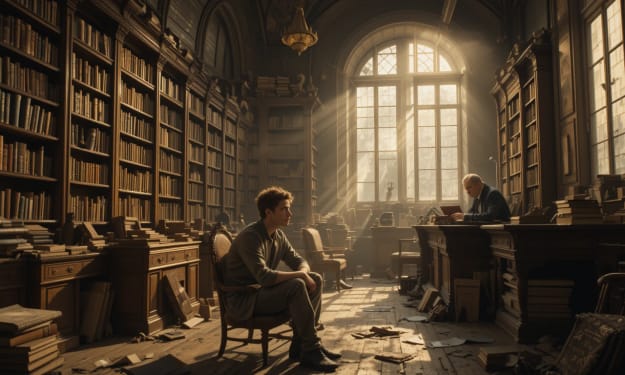
The Librarian's Apprentice Written by Noor Muhammad In a quiet seaside town in Portugal, far from Lisbon’s buzz and the glamour of tourist trails, lived a boy named Luca. He was the son of a fisherman who rarely returned home dry and a mother who worked at a local diner, wiping tables and dreams at the same time.
By Moonlit Lettersabout a year ago in Fiction
Hearts against the Storm
The night was colder than usual, with a restless wind scraping across the empty roads as I rode toward the old farmhouse. I had no backup. No phone. Just the folded copy of the evidence Hamza had given me, tucked in my inner coat pocket. And a flicker of hope that somehow, this meeting — this trap — might be the end of it all.
By Mehmood Niazabout a year ago in Fiction