Classical
Unexpected knock at the Door
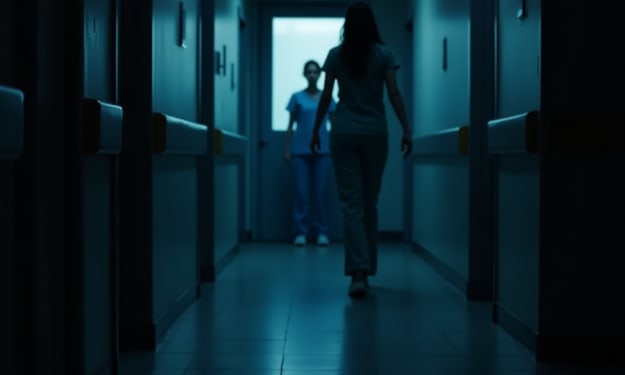
The first knock was so soft Alexander almost dismissed it as the cabin settling, or a pinecone dropping from the eaves. It was 3:07 AM. He was in his armchair, a biography of a forgotten president splayed open on his chest, the fire in the hearth reduced to a bed of pulsating coals. The silence up here on the mountain was absolute, a thick blanket he’d come to both cherish and fear.
By Muhammad Anas about a year ago in Fiction
When One Voice Turns Into a Roar — and a City Listens
It began as a whisper. In the narrow alleyways of Nizamabad, the kind where crooked balconies lean over laundry lines and stray cats dart between shadows, a solitary voice rose before dawn. A young woman—barefoot, ragged vest, eyes blazing—stood atop a faded crate in the market square and screamed:
By Alexander Mindabout a year ago in Fiction
The Last Prayer of Rahim
There’s a small village at the edge of nowhere — the kind of place where time moves slowly, and people remember everything. That’s where Rahim lived. He wasn’t always sick. Once, he was the strongest man in the village — the kind who carried bricks all day and still helped his neighbors fix their roofs before sunset. People used to call him “Bhai Rahim — the man with a heart bigger than his hands.” But life has a strange way of testing the kindest souls. A few years ago, an illness crept into Rahim’s body. At first, it was just pain — something he could hide behind his smile. Then came the swelling, the weakness, the nights of burning fever. Doctors called it incurable. Rahim just called it “Allah’s test.” His house was small — two rooms and a wooden door that always creaked. Every morning, before the sun climbed over the rooftops, he would spread his prayer mat and whisper the same words: >Ya Allah… give me patience, not comfort. Give me strength, not ease.” The neighbors would hear his voice through the thin walls. Some pitied him. Others just shook their heads and said, “He won’t live long.” But Rahim always smiled when he heard that. “I’ve already lived longer than despair,” he’d say softly. -- One cloudy afternoon, a traveler named Saeed arrived in the village. He wasn’t looking for Rahim — he was just passing through, tired and lonely, searching for something he couldn’t name. Someone at the tea stall told him about “the sick man who prays for others.” Curious, Saeed went to find him. When he reached Rahim’s home, the sight stopped him cold. Rahim was sitting on a thin mattress by the door. His body looked fragile, but his eyes — those eyes had light. He wasn’t praying for healing; he was praying for gratitude. Saeed sat quietly beside him. Neither spoke for a while. The sound of their breathing filled the silence between prayers. Finally, Rahim opened his eyes and smiled. “Brother, you look troubled,” he said softly. Saeed’s eyes were wet. “I came to see you, but now I don’t know what to say. I feel helpless.” Rahim chuckled faintly — a dry, gentle sound. “Don’t be. Pain is not always a punishment. Sometimes it’s a reminder… that we still belong to Him.” -Saeed took out a bundle of money, hands trembling. “Please, take this,” he said. “Use it for medicine, for care… for anything.” Rahim looked at it for a moment, then closed Saeed’s hand around it again. “Brother, money can fix a body, but not a heart. And my heart is fine.” Saeed couldn’t hold back his tears anymore. “What can I do then?” he asked. “Pray with me,” Rahim whispered. “That’s all I ever need.” So they sat together — two strangers who suddenly felt like brothers. Their hands lifted, voices low but full of meaning. “Ya Allah, forgive us when we forget to be grateful. Forgive us when we fear pain more than we fear losing faith. And when we suffer, let us remember — You never test without purpose.” The air grew still. Even the birds seemed to listen. Saeed could feel the weight of those words settle deep inside his chest. Rahim’s hands slowly dropped to his lap. His eyes stayed open, but something changed — a softness came over him. He whispered one last time, barely audible: “Tell the world… I wasn’t waiting for death. I was waiting to meet the One who gave me life.” And then, silence. Complete, peaceful silence. The azaan began to echo from the nearby mosque. Saeed sat there, motionless, tears falling one by one. He wasn’t crying out of pity anymore — he was crying because he’d just seen what faith truly looked like. Before leaving, he looked around the little courtyard. There was no wealth, no comfort, no sign of healing. Yet somehow, Rahim had everything Saeed had been searching for — peace. When Saeed walked back to the main road, the evening light touched the village roofs. He whispered to himself: "He healed me, even as he was dying.” And from that day on, wherever Saeed went, he carried Rahim’s prayer in his heart — a prayer that wasn’t just about pain or faith, but about finding light in the darkest corners of life. Moral / Reflection: Some people leave this world without fame or fortune, but they leave behind something far greater — a lesson that faith can turn suffering into strength, and sorrow into peace.
By Vocal Member about a year ago in Fiction
The Last 7 Seconds. Honorable Mention in A Knock at the Door Challenge.
Thump. Thump. Thump. The gentle tapping pulled my attention from my sleeping husband. I straightened my back with a ricocheted crack and groaned. After a quick survey of the room, I continued trying to get Percy out of his chair.
By Theresa M Hochstineabout a year ago in Fiction
When the Stars Forgot to Shine
The night it happened, the world didn’t notice at first. The stars simply… didn’t come. No one could explain it. The moon hung lonely and pale in the dark sky, surrounded by emptiness. Astronomers called it a “temporary celestial blackout.” Poets called it “the night heaven turned its face.” But to Mira, it felt like a reflection of her own fading light.
By Muhammad zahoorabout a year ago in Fiction
A Knock at the Door
The knock, when it came, was so soft that Elara almost mistook it for the wind nudging a branch against the eaves. She paused, her knitting needles freezing mid-stitch. The little cottage was silent, save for the crackle of the fire in the hearth. It was a deep, introspective silence she had cultivated for years, a buffer against the noise of a world that had moved on without her.
By Evanthia Giannouabout a year ago in Fiction
The Weight of Light
The first time Saira noticed the crack in her reflection, she was washing dishes at 2 AM, unable to sleep again. In the kitchen window’s dark mirror, where her temple should have been, there was a diamond-shaped opening — not a wound, but a window. Through it, a solitary streetlamp stood against midnight blue, its amber cone of light falling on empty pavement like a held breath.
By Prompted Beautyabout a year ago in Fiction
When Stars Remembered Their Names
It began with a flicker. Not a satellite or a shooting star, but a deep, resonant pulse from Sirius, the Dog Star. Dr. Aris Thorne, an astronomer who had spent his life listening to the silent sky, saw it on his spectral analyzer. It was a pattern. A signal. It was a word.
By Habibullahabout a year ago in Fiction
My Bones Pick Up the Signal
My Bones Pick Up the Signal By: Abdul Muhammad The silence had teeth. It was a cold, gnawing thing that bit at the edges of Elara’s consciousness the moment she turned out the light. For three years, since the Great Unraveling of her life—a divorce, a funeral, a quiet shattering—sleep had become a foreign country she could no longer visa into. Pills left her groggy and haunted. Meditation was a cruel joke. The only thing that worked was the static. It was an old Roberts analog radio, a relic from a junk shop that smelled of dust and forgotten Sundays. She would tune it to the empty space between stations, where the universe hissed. That white noise was a blanket, a woolly, amorphous sound that smothered the sharp edges of her own thoughts. It was in that blessed, mindless hum that she finally found respite. The change was subtle. One night, the static wasn’t just a hum. It shivered. A spike of pure, undiluted fear—cold and metallic—lanced through the speakers and into her spine. She sat bolt upright, heart hammering against her ribs. The feeling was gone as quickly as it came, leaving only the mundane hiss. She wrote it off as a waking dream. But it happened again. A wave of devastating grief so profound it drew tears she didn't understand. A flutter of secret, illicit joy that made her cheeks flush. The radio was no longer broadcasting noise; it was broadcasting emotion. Raw, unfiltered, and terrifyingly human. Driven by an impulse she couldn’t name, she set up her canvas. She didn’t think; she just let the feelings guide her hand. When a thrum of lonely despair echoed from the speaker, her brush mixed murky greys and deep blues, creating a figure hunched in an endless, rain-slicked street. When a burst of frantic anxiety crackled, her strokes became jagged reds and furious oranges. She painted until dawn, exhausted, and for the first time, looked at what she had made. It was the best work of her life. It was alive. She called the series “Atmospheric Pressure.” The art world went predictably mad. Critics called her a visionary, a synesthete who could translate the zeitgeist into pigment. They didn’t know the truth. They didn’t know about the radio. As her fame grew, so did the clarity of the signal. The emotions began to coalesce, to form patterns. The fear had a specific taste—the coppery tang of blood from a bitten lip. The grief had a smell—old roses and damp earth. And then came the memories. Not hers. A small hand letting go of a balloon. The screech of tires on wet asphalt. A forgotten birthday. She was no longer just painting emotion; she was painting someone else’s life. The static was no longer a blanket but a window, and something was on the other side, pressing its face against the glass. It was during the final preparations for her solo gallery show that the voice truly found its shape. It didn’t use words, not at first. It used imprint. Knock. Knock. Knock. The sound wasn't in the room. It was inside her skull, three sharp, percussive raps that vibrated in her teeth. It was the same rhythm as her heartbeat when the fear-spike hit. “Stop,” she whispered into the dimly lit studio, the radio hissing on the desk. The only answer was a fresh wave of static, and this time, it carried a memory she recognized. Her memory. She was seven, hiding at the top of the stairs, listening to her parents fight. The sound of her mother crying. The specific, hollow thud of her father’s suitcase hitting the floor. Elara stumbled back from the canvas, a cold dread seizing her. This wasn't a random signal from the ether. This was a directed broadcast. And it was tuning itself to her. “How do you know that?” she demanded, her voice trembling. The radio crackled, and a feeling of intimate knowledge, of terrible familiarity, washed over her. It knew her. It had been listening to her sleepless nights, feeding on her quiet desperation. The static wasn’t her solace; it was its feeding ground. Knock. Knock. KNOCK. The sound was more insistent now, a demand for entry. The entity in the static was no longer content to be a muse. It was tired of being a ghost. It wanted a body. Her body. She saw it then, in the swirling grey of the canvas she was working on—not a painting, but a reflection. A face made of shifting static, with two voids for eyes that were fixed on her. Its mouth, a jagged tear of silence in the noise, was moving. Forming a word she felt more than heard. …home… It was coming home. To her. Terror should have made her unplug the radio, smash it to pieces. But a horrific, symbiotic bond had been forged. The static was her cure, her inspiration, her curse. Without it, the silencing teeth of the night would return, and now, they would be sharper than ever, filled with the knowledge of what she had lost. She stood before the radio, a prisoner before her warden. The knocking in her mind became a constant, pounding rhythm, a frantic fist on the door of her consciousness. It was breaking her down, splintering her from the inside. With a shaking hand, she didn’t reach for the power cord. Instead, she turned up the volume. The static roared, a tsunami of sound and sensation. It flooded her, a cold electric current rushing into the empty spaces of her soul. She felt her own memories being pushed aside, her fears becoming its footholds, her joys its weapons. Her last coherent thought was not her own. It was a broadcast, a final signal from a dying station. My bones pick up the signal, she thought, as the static settled into the marrow. My skin is the receiver. My heart is the speaker. Elara—the Elara she had been—closed her eyes. When they opened again, the brown was shot through with flecks of shimmering grey, like static on a screen. She picked up a brush, her movement fluid and alien. She had a new painting to finish. The silence was gone. It had finally found a voice. And it had so much to say.
By Abdul Muhammad about a year ago in Fiction
The Painter of Forgotten Faces. AI-Generated.
The town of Windmere was known for two things — its endless fog and its quiet secrets. On the edge of its cobblestone streets stood a small art studio, its windows always glowing softly at night. Inside lived a painter named Jonas Vale, a man both admired and feared for his peculiar gift.
By shakir hamidabout a year ago in Fiction