Classical
Topaz
Pakhraj had been busy decorating the room for her future distinguished guest, doing everything herself. But when she received news that the Minister of Culture, Mr. Malik Aman Khan, would be her guest the following night, she spared no effort in offering the finest hospitality. Yet, deep down, she wished that this new visitor would eventually leave her room empty and sad.
By Syed Shahkar jalal about a year ago in Fiction
The Café That Waited for Love
The rain had been falling since morning, soft and unhurried, like the city itself had decided to move in slow motion. Inside Café Loraine, the windows fogged from the warmth of espresso and conversation, turning the world outside into a watercolor blur.
By Atif khurshaidabout a year ago in Fiction
The Light Beneath the Leaves
The Light Beneath the Leaves How the Forest Dwellers Built Harmony from Shadows in the Hidden Village of Thaloren Deep within the emerald heart of the Elderwood Forest, where the sunlight danced through layers of ancient leaves and time moved gently like a breeze, lay the hidden village of Thaloren. You wouldn’t find Thaloren on any map, for it wasn’t drawn with lines or walls—it lived among the trees, woven into the roots and branches of the forest itself. Thaloren was home to the Sylari, a gentle people with bark-textured skin, leaf-kissed hair, and eyes that shimmered like dewdrops. They lived in harmony with the forest, crafting homes inside tree hollows, gathering food from glowing fruit-bearing vines, and singing to the stars each evening from treetop platforms. Long ago, however, Thaloren had not always been peaceful. There had been a time when the forest dimmed, when the ancient canopy grew too thick and blocked out the sun. Plants stopped growing, animals grew restless, and the Sylari began to fear the shadows. They blamed each other for the darkness, building small fires to keep it away, which only scared the forest more. But in the midst of this fear, a young Sylari named Liora believed differently. She had always felt the forest breathe with her—each root a heartbeat, each leaf a whisper. "The darkness is not punishment," she told her people. "It is an invitation to listen. To learn what the forest needs." The elders laughed. “You’re too young to understand,” they said. “Fire is safety. Fire is control.” But Liora didn’t give up. Guided by dreams and quiet intuition, she wandered deep into the untouched parts of the forest, further than anyone dared. There, she found something unexpected—not monsters or danger, but light. Gentle pulses of golden glow rising from beneath the roots, where the forest stored its oldest memories. Liora knelt by the glowing soil and whispered, “What are you?” The forest answered not in words, but in warmth. In understanding. The light was life—pure, ancient, and shared. It had been buried, waiting to be remembered. When she returned to Thaloren, her hands glowed with the soil’s light. The villagers stared in awe. "This is the light beneath the leaves," she told them. “It’s not from fire. It’s from listening. From trusting.” With careful guidance, Liora taught them how to tend to the forest in a new way—by restoring the balance. They trimmed the canopy, allowing sunlight to filter through again. They sang to the roots, planted bioluminescent seeds, and slowly, the village began to change. The fires were no longer needed. The fear faded. Homes glowed softly at night from the natural light of moss-lanterns and crystal fruit. Children played in the trees without worry. Elders sat beneath moonflowers and told stories not of fear, but of hope. And Liora became the first “Lightkeeper” of Thaloren, honored not for control, but for care. Years passed, and Thaloren flourished. The forest thrived, not just above ground, but below, where light and life wove together like threads in an ancient tapestry. The Sylari no longer tried to tame the forest—they walked beside it. Every year, on the longest night, the village gathered around the Heartroot Tree—the oldest in the forest—and planted one glowing seed in the soil. It was their tradition, a symbol of trust, and a promise to the forest that had once been forgotten. As Liora grew older, she often sat by the Heartroot, her hands resting on the earth. When asked how she had known what to do, she would smile and say, "Sometimes the light you need isn't above you. It's beneath you—quiet, patient, waiting to be seen." And so Thaloren remained, hidden from the world, not because it needed to be secret, but because some places grow best when they grow together, gently, beneath the leaves.
By Muhammad Saad about a year ago in Fiction
The Tale of the Silent Bloom
In the heart of the great Whispering Woods, there lived a fairy named Lyra. Now, the Whispering Woods got its name for a reason: it was a beautiful symphony of sound. Every leaf had a gentle shhh, every sprite had a melodic giggle, and the wind sang a soft, constant hum through the ancient trees.
By fairy girlabout a year ago in Fiction
How Much Does it Cost to Wrap a Motorcycle? Full 2025 Guide
So, you're thinking about giving your bike a fresh, head-turning new look? A vinyl wrap is one of the coolest ways to do it. But before you dive in, the first question that pops up is: how much does it cost to wrap a motorcycle ?
By alinasir nasirabout a year ago in Fiction
The Last Rain in Bulawayo. AI-Generated.
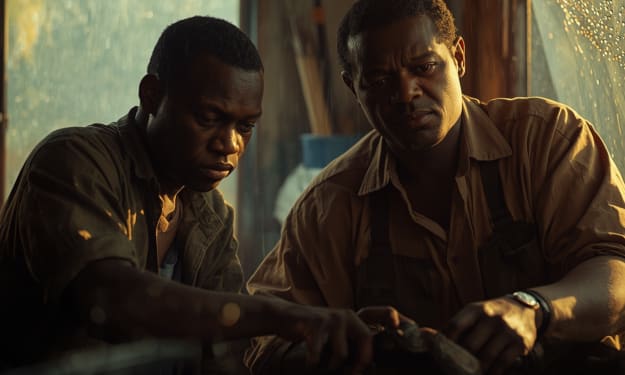
Bulawayo, 1998 — a city of sunburned streets and restless winds, where the scent of dust and diesel hung heavy in the air. In the township of Mzilikazi, two brothers grew up chasing the same dream but running from different ghosts.
By shakir hamidabout a year ago in Fiction
The Lantern Beyond the Dust
The old village slept beneath a veil of dust and silence. Houses made of clay stood shoulder to shoulder, breathing out the weight of years. The scent of earth and forgotten dreams floated in the still air. Every evening, as the sun sank behind the hills and shadows stretched across the narrow road, a single lantern came alive — hanging by the door of a small, crumbling house. That light belonged to Rahim, an old shoemaker who had long ago stopped fixing shoes and started fixing hearts. The villagers called him “Lantern Baba.” To the children, he was a mystery — a man who never let his lantern die, no matter how harsh the wind or how heavy the rain. Some said he was waiting for someone. Others believed he was just afraid of the dark. But Rahim knew why. That small flame was the last piece of promise he had left. One cold night, a stranger walked into the village. He was young but carried the posture of someone who had wrestled with life for far too long. Dust clung to his boots and sadness to his eyes. His name was Riaz Hamkar — a traveler who had not only lost his way but also the reason to keep walking. He had left the city behind, chasing silence. His dreams had been torn apart by disappointment, his ambitions drowned in the noise of survival. He had once believed he could light his own path — but life, with its cruel humor, had blown out every candle. When he saw the glow of Rahim’s lantern from a distance, something stirred inside him. It wasn’t hope, not yet — just curiosity. Why would someone keep a light burning in such emptiness? He knocked on the door. The old man opened it slowly, his face half-lit, half-shadowed. “Looking for a place to rest, son?” Rahim asked. Riaz nodded. Inside, the small room smelled of oil, leather, and quiet patience. Broken shoes were piled in one corner. On the wall, a faded photograph showed a young boy standing beside a proud father holding the same lantern that now burned on the table. “Your son?” Riaz asked softly. Rahim’s wrinkled lips curved into a painful smile. “Yes. He left for the city years ago. Said he wanted to become someone important. I told him I’d keep the light on, just in case he ever lost his way home.” The two men sat in silence. The wind whispered through the cracks in the walls, like the voice of memory itself. Rahim polished the lantern’s glass again and again, even though it was already clean. “Why do you keep it burning every night?” Riaz finally asked. Rahim looked up, his eyes glimmering like the flame itself. “Because sometimes, people need to see that even a small light can survive the storm.” Riaz didn’t reply. But that night, he couldn’t take his eyes off the lantern. The flame trembled, danced, and steadied again — like a heartbeat refusing to stop. When sleep finally came, Riaz dreamed of his father — of promises unkept and paths untaken. He dreamed of his younger self, still brave enough to believe in small lights. At dawn, when the first rays of sunlight slipped through the cracks, Rahim was gone. Only the lantern remained — burning, warm, alive. Riaz stood for a long time, staring at it. He thought of all the people who lose their light and never find it again. Then, without saying a word, he picked up the lantern, held it to his chest, and stepped out into the morning air. He walked for hours, following no road in particular, only the rhythm of his heartbeat and the whisper of the flame beside him. When he reached the next village, people saw a young man walking through the mist, carrying a glowing lantern. No one knew his story, but everyone felt something inside them — a quiet pull, a reason to look beyond their own darkness. That night, for the first time in years, laughter returned to one of the village homes. A mother hummed a lullaby to her child, and the old baker decided to reopen his shop early the next morning. All because a stranger had passed by with a light that refused to die. Years passed. The story of Lantern Baba spread like the wind — changing from whispers to legend. Some said the old man still lived inside that light, guiding those who had lost their way. Others said the traveler, Riaz Hamkar, had become the new keeper of the flame, carrying it from village to village. No one really knew the truth. But one evening, in another dusty town far away, as darkness fell and the wind howled, a soft light appeared again at the edge of the road. A small child tugged at his mother’s sleeve and pointed. “Look, Mama,” he whispered. “The Lantern Baba is here.” And somewhere, beyond the dust, the light flickered — steady and alive — just like the human heart.
By Riaz Hamkarabout a year ago in Fiction
The Apparition of Recognition. AI-Generated.
The gilded cage of her existence, though adorned with smiles and nods, had long been transmuted into a prison. Each year refined the artifice, polished the sepulchre, until no trace of her true self was permitted to emerge. The wound—that wound inflicted by that man—bled unseen, festering in silence, its venom consuming marrow, thought, and spirit alike.
By Carolyn Pattonabout a year ago in Fiction
Fate. Top Story - October 2025.
Despite seeing nearly five hundred years on its dusty dais, the meticulously crafted copy of Allgerion’s Catechism—the prophecy within foretelling that the first and only child of the seventh son of Avangarde and the third daughter of Mah’reel would usher forth the salvation of their world—was in a remarkable state of preservation.
By Matthew J. Frommabout a year ago in Fiction