Adventure
The immune War. AI-Generated.
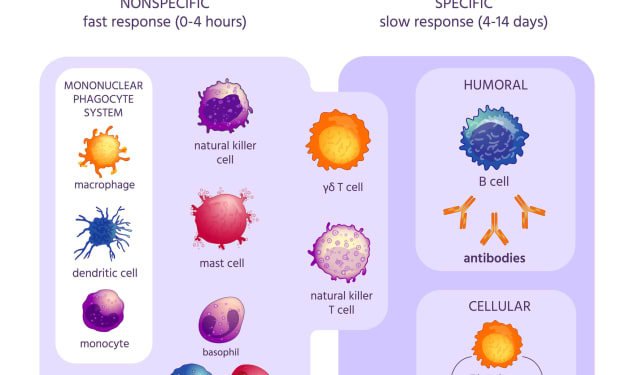
Every second of my existence, an unseen battle rages. Billions of microscopic invaders—bacteria, viruses, and fungi—constantly try to claim my body as their own. But I am not defenseless. My body has built an extraordinary army, a legion of cells and proteins with specialized roles: warriors, scouts, messengers, and engineers, all working in harmony to protect me from annihilation. Imagine this army has 12 critical missions, from slaughtering foes to sending urgent dispatches. It commands 21 unique cell types and 2 elite protein forces, each capable of performing up to 4 different duties. Together, they form a living, breathing defense network—constantly communicating, adapting, and fighting. And now... the enemy has breached the gates. It was a peaceful day—until fate intervened. A rusty nail, hidden in the grass, sliced into my skin. The first fortress of my immune empire had fallen. Opportunistic bacteria, lurking nearby, seized their chance. They slipped through the wound, multiplying rapidly, doubling their numbers every 20 minutes. At first, they moved in silence, avoiding detection. But as their ranks swelled, they grew bold, twisting the environment to suit their needs. If left unchecked, they would ravage the land. The call to arms had begun. Standing watch at every border were the Macrophages—giant sentinels, ever-vigilant. These mighty cells alone could crush most invasions, swallowing up to 100 enemies whole. They trapped their prey in membraned prisons, dissolving them with deadly enzymes. But they did more than kill. They sounded the alarm, summoning floods of water into the battlefield to aid the fight. You might notice this as a faint swelling—a sign that the war had begun. When the battle dragged on too long, the macrophages sent out smoke signals—messenger proteins that screamed for reinforcements. Answering the call came the Neutrophils—fierce, reckless warriors. They abandoned their patrols in the blood and stormed the battlefield, killing without discrimination. They wove deadly traps of toxic nets, ensnaring foes in webs of death. But their fury came at a cost. They slaughtered friend and foe alike. Knowing their own danger, they were programmed to "self-destruct" after five days—lest they turn the body into a wasteland. And yet… the enemy still advanced. Deep in the chaos, a single Dendritic Cell stirred. It was the "strategist", the mind of the immune system. It gathered fragments of the fallen invaders and displayed them like trophies upon its surface. Now came the critical choice: "Summon the virus hunters or the bacteria slayers?" The decision was made. The dendritic cell embarked on a perilous journey, racing toward the nearest lymph node—a fortress teeming with billions of T cells, each awaiting it's destiny. The T cells had endured a brutal training—only one in four survived. Those that did emerged with 'unique weapons', each designed for a specific foe. The dendritic cell scoured the ranks, searching for the one T cell whose weapon matched the enemy’s fragments. And then—contact. The chosen "Helper T Cell" ignited, multiplying into an army. Some became Memory T Cells, guardians of future immunity. Others charged into battle. And a select few stormed deeper into the lymph node, seeking the ultimate weapon-smiths… Their target? The "B Cells". When a B Cell met its matching T Cell, 'all hell broke loose' . The B Cell exploded into countless clones, morphing into plasma cells—factories pumping out millions of antibodies per second. But such relentless labor came at a price. The plasma cells burned themselves out, dying in days. Yet the Helper T Cells would not let them fall. "Hold the line!" they commanded, sustaining the factories until victory was assured. Back at the wound, the battle raged. The invaders had grown stronger, poisoning the land. Macrophages and neutrophils fought valiantly, but they were outnumbered. Then—reinforcements arrived. 'Billions of antibodies' flooded the battlefield, 'disabling, stunning, and marking the enemy' for slaughter. The antibodies linked up with killer cells, turning the tide. Now, the macrophages feasted—gorging on bacteria tagged for death. The enemy was crushed. Millions of fallen cells were replaced. Most warriors, on having their duty done, chose death to preserve resources. But not all. A few elite Memory Cells lingered, watching. If this foe ever dared return, they would be ready. This was but a glimpse of the immune system’s grandeur—a tale stripped of its full complexity, yet still awe-inspiring. Life is chaos. War. Beauty. And within you, every second, an empire fights to keep you alive. Never forget its might!
By FAVOURFRANCIS OFILI2 years ago in Fiction
The Thorned Rose of Anwyn
Prologue: The Blood Feud The forests of Cernyw had long been stained by the feud between the druids of the Blackthorn Circle and the Iron Wolf Clan. Generations of spilled blood hardened hearts, but not all. Eira, heir to the druids’ ancient magic, and Faelan, the Iron Wolf’s fiercest warlord, met in secret beneath the hawthorn grove—a place where the veil to the Otherworld thinned, and whispers of the Thorned Bride lingered.
By Dinesh Maurya2 years ago in Fiction
The Lost Mystery of the Milky Way
Chapter 1: The Unknown Signal Dr. Alian Novo, a renowned astronomer, is dedicated to unraveling the deepest mysteries of the universe. He detects a strange signal originating from the center of the Milky Way galaxy, unlike any ordinary radio signal. The signal follows a unique mathematical pattern, suggesting it was artificially created. Chapter 2: The Beginning of the Search To trace the source of this mysterious signal, an advanced spacecraft, Solar X, is prepared. This spacecraft utilizes a cutting-edge technology that distorts time and gravity, enabling rapid travel. Dr. Alian and his research team embark on a journey towards the central black hole of the Milky Way galaxy. Chapter 3: Discovery of an Unknown Civilization As they approach the black hole, they find it surrounded by a mysterious artificial station. This station was built by an unknown civilization that disappeared millions of years ago. However, astonishingly, their technology remains active. Chapter 4: The Lost Knowledge Upon entering the station, the research team discovers a supercomputer storing an immense amount of data. Analyzing this data, they learn that this civilization possessed knowledge about the structure of the universe and the nature of time—secrets still unknown to humanity. Chapter 5: The Ultimate Truth Dr. Alian discovers that this civilization had developed an energy source capable of instant travel to any part of the universe. However, the misuse of this energy led to their destruction. Chapter 6: The Future Horizon Upon returning to Earth, the research team brings back groundbreaking technological knowledge. However, recognizing its potential dangers, they choose a cautious approach, opting for gradual research rather than immediate implementation. This mission signifies the dawn of a new era, laying the foundation for humanity’s future journey into the vastness of the universe.
By Digital Home Library by Masud Rana2 years ago in Fiction
Giuseppe Verdi and Giuseppina Strepponi. AI-Generated.
In the picturesque town of Busseto, Italy, a chance encounter between Giuseppe Verdi, the renowned composer and Giuseppina Strepponi, a talented soprano, would spark a relationship that would last a lifetime. Their bond, marked by love, loss and artistic partnership, would inspire some of Verdi's most iconic works and leave an indelible mark on the world of opera. It was the year 1839 and Verdi, then 26 years old, had just arrived in Milan, seeking to establish himself as a composer. Strepponi, 29 years old, was already an established soprano, known for her powerful voice and captivating stage presence. Their meeting was nothing short of fate, with Verdi being immediately drawn to Strepponi's talent and beauty. Their relationship was intense and passionate, with Verdi and Strepponi sharing a deep love of music and art. They would often spend hours discussing literature, philosophy and music and Verdi would frequently attend Strepponi's performances, marveling at her talent. But their relationship was not without its challenges. Strepponi had a reputation for being difficult and demanding and Verdi's own temper and perfectionism often led to clashes between the two. Additionally, Strepponi's past was marked by scandal and heartbreak, having been abandoned by her previous lover and left to raise their child alone. Despite these challenges, Verdi and Strepponi's love for each other only grew stronger. They eventually married in 1859, and Strepponi became Verdi's closest confidante and artistic partner. She would often provide feedback on his compositions and even helped him to secure performances and commissions. Together, Verdi and Strepponi created some of the most iconic operas of all time, including "La Traviata," "Aida" and "Otello." Strepponi's influence on Verdi's music was undeniable and her own talent and dedication helped to inspire some of Verdi's most memorable heroines. Today, the story of Giuseppe Verdi and Giuseppina Strepponi serves as a testament to the power of love and art to transcend even the most challenging of circumstances. Their relationship, marked by passion, creativity and devotion, continues to inspire audiences around the world and their legacy remains an integral part of the world of opera. The Later Years: A Legacy of Love and Music As the years passed, Verdi and Strepponi's love for each other only grew stronger. They continued to work together, creating some of the most iconic operas of all time. Strepponi's influence on Verdi's music remained undeniable and her own talent and dedication helped to inspire some of Verdi's most memorable heroines. Despite their personal and professional successes, the couple faced numerous challenges in their later years. Verdi's health began to decline and he suffered from a series of strokes that left him increasingly disabled. Strepponi, devoted as ever, cared for him tirelessly, nursing him back to health and supporting him through the darkest of times. Together, they continued to work on Verdi's final operas, including "Falstaff" and "Otello." Strepponi's influence on these works was as significant as ever, and her own talent and dedication helped to bring Verdi's vision to life. Verdi passed away on January 27, 1901, surrounded by Strepponi and their loved ones. Strepponi was devastated by his loss, but she continued to promote Verdi's music and legacy, working tirelessly to ensure that his operas remained a vital part of the classical music repertoire. Strepponi passed away on November 14, 1897, four years before Verdi's death. She was buried in the Cimitero Monumentale in Milan and Verdi was laid to rest beside her after his passing. Today, the legacy of Giuseppe Verdi and Giuseppina Strepponi continues to inspire audiences around the world. Their love story, marked by passion, creativity and devotion, remains an integral part of the world of opera and their music continues to touch the hearts of all who listen. References: [1] "Verdi: A Biography" by Mary Jane Phillips-Matz [2] "Giuseppina Strepponi: A Life of Music and Passion" by Gabriella Carrara
By Henry Lucy2 years ago in Fiction
Franz Liszt and Countess Marie d'Agoult. AI-Generated.
In the salons of 19th-century Paris, a chance encounter between Franz Liszt, the renowned Hungarian composer and Countess Marie d'Agoult, a beautiful and intelligent French aristocrat, would spark a relationship that would be marked by passion, jealousy and artistic inspiration. Their tumultuous love affair would leave an indelible mark on Liszt's music and legacy, and remain one of the most fascinating stories in the history of classical music. It was the year 1833, and Liszt, then 22 years old, had just arrived in Paris, seeking to establish himself as a composer and pianist. Countess d'Agoult, 27 years old, was a member of the French nobility, known for her beauty, intelligence, and strong will. Their meeting was nothing short of fate, with Liszt being immediately drawn to the Countess's charms. Their relationship was intense and passionate, with Liszt and the Countess sharing a deep love of music, literature and art. They would often spend hours discussing the latest works of Victor Hugo, Honoré de Balzac and other prominent writers of the time. The Countess, who was also a talented writer, would often provide Liszt with inspiration and feedback on his compositions. But their relationship was not without its challenges. Liszt's jealousy and possessiveness would often lead to fierce arguments and reconciliations. The Countess, who was also known for her strong temper, would often retaliate against Liszt's accusations, leading to a cycle of tension and drama. Despite these challenges, Liszt and the Countess's love for each other only grew stronger. They had three children together, including Cosima, who would later marry Richard Wagner. The Countess would often accompany Liszt on his concert tours, providing him with emotional support and inspiration. The Countess's influence on Liszt's music was undeniable. She would often provide him with ideas and inspiration for his compositions, and her own literary talents would influence the librettos of his operas. Liszt's music, in turn, would provide the Countess with a source of comfort and inspiration, helping her to cope with the challenges of their tumultuous relationship. Today, the story of Franz Liszt and Countess Marie d'Agoult serves as a testament to the power of love and art to transcend even the most challenging of circumstances. Their relationship, marked by passion, jealousy and artistic inspiration, continues to fascinate audiences around the world and remains an integral part of the history of classical music. The Legacy of Liszt and the Countess Despite the challenges they faced, Liszt and the Countess's relationship had a profound impact on the world of classical music. Liszt's music, inspired by the Countess's beauty and intellect, continues to be celebrated for its passion, innovation, and technical brilliance. The Countess, too, left her mark on the world of music. Her literary talents and her influence on Liszt's compositions helped to shape the course of classical music history. Her legacy extends beyond her relationship with Liszt, and she remains an important figure in the history of French literature and music. In the years following their separation, Liszt continued to compose some of his most iconic works, including the "Piano Sonata in B minor" and the "Mephisto Waltz." The Countess, meanwhile, dedicated herself to raising their children and pursuing her literary career. Despite their tumultuous past, Liszt and the Countess remained in contact until the end of their lives. The Countess passed away on March 5, 1876, and Liszt followed her on July 31, 1886. They are buried together in the Bayreuth Stadtfriedhof, a testament to the enduring power of their love and their legacy. Today, the story of Franz Liszt and Countess Marie d'Agoult continues to inspire audiences around the world. Their passionate and tumultuous relationship serves as a reminder of the power of love and art to transcend even the most challenging of circumstances.
By Henry Lucy2 years ago in Fiction
The Ghost Train
Chapter 4: Midnight at Thornwood The night air hung heavy with anticipation, a thick blanket of silence draped over Thornwood Station. Sarah checked her watch for the hundredth time, her fingers tracing the worn leather of her notebook. Hayes's stern warning echoed in her mind: "Some stories are better left untold." Reeves had been equally adamant, his weathered face etched with a mix of concern and something else—was it fear?
By Shane D. Spear2 years ago in Fiction
The Dark Order 1.14: The Monarch Of Plant Magic!
The young hunter comes to. Startled by the gaze of an abnormally sized boa constrictor made from braided vines. It has wrapped around him, barring all movements. His eyes cut around the room. There’s a wooden table to his left, and inside a green mana barrier, is a colony of Mantis Hornets— Their thorax is covered in jagged, razor-thin barbs. Their wings soft as a pillow, allow them to fly silently. Their stingers are powerful enough to puncture deep muscle. Their deadliest quality is their bite, serrated flaps used to rip and shred their prey. They eat bone too.
By Donnie Barlow2 years ago in Fiction