Adventure
One Hundred Years of Solitude
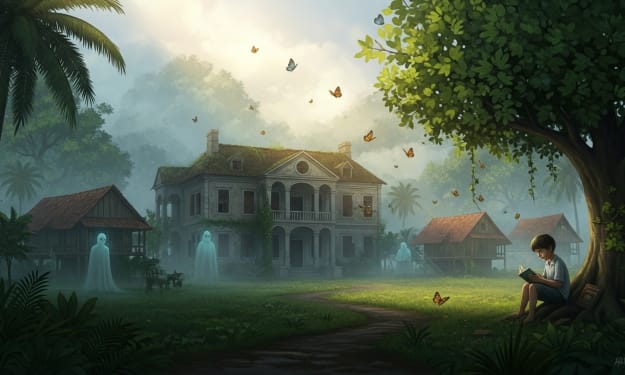
The Buendía house stood at the edge of the village of Santa Nieve, where the jungle whispered and time curled in on itself like old parchment. It had been there for a hundred years, though no one remembered building it, and no one dared to tear it down. The walls wept in the rainy season, the windows blinked with the wind, and strange lights flickered from the attic even when the house was empty. Except it was never really empty. The villagers swore they saw the same faces looking out from the upper window—faces of the dead. But it was not the dead that haunted the Buendía house. It was memory. --- Every generation of Buendías was born with two things: a peculiar birthmark shaped like an almond and an incurable yearning to escape the fate of their forebears. Yet they always came back—drawn by dreams, omens, or guilt—to the house that never aged, even as they did. Mateo Buendía was the last. At twelve, he wandered into the library on the second floor and found a dusty journal with a cracked leather cover. His fingers tingled when he touched it, as if the book had been waiting for him. Inside were entries dating back a century, written by hands that trembled with love, sorrow, and madness. The first entry: “Time is not a line. It is a circle made of forgetting.” Mateo read late into the night, the past whispering secrets through ink. --- He learned of Esperanza Buendía, who could see spirits but married a man who believed only in science. She danced with ghosts in the hallway and wept when her husband burned all her journals in a fire fueled by logic. Of Rafael, who tried to sail upriver to find the city of mirrors but returned years later with white hair, empty eyes, and a bottle that contained only silence. Of Alma, who once fell in love with a man in her dreams and searched the waking world in vain, never realizing he had been born decades after her death. And of Aureliano, the original—the first to write the journal, the first to speak of solitude not as loneliness, but as inheritance. --- “Why do they all return?” Mateo asked the old gardener one morning. The gardener, who had worked there longer than anyone alive could remember, said, “Because the house remembers what they forget.” That night, Mateo dreamed of Esperanza standing by the fig tree, beckoning him. Her voice echoed: "The curse is not solitude. It is silence. You must finish the story." --- Mateo wrote every night after that, filling page after page in a second journal. Not just with the tales of the Buendías, but with his own. Of feeling invisible at school. Of the boy who smiled at him once and never again. Of the silence that grew between him and his mother, who spoke to birds more than she did to him. The more he wrote, the more the house changed. The cracks in the walls healed. The air grew lighter. The attic door, sealed for generations, creaked open. Inside, Mateo found a mirror. But when he looked into it, he saw not himself—but every Buendía before him. They blinked, breathed, wept. And then, they smiled. --- Years passed. Mateo never left the house. People said he had gone mad like the others, obsessed with the past. But sometimes children saw him in the garden, speaking to butterflies or writing in the dust with his fingers. And at night, light still flickered in the attic. One stormy evening, lightning struck the fig tree. When the villagers came to check the ruins, the house was gone. All that remained were two journals under the roots—one old, one new—and a single almond-shaped birthmark burned into the earth. --- In time, the Buendía name became legend. A whisper. A tale told to children about the house that remembered and the boy who listened. No one dared rebuild on the land. For even in absence, solitude lived there still—eternal, magical, and waiting to be written again.
By Shah Nawazabout a year ago in Fiction
1984
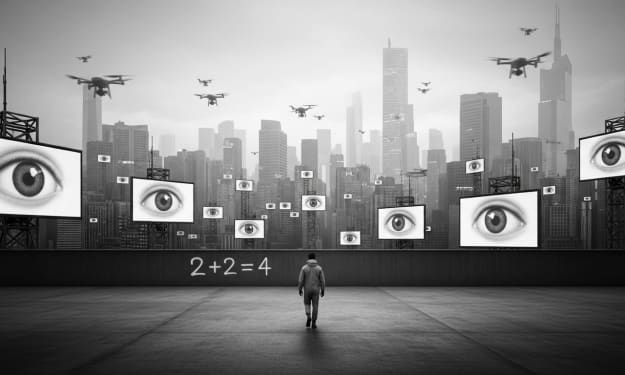
In Sector 7 of the Unified Republic, Winston Hale blinked away the sting of fluorescent light as the surveillance drone buzzed past his workstation. He kept his hands moving—filing data, erasing old entries, rewriting history. Truth was fluid here. And Winston, like everyone else, was expected to drown in it. It was the year 2084, but they still called it 1984, in tribute to the “Founding Vision.” The Party had long since digitized Orwell’s prophecy, weaponizing fiction into a blueprint. Every citizen wore their compliance like a second skin, and every screen whispered the same mantra: “Freedom is Obedience. Obedience is Peace.” Winston didn’t believe it. Not anymore. --- He first saw her in the corridor outside Archive Room Delta. Dark curls. Grey jumpsuit. Eyes too awake. Julia. Their first conversation was risky—a whispered joke about the food. The second was dangerous—a shared memory of the stars beyond the city domes. By the third, they were in love. And in rebellion. --- They met in abandoned metro tunnels, long forgotten by the city above. Julia brought old books salvaged from black market trades. Winston brought questions. "Why do they erase everything?" he asked once, flipping through a banned copy of History of the World Before Unity. "Because control," Julia whispered, “requires amnesia.” “They’ve made lies feel like truth,” Winston muttered. “No,” she said. “They’ve made truth illegal.” --- Hope, however, is combustible. And surveillance never sleeps. The morning the Thought Police came, Winston was already waiting. He didn’t resist as they dragged him from his apartment. He only asked one question: “Is she safe?” They didn’t answer. --- Room 101 was colder than he imagined. Not in temperature—but in silence. A single chair. A single screen. And behind the screen: Authority. Not a man. A voice. A system. “Winston Hale,” the voice echoed, “you are guilty of independent thought, emotional deviation, and unsanctioned intimacy.” “I know,” he said quietly. “Why?” He didn’t speak. “Why, Winston?” At last, he whispered, “Because I remembered who I was before I feared you.” --- Reeducation began with isolation. Then deprivation. Then immersion. For weeks, they fed him Party broadcasts until his dreams bled into propaganda. They made him watch videos of Julia’s arrest—real or fake, he couldn’t tell. In his final session, they presented him with a choice. A lever. A screen. One would spare Julia. The other, himself. “Choose,” the voice commanded. His hand trembled. Tears welled in his eyes. And then— He stepped back. “I will not.” Alarms blared. But Winston smiled. --- They released him. Broken, perhaps. Or maybe they thought he was. He returned to his job. Typed the lies. Filed the past. Wore the mask. But behind his eyes—still, a spark. Because rebellion isn’t always loud. Sometimes, it’s a memory. Sometimes, it’s the refusal to forget. --- Years later, children would find a scratched phrase hidden behind an old databank wall: “2 + 2 = 4” And though they didn’t understand it, they whispered it anyway. Like prayer. Like prophecy. Like truth.
By Shah Nawazabout a year ago in Fiction
The Odyssey
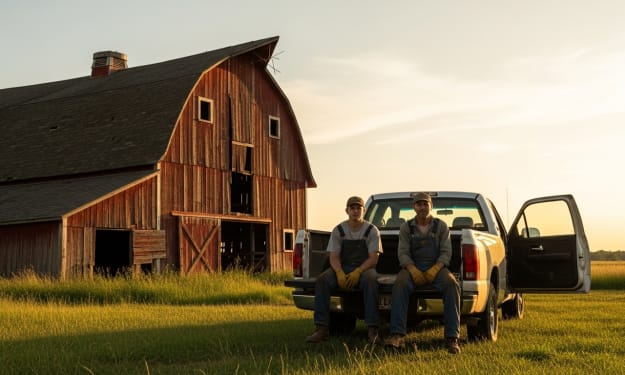
Rain blurred the windshield as the old pickup truck crawled along the cracked highway. Elijah North gripped the steering wheel like it was the only thing keeping him tethered to the Earth. A duffel bag sat in the passenger seat—his only luggage after five years away. Home. He hadn’t said that word out loud in years. Not since the argument. Not since the slamming door. Not since his father's voice, rough and angry, echoed behind him—If you walk out that door, don't come back. He did. And now, he was. The town sign for Maple Hollow passed by, half-covered in rust and moss. Pop. 2,108. It hadn’t changed much, he thought. But he had. A beard where a boy’s stubble once was. Hands calloused from oil rigs and rail yards. Eyes that had seen too much. His stomach twisted as the house came into view—white paint peeling, the swing on the porch swaying gently in the wind, like it was still waiting for someone to come sit. He parked by the mailbox. The same dent on the side from when he’d crashed his bike at twelve. No one was outside, but the lights were on. He stood at the edge of the gravel path for a long time, heart pounding, staring at the front door. Five years was a long time for silence. He climbed the steps. Knocked. Footsteps on the other side. A pause. The door creaked open. His mother stood there. “Elijah,” she whispered. “Hey, Ma.” Her eyes filled with tears before she pulled him into a hug. She didn’t ask questions, didn’t lecture, didn’t cry out. She just held him. And in that embrace, he wasn’t a runaway. He wasn’t a disappointment. He was her son. “He’s in the barn,” she said softly when they finally pulled apart. Of course he was. His father’s refuge. Elijah didn’t hesitate. He crossed the muddy yard and pushed open the barn doors. The smell of hay, old tools, and memories flooded him. His father was there, wrench in hand, fixing the engine of an old red tractor. He looked up. Their eyes locked. The silence cracked with tension. “I heard you were back,” his father said at last. “I am,” Elijah replied. Another pause. “You fixing the old Massey?” “She still runs. Needs coaxing.” Elijah walked forward, hands in his jacket pockets. “You kept her running all these years?” His father gave a grunt, somewhere between agreement and dismissal. “Someone had to.” Another silence. Elijah looked down. “I… I didn’t come back to fight.” “No?” his father said, a challenge in his voice. “I came back because I couldn’t carry the weight anymore. I thought leaving would make me a man. But it just made me lost.” His father’s jaw tightened. “You left without looking back.” “I know. And I was wrong.” He stepped closer. “I’m not the same kid who ran off. I thought I had to prove something. That I could survive without you. But all I learned was how much I needed to come home.” The wrench dropped to the floor with a clank. “I was hard on you,” his father said. “Too hard. My father raised me that way, and I thought it was right. But when you left… I realized I’d pushed too far.” Elijah’s throat tightened. “I just wanted you to be proud of me.” “I always was,” his father said quietly. “I just didn’t know how to say it.” The silence this time wasn’t heavy. It was healing. “I can help with the tractor,” Elijah offered. His father nodded. “Go grab a wrench.” For the next hour, they worked side by side—two men who had once been strangers, now finding their rhythm again in the language of machines, grease, and quiet understanding. Later, they sat on the tailgate, watching the sky shift to twilight. A few stars blinked awake. “Ma’s making pot roast,” his father said. Elijah smiled. “She always said pot roast fixes everything.” “Maybe it does,” his father replied, then added, “You staying a while?” Elijah looked up at the stars. “Yeah. I think I am.”
By Shah Nawazabout a year ago in Fiction
The Unranked Heir
Chapter 1: The Weight of Inheritance Power isn't inherited—it's imposed. I learned this the moment I drew my first breath, when the world seemed to hold its breath with me. My uncle, a man who had lived in penthouses for two decades and witnessed every excess wealth could buy, called my birth "the grandest celebration he'd ever seen." Coming from someone who'd attended the coronation of oil princes, that meant something.
By Emmanuel Ikerionwuabout a year ago in Fiction
The Diamond Treasure in the Depth of the Sea
Long ago, beneath the surface of the Southern Sea, there existed a hidden underwater kingdom known as Sirena. Protected by glowing coral walls and ancient sea magic, Sirena thrived in silence, unknown to the surface world. At the heart of its power was a legendary jewel called The Heart of the Abyss—a massive diamond that pulsed with light, magic, and life.
By Engr. Mansoor Ahmadabout a year ago in Fiction
Echoes in the Glass Room
I can’t tell anymore if the pain started yesterday… or years ago. It’s not sharp. It’s not loud. It’s just there—a dull weight pressing down on everything I think, everything I try to feel. I want to wake up from this heaviness. I want to feel air that doesn’t taste like regret. It’s silent around me, but not peaceful. The silence here is tight, like the air is listening. And when I move, I feel like I’m being followed. Not by footsteps—but by thoughts that don’t belong to me. Paranoia with a voice that sounds too much like mine. I want to hide. I want to be alone. But I am. Completely. Still… I feel watched. Not by others. But by the part of me that never sleeps. The inner voice with no mercy. The one that remembers every wrong move I made. My skin feels too tight. My heart beats in uneven bursts. I close my eyes. And I fall—not into sleep, but into somewhere else. . . . I open my eyes in a glass room. A place with no edges. Just reflections—endless copies of myself staring back. Some with tears, some with rage, some with blank, empty stares. The floor cracks beneath me with every step, but never fully breaks. Above me? Ropes made of light. Thin, glowing threads suspended from nothing. Some flicker. Some blaze. I reach for one. The moment I touch it, the room shifts. The mirrors warp into shifting walls, forming a tunnel. I move through it, led only by instinct, by desperation. As I walk, the walls shimmer with images. Memories. Mistakes I thought I buried. Choices I pretend I didn’t make. “Was this the path I needed? Or just another trap?” I don’t know. But stopping feels worse than moving. Then, the floor opens beneath me again. I drop fast—heart pounding, arms flailing— And land softly in a new place. It’s a garden. But not beautiful. The plants are made of glass. The trees hum like machines. The wind feels programmed, artificial. Too perfect. Too still. It feels… wrong. Still, I sit. For a moment, the pain lessens. The colors soothe me. I pretend it’s real. But deep down, I know this peace is a trick. Soon, the sky glitches—pixels breaking apart, fading in and out. The plants start to wither, not naturally, but like someone pressed a delete key. I look around. A giant door stands in the distance. I run toward it, my lungs burning. As I reach it, the handle vanishes. Instead, a ladder drops from the sky—leading back into the unknown. I don’t want to go. I want to rest. I want this to be the end. But the pain is creeping in again. The garden can’t hide it anymore. I climb. The ladder twists and coils, turning into a bridge. Then stairs. Then a hallway. At the end—a mirror again. Only this time, the reflection looks different. Tired, yes. Hurt, yes. But still standing. The room fades. I’m back. In the world I tried to escape. But I brought something with me this time. Not answers. But the proof that I can keep going. Even when it hurts. Even when I’m scared. Even when the maze resets.
By Hazrat Usman Usmanabout a year ago in Fiction
The Bench Under the Old Tree
Fifteen years. That’s how long it had been since Arman last stood at the edge of that rusted gate, staring into the park where his childhood used to live. The wind still whispered through the branches of the massive old tree in the center, just as it did on that unforgettable evening—the one where everything changed.
By Soul Pagesabout a year ago in Fiction