Adventure
Love in the Shadows of Cappadocia
Love in the Shadows of Cappadocia Written by Noor Khan It was supposed to be just another solo trip for Amara—a quiet escape to heal after the slow, painful collapse of her three-year relationship. She had planned the tour months ago, long before things ended. She thought about canceling, but her heart whispered otherwise. Turkey had always called to her, and Cappadocia’s fairy chimneys and dreamy balloon-filled skies seemed like the perfect place to lose—and maybe rediscover—herself. The dusty airport road to Göreme welcomed her with warmth, simplicity, and charm. Mountains stood like guardians around the villages, and the air felt ancient. Her boutique cave hotel offered sweeping views of the valley, and for the first time in months, she exhaled deeply. The next morning, Amara joined a small group for a guided sunrise tour to the Red and Rose Valleys. The group was diverse: a family from Spain, a newlywed couple from Denmark, and then… him. He introduced himself as Elias, from Lisbon, Portugal. His olive skin and tousled hair made him look like a character from an old European film. He wasn’t trying to be charming—but he was. He offered a polite nod and a soft “Bom dia” when they climbed into the dusty van. Amara responded with a smile, unsure if her voice even came out. Their first interaction was accidental. She had paused at a ledge in Red Valley, staring at the layered rock that resembled ancient flames frozen in time. Elias stood beside her. “It looks like fire trapped in stone,” he said quietly. Amara looked at him. “Exactly what I was thinking.” A few hours later, they were both seated on a stone bench at Love Valley, laughing about how the name didn’t quite match its odd phallic rock formations. By lunch, they sat together, talking about travel, old heartbreaks, and the silence of solo adventures. She learned that Elias had lost his mother a year ago and had been traveling since, trying to fill the silence she left behind. That night, after the tour ended, they went for tea at a hillside café that overlooked the lantern-lit rooftops of Göreme. The call to prayer echoed softly in the background as they sipped hot apple tea and exchanged stories about childhood, regrets, and small joys. It wasn’t rushed. It wasn’t planned. For the next four days, they toured together—Derinkuyu Underground City, the frescoes of Göreme Open Air Museum, and the old Greek houses of Mustafapaşa. Their moments were effortless—shared headphones on bus rides, trading bites of Turkish delight, laughing at tourists who stumbled during camel rides. Elias had a Nikon camera and loved taking candid pictures of Amara—capturing her laughing in front of fairy chimneys or with her scarf blowing in the wind during a sunset hike. “You don’t smile like that in posed pictures,” he said once. She didn’t reply, but she blushed. On the fifth morning, they booked a hot air balloon ride. It was still dark when they were picked up and taken to the launch site. As the sky blushed pink, and the balloons rose one by one, they found themselves floating above ancient valleys and winding trails carved by centuries. The wind was light, the air crisp. Amara stood at the edge of the basket, holding her breath at the magic of it all. Elias stood behind her, not touching her, just there. “You ever wish moments like these could stretch longer?” he asked. Amara looked back at him, eyes soft. “I wish they didn’t have to end.” But they both knew they would. On her last night in Cappadocia, they sat again at the café. This time, the silence was heavier. She was flying back to London the next morning; Elias was headed toward the Aegean coast. “I don’t believe in vacation romances,” she whispered. “Me neither,” he replied. “But I believe in this one.” She looked at him, unsure whether to cry or smile. “What is this one?” He reached for her hand. “Something real, even if short.” When morning came, she left a note on his bed instead of saying goodbye in person. It read: “You gave me back something I didn’t even know I’d lost—hope. Thank you. Maybe one day, somewhere else in the world, we’ll find each other again.” She boarded her flight with tears that tasted like both grief and gratitude. Months passed. They exchanged a few messages, sent the occasional picture. But life resumed its usual rhythm. Then, one snowy evening in London, Amara opened a small package delivered to her flat. Inside was a photo of her—standing at the edge of the balloon basket, the wind in her hair. On the back of the photo were only three words: “Stretching the moment.” She looked at it for a long time before smiling through tears. That day, she booked a flight—not knowing if he was waiting, but knowing that some stories, even the briefest ones, are too real to leave unfinished.
By Moonlit Lettersabout a year ago in Fiction
The Clockmaker’s Promise
Part 1: The Inheritance of Gears Elara’s grandfather died on a Tuesday. By Friday, she stood in his clock shop, "Chronos & Heart," breathing air thick with oil and loneliness. Hundreds of timepieces covered the walls—grandfather clocks sighing like tired giants, pocket watches humming in drawers, cuckoo clocks silent behind sealed doors.
By Habibullahabout a year ago in Fiction
The Summer Below
The summer was supposed to be perfect. Jayla had made a list: get her lifeguard recertification, work mornings at the pool, spend nights at the lake with Theo, and maybe—finally—tell him she liked him as more than a friend. They’d joked about it during senior week. He’d touched her hand and hadn’t let go.
By Shai Andersonabout a year ago in Fiction
The Silent Mountain
The Silent Mountain Written by Noor Khan Part I: The Whisper of the Carpathians In the autumn of 1947, just two years after the end of World War II, Europe was still licking its wounds. Towns were rebuilding, families were reuniting, and the continent's scars ran deeper than any map could show. But in a quiet café on the outskirts of Brașov, Romania, a different story was about to unfold. The café was filled with cigarette smoke and murmurs when a man named Elias Kovács stepped inside. A Hungarian linguist and former codebreaker during the war, Elias wasn’t there for coffee. He carried a leather satchel filled with maps, letters, and a single photograph: a grainy black-and-white image of a snow-covered mountain with strange markings near its peak. “I need a team,” Elias said quietly to the woman sitting at the corner table. Her name was Ana Petrova, a Bulgarian geologist who had studied fault lines all through the Balkans. She took a sip of tea, then nodded slowly. “I’ve heard of this mountain. Locals call it Tăcerea, the Silent One. No birds fly near it. No one who climbs it ever speaks of what they saw.” By the end of that week, five had joined the expedition: Elias, the linguist and seeker of hidden codes. Ana, the scientist chasing seismic anomalies. Luca, an Italian war photographer haunted by the past. Elena, a Polish nurse turned herbalist, fascinated by ancient cures. And Henrik, a stoic Austrian mountaineer with lungs like bellows and eyes that missed nothing. They set off from Brașov with mules, canvas tents, and little fanfare. Their destination: a forgotten path through the southern Carpathians, rumored to lead to a site that predated Roman rule—a mountain lost in silence and time. --- Part II: The Mountain That Watched The climb began gently. Green meadows gave way to dense fir forests. Villagers in nearby hamlets whispered warnings in half-lost dialects: “Don’t stay on the mountain after sundown.” Others simply crossed themselves and closed their doors. On the third night, as the group camped near a frozen stream, Henrik said he’d seen figures among the trees—silent, unmoving, and gone when he looked back. “Elk, maybe?” Luca offered. Henrik shook his head. “Elk don’t watch. These did.” On the fifth day, they reached the base of Tăcerea. The snow was thin but icy. Strange spirals were carved into the rocks—patterns that Elias matched with symbols found in a pre-Christian manuscript from Transylvania. “These weren’t just markings,” he said. “They’re warnings. Directions, maybe. Or barriers.” Elena found herbs growing where no light reached. “This plant shouldn’t exist here. It’s used in rituals... old ones.” And Ana, placing a seismograph into the ground, discovered constant vibration—not from the earth below, but from within the mountain itself. That night, the wind howled in bursts like whispers. The fire wouldn't stay lit. Luca’s camera snapped twice—no one had touched it. --- Part III: The Descent into Silence On the seventh morning, Henrik didn’t wake up. He was alive, but stiff as stone, eyes wide open, lips murmuring nonsense in an unknown tongue. When Elias leaned closer, he gasped. “He’s repeating the same five words… over and over. But it’s not a language I know.” They tried to carry Henrik down the mountain, but as they descended, the mountain began to change. The trail they had marked was gone. The rock underfoot seemed to breathe. Luca tried to photograph the spirals again, but every picture came out black—except one, which showed six shadows instead of five. Panic set in. Elena, normally calm, broke down crying. “We were warned. We shouldn’t have come here. This isn’t science or history—it’s something older. Something angry.” On the ninth day, with food low and sanity fading, the group split. Elias and Ana tried to trace their steps back. Luca insisted on finding the spiral chamber again. Elena stayed to care for Henrik, who now spoke clearly—but in a dead language no one understood. Only Ana returned. --- Part IV: What She Told the World Ana was found two weeks later by a shepherd. She was pale, bruised, and holding a cloth bag containing only Henrik’s compass and Luca’s broken camera. She never spoke publicly about what happened. In a letter to her sister, smuggled out of a hospital in Vienna, Ana wrote: > “The mountain doesn’t want to be known. It was never meant to be touched. Whatever was buried there… watches still. We weren’t the first. We won’t be the last. But I pray the next ones don’t come so soon.” The film from Luca’s last shot was eventually developed. It showed a cavern lined with glowing moss and a dark figure standing just beyond the group—tall, faceless, arms stretched wide. That photograph, now locked in an archive in Warsaw, has never been released.
By Moonlit Lettersabout a year ago in Fiction
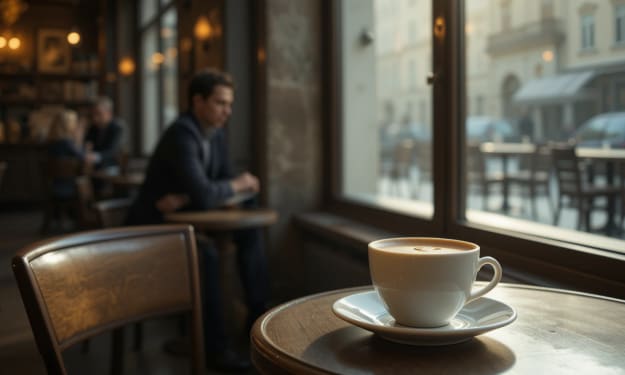
The Ring in Her Coffee
The Ring in Her Coffee Written by Noor Khan Sofia never liked early mornings. But working the 6:30 AM shift at Café Vento in the heart of Florence meant she had no choice. The job wasn’t glamorous—wiping tables, smiling at tourists, and making espressos—but it paid enough to help her cover rent for the tiny attic apartment she shared with her cat, Leo. At 26, Sofia had once imagined herself an art curator or maybe even a travel blogger. But somewhere between her father's heart attack, dropping out of university, and the pandemic that followed, dreams were shelved. Now, every morning, she tied her hair into a messy bun, pulled on the green apron, and served people chasing their own lives. Fridays were her least favorite. Tourists crowded in early, and the regulars didn’t leave tips. On one such Friday morning, her manager shouted from the back, “Special order, table three!” Sofia glanced at the counter. A simple cappuccino, with a cinnamon heart on top. Nothing special. She sighed, picked up the cup, and weaved through the tables. Table three was by the window—the one seat in the café where the sun hit perfectly after 7:15. A man in a navy coat sat there. Clean-shaven, mid-thirties maybe, looking out the window as though waiting for something bigger than coffee. “Here you go,” she said, placing the cup down. He smiled. “Thanks.” She turned to leave when he added, “Do you believe in timing?” She paused. The question was strange. “Like... punctuality?” He chuckled. “No. I mean, life’s timing. Like—things happening exactly when they’re supposed to, even if it doesn’t feel that way?” Sofia gave a polite shrug. “I believe in coffee being on time.” He laughed softly, and she walked back behind the counter, trying not to think about him. ☕ A Week of Coincidences Every day that week, the same man returned. Always table three. Always a cappuccino. And always a question. Monday: “If you could live in any era, which would you choose?” Tuesday: “When was the last time you surprised yourself?” By Thursday, Sofia began to look forward to him. She even made sure his cup had extra foam. He noticed. “Have we met before?” he asked that day. “No,” she said, though part of her wondered too. “You seem familiar,” he added. “Like a page from a book I’ve read.” 🌧️ The Friday Surprise The next Friday, it rained. Florence looked like a watercolor painting smudged at the edges. Fewer tourists, quieter tables. Sofia served two cappuccinos before she saw him again. But something was different. He looked nervous. Fidgeting with his coat buttons. Table three seemed too small for his energy. When she brought his drink, he didn’t ask a question. “You okay?” she asked. He nodded, then pulled something from his pocket. A small black box. Before she could react, he opened it. Inside sat a delicate gold ring with a tiny sapphire, shaped like a teardrop. “Wait—” she began, stepping back. “I know this is crazy,” he said. “But I’ve come here every day for a reason.” “I’m not sure—” “You remind me of someone I used to know. Her name was Elisa. We were supposed to get engaged here in Florence—at this exact café, table three. But she died in a car accident two weeks before the trip.” Sofia’s hand reached instinctively to her apron. “I wasn’t going to come,” he said. “But something kept pulling me. And then you... you look like her. Not exactly, but enough to make me believe again.” “I’m not her,” Sofia said, softly. “I know,” he replied, closing the box. “But you made me feel something I haven’t felt in years—hope.” 📖 The Ending That Wasn't Sofia thought about him all weekend. His story. The ring. The sadness behind his smile. And how—somehow—she’d become part of someone else’s healing. On Monday, he didn’t come. Nor Tuesday. By Thursday, table three felt like a ghost. That Friday, her manager handed her a small envelope left at the counter. It had her name on it. Inside was a handwritten note. > “Dear Sofia, Thank you for reminding me that the world still spins even after the heart breaks. I’m going back home. Starting fresh. I’m not asking you to remember me, but I’ll always remember you. P.S. I left something behind—table three.” She walked to the table. On the seat lay the ring box—open. And under it, a note. > “Give this to someone who makes you believe again
By Moonlit Lettersabout a year ago in Fiction
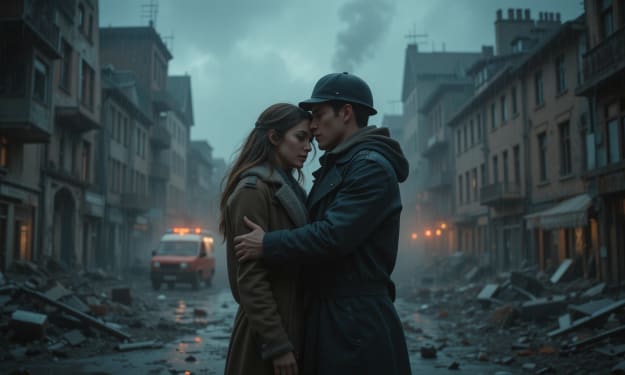
When the Sirens Stopped
When the Sirens Stopped Written by Noor Khan The air smelled like smoke, and the sky never turned blue anymore. In a shattered corner of Eastern Ukraine, just miles from the frontlines, 22-year-old Lena clutched her backpack tighter and glanced over at Amir. Dust clung to his eyelashes, and his hands trembled as he checked the half-broken radio for updates. The sirens had stopped two days ago, but no one knew whether that meant safety — or silence before the storm. Lena had grown up in Luhansk. She was a university student when the war escalated again, studying literature and dreaming of teaching. Amir was a foreign volunteer medic, half-Ukrainian, half-Turkish, who had arrived to help civilians. Their paths crossed during an airstrike at the local hospital. Amid chaos, their eyes met. She was bleeding from her arm; he wrapped it with a torn shirt and whispered, “You’ll be okay.” She wasn’t. Nothing was. But she followed him anyway. They had been hiding together for eleven days in a collapsed train station basement with no heating, little food, and one flickering flashlight. The city above them was rubble — bones of what once was home. But in that underground darkness, something quietly bloomed. “Do you still think we’ll make it out?” Lena asked one night, her voice barely a whisper. Amir looked at her and smiled faintly. “I don’t think. I believe.” That was Amir. A man of belief. Belief in survival, belief in hope, belief in her. Every few hours, they took turns peeking through a shattered concrete crack above the stairs. Drones still buzzed in the sky. Gunfire echoed like thunder. They scribbled poetry on the back of ration wrappers just to feel human. Then came the twelfth night. They heard footsteps. Loud. Unhurried. Foreign. Amir held his breath and slowly turned off the flashlight. Lena pressed her back to the cold wall, her heartbeat louder than any bomb. The footsteps passed. Then returned. “Russian patrol?” Amir whispered. She nodded silently. They had no weapons. No way to run. Just each other. Suddenly, the footsteps stopped. A voice called out in broken Ukrainian, “We know someone is here. Come out.” Amir grabbed Lena’s hand. “No,” she whispered. “They’ll shoot.” “We can’t stay. We’re out of food. If they find us here, it’s worse.” “But…” “If anything happens—remember your name. And that I love you.” She wanted to scream. Instead, she kissed his forehead, and they stood up together. But fate is strange. As they reached the top of the stairs, a sudden blast rocked the building. Dust rained from the ceiling. The patrol scattered. A nearby apartment tower had been hit — not them. Using the confusion, Amir pulled Lena through a broken side tunnel he had spotted days ago but never dared to use. They ran. Through collapsed corridors. Through narrow alleys lined with burnt-out cars. Through snow dusted with ash. That night, they reached an abandoned Red Cross outpost. It had no doors, no staff, and no medicine. But it had maps. And a working radio. Amir managed to call an NGO in Poland using an old frequency. “Two survivors. One injured. Near checkpoint Bravo 9. Need extraction.” They waited 48 hours in the broken building, feeding on crackers and hope. Finally, a drone hovered above, dropping a flare. Minutes later, a black van appeared from the west — silent, fast, foreign-plated. They were rescued. 💬 Why This Story Matters Lena and Amir now live in Warsaw. She teaches Ukrainian refugee children; he volunteers at a trauma clinic. They still write poems on the backs of receipts. They say war took everything — except what mattered most. Love in a dangerous place is not romance. It's survival. It's staying when everything says to run. It's sharing silence in a room full of fear. It’s believing in life when death is outside your door. Their story never made headlines. But somewhere, in a city still broken, a wall stands with faded graffiti: “The sirens stopped — but we didn’t.”
By Moonlit Lettersabout a year ago in Fiction
The one I couldn't forget. AI-Generated.
I met Ayaan when I was seventeen. He was sitting alone on the school bench during lunch, reading a book no one cared about. He wore a black hoodie, headphones around his neck, and had a calm, quiet smile that never left his face. Nobody really talked to him. He was that kind of boy — always distant, always somewhere else. But I was curious. One day, I sat beside him and asked, “What are you reading?” He looked at me, a little surprised, and replied, “It’s a story about a boy who travels the world to find what he already has.” I laughed. “That sounds confusing.” He smiled. “Sometimes, life is confusing too.” That was the start of something beautiful. We became friends. Slowly, but surely. Ayaan wasn’t like the other boys. He never made fun of people. He didn’t talk loudly or show off. He listened. Really listened. And when he spoke, his words felt like they came from a deeper place. I started sharing things with him I never told anyone. About my dreams, my fears, and the songs I loved. He told me about the stars, his favorite writers, and how he believed people meet for a reason. He always said, “Everything happens when it’s meant to.” A year passed. Then another. By the time we finished school, we were inseparable. Everyone said we looked good together, but we never said anything about love. It was there, unspoken, floating between our words and smiles. Then came college. We went to different cities. I cried the night before he left. He held my hand and said, “We’ll meet again. This isn’t the end. Just a pause.” We texted every day at first. Then once a week. Then… silence. I don’t know what happened. Life happened, maybe. New people, new places, new dreams. I sent him a message once: “Do you still remember me?” He never replied. I waited. One month. Two months. A year. Still, nothing. It broke me in ways I didn’t understand. How could someone who knew me so well forget me so easily? But life moves on. And so did I. Five years passed. I graduated. Got a job. Made new friends. Smiled in photos. Laughed at jokes. But at night, when everything was quiet, I thought of him. Every bridge I crossed. Every song I heard. Every time it rained. He was there. Like a ghost I never wanted to forget. Then one day, out of nowhere, I got a letter. A real letter, not a message. Just an envelope with my name on it. I opened it with shaking hands. It was from Ayaan. > Dear Zara, I don’t know if this will reach you. I don’t even know if you still live at this address. But I had to try. I’m sorry. For the silence. For disappearing. For making you feel forgotten. You were never forgotten. Life got hard. I lost someone in my family. I couldn’t talk about it, not even to you. I didn’t know how. So I shut the world out. Including you. That was my biggest mistake. I came back to our old school last week. Sat on the same bench. I remembered your laughter. Your questions. Your dreams. You’re the one person I still carry in my heart. I don’t expect anything. I just hope… maybe we could meet again. Even just for a walk. Like old times. If you ever feel the same, I’ll be at the bridge — the one near the lake — this Sunday at 5 PM. If you don’t come, I’ll understand. But I’ll still wait. Yours, always, — Ayaan I read the letter a hundred times. My heart felt heavy and light at the same time. Sunday came. I stood in front of my mirror for an hour. Should I go? Would he really be there? Or was it just another goodbye? I took a deep breath and left. The sun was setting when I reached the bridge. The same colors painted the sky — orange, pink, gold. I walked slowly, my hands shaking. And there he was. Leaning against the railing. Looking at the water. Just like before. He turned. His eyes met mine. And suddenly, nothing had changed. We didn’t speak at first. Just stood there, the silence saying more than words ever could. Then he whispered, “I didn’t think you’d come.” I smiled, my eyes full. “I didn’t think you’d wait.” He pulled something from his pocket — an old photo of us sitting on that school bench. “I carry this everywhere.” Tears ran down my cheeks. “I never forgot you,” I said. “I never stopped loving you,” he replied. We talked for hours. About everything. About nothing. We laughed. We cried. We remembered. That night, as the stars appeared one by one, I realized something: Some people come into your life for a moment. Some stay for a season. But a few — just a few — are meant to stay forever. Even if they leave, even if time passes, their place in your heart never fades. They are the ones you can never forget.
By Asad Ullah khan about a year ago in Fiction
A Love Letter to photography
I write this from the edge of a cliff in Santorini, the Aegean stretched out like a brushstroke of blue beneath the sun. You’d love this place—the way the sky kisses the sea, the quiet whispers of the wind, the hum of life that pulses beneath the whitewashed walls. It reminds me of you. Everything beautiful does. You once asked me why I chose this life—why I always run toward the horizon, camera in hand, chasing fading light and fleeting faces. I never had a good answer then. Maybe I didn’t know. Maybe I didn’t want to admit that every road I follow is just another attempt to find a piece of you in the world. The truth is, I fell in love twice. Once with you. And once with the world. But they aren’t separate. You see, I carry you with me in every sunrise I shoot, every stranger’s eyes I try to capture, every hidden alley I wander. You are in every frame, tucked between the shadows and light, as if the world echoes your presence back to me, no matter where I go. I remember that day in Kyoto—the cherry blossoms falling like pink snow, the air soft with spring. You were laughing, your hands full of postcards we’d never send. I had my camera slung around my neck but I couldn’t take a single photo. Not because the scene wasn’t beautiful, but because it would never match the memory. Some moments are too sacred to trap in pixels. You told me once that you worried I’d choose the road over you. That my heart belonged more to airports and alleyways than to quiet dinners and morning coffee. I didn’t know how to answer then. I guess I thought love was something you came back to, not something you took with you. But I know now: love is a lens through which you see the world. I see you in the storm clouds over Iceland, in the early light of a Moroccan market, in the laughter of children running barefoot through the streets of Cartagena. I see you in the pauses between shutter clicks. I hear your voice in the silence after the sun sets. I used to chase the perfect shot. Now I just try to capture the feeling—of being alive, of being in love, of being lost and found all at once. There’s a photo I took last week in Rajasthan. A woman in red stood in the doorway of her home, light slanting across her face like poetry. Her eyes held centuries. When I showed her the photo, she smiled without looking. “You’re not looking for photos,” she said, “you’re looking for someone.” She was right. Maybe I photograph places hoping one day you’ll follow the trail. Maybe I send you these prints and postcards like breadcrumbs across the world. Maybe each shutter click is my way of saying I miss you, I love you, I remember. But love isn’t always about being in the same place at the same time. Sometimes it’s about holding someone so deeply that even the sky starts to resemble their smile. I don’t know when I’ll stop. Maybe I never will. Maybe the road has no end, and maybe that’s okay. Because every step forward is a memory of you, every mile is a testament to what we shared. I hope you still keep the photo of us in Lisbon—our hair windblown, your eyes half-laughing, my hand mid-reach toward yours. That was the moment I knew. It wasn’t the city, the light, or even the composition. It was you. It’s always been you. Wherever I go, you are my home. I’ll write again from the next place. Maybe the Andes, maybe a rooftop in Havana. Or maybe I’ll knock on your door one day, no map in hand, just a camera full of stories and a heart full of you. Until then, With all my love, Yours in every frame, L.
By Israr khanabout a year ago in Fiction
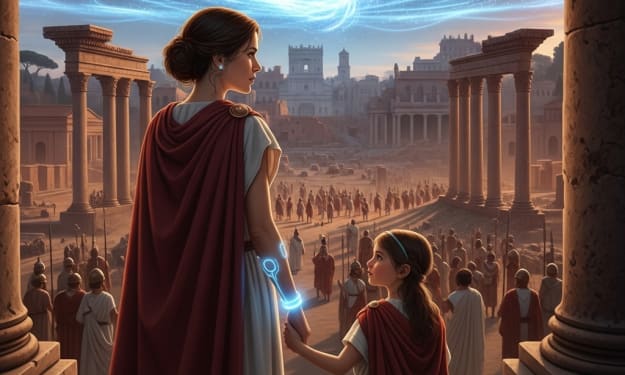
The Tides of Rome
Title: The Tides of Rome In the year 2493, history was no longer confined to books and digital archives. Thanks to the invention of the Temporal Corridor, time travel had become possible—but only for a carefully chosen few. These were not tourists or adventurers, but highly trained specialists whose mission was to preserve, observe, and never interfere.
By Malik BILALabout a year ago in Fiction
Hearts against the Storm
Two weeks later, the world had changed — or maybe we had changed enough to see it clearly. The headlines were still buzzing. Investigations were underway. Arrests had been made in the land fraud case tied to my uncle’s death. My father's political allies had started to disappear like shadows under sunlight.
By Mehmood Niazabout a year ago in Fiction
Hearts against the Storm
The night was colder than usual, with a restless wind scraping across the empty roads as I rode toward the old farmhouse. I had no backup. No phone. Just the folded copy of the evidence Hamza had given me, tucked in my inner coat pocket. And a flicker of hope that somehow, this meeting — this trap — might be the end of it all.
By Mehmood Niazabout a year ago in Fiction