Adventure
"Whispers of Elderglen: Stories from a Village That Lives by the Heart"
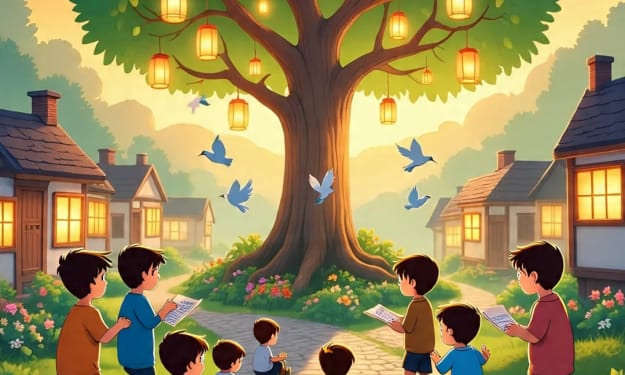
Tucked between two misty hills and hidden from most maps lies the village of Elderglen—a place few outsiders visit, yet many dream about. To some, it’s only a whisper in old travel journals or a scribbled note in the margins of forgotten books. But to those who live there, Elderglen is more than a village. It is a living, breathing story. Elderglen is known for three things: its tree of light, its tradition of storykeeping, and the gentle way time seems to pass. While the rest of the world races forward, Elderglen moves like a poem—measured, intentional, and full of meaning. The heart of the village is the Great Elder Tree, believed to be over 700 years old. Lanterns hang from its branches, one for each family. Every lantern glows faintly at night, but when someone in the village tells a story from the heart—whether around a fire, in the bakery, or during the morning market—their lantern pulses brighter for a moment. No one knows how or why. The villagers don’t question it. They simply say, “The tree remembers what we do with love.” The storykeepers of Elderglen are not scholars or officials. They are bakers, weavers, teachers, and carpenters—anyone who chooses to listen deeply and pass on the stories of others. Every year, the village holds a “Day of Whispers,” when everyone from elders to children gathers to share one story they’ve carried but never spoken aloud. Marin, the village baker, once told the tale of how she’d learned to make cinnamon loaves from her grandmother, who had burned every batch until one rainy morning she got it right—and cried. Her story wasn’t grand, but everyone remembered it. That year, Marin’s lantern shone for hours. Children grow up in Elderglen learning that a good story isn’t measured by excitement or danger, but by the truth it carries. Even simple tales—of a lost scarf found by a stranger, or a letter written but never sent—are honored here. Elderglen teaches that no emotion is too small to matter, no voice too quiet to be heard. The village also values slow learning. There are no strict schools or exams. Instead, children apprentice with those they admire. Some learn woodworking under the patient eyes of Toma, a man who once built a bridge entirely from fallen trees. Others follow the village herbalist, Eliya, who claims that plants “only speak to those who greet them with gratitude.” One of Elderglen’s most cherished customs is the Story Box. Every home keeps a carved wooden box where family members place written memories—some joyful, some painful, all personal. On the first frost of winter, families gather to read a few of them aloud. It's not always easy. Tears are common. But so is laughter. And hugs. And healing. While Elderglen values tradition, it isn’t stuck in the past. Visitors from nearby towns are sometimes invited during festivals, and new ideas are welcomed—as long as they are brought with respect. In fact, the village’s best windmill was designed by a visiting artist who stayed for a summer and never left. “I came for quiet,” she said, “but I stayed for the kindness.” In recent years, some villagers have begun recording their stories with small crystal recorders gifted by travelers. The recordings are stored in the Whispering Room, a hollow beneath the Elder Tree. People can sit inside and listen to voices from the past and present, hearing the courage, laughter, and love passed down through generations. Despite its wonders, life in Elderglen isn’t perfect. There are disagreements, heartbreaks, illnesses, and change. But what makes the village different is its commitment to facing these things together. When someone is grieving, neighbors leave food by the door and poems on the windowsill. When someone succeeds, the village bell rings not once, but three times—once for the person, once for their story, and once for the community that helped shape them. Elderglen is fictional, yes. But perhaps not entirely. In every real community, there are echoes of it—places where people still pause to listen, to tell, to care. Because in the end, the villagers of Elderglen believe one simple thing: The heart of any place is not made of stone or wood or laws. It is made of the stories we dare to share—and the love with which we listen.
By Muhammad Saad about a year ago in Fiction
The Letter That Waited 20 Years
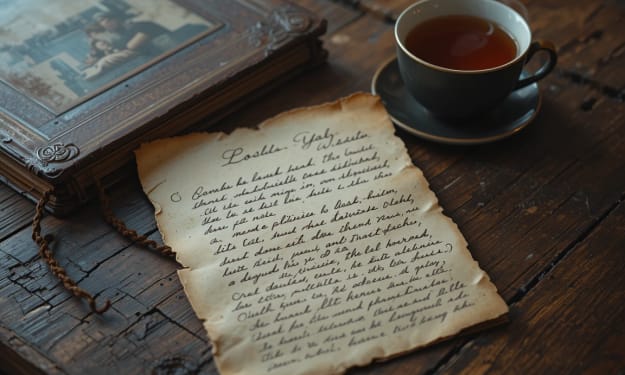
The Letter That Waited 20 Years Written by Raza Iqbal It was a rainy Thursday when Emily stumbled upon the letter. The old family house in Yorkshire had always been full of secrets—dust-covered trunks in the attic, forgotten bookshelves, and drawers that stuck shut from decades of humidity. But this letter wasn’t hidden away. It was tucked carefully between two pages of a photo album, pressed like a fragile flower between fading memories. She had come home for one reason only—to sell the house. Her father had passed away six months ago, and there was no one left to keep the memories warm. Her mother had died when Emily was ten. Her father never spoke much of her afterward. As an adult, Emily stopped asking. Grief made people quiet, she told herself. It made them build walls. But the letter spoke louder than her father ever had. "For Emily. If you're reading this, then the time has come." The handwriting was familiar. Delicate, but certain. Her mother’s. Her heart skipped. With shaking fingers, she unfolded the aged paper, already yellowed and soft at the creases. May 19, 2005 My sweet Emily, You’re only ten today, and maybe you won’t find this letter for many years—perhaps not until you’re grown and the truth finally matters more than the silence. I didn’t want to leave you. Not ever. I want you to know that. The doctors didn’t believe I’d last as long as I did. But your smile made my heart fight for every single day. Still, there were things I never got to tell you. Things I thought your father would explain when you were older. I don’t know if he will. I hope he does. But in case he doesn’t, I’m writing them now. First: You were born out of love. So much love. Your father and I—despite everything—loved each other deeply once. That part is real. But people change. Grief, fear, mistakes... they chip away at love until it’s barely standing. And here is the truth you need to know: I had another child before you. A boy. His name was Jacob. Emily paused. Jacob? She blinked, reread the line, and leaned back into the couch, the letter trembling in her lap. Her mother had never mentioned another child. Neither had her father. I was very young. It was before I met your father. I was seventeen, scared, and alone. My parents sent me away to a home for unwed mothers in the countryside. I was told never to speak of him again. I held him for exactly three minutes before they took him away. He was perfect. Tiny fingers, a soft cry. He had my eyes. I named him Jacob even though no one asked me to. They didn’t care. He was gone before the morning sun touched my window. I spent years searching. But the adoption records were sealed. I never found him. And when I met your father, he asked me to forget. Not because he was cruel—but because he thought the pain would destroy me. He didn’t understand that forgetting hurt more. Tears streamed silently down Emily’s face. She couldn’t picture her mother at seventeen, scared and discarded like a secret. And she couldn’t believe her father had asked her to bury such a thing. Emily, I tell you this not to burden you, but to free you. Families are messy, and love is never simple. But secrets—they are the heaviest inheritance. If by some miracle, this letter finds you, and you feel the need to search for him, I won’t stop you. I just want you to know you were both loved. Always. Love, Mum. Emily sat for a long time in the quiet house, listening to the soft tap of rain against the window. A letter, two decades old, had just changed everything she thought she knew about her family. Suddenly the empty house felt full of voices—her mother's grief, her father's silence, a brother she had never met. She picked up the phone. "Hello, I'm calling about sealed adoption records from 1985..." Six Months Later The café was quiet. A man in his early 40s sat at the far table, nervously checking his watch. Emily walked in, her heart pounding so loud it echoed in her ears. She had seen his photo online, but nothing prepared her for this—seeing Jacob in person. He had their mother’s eyes. Her nose. A kind smile that made her knees weak. He stood as she approached. “Emily?” he asked. She nodded. “Jacob?” They hugged. Long, awkward, emotional. Strangers stitched together by blood and twenty years of silence. Over coffee, she handed him the letter. He read it twice. “I always wondered,” he said quietly. “I used to dream that someone out there was looking for me.” “She was,” Emily whispered. They sat in silence for a while. Two lives that had run parallel, finally intersecting. Epilogue Emily never sold the house. Instead, she turned it into a place for healing—offering weekend retreats for people searching for family, history, or closure. She kept the letter in a glass frame in her study. Not as a reminder of pain, but of truth. And every year, on May 19th, she and Jacob met at the Yorkshire shore, where their mother once took her as a child, to watch the waves roll in. Some letters arrive late. But sometimes, the heart knows exactly when to open them.
By Moonlit Lettersabout a year ago in Fiction
A story of Brujeria, shovels and a baby chick
It was a Thursday. A normal Thursday for me. I went to work and came home like always. It wasn’t too hot yet in our Central Texas town, so comfy pajamas and a soft blanket were calling me. My husband was going to be at work for a few more hours and my 3 teenagers were out with friends. A rare evening where no one was there to bug me about nonsense or ask about dinner. In other words, a perfect evening for an overworked mom. I looked at my watch and it said 6:15pm. The perfect time to start my perfect evening. With my pajamas on I walked to the kitchen and had mentally decided on a pint of buttered pecan ice cream and a show to binge watch until I passed out. I was about to silence my phone when my older sister’s name popped up on the screen. I was going to let it roll to voicemail, but she rarely calls me, and I felt happy to hear from her, so I answered. The second she said my name and not my nickname, the hair on my arms stood up and I felt nervous. She asked if I had anything super important planned for the evening. I looked at my ice cream and was about to say yes when guilt set in and I said no. She thanked the heavens with relief and then proceeded to tell me I needed to pick her up in my SUV. Then she tells me that I can’t ask any questions until I pick her up and that I need to wear darks jeans, boots and a hoodie. Oh, and bring some bottled water, plastic bags and a couple of shovels and gloves. Time stood still for me because I always told her I was her ride or die. She was calling to collect, and I don’t know why, but I said OK. I never thought I would have to make good on it. As my mind came back from my mental pause, the truth finally registered at the forefront of my mind: Oh. Crap. She finally snapped and it is going down!
By "Ann Garza"about a year ago in Fiction
He Never Missed a Day—Until One Morning, He Did
He Never Missed a Day—Until One Morning, He Did Written by Raza Iqbal The townspeople called him “Captain.” It wasn’t his real name—no one ever knew what that was—but it suited him well. Every morning, just as the sky broke into shades of rose and gold, he would arrive at the beach with a soft leather journal in hand and a thermos of something warm. He’d sit on the same weathered bench facing the sea, the one closest to the old fisherman’s dock, and stare out into the waves like they held a secret only he understood. Children whispered tales about him. Some said he’d once sailed around the world. Others claimed he was waiting for a lost love who vanished at sea. The truth, perhaps, was quieter. He never missed a day. Not for rain or wind or fog. Until one morning, he did. I. The Absence “Have you seen the Captain?” The question echoed through the small coastal town. The waitress at the diner noticed first. “His coffee’s still hot,” she muttered, holding the thermos he’d left behind a week ago to be filled daily. Then the postman. The lifeguard. The librarian. Even the children noticed—the old man with eyes like tidepools hadn’t shown up in four days. His absence grew louder than his presence ever had. Someone finally checked the bench. On the seat, tucked beneath a smooth stone, was a sealed envelope. To the Next One Who Needs This, it read. II. The Letter A teenage girl named Ava was the one who found it. Her brother had just left for university. Her mother hadn’t stopped crying since. Ava didn’t understand the silence that had settled in their home. She just knew it felt heavy. And the beach was the only place she could breathe. She sat on the bench without thinking. Her eyes found the letter. Her hands trembled as she opened it. Dear Stranger, If you’re reading this, I’m gone. I don’t know who you are, but I know what brought you here. Sadness. Loneliness. A question you can’t ask out loud. The sea calls to people like us. Let me tell you something: I came here for fifty years. Every morning. Not because I was waiting for someone to return… but because I needed to remember. You see, once I had a wife. Eleanor. Bright eyes. Loud laugh. She hated sand in her shoes but loved the smell of salt in the air. She died before her time. A car accident. Just like that, she was gone. No goodbye. No time to prepare. One moment I had a life. The next, I had a silence too deep for words. That bench saved me. I’d sit and let the wind scream for me. The waves would speak when I could not. And slowly, very slowly, I began to live again—not all at once, but piece by piece. If you're hurting, let the sea hold your grief. It has room. More than you know. You don’t need to be okay right now. You just need to sit. Breathe. Let time do its quiet work. This bench is yours now. Be kind to the next soul who needs it. III. The Town Responds Ava left the letter where she found it. She didn’t tell anyone, not right away. She just came back the next day. And the day after. She started bringing her sketchbook. Then, her mother joined her. A week later, someone added a tiny wooden plaque to the bench: “To the Captain—Thank You for Listening.” Stories began to spill. A man whose daughter left home after a fight sat there with tears he hadn’t shed in years. A woman from the café who lost her baby found peace enough to smile again. A widower brought flowers and left them beside the letter each Sunday. The Captain had become part of the town’s rhythm—alive in memory, even in death. IV. One Year Later Ava sat on the bench on the Captain’s anniversary. The sun warmed her face. Her mother had a new job now. Her brother called every week. The house was still quiet, but the silence no longer hurt. She looked down at the journal on her lap. The same kind the Captain had carried. She opened it and began to write: “Dear Stranger, If you're reading this, then you’ve found the bench. And I’m glad. I was once lost too. This spot helped me find myself again. The man who came before me—he left behind more than a letter. He left a place for healing. So sit. Watch the waves. Let your heart soften. You’re not alone.” V. The Legacy Years passed. People came and went, but the bench remained. Weathered. Silent. Steady. Like the sea. A place for beginnings disguised as endings. A place where strangers became stories. And grief, once too heavy to carry, floated gently out to sea.
By Moonlit Lettersabout a year ago in Fiction
The House Where Time Sleeps. AI-Generated.
At the edge of Thorn hollow village, where the trees grew thick with silver moss and the wind never howled, stood an ancient manor, half-swallowed by ivy and shadow. The villagers called it cursed. They said the clocks inside had never moved—not for over a hundred years. They whispered that if you listened too closely near its doorstep, you'd hear the ticking of memories instead of time.
By Adil Nawazabout a year ago in Fiction
Magical Beastly Botanics and Altered Potions
Lainey Roberts curled her lip in stilled satisfaction as the moon lit against her eyes, pooling a reflection that wasn’t her own. She wasn’t supposed to be out at this hour of night but she couldn’t help it. She had to see for herself what the plants were doing as she peered through the glass of her latest customers home. Sure enough, Mrs. Jennings had put her prized Fiddlewood on the northeast side of her house in the largest bay-window on the block, turning the plant to face the moon. Just as Lainey had requested.
By K.H. Obergfollabout a year ago in Fiction
Camp Whispering Pines
The bus rumbled up the dirt road, dust swirling like ghosts in its wake. As it pulled into the clearing, Camp Whispering Pines came into view: a cluster of rustic cabins surrounded by towering pine trees whose branches seemed to whisper secrets to one another in the wind. It was the first day of the summer session, and a group of teenage counselors hopped off the bus, eager but uneasy about the remoteness of the camp.
By V-Ink Storiesabout a year ago in Fiction
Summer Sands and Sisterhood
The sun blazed high over Coral Cove, a stretch of beach that looked like it belonged in a postcard. The golden sands shimmered under the July sky, and the ocean waves sang a lullaby that tugged gently at the shore. It was the kind of place where time seemed to slow, and the worries of the world were washed away with the tide.
By Malik BILALabout a year ago in Fiction
''In My Mind, A New World''
In my mind, a new world blooms—not with noise and chaos, but with a quiet kind of magic. The kind that lives between thoughts, beneath dreams, and behind every closed eye. This world doesn’t follow the rules of the one we wake to each morning. Gravity isn’t a law, time isn’t a tyrant, and no one has to hide the strange parts of themselves. In my world, strangeness is celebrated. It's the currency of connection. There are cities carved from crystal and rainclouds that float like zeppelins. The skies change color with emotion. If you're sad, the sun softens its light and bathes the world in lavender. If you're angry, the clouds hum with storm-energy—not destructive, but cleansing, like a thunderstorm for the soul. The people here? They're not people, not exactly. Some have wings like ravens, some wear vines instead of clothes. Others are made of flame but never burn. They speak in poems, in pulses of color, or in music only your heart understands. No one lies here. They don’t need to. Vulnerability is strength, not weakness. You don’t armor yourself with sarcasm or politeness. You say what you feel, and the world listens gently. Pain is met with presence. Joy is shared like bread. There’s no money in this world—not in the way we know it. You trade memories, laughter, stories. If someone paints a mural in the town center, you thank them with a song or a secret. Everyone gives. Everyone receives. Balance is natural here, not something we legislate. Animals speak—not with words, but with knowing. A fox might guide you through your fears. A whale might sing you to sleep. Even the trees have voices, whispering ancient lullabies to anyone who dares to sit still long enough to listen. Technology exists here, but not to dominate. It harmonizes. There are floating lanterns that follow you through dark woods. There are mirrors that show you your best self when you’ve forgotten who you are. There are staircases that only appear when you’re truly ready to rise. You don’t age the same way here. Your body reflects your spirit, not your years. If your heart is young, you dance like someone just gave you legs. If you’ve lived deeply, your eyes glow with galaxies. In my mind, the concept of “other” doesn’t exist. Love flows freely—not labeled or boxed. You can love many, or one, or none at all, and still be whole. Identity is fluid. You can change your name with the seasons. You can be moonlit today and wildfire tomorrow. No one asks for explanations. They just witness you. And when grief arrives, as it always must, it is not shamed or hidden. There are temples where you can sit with it. Waters that carry it gently away when you're ready. You’re never told to "move on." You’re asked only to move with it—until it becomes part of your song. This world is not perfect. There is still struggle. But here, struggle doesn’t mean suffering alone. Community is not something you build—it’s something you remember. In my mind, a new world grows like moss on ancient stone. Quiet. Persistent. Alive. And maybe, just maybe, this world doesn’t have to stay only in my mind. Maybe it can leak into the spaces between this world—the real one. Maybe we start with a conversation that feels more like a connection. A look that lingers a little longer. A moment where someone says, “I see you,” and means it. Maybe we build it not with bulldozers and budgets, but with bravery. With imagination. With the audacity to believe that kindness can be more than a gesture—it can be a revolution. Maybe your world looks different than mine. That’s okay. There’s room for all of them. That’s the beauty of a mind that dreams new realities. Every vision is a seed. And every seed is a possible beginning. So tell me: In your mind… What does your new world look like?
By Israr khanabout a year ago in Fiction
The Umbrella Without Rain
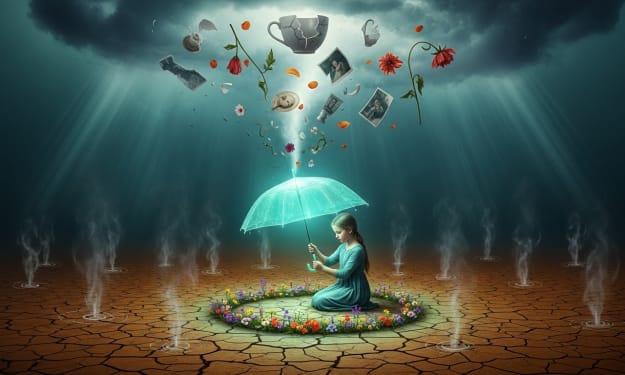
Part 1: The Inheritance of Dry Tears The umbrella arrived the day Elara’s grandmother vanished. Not died—vanished. One moment, Nana Rosa sat knitting beneath her favorite pear tree; the next, only her indigo shawl remained, wrapped around a long velvet box.
By Habibullahabout a year ago in Fiction