Adventure
Under the Crimson Sky
By Nadeem Shah The sky bled red the evening I returned to Raven Hollow. I hadn’t been back in twelve years—not since the night everything I believed in was shattered. The roads felt narrower, the trees darker, like the whole town was holding its breath, waiting for me to remember what I’d tried so hard to forget.
By Nadeem Shah about a year ago in Fiction
Wild Tribe
The plane was moving smoothly when it suddenly started to sway in the air. All the passengers were scared. Some started screaming loudly. Some passengers started praying. The pilot was unable to control the plane at all. He could not even communicate with the control room. The plane was falling rapidly towards the ground. All the passengers were crying in fear.
By Echoes of Lifeabout a year ago in Fiction
The Five-Minute Butler. Top Story - August 2025.
As he looked in the rearview mirror, Daryl saw that his bow-tie was crooked. He quickly fixed it, and when he saw that the rest of his appearance was satisfactory, Daryl nodded before he left his car. This was his first shift after all. He had to make a great impression.
By Rebecca Pattonabout a year ago in Fiction
Hungry River. Top Story - August 2025.
My name is Zayden. I am three years old, and I enjoy climbing on things. My mom and dad got separated when I was two. My parents are trying to get back together again, and now I have a baby brother named Zion. My mom was young; she had me when she was just 18, a high school graduate.
By Mariann Carrollabout a year ago in Fiction
When the Fog Rolled In
I was prescribed Clonazepam for panic disorder when I was 25. At first, it helped. I could work, sleep, talk to people again. But what I didn’t realize was how fast things would spiral. My first dose? Four milligrams a day, extended-release. No buildup. No gradual start.
By Enric Millyabout a year ago in Fiction
The Man Who Wrote His Goodby
The Man Who Wrote His Goodby Every morning since she turned thirty, Nina Alvarez followed the same quiet ritual — brewed coffee, gentle jazz, and the city paper spread across her small kitchen table, once owned by her mother. It was her way of feeling anchored in a world that often spun too fast.
By Enric Millyabout a year ago in Fiction
She Read His Obituary Before He Died
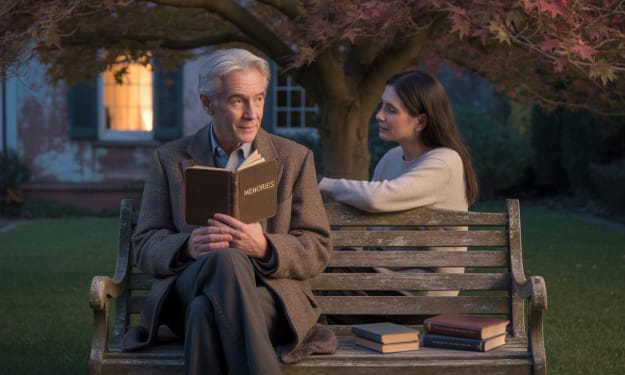
She Read His Obituary Before He Died Written by Muskan Maya had always started her mornings the same way since she turned 30 — strong coffee, soft music, and the local newspaper spread across the small wooden kitchen table her grandmother once owned. It was her ritual, grounding her in a world that sometimes felt too fast, too loud, and too fleeting. But nothing in the pages ever prepared her for what she saw that Wednesday morning. “Dr. Jonathan Hale, 68, passed peacefully on Tuesday evening. A revered linguistics professor and poet, Jonathan spent his final years quietly, often spotted in the garden of his family estate, book in hand…” Maya stopped reading. Her throat tightened. She blinked once. Twice. No. Her heart refused to believe what her eyes read. Jonathan Hale was not dead. He couldn’t be. He was alive just yesterday. She knew this because she had seen him — with her own eyes — walking down the cobbled path near the university’s old fountain. His steps were slow, sure, his coat too large for his frame but familiar. She had almost called out his name. Almost. Instead, she had stood still, silent, as he passed. And now he was dead? She folded the newspaper slowly, like she feared it might scream if handled wrong. Her hands trembled. Her coffee had gone cold. There had always been something mysterious about Jonathan Hale. When she took his poetry class ten years ago, she had been mesmerized by his presence — tall, quiet, eyes like fading ink, and a voice that carried sadness like it was a song. He rarely smiled, but when he did, it was like winter sun—brief, beautiful, and almost apologetic. Maya was one of his favorite students, though he never said it aloud. He showed it in smaller ways — a poem returned with more notes than others, a rare compliment scrawled in the margins, and once, a hand-written letter praising a piece she wrote about time and loss. And then, one day, he vanished. He stopped teaching. His office was emptied without notice. Rumors whispered that his wife had passed and that grief had consumed him whole. Others said he simply decided the world had taught him enough sorrow. No one knew for sure. But Maya never stopped wondering. And now she held his obituary in her hands. The final line read: “He leaves behind no children, but countless students who carry his words.” A tear fell onto the printed page, smearing the ink. That evening, against her better judgment, Maya made her way to the estate listed in the obituary. She didn’t know what she hoped to find. Closure? A final goodbye? Perhaps a glimpse of the garden where he spent his last days? The house stood just as she imagined — regal but tired, its paint faded and windows large and knowing. The front door was slightly ajar. Her heart pounded as she stepped in. “Hello?” she called softly. Silence answered. She walked past the threshold, following the faint scent of old paper and lavender. The living room was lined with books, and in the corner sat a record player, spinning nothing but static. Then, from the garden, she heard a soft cough. Maya froze. She stepped outside slowly. There he was. Jonathan Hale. Alive. Alive. Sitting on a worn bench beneath a cherry blossom tree, a book in hand. He looked older, thinner, but unmistakably himself. She gasped audibly. He looked up. Their eyes met. A pause. Then he smiled — faint, knowing. “Miss Rivera,” he said, voice softer than she remembered, but still laced with poetic rhythm. “You read it, didn’t you?” “The obituary?” she whispered. “I… I don’t understand…” He patted the bench beside him. She sat, breathless, confused, and heart racing. “I wrote it,” he said plainly. “Months ago.” “Why?” “To see who still remembered me. To know if I mattered.” “That’s—crazy. It’s… cruel.” He nodded. “Yes. But solitude does strange things to a man.” She looked at him. “You’re not forgotten. You never were.” He turned to her, and for the first time in a decade, she saw something break in his eyes. Not sadness. Not madness. Just a deep, echoing loneliness. “I just wanted one person to come,” he said. “You got one,” Maya said softly. They sat there for hours, talking about poems and pain, memory and time. The stars came out, unapologetically bright. When she left, he gave her a small notebook — filled with poems he never published. “For when I’m really gone,” he said. Three months later, the real obituary came. This time, there was no mistake. But she wasn’t mourning anymore. She was remembering. And through the ink of his words, he lived.
By Moonlit Lettersabout a year ago in Fiction
He Replied to Her Letters—20 Years After She Stopped Writing
He Replied to Her Letters—20 Years After She Stopped Writing Written by Raza Iqbal The first letter arrived on a Tuesday. It was spring in the sleepy coastal town of Whitby, where the sea spoke in hushes and the wind carried secrets through the alleys. Nora Blake, now 47, nearly mistook the letter for junk—until she saw the handwriting. Slanted, familiar. A style etched into her memory like ocean tides into stone. She froze in her doorway, groceries tucked under one arm, the envelope trembling in her hand. Her breath caught. The handwriting belonged to Jacob Bell. Jacob, the boy she had loved as fiercely as the wind and waves of their seaside town. The boy who promised he'd write back every week when he left for university. He did—for a year. Then silence. Still, she wrote. Every Sunday evening for six years, she penned a letter and placed it in a box. Pages filled with the mundane and the meaningful—her father’s illness, her favorite poem that week, the smell of summer storms. She never knew if he read them. Never even knew where he’d gone. She stopped writing after year six. Life moved on, or pretended to. Her mother died. She opened a small bookstore. She adopted a cat. And yet, in the attic, those six years of letters sat bundled by season. Until now. Nora stepped inside, placed the groceries on the floor, and slowly opened the envelope. Dear Nora, I don’t deserve to write to you after all this time. I know that. But today, I found one of your letters. It was buried in a box I never opened—sent to my father’s home after he passed. And I kept reading. One letter became five. Then twenty. Then all of them. I read your entire life through ink. I can’t begin to explain the reasons I never replied. Not yet. But please know—your words saved me more than once. Would you meet me, just once? If only to say goodbye properly. If you still live in Whitby, I’ll be at the old café by the pier, this Sunday at 10 AM. I’ll understand if you don’t come. Always, Jacob Nora didn’t sleep that night. Her thoughts were a tide pool of emotion—rage, heartbreak, aching curiosity. Why now? Why 20 years later? And yet, the next morning she stood at the mirror, brushing out her hair. She chose a simple navy dress and a grey scarf. The same one she wore the day Jacob had kissed her goodbye on the platform. The café hadn’t changed. Same chipped tables, same tang of coffee and sea salt. She walked in and scanned the room. Then she saw him. Jacob Bell, older but unmistakable. His dark hair now peppered with silver, lines etched deep around his eyes. He stood when he saw her. Their eyes locked. For a moment, neither of them moved. “I didn’t think you’d come,” he said softly. “I almost didn’t.” They sat. Silence lingered, but it wasn’t empty. “I don’t know where to begin,” he said. “Why not the truth?” she replied. Jacob’s fingers trembled around his coffee cup. “After I left Whitby… things went wrong. My father fell ill, but worse than that—he began unraveling. He was diagnosed with early-onset dementia. I dropped out. Came home. Took care of him.” Nora’s lips parted, but no words came. “He refused to send or receive letters. He hid things. I didn’t even know you were writing. Not until he passed and I found the box.” Nora’s throat tightened. “So… you didn’t forget me?” “I tried,” he admitted. “But every part of my life had your voice in it.” “Then why wait another year after finding them to reply?” Jacob hesitated. “I was scared. You wrote with such hope. I didn’t want to destroy that.” “You didn’t,” she said quietly. “Time did.” They spoke for hours. About what could’ve been. What never was. He had never married. She hadn’t either. They’d both come close—but something always held them back. Or someone. As the café emptied, Jacob reached into his coat and placed a small box on the table. “What is it?” she asked. “Your letters. All of them. I thought you might want them back.” Nora’s hands shook as she opened it. Her handwriting greeted her like an old friend. Folded pages. Ribbons still tied. She found one on top. A final note—his reply. “I’ve added one,” he said. “For every year I should have written you back.” Two weeks later, they met again. And again the week after that. They walked the beach where they once shared their first kiss. They sat on the library steps, remembering when they'd skipped school to read poetry. But it wasn’t love at first sight—not anymore. It was something deeper. A mending. A recognition. Of what had been lost. Of what still might be found. One year later, they stood in her attic. Nora opened the old letter box and placed Jacob’s replies inside—next to hers. The two timelines finally met. She looked at him. “We wasted so much time.” Jacob smiled. “Or maybe… we just paused.” And outside, the sea whispered its approval.
By Moonlit Lettersabout a year ago in Fiction
Where is Daisy?. Top Story - August 2025.
The colour of the leaves turned to burnt sienna around the edges. Some were green and strong, sporting no change. Some were sheltered and yellow. But others flew to the ground in despair as they waited for our feet to crush them, their parts caught in the crevices underneath our shoes. Turning to grains falling away as we walked. The odd ones stuck to the bottom, refusing to let go.
By Caitlin Charltonabout a year ago in Fiction
The Postcard That Arrived 50 Years Late
The Postcard That Arrived 50 Years Late Written by Mirza It was a rainy Thursday morning in the quiet town of Bellhaven when Margaret Fielding opened her mailbox to find a yellowed postcard tucked among the usual bills and catalogs. The paper was brittle, the ink faded, and the stamp bore the mark of 1975. She squinted, her arthritic fingers trembling slightly as she turned it over. It was addressed to her, but in a handwriting she hadn’t seen in decades—one she had once known better than her own. It was from Thomas. Margaret's breath caught in her throat. She hadn’t heard that name aloud in fifty years, hadn’t spoken of him since the summer of '75. It had been a summer of picnics, long walks by the lake, and whispered dreams under starlit skies. They were in love—intensely, youthfully, foolishly in love. But life had different plans. Thomas was drafted. They promised to write. She wrote every week. He never replied. Heartbroken and confused, Margaret moved on. She met Edward, a kind man who gave her stability and a quiet kind of love. They married, had two children, and settled into a life built on gentle routines and shared respect. But Margaret never stopped wondering why Thomas had disappeared. She assumed he’d been killed in the war or perhaps chose not to return. Either way, she buried that part of her heart long ago. And yet—here it was. The postcard read: > "Margaret, If you're reading this, it means the world hasn’t forgotten me. I'm coming home soon, and I hope we can pick up where we left off. I think of you every single day. Love, Thomas." Tears blurred her vision as the decades melted away. Why had this postcard never arrived? She contacted the local post office, who explained that a box of undelivered mail from the 1970s had recently been discovered in a closed rural facility. Apologies were given, but it didn’t change the past. Margaret sat on her front porch that afternoon, the postcard pressed to her chest. She thought about all the what-ifs. What if this had reached her in 1975? Would she have waited for him? Would Edward still have been part of her story? The sun dipped low as she sat in silence. Later that evening, her granddaughter Lily called. Margaret hadn’t told her much about her youth, but now she poured out the whole story, voice trembling with memory and emotion. Lily listened with wide-eyed wonder. “Do you want to find out what happened to him?” Lily asked. Margaret hesitated. She didn’t know if she was ready for the answer. Still, something deep within her stirred. Closure? Curiosity? Maybe hope? With Lily’s help, they began searching. Newspaper archives, veterans’ forums, old address registries. Days turned into weeks. And then—they found him. Thomas Hargrove. Alive. Living in Oregon. Eighty-one years old. He had never married. Margaret’s heart pounded as Lily arranged a video call. When the screen lit up, and an old man with kind eyes and silver hair appeared, Margaret gasped. “Margaret?” he said, voice thick with emotion. “Yes,” she whispered. He told her everything. He had written to her from overseas. Many letters. But he never heard back. When he returned, he thought she had moved on. Margaret’s letters, it seemed, had suffered the same fate as his postcard—lost in the ether of time and poor military mail routes. “I thought you forgot me,” he said. “I never did,” she replied. They laughed. They cried. They spoke for hours. Over the next few months, they spoke often—rekindling a bond that had never truly broken. Margaret didn’t feel guilt; she felt grace. Life had given her a husband, children, a story worth telling—but it had also given her this moment. A thread from the past, finally tied. One spring morning, Margaret flew to Oregon. When she stepped off the plane, Thomas was waiting with a bouquet of daisies—the same flowers he used to bring her in the summer of '75. They embraced like no time had passed. And in that moment, Margaret knew: sometimes, even if it takes fifty years, love finds a way back.
By Moonlit Lettersabout a year ago in Fiction
Where the Birds Waited for Her
Where the Birds Waited for Her Written by Shah Zeb Every morning at 6:45 AM sharp, Eleanor stepped onto her small balcony with a cracked ceramic bowl full of seeds. Her balcony overlooked the modest garden she tended to herself, a little square of green in an otherwise graying suburban neighborhood. A line of small wooden birdhouses hung from the awning above, painted in pale blues and gentle pastels. They looked like a row of forgotten memories, faded but tender. The birds came with the sun. Chickadees first, then cardinals, then the plump mourning doves who always arrived late, like tired guests at a Sunday brunch. She had names for them all—not based on science or species, but on feeling. The tiny brown one with the crooked wing was Pip. The red-breasted visitor was Clara. The loud, bossy one with the attitude? That was Detective. Eleanor was 82 and lived alone. Her husband had passed away ten years earlier, and her daughter, now grown, lived two states away with children of her own. They called weekly, sent cards on birthdays, and promised to visit more often. Eleanor never resented the distance. She understood life moved fast, and she had made peace with her solitude. Her birds, however, were daily guests she could rely on. "Morning, Clara," she'd whisper, gently tossing seeds across the railing. Clara would hop once, then twice, before pecking the ground gracefully. Pip would flap around anxiously, waiting for his moment. The ritual was always the same, as familiar to Eleanor as her own heartbeat. The neighbors had noticed her little ritual, though few ever spoke of it. They thought of Eleanor as kind but quiet, the sort of neighbor who’d smile softly but never overstay a conversation. Some of the children had called her the Bird Lady. One summer, a group of them had even drawn bird footprints with chalk leading up to her gate. And then, one morning, Eleanor didn’t come out. At first, the birds waited on the roof and railing like always. Pip fluttered his wings in a nervous rhythm. Clara perched on the balcony's edge, her head cocked toward the window. Detective let out two loud chirps and flew away. But Eleanor’s window remained still. By noon, the seeds remained in their ceramic bowl by the kitchen sink. She had passed away in her sleep. The news trickled slowly. A concerned neighbor noticed the mail piling up. The garden, always tidy and lovingly trimmed, was beginning to wilt. A wellness check was made. Her daughter arrived two days later, her face pale and lips pressed into a thin line. She stood on the balcony in the early morning, clutching the bowl of seeds in her hands. She scattered them. And the birds came. Pip landed first, more hesitant than usual. Clara followed. Even Detective made a rare, quiet appearance, as if sensing something different. Eleanor’s daughter wept behind the curtain of her long sweater sleeves as the little wings fluttered and dipped, feeding in silence. In the weeks that followed, the balcony stayed empty. But the birds kept coming. Every morning at 6:45 AM. The neighbors noticed. The woman was gone, but the birds—dozens of them—still came. They lined up on the balcony railing, perched on the old birdhouses, and waited. No food was there, but they came anyway. Pip still flapped nervously. Clara still tilted her head, scanning the window. It became a quiet mystery. A retired teacher who lived across the street wrote about it in the neighborhood newsletter. Someone else posted a photo online, captioned: “She’s gone, but they remember.” The story spread. Comments flooded in. “Nature remembers kindness.” “Proof of soul.” “Not all routines die with us.” One morning, a child from the neighborhood—maybe nine or ten—climbed the gate and placed a small bowl of seeds on the balcony. Her parents scolded her later, but the next morning, when she returned with her father, the seeds were gone. Birds, full and bright, fluttered into the sky as she beamed. So began the second ritual. Neighbors took turns. They left seeds. Hung new birdhouses. Repainted the railing in Eleanor’s favorite pale blue. The garden was weeded and watered. Even the mailman brought a bag of sunflower seeds one morning, leaving it neatly by the gate. Eleanor’s daughter visited on the anniversary of her passing. She stood among people she’d never met—neighbors, children, elders. Together, at 6:45 AM, they watched as the birds came again. And waited. The ceremony was brief. No speeches. Just seeds scattered, and wings rising into the morning light. Someone had made a small plaque: “She gave, they remembered. Eleanor’s Birds.” Years passed. The house eventually sold to a young couple. They kept the garden. Refilled the feeders. The tradition stayed. Tourists even visited sometimes, drawn by the quiet beauty of it. The birds kept coming. Not because of habit. But because, perhaps, they felt something there. Something left behind. Not all goodbyes are echoes. Some are seeds. And some seeds bloom with wings.
By Moonlit Lettersabout a year ago in Fiction