Adventure
Steps Into the Unknown
The night was thick with fog, curling through the narrow streets of the village like living fingers. Raina stood at the edge of the cobblestone bridge, staring at the dark river below, her heart pounding in rhythm with the wind. The festival lights behind her flickered weakly through the mist, distant and hollow. Everyone else had retreated to warmth and laughter, but she felt a pull toward the forest that bordered the village—a pull she could neither name nor resist. No one from the village ever ventured there after dusk. Legends told of wandering spirits, strange whispers, and travelers who never returned. Yet tonight, the warnings felt less like danger and more like a challenge. She gripped the strap of her satchel, containing nothing but a journal, a sketchbook, and a lantern whose flame danced nervously against the fog. The first steps were the hardest. Every footfall echoed off unseen walls of mist. Trees loomed closer, their gnarled branches reaching outward as if to bar her passage. Her mind raced with doubts: Was she brave? Foolish? Perhaps both. Yet every fiber of her being urged her onward. As she entered the forest, the air grew cooler, filled with the scent of damp earth and wildflowers that glimmered faintly in the lantern’s glow. Shadows twisted unnaturally around her, some moving with a life of their own. She felt eyes upon her, but no creature appeared. The forest was alive, she realized—not hostile, just observant. Raina walked for hours, though time seemed to stretch and fold around her. The path beneath her feet shifted subtly; what had been open ground moments ago now gave way to tangled roots and narrow trails. She stumbled once, catching herself against a tree trunk, and heard a soft, melodic hum nearby. Following the sound, she came upon a clearing where the mist parted to reveal an old stone well, its surface etched with symbols she did not recognize. Kneeling beside it was a figure in flowing robes, their face hidden beneath a hood. The figure lifted their head slowly, revealing eyes that gleamed like molten silver. “You seek what lies beyond,” the stranger said, voice echoing in the still night. “Few dare step into the unknown willingly. Even fewer return unchanged.” “I must,” Raina whispered, her voice steady despite the tremor in her chest. “I’ve felt it calling me my whole life—the forest, this path… something I cannot name.” The stranger nodded. “Then listen closely. The forest tests not the body, but the heart. You will face choices, fears, and memories long buried. Each step into the unknown will demand honesty, courage, and surrender.” Raina nodded, feeling a thrill of fear and excitement swirl together. She took a deep breath and stepped forward, her lantern held high. The forest seemed to react, its shadows stretching into arches and tunnels of light, guiding her. Hours—or perhaps minutes—passed. She crossed streams that shimmered with a spectral light, climbed rocks slick with mist, and walked through thickets that whispered secrets of old travelers. Each obstacle seemed less physical than emotional; with every step, she confronted memories of failure, regrets, and moments when she had silenced her own voice. At one point, she found herself in a grove of silver-leaved trees. The leaves whispered in a language she almost understood, recounting dreams she had abandoned, aspirations she had dismissed. Raina knelt among the roots, letting tears fall freely. The forest did not judge; it merely waited. “Do you see now?” the stranger’s voice came again, gentle yet firm. “The unknown is not a place. It is your courage, your willingness to face what you have avoided, your commitment to continue even when the path is unclear.” Raina rose, brushing leaves from her hair, and understood. Each step she had taken was more than distance traveled—it was a declaration of herself, of the life she wished to live unafraid. By dawn, the mist thinned, revealing the forest’s edge. The stranger was no longer visible, but Raina felt their presence within her—a quiet reminder of her journey. Beyond the trees, the village awaited, waking to a new day, yet she no longer felt constrained by its familiar streets. She carried the forest inside her, a reservoir of courage and clarity. From that day forward, Raina embraced the unknown in all its forms: choices that challenged her, opportunities that frightened her, and moments of silence that demanded reflection. She learned that stepping into the unknown was not about avoiding fear, but about moving forward with it, learning from it, and letting it illuminate her path. And sometimes, when the night was quiet and the world seemed still, she would take another step—small, deliberate, courageous—into whatever lay ahead, trusting that the unknown always held a lesson, a gift, or a truth waiting to be discovered. --- Moral of the Story: Courage is not the absence of fear, but the willingness to move forward despite it. Every step into the unknown teaches us more about ourselves than any familiar path ever could.
By Noman Khanabout a year ago in Fiction
A Walk Past Midnight
The village feast had been loud, boisterous, and hollow in ways Clara could never quite explain. She had smiled, laughed when expected, and applauded the music like everyone else, but inside, her heart had felt heavier than the lantern she carried. Midnight had already passed, and while the others were stumbling home, voices slurred and eyes bleary, Clara felt an inexplicable pull toward the forest at the edge of the village. No one should walk in the forest after dark. That was the rule. But rules were always easier to bend when curiosity burned hotter than fear. She stepped over the soft, dew-laden grass, the lantern trembling slightly in her hand. Its warm glow cast jagged shadows on the trees, giving them the semblance of silent, watching figures. At first, the forest seemed ordinary enough—trees towering, leaves rustling faintly—but soon the sounds of the village fell away completely. No crickets chirped. No owls called. Only the crunch of her boots against the soil and the faint sway of her lantern’s light accompanied her. With every step, she realized how isolated she truly was, and yet, strangely, she felt alive. The deeper she walked, the more the forest seemed to bend around her. Roots rose from the ground like the knuckles of sleeping giants. Branches reached toward her like grasping hands. Her heartbeat quickened. She reminded herself to breathe slowly, to keep walking, to trust the path. Hours—or maybe minutes—passed. Time lost its meaning here. Every flicker of the lantern seemed to reveal more than the forest wanted to show. And then, amidst the shadowed trees, she saw a figure. He was leaning against a twisted oak, wearing black so deep it swallowed the lantern’s light. His face was pale, his eyes hollow, yet somehow filled with an old sorrow. He did not speak at first. He merely watched her approach, tilting his head as if weighing the worth of her curiosity. “You shouldn’t be here,” he said finally, his voice low and echoing, though no wind stirred. “Not all who walk past midnight find their way back.” Clara gripped her lantern tighter but did not step back. “I have to know,” she whispered. “I can’t return until I do.” He sighed, the sound like a breeze through dead leaves. “Then you must choose,” he said. “Return now and forget what you’ve seen, or walk further, knowing the forest feeds on solitude and doubt. It will show you truths… but at a cost.” The forest seemed to lean in, waiting. Clara thought of the village—the laughter, the feasts, the safety—but something inside her stirred, stronger than fear, stronger than duty. “I will walk,” she said. For a moment, the stranger’s expression softened. “Then follow, but keep your light close. And know: not all shadows are outside you.” Clara’s steps grew cautious. Every crack of a twig, every rustle of leaves seemed amplified. Yet she felt strangely guided, as if the forest itself had shifted to allow her passage. She realized that the path was not random; it seemed alive, responsive to her thoughts, her fears. Hours—or again, perhaps minutes—passed. Shapes moved in the corner of her vision, but when she turned, they vanished. Whispers of wind sounded like voices, whispering doubts, memories, regrets. Each step tested her resolve. At one clearing, she came upon a small pond, its water black as ink. The lantern’s reflection trembled on the surface. And in that reflection, she saw herself—not just as she was, but as she might be: lonely, lost, afraid of her own silence. The stranger’s voice came again from behind her. “This forest shows what you hide from yourself. Look well, Clara. The path is as much inside as it is ahead.” She stared at her reflection, her breath fogging the air. She had always feared silence, feared the empty spaces where no one’s voice filled the room. But now, she understood that fear was a shadow, one she could either flee from or embrace. The lantern flickered violently, threatening to go out, and Clara’s heart leapt into her throat. Yet she held it higher, and suddenly, she felt something shift. The shadows no longer clawed at her; they seemed to recede, acknowledging her courage. “You see now,” the stranger said softly. “Courage is not in defiance, nor in daring the unknown alone. It is in facing what you have ignored—your own silence, your own truth.” Clara felt tears prick her eyes. She thought of all the nights she had buried her thoughts beneath laughter, all the moments she had silenced her voice to please others. She realized the forest had not been threatening her—it had been offering her a mirror. By dawn, the trees began to thin. Mist hovered over the ground like a soft blanket. Clara emerged from the forest, her lantern still lit, though the sun now started to peek over the horizon. She was exhausted, yet unburdened. The village awaited, still waking from its drunken slumber, still echoing with the same shallow laughter. But Clara felt different. She had touched the depth of herself, and the noise of the world no longer frightened her. The stranger did not follow her out. He remained at the forest’s edge, a shadow among shadows, a silent guide. And Clara understood: he was a part of her, the fragment of herself she had long neglected. She returned home carrying the forest within her, a secret light, a quiet strength. And though she would walk among villagers again, she knew she could face silence, darkness, and doubt—because she had walked past midnight and found herself waiting there. From that day on, Clara was no longer afraid of solitude, nor of the quiet spaces where her thoughts roamed. She had learned that the forest, like life, asked only that she be honest, that she carry her light even in the deepest dark. And sometimes, when the night was still and the world quieted, she would light a lantern and walk a little further, smiling at the knowledge that the forest would always be there, teaching, guiding, and reminding her that courage begins within. --- Moral of the Story: True courage is not in defying rules or dangers, but in facing the silence within ourselves. When we dare to walk past midnight, we discover the light we carry was always enough.
By Noman Khanabout a year ago in Fiction
The Gemstone Search
It wasn’t a lie, or then again, maybe it was. Could I actually be so gullible as to believe such a thing really existed when my common sense told me it was totally illogical. Perhaps if I hadn’t listened to all those stories about pirate treasures and quests for lost cities or the holy grail, I would have dismissed this story as one more bogus pipe dream. Unfortunately, that wasn’t what happened.
By Mark Gagnonabout a year ago in Fiction
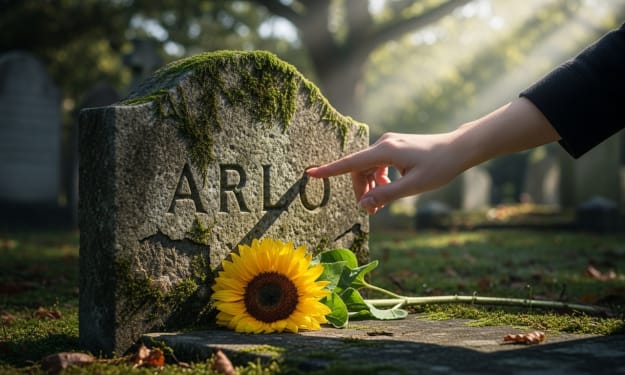
The Forgotten Name
The name was her final breath. A soft, sighing word that hung in the sterile hospital air after she was gone. “Arlo.” We all heard it. My parents, aunts, and uncles exchanged confused glances over her bed. A prayer was resumed, but the question lingered: Who was Arlo?
By Habibullahabout a year ago in Fiction
Shadows on the Edge of Tomorrow
The train station was almost empty, except for a few scattered travelers dragging their suitcases across the cold concrete floor. The air smelled faintly of rain, and the giant clock above the platform ticked louder than usual, marking each second like a reminder that time was both a gift and a thief.
By Nadeem Shah about a year ago in Fiction
Behind the Locked Door — A Story of Secrets and Second Chances
The house had been empty for nearly three years when Ayaan returned. It stood at the edge of the small town like a shadow of its former self—paint peeling, shutters hanging loose, garden overgrown. To most people, it was just another abandoned property. But to Ayaan, it was home. Or at least, it had been once.
By Nadeem Shah about a year ago in Fiction
Yixin Yixuan
ZBrush Sculpt - See more on IG or Artstation; Links below In a world divided by conflict and silent defiance, Yixin Yixuan travels as a seeker of peace. After losing her parents to violence and growing up with a warrior couple in the mountains, she stands for resilience and gentle strength. Her journey takes her from loss to legend, as she finds friends and shows a fractured world that sometimes the greatest victories come without fighting.
By Neshzivne Dadirriabout a year ago in Fiction
Love's First Shadow. AI-Generated.
The world, for Elara and Liam, had been painted in hues of sunrise and starlight. They met in the bustling corridors of their university library, a serendipitous collision of textbooks and shy smiles. She, with her wildfire spirit and a sketchbook filled with dreams; he, with his quiet determination and a mind geared for logic. Their attraction was immediate, their connection effortless. Their love bloomed in the final throes of their academic year, a vibrant, insistent bloom against the backdrop of impending adulthood.
By Mehrdad Rajabiabout a year ago in Fiction
The House on Harbor Street
M Mehran No one on Harbor Street liked to talk about the gray house at the corner. Its windows were always shuttered, the garden overrun with ivy, and the gate leaned as if it might collapse under its own rust. Children dared each other to touch the front steps, but few stayed long. The house had been empty for years—or so everyone thought. Then one rainy October evening, a moving truck appeared. The neighbors peered through curtains as boxes were carried inside. By morning, the house that had long been silent now had life: lights in the windows, smoke curling from the chimney, and the faint sound of a piano drifting into the street. The new owner was a man named Adrian Cole, a quiet figure in his late forties. He wore long coats, spoke softly, and seemed uninterested in small talk. When Mrs. Douglas from next door brought him a plate of cookies, he thanked her politely but shut the door before she could ask questions. Soon, Harbor Street buzzed with speculation. “He’s a writer,” said one. “A recluse,” whispered another. “Or hiding from something,” muttered old Mr. Gaines at the corner store. But it was eleven-year-old Emma, curious and fearless, who discovered the truth. One evening, as she walked home from school, she heard the piano again. The melody was unlike anything she had heard—soft, haunting, full of longing. Drawn by curiosity, she crept closer until she was peeking through the iron gate. To her surprise, the garden no longer looked wild. The ivy had been trimmed, roses bloomed where weeds once strangled, and lanterns glowed along the path. The music stopped. “Are you going to stand there all night, or will you come in?” a voice called. Emma froze. Adrian Cole was at the door, watching her with tired but kind eyes. Embarrassed, she shuffled forward. “I… I just liked the music.” He studied her for a moment, then smiled faintly. “Then come listen properly.” Inside, the house was nothing like she had imagined. Instead of dust and cobwebs, the rooms glowed with warmth. Bookshelves lined the walls, filled with journals and thick novels. Paintings of strange landscapes—moons with two suns, forests made of glass—hung above the fireplace. On the piano rested sheets of music, handwritten and delicate. Emma pointed at one. “Did you write this?” “Yes,” Adrian said. “It’s part of a story I’m working on.” “You write stories and music?” “They’re the same thing,” he said softly. “Stories are music for the mind. Music is a story without words.” From that day, Emma visited often. She sat by the piano while Adrian played, and in return she told him about school, her friends, and her dreams of becoming an artist. But as weeks passed, she noticed something strange. The stories Adrian read to her weren’t ordinary tales. When he described a forest, she swore she could smell pine. When he spoke of rain, her hair dampened with mist. And once, when he read about a storm at sea, the entire room shook with thunder. “Is it magic?” Emma asked breathlessly. Adrian paused, then nodded. “Words have power. Too much, sometimes. That’s why I came here—to hide them, to keep them safe.” “Safe from who?” He closed the book carefully. “From people who would use them to change the world without caring for its consequences.” Emma wasn’t sure she understood, but she knew one thing: Adrian was no ordinary writer. One cold evening, as wind howled outside, Adrian handed her a leather-bound journal. “I want you to have this,” he said. Emma opened it. The first page read simply: “For the next storyteller.” “Me?” she asked. “You see the magic,” he said. “That means you can carry it when I no longer can.” Before she could protest, the room shook violently. The lanterns flickered, books fell from shelves. Outside, shadows moved in the street—tall figures cloaked in black, their eyes glowing faintly. “They’ve found me,” Adrian whispered. The shadows pounded at the door. Emma clutched the journal. “What do I do?” “Run,” he said firmly. “And don’t stop until you’re safe.” “But what about you?” He smiled sadly. “Stories never die, Emma. They only find new voices.” The door burst open. Adrian raised his hands, and suddenly the house itself seemed to awaken. Walls trembled, the piano roared a furious chord, and light blazed from every book as though the words themselves were fighting. “Go!” Adrian shouted. Emma fled into the rain, clutching the journal to her chest. Behind her, the house glowed brighter and brighter until it vanished in a flash of light, leaving nothing but the rusty gate and the sound of fading music. The next morning, Harbor Street was quiet. The gray house stood empty once again, as though Adrian Cole had never been there. Neighbors shook their heads and muttered about tricks of the storm. But Emma knew better. Late at night, when the street was silent, she opened the journal. The blank pages whispered softly, waiting for her pen. And as she wrote her first line, she felt the same hum she had heard in Adrian’s music—alive, powerful, endless.
By Muhammad Mehranabout a year ago in Fiction
The Fisherman’s Net
The Fisherman’s Net The net was my grandfather’s true legacy. Not the small cottage, not the rickety boat, but this twenty-foot span of hand-knotted cork and twine. It smelled of salt, seaweed, and a lifetime of hard work. After the funeral, it was the only thing I wanted.
By Habibullahabout a year ago in Fiction