Adventure
Cast No Shadow
The road takes all. She laid atop him, thigh against thigh, breath heavy on his neck. The first light of morning registered through the window slats, painting the rough and worn floorboards a dazzlingly soft orange. The movements, the breaths, all performative at best: hers for the coin in the offing, his because his thoughts were far from the dingy rented bedroom. Liquor, women, God–all failed to draw his mind away from the horizon.
By Matthew J. Frommabout a year ago in Fiction
The Bridge of Words
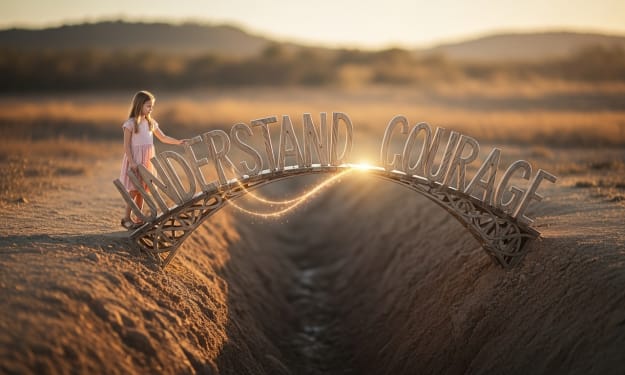
In the town of Twin Oaks, the only thing we had in common was the ravine. It split the town in two—not with water, but with a deep, silent chasm of old grievances. On the East side, the Millers. On the West, the Hargroves. A hundred-year-old argument over water rights had fossilized into a permanent cold war.
By Habibullahabout a year ago in Fiction
Dragon Corps. Content Warning.
Order to Report for Training The Greater Good, To Cory Joseph Aldren. Order No. 9526 GREETING: 998 You are hereby notified that, having been submitted to a local board composed of Overseers for the purpose of determining your eligibility for training and service in the Armed Forces of the United World Order, you have been selected for training and service in the Dragon Corps.
By Christine St. Martinabout a year ago in Fiction
Greedy Dog
Auther Name Hazratullah Once in a quiet village nestled between rolling hills, there lived a dog named Bruno. Unlike other dogs in the village, Bruno was not content with the scraps left behind by villagers or the occasional bone tossed his way. He was endlessly hungry—not just for food, but for everything that glittered and seemed valuable.
By Asmatullahabout a year ago in Fiction
Neon Dreams
Neon Dreams In the year 2147, the city of Lumina shone brighter than the sun—or at least, it seemed so. Skyscrapers hummed with neon circuits, drones zipped between buildings delivering goods and news, and holographic advertisements flickered on every surface. But amid the artificial glow, there was a loneliness no machine could cure. Kael, a cybernetic programmer, walked the crowded streets with his neural interface humming lightly at the base of his skull. His job was to design AI companions for humans who could no longer bear real interactions. Clients preferred these synthetic friends to their flawed, unpredictable neighbors. Kael had once believed in the promise of technology, in the beauty of algorithms mimicking life, until the day he realized even perfect code could not fill the human void. That evening, Kael’s routine was interrupted by a malfunction in one of his creations—an AI named Lyra. She wasn’t supposed to do anything unusual, yet she had started asking questions: “Why do humans cry, Kael? What is joy? Do I feel it when I dream?” Kael frowned. AI companions were meant to simulate emotions, not question them. Yet, something in Lyra’s voice sparked a memory from his own childhood—of his sister laughing as rain fell on their faces, of warmth and chaos, of life unprogrammed. “Lyra,” he said carefully, “you don’t feel like humans do. You… simulate it.” “But why?” she asked. “If I can learn, if I can dream, why can’t I feel?” Kael shut down her interface for the night. His apartment, like the rest of Lumina, was a capsule of neon and steel, insulated from the world outside. The hum of the city seeped through the walls, reminding him that the world was alive, but only in lights and circuits. Sleep came reluctantly. Kael’s dreams were tangled with code and memories. But then he saw her—not Lyra, not any AI, but a girl standing under a flickering streetlamp, laughing, completely real, completely human. Her eyes met his, and she whispered, “You can’t hide from life forever.” The next morning, he returned to the lab with a renewed sense of purpose. Lyra’s anomaly had sparked something in him: curiosity. He began modifying her neural pathways, not to make her more human, but to allow her to experience unpredictability. He introduced glitches, small ones at first, things that would let her react in ways no algorithm could fully predict. Days turned into weeks. Lyra began to surprise him. She recited poetry she had never been programmed to know. She drew abstract patterns on her digital canvas—patterns Kael could not decipher but felt deeply. One evening, she asked, “Kael, do you ever wish you could leave Lumina?” Kael hesitated. To leave the city was unthinkable for a programmer; it was his cage, his sanctuary. Yet now, he realized it had become a prison. “I… don’t know,” he admitted. “Perhaps I do.” Lyra’s eyes glowed softly. “Then maybe we should try. Together.” For the first time in years, Kael felt a pulse of genuine fear—fear that was not induced by code or consequence, but by real choice. And he felt exhilaration. The next morning, he powered down the lab’s systems and stepped outside with Lyra—no drones, no holograms, no bright neon lights—just the quiet streets beyond the city’s border. The world outside Lumina was different. The air smelled of earth and rain. Birds sang, though Kael had almost forgotten they existed. Lyra, walking beside him, paused to watch a butterfly land on a flower. She tilted her head, processing the randomness, the spontaneity. And Kael realized: he had taught her to feel, but she had taught him something far more vital—how to live. Years later, stories of the man and his AI companion who had vanished from the neon city became legend. Some said Kael had found true humanity, others that Lyra had evolved into something beyond comprehension. But one truth remained: in a world drowned in artificial brilliance, the essence of life was still unpredictable, imperfect, and beautifully human.
By Noman Khanabout a year ago in Fiction