


Let me tell you, reader, how I got here, in a sterile house of mirrors full of endless halls with endless rooms and locked windows and men in lab coats walking up and down and in and out of these endless halls with endless rooms. I don’t belong here. The others stare like tired zombies out onto the parking lot of Honda Civics and Toyota Corollas. Some of them laugh to themselves even when nothing seemingly funny has happened, or worse, nothing at all.
The food tastes like someone lost the salt shaker. The smell of 99% ethyl propyl alcohol lingers in my nostrils as I doze off to sleep on my old, worn-out mattress marked by years of abuse by other sorry souls. Every morning as I drift from my dreamlike state back into reality, I wonder how I let things go so wrong.
It started early last summer. I had recently acquired my degree in horticulture and saw before me endless possibilities in ecology or forestry or farming or design. I could even work in a nursery or greenhouse or maybe start my own retail plant store where you could also buy books and coffee. The possibilities were vast, and my heart was full of hope and optimism.
Unfortunately, my dreams were interrupted by a letter from Uncle Sam informing me that my student loan payments were about to kick in. It was time to find a job, any job. I quickly secured a summer position on an estate in Newport, Rhode Island, in turf maintenance. Before I go further, I should explain that I am a 125 pound, 5’4” female with a size 26” waist. All that to say, I didn’t exactly share the stature of the burly, rough men I would be working with. Why did they hire me? I’m not exactly sure. It could be for my knowledge and degree, or possibly my assuredness in my ability to handle a walk behind mower, or it could be that someone, somewhere, complained about the lack of women in their department and they feared that if I wasn’t hired, I would sue. Whatever the case, I got the job.
My first day, walking into the locker room, I felt the glare of 30 skeptical eyes fall upon my meek frame. Immediately I felt the need to prove my worth to those men who looked at me like they were already making bets on how long I would last into my first week on the job before quitting.
It was unusually hot for mid May. A man named Phillip showed me the ins and outs of the 48. That just meant that the cutting deck of the mower was 48 inches wide. They had terms for everything that made no sense to me. I called the front end loader the big scoopy thing and the backhoe, the small scoopy thing. The step van was the ice cream truck because, well, it looked like an ice cream truck. It was a new language I didn’t bother learning as I assumed, as these men did, that I wouldn’t be in this foreign environment for more than a summer.
After Phillip was done explaining the levers, belts, and grease points to me, I was ready to take this 350 pound beast for a test run. It roared as the blades began spinning. Even through the muffled noise of my ear protecting headphones, it sounded like there was a helicopter hovering below my feet. As I squeezed the levers to begin moving forward, the machine jerked and sped ahead, pulling my skinny arms with it. I quickly let go, and the whole thing shut down, a safety feature built in for callow trainees like me.
Phillip smiled as if he were satisfied with his predictions. “It’s ok, try again,” he grinds through his teeth, holding his laughter.
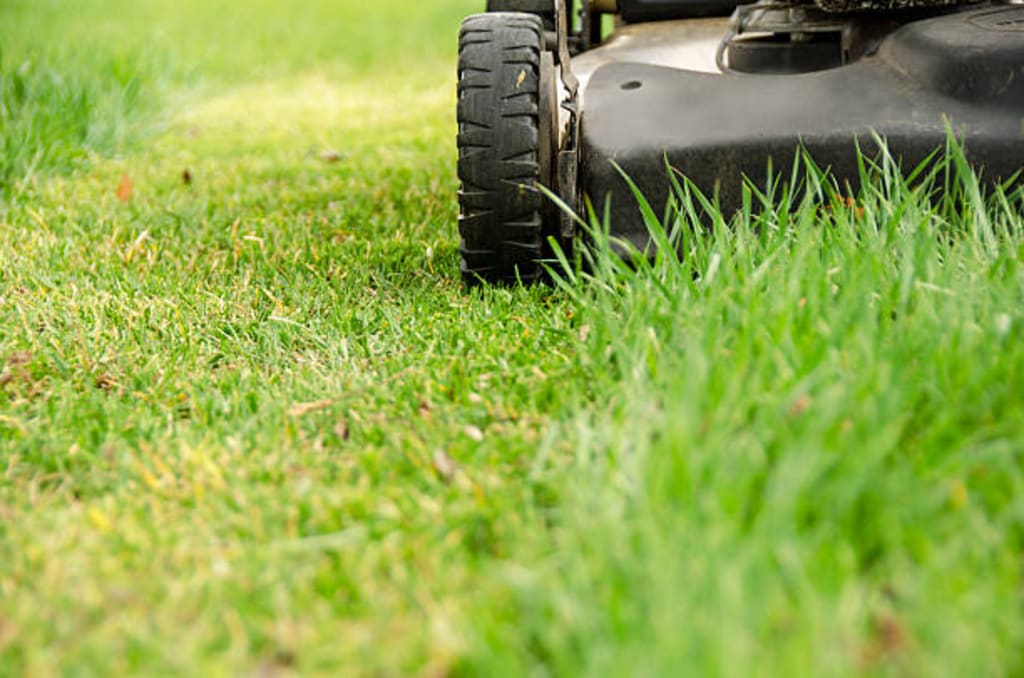
I gripped the machine firmly, took a deep breath, and squeezed the levers, slowly this time, ensuring a smooth start. The beast moved forward, and I walked along with it. My grandmother with two fake knees could have kept pace with me for how slow I was going, but the point is, I was going and in control. As I inched forward, one slow motion step at a time, I looked behind me. A smooth, even, blanket of grass lay in my wake, 3 inches high and 48 inches wide. It was beautiful.
I won’t bother you with the details of me learning how to make turns, go up and down hills, or get this thing on and off trailers for transport. Each step preceded the next, each giving me more confidence as I slain the next dragon. By the end of the week, I’m pretty sure every one of those guys had lost their bet on how long I would last. Yes, I was unstoppable! I showed myself that I could do anything, even the tasks people often deemed unsuited to “nice young women.” No one could stop me! After that, I easily picked up the backpack blower and the string trimmer. I felt fearless.
Of course, that’s when the problems began. I was becoming obsessed. I was obsessed with the perfect line and cut. Every pass I made on the lawn had to be exact. If your line was curved, it was called a banana, hence the shape, and that was bad. If you overlapped your last line, it was inefficient and could leave tire tracks, so that was bad. However, if you left any space between your last pass and this one, you would leave a thin strip of grass uncut in the middle of the lawn. They called that a mustache, and your lawn would start looking like Gomez Adams, which was very, very bad. Your edges also had to be perfect. If you couldn’t get the machine all the way up to a wall or lamp post or the edge of the concrete, you would leave what looked like a Hawaiian skirt around the side and have to go back in with the string trimmer.
Oh, the string trimmer! There were two things you could do with that machine. You could do what we called flat topping, meaning you cut the grass at the same height as the mower, a skill of precision and accuracy. Or, you could do what we called edging, meaning you turn the trimmer sideways and run it along the edge of a lawn, creating a perfect, 90 degree angle.
All of this detail may appear boring to you, but to me, it was exhilarating! Like an architect building a base plan, I needed perfect lines and measurements. Like an artist painting on a canvas, every stroke of the brush had to be intentional, every movement meaningful. Like an army rolling out their tanks, our fleet of mowers left the garage every day at 8am with a mission to accomplish. We were at war with the sun and the weeds and the ever growing blades of grass, which had their own agenda to grow faster than we could cut them. I stepped out like a soldier in a sunhat, ready to vanquish the enemy!
As the summer drew on and the days got longer, the heat became more intense. One particular summer day hit harder than others. It was early August. As the midday sun reached its peak over my head, the gallon of electrolyte water I consumed that morning gushed out in steady beads from every gland on my body. My sweat soaked shirt was useless in the still, stale air, without a gust of wind for miles to lend reprieve to this weary soldier. The dense humidity hindered my breathing, forcing each inhalation of my lungs to work harder than the next.
As I cut, each blade of grass seemed to have its own personality, collectively taunting me, bobbing up and down, laughing in a high-pitched squeal as my machine moved over their heads, each performing their own furtive limbo. My anger rose, and I lowered the deck height by half an inch, bringing my blades down further towards the ground, making a second pass over the South lawn.
I turned around to find a battle field of carnage. Lowering myself to the ground, I gazed laterally upon my work, expecting a straight, uniform sea of green. But as I looked closely, I found a few enemy soldiers still hiding among their broken peers.
“I’ll get them!” I thought to myself, or maybe I said out loud. I can’t remember. I only remember the feeling of my face burning and turning red, whether from the rage or the sun. I lowered the deck height again, and again, and again, each time finding more previously unseen foes.
The following hours were a blur to me. The blades spun like three machetes below my feet. Sweat mixed with sunscreen, melting together on my forehead, cascading down my face and stinging my eyes. Salt accumulated on my upper lip. Dirt lined my hair and my chin as it flew back into my face from the bowels of the snarling beast. Mockingbirds mocked me while other birds squawked like the audience at a UFC fight. The world spun and my vision doubled. I had truly descended into madness.
It’s a shame no one came to check on me sooner, for perhaps my job and even my sanity would have been spared. However, by the time Phillip came to see why the West hill remained uncut, it was too late. He showed up to find a once lush lawn, scalped down to brown nubs. Months of hard work seeding, watering, and fertilizing were gone in a matter of hours, not to return until next spring.
Of course, I was immediately fired. Looking back now, I can’t blame them. However, at the moment I was furious. Still in my fit of madness, my ears steamed as I cursed my way out the door. I wish this was the end of the story. I wish I had simply walked away and moved on with my life. However, as you can guess, this act alone wasn’t enough to land me a bunk in Mother Mary’s Psychiatric Hospital.
I just couldn't get past it. Those snarky little blades of grass taunted me as I was escorted off the premises. I tossed and turned in my bed that night, still hearing their petulant voices in my head. Without thinking, or even recognizing I was conscious, I sprang from my bed and into my car. I had to get back to the estate and silence the squealing laughter of those pesky jokesters.
It was around 5am when the grounds manager, Robert, arrived for work to find a short, brown, patchy sprawl of land and me in a sun hat, steel-toe boots, and silky pink pajamas, muttering to myself and walking behind my 48 mower, blades on full speed.
That was three months ago. The police arrested me for trespassing and destruction of property. We never went to court. My lawyer said if I plead out, I could get away with just a few months in this place and some community service, though no one will let me near the parks.
I understand why I was arrested and that what I did was wrong. I also understand that the grass has no power of speech or will. It can’t taunt me or laugh at me. It can’t limbo or duck and swerve away from the mower. The grass simply grows, slowly upward, beholden to the laws of nature.
Still, when left alone to look out the window onto the great lawn of this facility, I hear them laughing and joking, saying, “You’ll never catch us!”
About the Creator
Samantha Parry
Samantha is a NYC based writer and actress. Previous works include writing and directing her play, Brothers, Sisters, Husbands and Wives. For more, follow her Instagram, @SamanthaLynParry.
Enjoyed the story? Support the Creator.
Subscribe for free to receive all their stories in your feed. You could also become a paid subscriber, letting them know you appreciate their work.
Comments
There are no comments for this story
Be the first to respond and start the conversation.