
Exile
by Henry Bernstein
He sat alone now. For the first time, he was truly alone. Seated on a boulder, eyes on the grassy tundra around him.
He looked up the hill where his family had stood with the elders and some of the villagers. How long had it been since they’d left him? He could nearly see their colors, their auric wakes like desolate specters in the smokecurled distance. How long had he been sitting here? Twenty runs? A tide? Two tides?
It must have been several tides since they left him, he estimated. The boulder was growing uncharitable against his bottom. He shifted, then decided to stand. He peered out at the top of the hill. If he trekked over it, would he see his family waiting down there on the other side? Was this some test; some cruel prank? Then they would approach and hug him and ruffle his hair, present him hot food and warm clothes and tell him he passed their callous checkpoint and could come home. But he knew this would not be the case. What was done was done.
He recalled the glare in his father’s eyes. It flickered and spangled like dying flame at first. Battlefield rage, all those years pressuretight, escaping now at his only son. Then Blackfoot noticed a change at the councilmeeting. His father no longer glared at him. He did not even look at him. This was somehow a thousand times worse. His father merely looked at the ground, eyes doing nothing. Surrender. To see the old Captain surrender hurt Blackfoot’s soul, even if that captaincy was rooted in, as he saw it, malignant soil.
His mother was not angry. Never angry. She was the calm shore to his father’s tempest. Always had been. She soothed the man’s heart. But now she would not touch her son. The Great Spirit forbade it, she said. He was marked now for what he did. He heard her weeping at night, those 3 sleepless nights in the suspense of his infamous curtaincall. It was 3 nights that he waited for his verdict, sleeping in his childhood room in his family’s hut while guards stood outside with spears and arrows. As if he had any more escape on his mind after what he’d caused his family.
The only one who had his back was his little sister, River Eyes. She was only 15 harvests old but seemed to know and see things beyond her precious walls. Her mind was independent, for which Blackfoot took silent credit. All those years in their rooms after dark, reading to her forbidden books which he’d procured from Amos behind the Burial Ground. Amos is a slave’s name, he said. Yes in my body but my mind is unchainable. That was how it started.
His crime? It was not, at least to him, a crime at all. Not in the true sense of the word. But in the village there was no due process, something he’d learned about in one of the books. And so by collective authority he was condemned. His crime was that of treason. He was a deserter.
Desertion was upheld as the most heinous thing a young man in the village could do. They knew this from the lessons, drilled into their brains from the time they were younglings. Every boy of 17 harvests was expected to join the village brigade. It was considered the highest honor for a male. Do you not wish us to prosper? To carry on? Do you not pray to our Spirit and hail our flag? And what of the barbarians on the outskirts? Should they reach us without resistance, imagine the carnage. Think of the women and children. Imagine the holy Burial Ground. Rejecting the honor to serve, then, must be the worst possible thing he could do. And he had done it.
It had been on his mind for some time. His mate Starkid had first said it outloud; Blackfoot echoed that they’d both been thinking it. Starkid was the kind of mate one aligned with from boyhood, even though such friendships were frowned on by the elders. Friends are dangerous, they said. Starkid mentioned his secret vision weeks before the raid. The pair never devised a plan, the oversight at the guardhouse being nearly omniscient. But Blackfoot’s imagination was like a stampede, and soon his private moments were fecund with defiance.
Then the raid was in place, and Blackfoot knew his impending mission. He knew what would happen down in that valley. There were women and children in the encampment. The nomads were a tribe of peace, they hadn’t even weapons. Yet somehow they would become enemies? Prophecies written by the elders were injected through the guardhouse in scriptures and diatribes like slanderous tentacles. These particular nomads were on the verge of knowledge, the precipice of ambition, and ambition soon becomes threat. They would turn on the village, the gleaming capital on the hill. The impure need a host to survive but the pure do not. These were his instructions and he finally saw them for what they were: propaganda. He’d never heard the word before; now it sang to him from his books at night like a voice in his head, rousing him to act.
He made his decision alone. He did not want to implicate Starkid. That night would be the last time he would see his dear friend. Had he known, he would have arranged it differently.
He packed his things and exited the guardhouse. Impersonated a sentry, faked a night mission into the woods, ran down the road back toward the village. Entered the village upon a false message for the council. Slipped down the main trail, between the huts and into his home. Told his noctambulating sister to go back to bed. Told his parents in the morning he’d been wounded. No, don’t touch it, it’s bandaged. He took refuge in his room, closed the bamboo door, his head whirling and thrumming, his lip a-snarl.
The next day around highsun there was a knock on the door. It was only a matter of time until they came. He just didn’t anticipate so soon. He had a vague blueprint to escape back into the woods, but had not yet connected an explanation for his family. And on some level he’d already acquiesced. The desertion was his act, and if he was not there to see it through, what kind of protestor would that make him? This was where he wanted to end. The hut in which he grew up. Where he’d found his Tree of Knowledge in those forbidden pages, all those cosmic teenage nights. The hut where his sister lived.
He heard muffled conversations in the main room. The energy of the event shifted ponderously and angled toward his door. His parents did not have a chance to lie for him as the guards charged his door; he wondered if they would have. He sat in his bed cursing his life. Cursing the place in which he was raised.
For deserters, everyone knew, the punishment was execution. But because his father had served honorably and was even considered a war hero in village folklore, the council decided to spare Blackfoot’s life. He was instead sentenced to exile.
They traveled 50 plotniks from the gates of the village and deposited him in a land that was unfamiliar to him. When they removed the blindfold, there was his family a ways away, staring down the hill at him. Others from the village stood there as well, people he recognized as elders and ranking officers. Then they left. And now he was alone.
He hiked to the top of the hill and sat, gazing after his vanished family. As the snow began to take shape along the outwoods, he wondered if exile was worse than death here. He had learned of this land as a child. It was the land of the inedible. The berries and mushrooms were poisonous. The leaves malnourished, the roots said to cause dysentery and insanity. It was too cold and dry, especially this time of year, for any reasonable organisms to make their home. The air was wind-driven and inhospitable to fires. The land of his exile was a wasteland, a stage on which slow painful starvation and death were the only natural conclusions.
He was a student of survival, having spent now 2 years in the brigade. Though he’d come to reject their ideology he remembered their expertise. Reading of maps and directional markings. Tracking, hunting, how to forage for tinder and nourishment. Moreover his father and grandfather had taught him the ways of the woods. They taught him animal calls and windspeak. He could tie a knot in 16 different forms, skin a bear, and hit a target from a hundred paces with one eye closed. But all this knowledge would help him none if there was no sustenance to harvest.
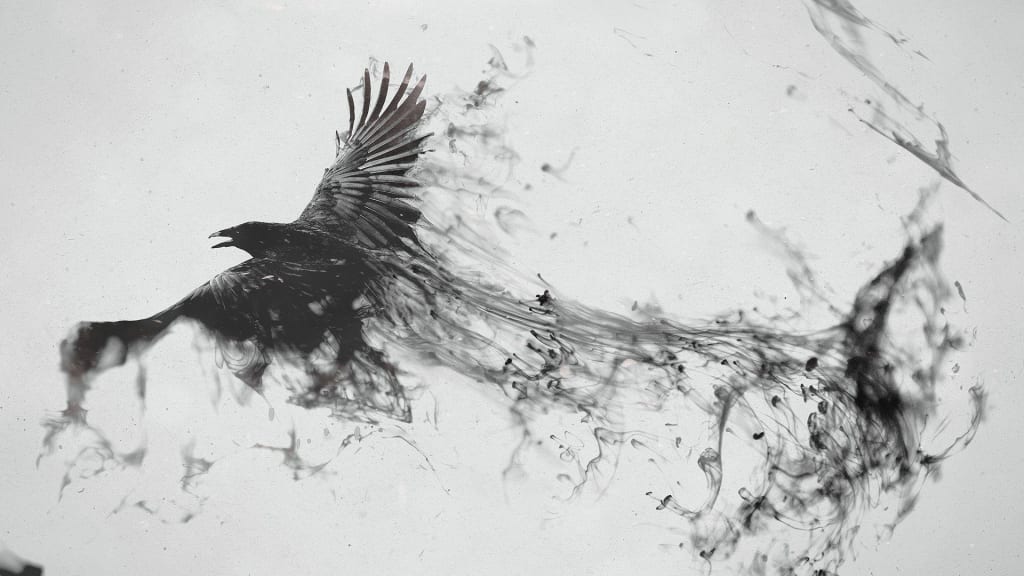
Above him a bird circled. A single black bird. Too small for a buzzard. Must be a raven. Great, he said to himself. I’ll be dinner for him in a few days. Looking back, it was curious to Blackfoot that he had not felt fear when he made his decision, nor when he was discovered, nor when the guards confronted him with spear tips in his childhood bed. It had simply been what he was supposed to do, written in the inertia of his conscience. But now, for some reason, he was terrified. Now in the solid of consequence. He shivered and sniveled against the cracking wind. He wrapped his arms around himself and began to rock back and forth on the boulder, slowly decomposing.
Just before they left him, his family had been allowed to give him 3 items. That was the rule, apparently. The elders put no restrictions on these items. What trouble could he possibly make out here, anyway? His father was too ashamed to take part, so his mother handed them to him. The first was a single blade carved of thighbone, 2 fingers long. He holstered it in his waistband. The next was his grandmother’s sheepskin blanket. He wrapped it around his shoulders, nose dripping, hair across his face. The third was a prayer book from the Rain House. He took the prayer book and ripped it up on the spot. Some of the elders gasped. His mother wept. His father did not look.
How could a just god punish someone innocent? he said. While the nomads die under our swords? How could a true god stand with us? The crazed onlookers said nothing.
I support you, Blackfoot, said his sister. His mother yanked her away.
He trekked to the sparse woods. It was about about five hundred paces. The trees were skeletal banda trees. They were shaped more or less like human ribcages. These mystical trees needed almost no sunlight or rain to exist for thousands of years, or so it was said. Of course everything he knew was in question now.
He found branches scattered on the forest floor and with them tried to make a fire. It lit, but lasted only 20 or so flights before failing against the snowy wind. The air was dense with snow and ash, but the ground held almost no water, creating an ecological paradox that proved discourteous to his needs. The low plains ached and howled in the distance.
He found a dead thicket and curled up under the blanket, wondering if he would survive the night. He began muttering to himself. Wishing for help. Yearning for a sign. Invariably his thoughts turned to the Great Spirit. It had been months now since they were on speaking terms, but out here there was no one else to talk to, and he was lonely.
Why, Great Spirit? he said. Why have You put me in this position? To carry out tasks I know in my bones are evil. And why, even then, do I understand evil at all? If it is taught to me as good, then why am I made to reject it? You put me in this impossible riddle, this horrifying maze, and still, I turn to You. Why do I turn to You still? Do You even exist? How do I know You exist? Because of my ancestors. They consorted to bring You to me. And what of them? Of my ancestors, who are said to watch over me with Your blessings? Are they here too? Or have they turned their backs on me as my living family has? Am I being punished for putting all this on their name, and on the lives of Mother and Father and little River Eyes?
And then he said, Evil is not evil in nature, nor is Good good. They are just words. A spurious code devised of two tongues. An intricate game to be played by fools. Spittle flung from his mouth, tears stung his face. And if it’s all a lie, then what? What is this existence? A ruse? A mistake? A flaw? A great nothingness exemplified by the terrain that hovers before me now? Barren wasteland, just like this deathly place. Maybe that’s it. It’s all just vacant. All of this, meaningless. That’s what I’m supposed to see out here. There is no puzzle to be solved, there is no answer in the end- there can’t be if this is the game to get there. Man floats in an empty void, he battles each day with emotions and callings that inevitably lead him to his demise. Some stumble upon life, passion, luck, and what we perceive as justice. Nay, conceive as justice. Because yes, justice can only be conceived by such a self-deceptive creature as man. The human mind is the only place it exists. Nowhere in nature does one find justice, or fairness, or any semblance of equality. Some conceive of it here in this aimless crypt, while others, like myself, the unfortunate recipients of the ruling forces of cosmic randomness. And we must bear the burden for the lucky ones.
At some point his bitterness became exhausting and the sky darkened and he fell asleep. His dreams were furious and indiscriminate, pulling the hunger he would soon face to the front of his conduction. Wagons of fire whisked him away, denuded virgins told him he was nothing. He dreamt of his sister’s eyes looking back at him from the hill as he melted into quicksand. At one point he was kneeling and then supine, the rock beneath him glowing with golden warmth, and found himself armlocked with an angel. He did not know the angel’s name or see his face, but he could tell by the purity of his hands and feet that he was a creature notwalked in unholy places.
He woke. Light on his face streamed in through the branches. He did not know how long he slept or when it was in the day. He could not find the sun beyond the pale of whitegray fog. But he did feel some sense of renewal. A fresh rhythm in his heart, a new urge to find salvation. In his talk with the Great Spirit, they had come to some minor resolutions. At least, he felt he’d gotten some things off his chest. Whether he’d been heard was largely backstory. Blackfoot gazed up at the clearing in the trees. No raven overhead.
He crawled and peered out from the bush. Then he saw it. The raven was perched on a far rock. You again. It took flight before he could move and resumed its deathly halo. All the logic from his good dreams vanished. The Great Spirit will not save me, he remembered. I’m marked.
The sunlight met him as he climbed out from the bush. Barren plains in all directions. He set out to explore. He found mostly rocks. Flat ones embedded in the mossy ground, larger ones smoothed and curved by the years. Here and there an island of jagged boulders like reverse oases rising from the bald white swells. He lifted some of the smaller boulders finding fungi and pressed worms. No insects, no other wildlife. The air was grim, ashes floating across his nose. Are there any creatures in these mountains? he said. There must be. The creatures of this world can adapt to all environments. In the deepest waters and darkest caves there is life. There must be here as well. Or were all the books wrong? Is this pitiful wasteland all there is beyond the village?
Finally he found something that stood out in the wispy gravel. Hoofprints. His heart leapt when he saw them. Big animals, he estimated. A small herd by the looks of it. Horses? Domesticated? But where? He continued to scour the earth for signs. He followed the hoofprints to a nearby rocky peak and gazed over the landscape, but saw nothing. They seemed to disappear in the gravelly slope.
Rrraaaahhh! he shouted, hurling a rock. Then another. Then another. Being so close to any kind of lifeline was a new form of torture.
Later that day.
Hours, he walked. Plotniks and plotniks across the barren hills. A wooded outgrove here, some boulder pits there. No sign of higher existence. He followed some scruff trees down into a valley. A small stream trickled through. Life, finally. It was small in size but incalculable in his journey. His throat cracking, lips bleeding in thirst. But he hesitated. He remembered what he’d learned in the brigade, and from his grandfather. In a place like this, evil mushrooms could grow in the water, tainting it for humans. If he was to be poisoned it would be in these gothic hills. He walked upstream, eyes searching. The stream was small at the source, barely a drizzle. He spotted the origin of the water- a small lip of ground that was covered in snow, melting into the crevice. He found nothing in or around the water that should concern him. Still cautious, but feeling slightly more optimistic. He finally got on his hands and knees and cupped the water into his mouth. I’ve peaked, he said, slurping. Blood from his lips ran with the water through his fingers into the stream, sullying it for the next to be exiled here. Gathering his wits, he tried to peer beyond the validation of the moment and discern if the water tasted askew in any way. He didn’t think so. He drank his fill.
Soon it will get colder, he knew, and this stream will be ice. Then what? A bridge to cross, but not now. It was imperative he keep moving. He had to find food.
His stomach moaned. He realized he’d never experienced true hunger before. Appetite, yes, but never famishment. His family and then the brigade had fed him appropriately. Now an unfamiliar haunting was starting to set in. A pain in his being like nothing he’d ever felt. Like he was being eaten from the inside.
The sun was shelling under the hill behind the whiteness. The sky began to darken again. He found refuge on a dusty hill under a rocky overhang. He lit a small fire and fell asleep under his grandmother’s blanket.
The next morning he woke. Snow tickled his nose and eyelashes and whitened the scene beyond his hill terrace. The sky was gray, so everything was gray because everything was the sky here. He looked up for the raven and sure enough there it was, circling him. The only thing he could count on here was imminent death. How close or how far was the only question. Even in this lonely place, he said, you find the one misfortunate soul to taunt. Why don’t you at least let me die in peace? Had I wanted a companion to watch me die, I would have stayed at the guardhouse.
He hated the bird for being here to profit off his misfortune. He hated everything. He knew he would need to find food today or he’d die soon.
The hunger reported in his sides and stomach, blunting his mind as soon as he lifted himself. The angles of his rest were pounding and cramping against his rocky bed. As he emerged from the cobwebs of his slumber the hunger continued into his wrists and ankles and his very spirit. How many days had it been without food now? He couldn’t think, couldn’t remember. Time was different now. He gazed out toward the edge of the hill, his vision blurring and largely unreceptive. The thin woods to his rear friendlier than the vast tundra over the cliff which he did not have the energy to comprehend. Through the woods he spotted a Quetzalcoatl wielding a spear. It pranced among the trees then disappeared. He pressed his eyes shut and back open. He was so hungry he was seeing things. There in the corner behind the boulder was Starkid’s ugly face, and with him Longbow and Littleone. They were mugging at him, laughing, throwing him beefchips that disappeared in the air. Then they were gone.
In a fleeting glimpse he saw River Eyes staring at him from long ago, her little sunkissed forehead wrenched in concern. Then she was gone too.
A native tribe, architects of a thriving and cultural village, were once burned alive in these hills. Perhaps on this very spot. The last members cursed the land for eternity before they perished. That’s why it was so gray and desolate. No more wildlife. Was that story true? Or just a dream? Where had he even heard it?
He remembered the last meal he’d had before exile. Hearty steaming stew in a redclay bowl, large chunks of savory beef and poultry and vegetables. He gobbled it with a wooden spoon, mopped up the bowl with bread. He could smell and taste it. It swam in his vision like divine coals on a prairie. It had burned his mouth.
Are you a reductionist? Do you reduce everything to its simplest terms? Because really, your mouth is just a hole in your face. You don’t want to be a role model in your community? No sir, I happen to hate my community. Blood in, blood out. I am a celebration of conflicting substances. I smoke keyoka on Burial Ground and drink wormwood at night. I converse with Christians and alchemists, then live on the fruits of my people. And if you are going through Hell, as they say in the West, keep going.
Do you pray? Then pray. Now is the time if ever.
He understood himself now. He was never meant to get out alive. He was always just a resource. A mere backup, a stockpile for those above him. And now he was the only one around, and still, he was a resource. Human chattel to be expired at the whim of conquest.
The only way out of this mess was to fly. He saw it clearly now. He would not make it on foot. He had to acquire wings. He knew from his books that to fly one must give up everything that holds him down. Sacrifice. But a small sacrifice for a great goal.
He looked down at his own arm. He considered it. The blade felt firm in his hand. Maybe he could start with just a piece of his bicep. Or maybe his thigh. He was athletic, a firm jumper, had a broad base and large legs. He could certainly manage to lose just a piece of his leg. Human muscle, so forbidden, so tempting, potentially delicious. The final fruit. Forbidden now such a silly concept in the face of death.
In the top of his view, the black bird hung. It vocalized, then floated down and perched on a banda tree.
Look who, he said. You’ve courted me long enough. Let’s see if you’re man to finish the job. He headed to the tree. Placing foot in hold and grasping upper branch, he remained cognizant to conserve as much energy as he could. It seemed his forward motion snapped his self-destroying reverie and had put at least marginal human sense back in him.
The raven sat on a branch, its back to him. Somehow he was silent and deliberate enough to avoid alerting it. It jerked and blinked with mocking sagacity above him. Its head twitched from side to side, but never down at him, and he climbed closer. He lifted the blade. He knew he had one shot. If he missed he’d certainly scare it off, maybe forever.
Suddenly it turned to him, its head rotating entirely on its black glittering body. It stared direct at him and cawed. The suddenness almost sent him off the tree. He clung with all his life. It sat fixed on the branch and stared at him. Rraaakk it said. Again. A third time, it’s throat puffing. He noticed up close it appeared gaunt and disheveled. Starving, like him. Then it was gone, flashing into the air away from the tree.
Wait!
It lifted and flapped into the gray far. Across the desolate plain, toward a valley in the distance. It was now about a hundred paces away. He followed it. Now three hundred, now five. He picked up his strides. His heart raced; he ignored his warbling stomach and buckling, splitting sides. The cold air burnt his lips and face, hair flashing back on his scalp. The wind had ceased; he was the wind.
The bird dipped across a valley where it flattened out and began to circle again. Blackfoot hurried to the crest that overlooked the valley. The bird cawed again, circling lower. Blackfoot looked down.
In the valley lay a formidable creek, far wider and presumably deeper than the tiny rivulet from earlier. What was left of his mind nearly left him when he saw what was at the bank of the creek, what the raven had led him to. His hoofed ghosts. An entire herd of elk, feeding. Dinner. For both of them.
He looked back up at the raven, tears in his eyes. Snowy wind whipped his face. He turned his gaze to the gray heavens and spoke to the Great Spirit.
About the Creator
Enjoyed the story? Support the Creator.
Subscribe for free to receive all their stories in your feed.
Comments
There are no comments for this story
Be the first to respond and start the conversation.