
There are three facts that I learn about my biological father while I am growing up:
1. His name is Shahryar Khani, but he goes by Shar.
2. He is Persian-Jewish.
3. He wants nothing to do with me or my mother.
The fourth fact I learn is that he cracks his neck at the dinner table. The first time my mom notices I do this, she turns pale like she has seen some kind of ghost.
I crack my neck both ways before diving into my mom’s pork adobo, fatty pork stewed in vinegar, soy sauce, garlic, and bay leaf. Every Filipino American kid always thinks their mom’s adobo is the best, and I am no exception.
“Are you sure you have never met your biological father?” she asks me, her eyes turning into slits.
“No…” I am perplexed by this question. It’s actually quite preposterous. I only know those three things.
“Why do you ask?” I ask her, and I smile because I can feel I am on the verge of learning a fourth fact.
“Your father used to do that,” she says, “Crack his neck at the dinner table.” She is lost in a memory as she says this, and I stay silent, hoping she will volunteer more information. My mother does not, however, and I do not know what else to say, how to find out more.
Growing up, my mother rarely gave me information about my dad. Even then, it is stated simply without brouhaha, with as much kindness as she can bestow.
The first time I ask about him, I am in kindergarten. I attend a Catholic school so all the other kids’ families are very traditional. I am the only child who does not have a dad. My mother raises me with so much love and happiness that I don’t know other kids I meet will have dads. I’m unaware it is an anomaly to grow up without one.
The teacher assigns an art project: draw your family. So I draw my family: my mom, myself, and our Chow Chow puppy, Tobie. Mine is a small family by comparison. Most of the other kids have two or three siblings, in addition to a mom and a dad.
One of the girls in class sees my artwork and asks, “Where is your dad?”
“I don’t have a dad,” I reply simply.
“But you have to have a dad,” she looks at me wide-eyed.
“I don’t have one,” I tell her.
“Is he in heaven?” she insists perplexed.
I bring this question home with me to my mom after school that day. This is a story that my mom recounts to me more clearly than I can recollect. My mom tells me that I do have a dad, but he is not around. And in my young brain, that is enough information I need on the subject.
My mom took care to never speak of Shar unless she had to. When I grow up and ask more questions, she never says anything negative. She tells me, “Even though he is not around, he is still your father.”
In this way, she allows me to draw my own conclusions. As my birthdays pass, I blow out candles, and I wish for him. I do not tell my mother this, but I never need to. This is something that she already knows. It is something she wants for me too. With the sparse information from my mother, I wait.
I am ten, and I watch The Princess Diaries repeatedly. I fantasize Shar is the crown prince of Persia. I am the first-born and rightful heir that will inherit the crown and the throne, and my grandmother (who is also Julie Andrews) will soon come to prepare me to take the throne.
He never came. Neither did Julie Andrews.
Shar is friends with my godfather, whom I call Uncle Ali. Uncle Ali is a large bull of a man who always wears cheap brown suits. He adoringly refers to me as his “little bambina cappaccina.” He is Persian Jewish, and he is the one who introduced my mother to Shar at a party. Anything I learn about being Persian or Jewish, I learn from him. The first thing he teaches me is that I am Persian Jewish, not Iranian. He tries to explain the importance of this, but it is too complicated for my young mind to comprehend.
“Yek, do, se, char, panj,” he teaches me how to count in Farsi. Most of our family and friends speculate that he is, in fact, my biological father. He is very present in our lives. He is over for dinner all the time. Whenever we are sick, he is there. One time, my mom and I both had a cold, and he made us soup. It is not good soup, like my mom’s, but he made it to take care of us while we were unwell nonetheless.
Uncle Ali is the one who informs me that Shar has other children. This news makes me feel better. I may never meet my half-siblings, they probably will never learn of me, but I am not an only child anymore. When the other kids say things like, “you don’t have brothers or sisters,” I can tell them I do; I just don’t know them. Just like my dad, they are not around.
Father’s day is always the most awkward holiday of the year. I hate this holiday. There is always some art project around Father’s day where we are told to draw a picture or write a letter or do something for our fathers. I am the only child in class who is at a loss when this day rolls around. My second-grade teacher approaches me because I do not know how to start this art project. There is glitter and glue, colorful pipe cleaners, and construction paper laid out on the table before me. The assignment is to draw yourself with your father in a card that we will gift him after school.
One of the other kids volunteers this information on my behalf, “Hannah doesn’t have a dad.”
The teacher towers over me in my little desk chair, her hands are full with papers that require grading, “Do you have a grandpa? You can make the card to your grandpa.”
“No. My grandpa is dead,” I state this simply, and I can feel that I have made my teacher uncomfortable in the way she flinches ever so slightly the way young children stating simple harsh truths can make adults feel uncomfortable. There are countless people I write to instead of Shar on Father’s Day, like Uncle Ali or my best friend Grace’s dad, Uncle Bill.
In the sixth grade, for an extra fee on top of tuition, St. Joseph Elementary offered after school care – which my mom had no choice but to use on days that I didn’t have a babysitter. After school care is always raucously loud with all the different kids from every grade intermixed playing board games. There is usually a rolling TV stand in front of the blackboard playing adventure cartoons with a religious cucumber and a religious tomato that is barely audible over the din of children laughing and playing.
A girl from my class asks in front of one of the other cool kids, “So, a bunch of us were wondering – what happened to your dad?”
This shouldn’t feel like such a personal question, but it is.
“I don’t know,” I tell her, “He’s just not around.”
She is persistent and nosy, and I don’t really have much to offer to answer her questions. I want to tell her that my dad is a prince that will come one day and marry my mom and make our family whole, but I don’t know that. That’s just a fantasy.
I find his number on the Internet. Sometimes I call him, and he picks up the phone and says, “Hello?”
His voice is low and husky, and every muscle in my body clenches in preparation to say something. Still, before I can even breathe out a hello back, I hang up. Sometimes Shar hangs up first. Did he know it was me? I wonder if he can tell from the silence that hangs in the air. Does he ever wonder? I can’t say how many times I’ve done this.
In my twenties, I find myself my own general practitioner. My new doctor asks me about my family history – asks about Shar. At this moment, I have never been so fed up with my own ignorance about my own father. I find it gives me audacity, a bravery I never knew I had inside me, to find him and ask all of these questions. I find his phone number and email on the Internet. He owns a garment business which makes things easy. I have done this enough times at this point. I find the information I need in under five minutes.
I send a vague email instead of calling. I would like to offer him discretion. I don’t know why I wanted to offer him this courtesy when his absence all these years was anything but discreet. My father’s absence in my life is the invisible pebble in my boot. Sometimes, it is easier to ignore when I am so focused on my journey, but then when I stop, it is there. All I can focus on. Shockingly painful.
Shahryar is unsurprised to hear from me. He tells me the paternity test done when I was born was “only confirmed with 98% accuracy,” like he has placed all bets on the 2% chance that I am not his daughter. It is evident from these messages that English is his second language. It makes me wonder if he would have taught me Farsi like Uncle Ali had tried when I was little.
He says the words, “unplanned pregnancy.” With that, I can empathize. I am an adult now. I can’t fathom what it would be like to have a child with someone who didn’t want one to begin with. Any pregnancy I have will be a choice I make between my partner and myself. I will do everything in my own power so that any child of mine will not be submitted to the kind of disregard he gave me.
Shar declined to send me any photographs of himself. He said he hadn’t taken a photo in twelve years. Since the dawn of Google Image Search, I have played a silly game where I guess which one might be him. I stare at a mirror then stare at these photos of Iranian men and wonder which one might be him. It is hard to say, though, because I have so much of my mother in me.
When I was young, I asked my mother to describe him. She had no pictures either. She told me, “he was short,” and then went on to say that he had a receding hairline from a young age. I have always envied how thick my mom’s hair is, and it’s clear now the thinness of my hair comes from Shar. She then describes what a picky eater he was. He hates Filipino food. That’s abominable.
Shar tells me he is “not interested in any ongoing relationship.” We never developed a bond, he says. That is a pathetic excuse. He actively refused any kind of bond with me. It wasn’t enough for me to want him. To wish for him. Sometimes, that is not enough to change someone’s mind. When I finally open up to my mother about the emails, she eagerly asks me what Shar said. I roll my eyes and tell her about how he said the paternity test was only confirmed with 98% accuracy.
“He is such a liar!” This is the first time she has ever come outright and said anything negative about him. When she says it, I realize she was waiting to have this conversation with me for thirty years.
“It was 99% accurate,” she corrects this grievance very forcefully, “The first time he was ordered to have a paternity test done, he sent someone else. He sent a friend. Obviously, it came back negative. When the courts found out, they ordered that I would have to be there while he was tested to verify the results.”
What an asshole.
I often wonder what kind of father he was like to his other children. It is easy to imagine that he is a shitty father to them, not so different from the kind of absent father he is to me. Other days though, I imagine he is more like all the men who acted as his substitute in my life. Kind and wonderful, and sweet, and proud of me. And when I imagine him this way, it is so painful. What did I do by being born that is so wrong and so terrible that I didn’t deserve any kind of love from him whatsoever? Is his other daughter married? Did she get daddy-daughter dances? Is he proud of her?
Perhaps, parental love is not so dissimilar from romantic and platonic love. Maybe parents must also fall in love with their children, and this is why parents play favorites.
Shar would never know, but there are men who took me in and embraced me as their own child, like my Uncle Bill. They did the job he didn’t want to do, and they did it so much better than him. They loved me and guided me, and showed me what fatherly affection could look like.
My father not being a part of my life is his loss.
Not mine.
I meet Uncle Bill’s daughter, Grace, in kindergarten. To be honest, I don’t remember the moment I met her, even though she is one of the most significant people in my life. I don’t even remember meeting him. Grace and Uncle Bill are both people who have just always been around. Always a part of my life, like most members of my family, even though we aren't related by blood.
For twenty-seven years, there are few people I can look up to in Shar’s absence. Uncle Ali gave me a glimpse of what it meant to have Persian-Jewish heritage. But my Uncle Bill? He showed me what it means to live a life worth living is by doing the things you love doing.
When people ask me why I chose to be a nurse, I never tell them that it was so I could write. I am a junior in high school, and my grandmother has just died. Schoolwork is ten times more complicated than it was before. I retreat by escaping into building my own fantasy world full of romantic angels and angry gods. I craft a world around me on paper, but I start to realize the world I am building is so similar to the one I am already living in.
I question everything I believe about Catholicism. It is easy for me to confess this to Uncle Bill. He believed in God even though he did not go to church. If I can create anything I want on these pages, am I not a god? What does it say about me to write these stories and develop this world in my mind?
My grades suffer by Asian standards. They are good enough to get into a local university but definitely not good enough for an Ivy League. Whether or not I’d get into a prestigious local university is a coin toss. Applying to different colleges is expensive. When we return from my grandmother’s funeral in the Philippines, my mom has offered to pay for all of my undergraduate tuition under the condition that I go to the Philippines to study nursing. If I choose to stay stateside for college, I will be on my own.
Uncle Bill and my mother shared their differences, but they agreed with each other on this one count. For years, I swore not to conform to the stereotype of Filipino nurse. It is a noble profession, to be sure, but it is not what I dreamed of becoming. It is the dream my mother fashioned for me.
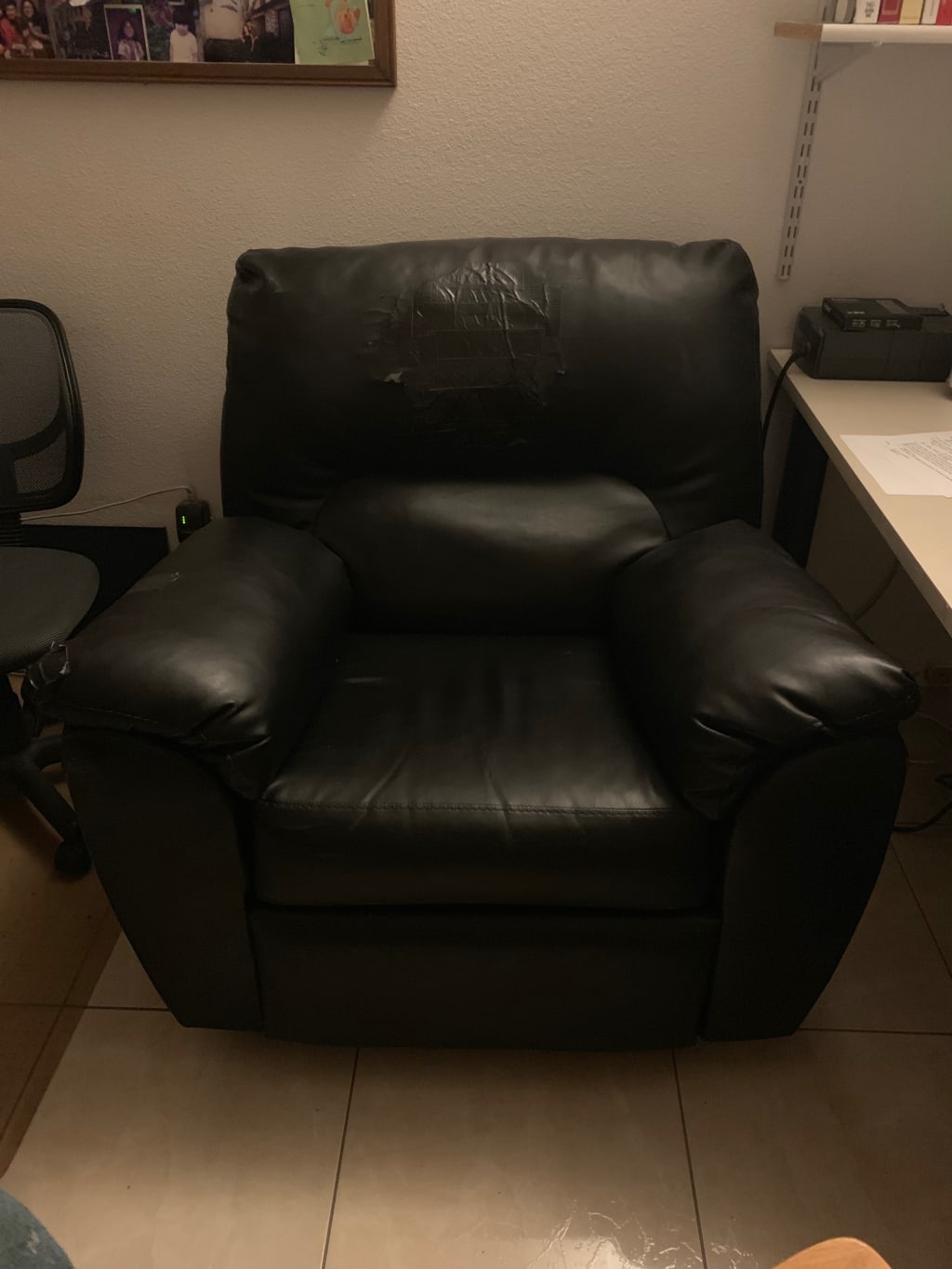
Uncle Bill and I both sit in the upstairs study where there is a whole wall dedicated to books. The shelves groan under the weight of physics textbooks, philosophy, and fiction. A single desk lamp illuminates the desk that divides us littered with notepads, more books, and pens and pencils. A napkin rests on an empty plate from lunch – Bistek Tagalog with half a banana peel leftover from dessert. I sit with my feet tucked under me comfortably in the oversize La-Z-Boy recliner, its black leather is peeling. He sits across from me at his computer station. I tell him about my grades and also the offer my mother gave me in regards to university.
First, he scolds me, “You got yourself into this situation with your grades in this state. It will be difficult to apply for scholarships and financial aid this late in the game. The offer your mother is giving you is a reasonable one.”
I know this too. I resign myself to university in the Philippines, convincing myself studying abroad will be a great adventure. He reasons with me. He gives appeal to the life choice my mother presented me in the most pragmatic way possible, “If you’re a nurse, imagine all of the time you will be able to spend on crafting your passion for writing if you only work three days a week. You do not need to become a starving artist to make your dreams come true.”
His eyes twinkle full of hazel hope as he told me, “Think of all the people you will encounter! Such good writing fodder!”
Nobody was prouder of the little writing contests I have won. Nobody fueled this passion of mine for literature, poetry, and mythology the way he did. In the summers, I spent weekends with Grace while my mom was at work. Our Saturday outings after art class or dance class always consisted of a trip to Barnes and Noble that lasted several hours and occasionally a movie.
I was a bad influence on Grace. Sometimes I'd find all the romance novels and read the dirty parts aloud. I did all the voices. This makes us both giggle, but it also makes older white ladies who pass by give us the stink eye and tell us how inappropriate we’re being. Usually, Grace and I peruse through stacks of shelves and pick several to start reading. We have a usual spot in the children’s section with a sitting area where they usually host reading time for little children; it has been crafted to look like the Hundred Acre Woods from Winnie the Pooh on a raised dais in front of little wooden benches. He always knew to come find us here when it’s time to go home, our noses shoved next to pages. We were allowed to pick one book each that we got to take home and we always made sure to pick different books so that we could trade afterwards.
Uncle Bill and my mom took turns bringing us to children’s book clubs and Pizza Hut to avail our free pizzas for the number of books we would read over the summer. When we would tire of reading, he took us to play in the park, and we'd walk and talk about books. Sometimes Grace and I attempted to dig a hole all the way to China in the sand of the playground, but other times on these nighttime walks he would teach us about Shakespeare. He would recount the journey of Odysseus. He recited Desiderata. I learned about Joseph Campbell.
I resolved to study nursing in college. If the one adult who believed in me, who believed in my writing, is convinced this is the road to follow, then I can take this path. I can try this unconventional approach because I am not being told no. Instead, he said, “I have seen your talent, and I believe in your dreams. If you can wait, take this way. It will be safe.”
Nursing school is hard, but I finish and move to Seattle. He still asks me how the writing is going, and I admit that all of my spare time has been dedicated to dance instead. It’s okay, he reassures me. More experience to add to my repertoire for writing one day.
It is August 1, 2018. When Grace calls to inform me that her dad has died, I pick up while I’m driving down the 405. It is summer in Seattle, and the sun is shining in a blue cloudless sky, a sharp juxtaposition to the news I am about to be told. Grace and I do not talk very often, but I immediately know something terrible has happened. Grace’s mom found him passed out at home and called 911 and started CPR. Her mom is a nurse. She already knew. I am one of the last people Grace calls that day to inform about this, and I understand why. It is not easy to tell this news, and I am not the easiest person to tell this story to.
I struggle to form the words to talk about him, to talk about what happened. What words do I use to describe the inimitable sadness I feel at his loss? My life guide, the person I looked up to as my own dad? What words am I supposed to use when he is the one who helped cultivate my love for them?
The last real conversation we have is by email two and a half months before he dies. Over the last two years, I have taken to calling him dad occasionally. He refers to me as his kid. He has interesting dreams, strange dreams steeped with symbolism and mythology. It feels ominous to interpret them. I feel like I shouldn’t, but he and I don’t have the kind of relationship where we would ever lie to one another.
Subject: How do you interpret this?
May 5, 2018, 9:59 AM
A month ago, I had a dream about myself that I was puzzled about. I dreamed that I was rowing a boat down a river. The water was sparkling and crystal clear. There was this lady on another boat paddling beside me. I didn’t know her but she stuck close to me. Then the waters turned black, but we kept on rowing. Soon we got back to clear waters again. It took me several days to interpret this dream.
My interpretation: the river is the river of life. The clear waters are when things are looking up in life. The dark waters are when things look foreboding, challenging, even painful and sad. That lady was close to me in clear or dark waters and saw me through to clear waters again. Our connecting link to the general unconscious or universal consciousness is our alter ego, which is the opposite sex of what we are. If we seek the help of our universal connection (represented by our alter ego) through meditation, we will find our way through life’s challenges. Our alter ego is right beside us to help us connect.
You seem to be well connected to the universal consciousness. It takes proper meditation to achieve this. Don’t worry about your mom. Just love her. With your “thoughts and prayers” she will find her way and be at peace with her destiny. That is all we can hope to achieve. Everything else is noise.
Love,
Uncle Bill
Subject: Re: How do you interpret this?
May 21, 2018, 3:31PM
I have had some time to dwell on this dream you had, and I agree that I interpreted the river as the river of life, but I think the black water and boat guide is something that brought to mind the River Styx. Basically, Styx guided you from this life and into the next. Forgive me because my interpretation is a little more morbid. I think your interpretation is better.
Miss you, Hannah
Subject: Re: Re: How do you interpret this?
May 21, 2018, 3:47PM
Hi Hannah,
Regarding your interpretation of my dream, I give it top marks. I am convinced that the key to peace and happiness is seeing life and death as one integral whole. I continue to meditate on death, and it is not morbid. It gives me the proper perspective on life. If I’m close to death, so what, if that is my destiny. I am trying hard, with the help of meditation and my unconscious, to be a better person and be caring. If it is my time, I have no regrets.
Love You,
Uncle Bill
When Grace tells me her dad died, I fear she will find these emails and blame me. I am the one who predicted it. I am the one who saw Styx. I am the one who has brought about these thoughts of death, and the trajectory has sent him spiraling to his actual death.
I fly into LAX for the funeral. I have not given myself any time or space to cry in the week since his passing, so when I take my seat on a two-and-a-half-hour plane ride down to LA, alone with my thoughts I begin to weep. I do not bother explaining myself to the bewildered man sitting next to me. I cannot.
When the flight attendants ask me what is going on, I blubber to them that my dad has died. It is easier to get out the words, “My dad has died” than, “Well, you see, my best friend since kindergarten – she has a dad – I mean, had a dad and he is – I mean, was – the closest thing I actually have ever had to a dad who loved me and now he’s gone.”
At Grace’s house, I sob into her lap. We cry together. I have her re-read the passage he read us aloud once by Kahlil Gibran before we ran out the door for salsa class. I am reminded again of his dreams. I am reminded of the river.
You would know the secret of death.
But how shall you find it unless you seek it in the heart of life?
The owl whose night-bound eyes are blind unto the day cannot unveil the mystery of light.
If you would indeed behold the spirit of death, open your heart wide unto the body of life.
For life and death are one, even as the river and the sea are one.
In the depth of your hopes and desires lies your silent knowledge of the beyond;
And like seeds dreaming beneath the snow your heart dreams of spring.
Trust the dreams, for in them is hidden the gate to eternity.
At “Trust the dreams,” I completely lose it.
Grace tells me how she played piano for him the night before he died, had a lovely family meal. How all of this is so unexpected. How could he have gone this way? How could he have been ready? So suddenly?
“No,” I confess, “he was ready.”
And now I have no choice but to show her my messages.
I hold my breath when I show her the emails. His last words to me. And then Grace is crying, and we hold each other close, and she meets me in the eye with the eyes that Uncle Bill gave her. They are his eyes - sharp, hazel, and kind. But instead of the blame I am expecting, there is something else there altogether.
Both our faces are wet with tears when she manages to get out, “Thank you.”
She asks if it is alright for her to show her mother because while all of this is still too new, his words to me are the first tiny step towards acceptance. She reads his last words to me during the eulogy.
I don’t know how she made it through the eulogy. She is so much stronger than me. I lose it when she reads it. My mom is there, consoling me and holding my hand, stifling the sound of my sobs, wrapping her small, lithe arms around my wide shuddering shoulders.
Grief is a strange thing, because it comes in waves. It hits me at the most random times, months after he is gone. I cannot talk to people about Anthony Bourdain without choking back words, needing to excuse myself mid-conversation to shed tears because Uncle Bill loved him so much. I finish cooking bistek to share with people who have never tried Filipino food, and I need to stop for a moment because there are tears that have sprung on so suddenly, sharp and stinging. A local restaurant in Seattle has posted a quote from Hamlet in chalk outside their door, “To sleep: perchance to dream: ay there’s the rub.” It is quite witty for a barbecue place to have come up with that, and I am left laughing through my tears on the sidewalk.
At the funeral, a friend asks me, what made Uncle Bill so different? Even in his old age, he was the eternal optimist, a liberal, and at peace even given the world’s calamities.
I told him, “He accepted that life is suffering and that the world is beautiful, that there is nothing more important than to love unapologetically.”
I know this fact because this is what my real dad taught me.
About the Creator
Hannah Jornacion
I write so I’m a writer. I dance so I’m a dancer.
Enjoyed the story? Support the Creator.
Subscribe for free to receive all their stories in your feed.
Comments
There are no comments for this story
Be the first to respond and start the conversation.