
They Trusted Each Other, But Still Chose a Financial Consent Order
A couple who couldn’t communicate, and how a financial consent order could have changed everything.

The day we agreed to separate, we sat at the kitchen table and split a packet of custard creams between us. That detail has stayed with me. Eighteen years of marriage, two children asleep upstairs, and we were sharing biscuits like we were discussing what to watch on telly. There was no shouting. No accusations. Just a quiet, awful sort of relief.
People have asked me since whether it felt like a failure. It didn't, not really. Mark and I had grown into different people. We still loved each other in the way you love an old friend, but the marriage part had drifted off somewhere and neither of us had the energy to chase after it.
So when we started talking about how to actually do this, the divorce, the house, the savings, the pensions, we did it the same way we'd always done things. Calmly. Over tea. With a notepad between us.
My sister thought we were mad. "You need a solicitor," she kept saying. "He'll take you for everything. Mark seems lovely now, but wait until money's involved."
I remember laughing. Mark had cried when our daughter was born. He'd stayed up three nights in a row when my mum was dying, just sitting in the chair next to her bed so I could sleep. The idea that he'd suddenly turn into someone who'd hide money from me felt absurd.
And to be fair, he didn't. We sat down one Sunday afternoon with a spreadsheet and a bottle of wine, and we wrote down everything. The house, the equity, his pension, my smaller pension, the joint savings, the camper van we'd bought during lockdown and used twice. We added it all up. We agreed within about two hours.
I should have felt triumphant, I suppose. Instead I felt uneasy. It's a strange thing, agreeing on something that big without any kind of structure around it. We had a piece of paper with our handwriting on it. That was it. No witnesses. Nothing official.
The unease grew over the following weeks. I'd wake up at three in the morning thinking about it. Not because I doubted Mark, but because I'd started reading things. You go down a rabbit hole when you're going through a divorce. You start on a sensible website and three hours later you're on some forum at midnight reading horror stories about people whose ex-partners came back fifteen years later wanting half a lottery win, or half a redundancy package, or half a small inheritance from an aunt nobody had even met.
I mentioned it to Mark one evening when he came round to drop off some of the kid’s things. We were standing in the hallway, both still in our coats, and I said, half joking, "What if one of us wins the lottery in ten years?" He laughed. Then he stopped laughing.
We talked for another hour, standing right there. Neither of us could quite work out what would protect us, or what would protect the kids if anything ever happened to either of us. Mark mentioned he'd read about something called a clean break consent order, though at that point neither of us really knew what one was.
A friend at work pointed me in the right direction. I'd assumed mediation was for couples who couldn't agree, who needed someone to referee. She put me right. She'd been through it herself a few years earlier, also amicably, and she said it was the best thing they'd done. Not because they'd argued, but because the mediator had helped them turn their kitchen-table agreement into something proper. She'd used Mediate UK's fixed fee consent order service, and said the certainty of knowing the cost upfront had been one of the things that made the whole thing feel manageable.
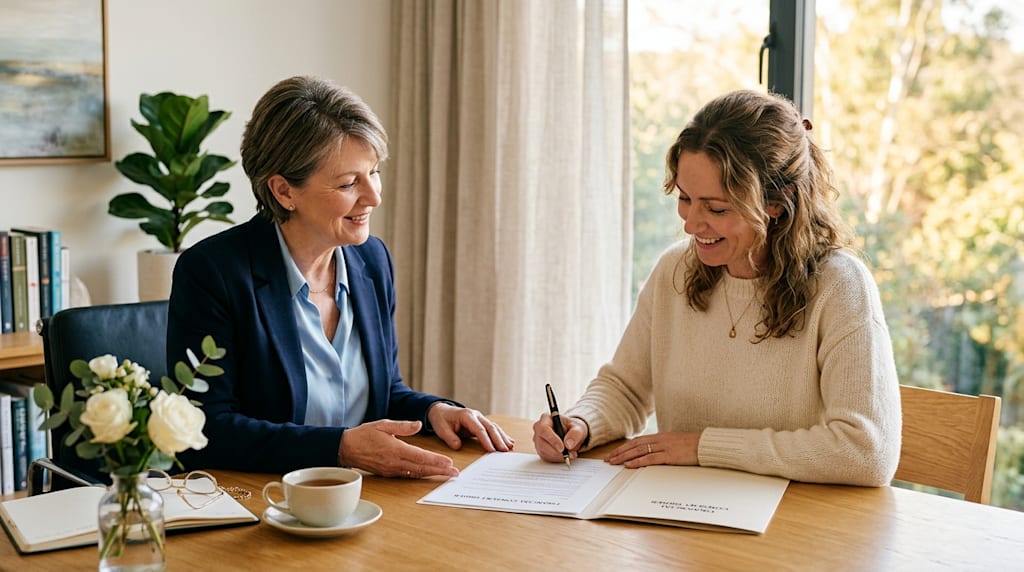
The mediator we found was a calm woman in her fifties with reading glasses on a chain and a way of asking questions that made you think more carefully about your own answers. She didn't try to change what we'd decided. She just kept gently pulling at the edges of it, making sure we'd thought about everything.
The pensions, in particular, were something we'd glossed over. She suggested we both get proper valuations done. She mentioned that pensions are the most valuable asset in a marriage and the one couples understand the least, and looking back, she was absolutely right.
She also raised something that hadn't occurred to either of us. What about Mark's mum, who was in her eighties and not in great health. If she passed away, Mark would inherit. Did we want that to be ringfenced? We agreed yes, that should be his alone. She also walked us through the practical bits, the Form A, the timings, the way the paperwork fitted around the divorce itself. None of it felt scary the way I'd expected.
By the end of three sessions, the agreement we'd scribbled at the kitchen table had become something thorough. Still ours. Still based on what we'd decided. But properly worked through.
Then came the part that turned it into something legally binding. Our agreement was written up into what's called a financial consent order, drafted by a solicitor and submitted to the court for a judge to approve. Nobody had to attend a hearing. The judge simply reviewed what we'd agreed, made sure it was fair, and signed it off.
The morning the order came back approved, I made myself a cup of tea and sat in the garden for a bit. The kids were at school. Mark was at work. It was a Tuesday in early autumn and there were leaves starting to turn on the apple tree. I read through the document, with all its formal language, and I felt this enormous wave of relief. It was done. Properly done. Not just on a piece of paper in a drawer.
People still ask me, when divorce comes up, whether it's worth the bother of getting a financial order if you've already agreed everything. I always say the same thing. Yes. Especially if you've agreed everything. Because the agreement isn't really for now, when you're both being sensible and remembering why you liked each other in the first place. The agreement is for ten years from now. For if Mark remarries. For if I do. For if one of us inherits, or hits hard times.
Mark and I still talk most weeks. The kids are doing well. We had Christmas dinner together last year, all four of us, at his new flat. We laughed about the camper van, which he kept in the divorce and which has, as predicted, sat unused in his driveway ever since.
The trust we had wasn't misplaced. But trust, on its own, isn't a legal document. And life is long. Getting that order was the kindest thing we did for each other. And, in a way, it was the last proper bit of teamwork of our marriage.
This story is based on real mediation experiences, with details changed to protect confidentiality.
About the Creator
Jess Knauf
Jess Knauf is the Director of Client Strategy at Mediate UK and Co-founder of Family Law Service. She shares real stories from clients to help separating couples across the UK.
Jess is author of The Divorce Guide in England & Wales 2016.
Enjoyed the story? Support the Creator.
Subscribe for free to receive all their stories in your feed.
Comments
There are no comments for this story
Be the first to respond and start the conversation.