
The Wisdom That Comes with Age
What Growing Old Has Taught Me About Success
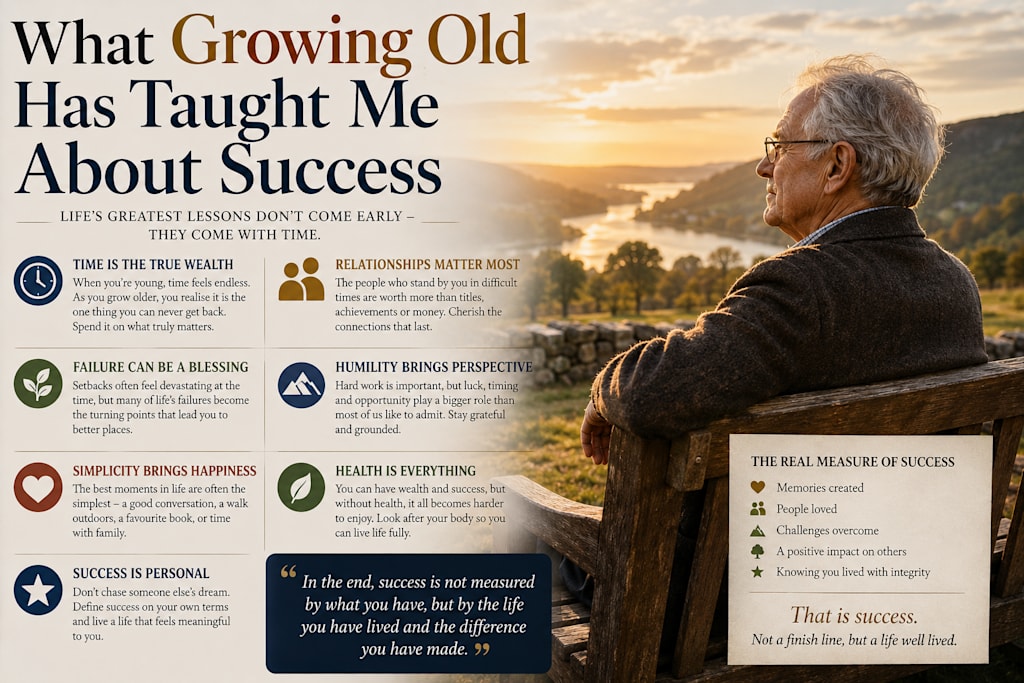
When I was young, success seemed straightforward. It was measured by achievement, ambition and progress. Success meant obtaining qualifications, finding a good job, earning more money and steadily climbing whatever ladder happened to be in front of you. Society reinforced these ideas at every stage of life. Schools measured success through examination results. Employers measured it through promotions and salary increases. Friends and neighbours often measured it through houses, cars and visible signs of prosperity.
As the years passed, I worked hard and followed many of those expectations. Like countless others, I spent much of my life striving towards goals that always seemed to lie just beyond the horizon. Whenever one target was reached, another immediately appeared. Success often felt less like a destination and more like a moving target.
Now that I am older, I find myself looking at the subject rather differently. Time has a way of stripping away illusions and revealing what truly matters. The lessons that come with age are not always pleasant, but they are often valuable. Looking back across the decades, I have come to realise that some of the things I once considered essential turned out to be surprisingly unimportant, while other things that seemed ordinary proved to be priceless.
One of the first lessons is that success is not simply about accumulation. Many people spend their lives collecting possessions, wealth and status. There is nothing inherently wrong with these things, and financial security undoubtedly makes life easier. However, there comes a point when additional possessions add little to genuine happiness. The excitement of acquiring something new eventually fades, and what once seemed vital becomes merely another object taking up space.
Time, on the other hand, becomes increasingly precious. When you are young, time appears limitless. The years stretch endlessly ahead and there is always another opportunity, another chance and another tomorrow. As you grow older, you begin to understand that time is the one resource that can never be replenished. No amount of money, influence or achievement can buy back a single day that has passed.
This realisation changes the way success is measured. Success becomes less about what you own and more about how you have spent your time. Did you spend it pursuing things that mattered? Did you invest it in people you cared about? Did you use it wisely, or let it slip away unnoticed?
Another lesson concerns relationships. Throughout my working life, I met countless people. Some were colleagues, some were clients, and others were simply passing acquaintances. Many of the professional achievements that once seemed so important have faded in memory, but the people remain. The conversations, friendships and shared experiences are often remembered far more vividly than contracts signed, meetings attended, or projects completed.
Growing older teaches that success is not measured solely by professional accomplishments but also by the quality of the relationships built along the way. The people who care about you when circumstances become difficult are worth far more than those who were only interested when everything was going well.
Age also teaches humility. When you are young, it is easy to believe that hard work alone determines outcomes. Experience eventually reveals that luck plays a larger role than many people are willing to admit. Being born in a particular country, meeting the right person at the right moment, avoiding serious illness and finding opportunities at crucial stages of life often involve elements beyond individual control.
Recognising this does not diminish the importance of effort. Hard work still matters enormously. However, it encourages gratitude rather than arrogance. It becomes easier to appreciate success without assuming that every achievement was entirely self-made.
Another valuable lesson is that failure is rarely as catastrophic as it appears at the time. Looking back, some of the events that seemed disastrous proved to be turning points that led to better opportunities. Jobs were lost, plans failed and expectations were disappointed. At the time these experiences felt devastating. Years later they often appear as necessary chapters in a much larger story.
Young people frequently fear failure because they believe it defines them. Older people know that failure is usually temporary. What matters is how one responds. Persistence, resilience and adaptability often prove more valuable than raw talent.
Growing older also changes attitudes towards recognition. In youth, there is often a desire for approval, status and validation from others. Many people spend years trying to impress colleagues, neighbours or strangers. Eventually, a curious thing happens. You realise that most people are too busy worrying about their own lives to spend much time judging yours.
This discovery can be liberating. Success becomes less about external applause and more about personal satisfaction. The question changes from "What do others think of me?" to "Am I content with the choices I have made?"
One of the most surprising lessons concerns simplicity. Modern life encourages complexity. Bigger houses, more possessions, more commitments and more responsibilities are often presented as evidence of success. Yet many older people discover that happiness frequently lies in simpler things. A quiet morning, a good conversation, a favourite book, a walk in familiar surroundings or time spent with family can provide more satisfaction than many of the ambitions that once consumed years of effort.
Health is another subject that age places into sharp perspective. When young, good health is often taken for granted. Few people spend much time thinking about their knees, eyesight, heart or kidneys until something begins to go wrong. As the years pass, health increasingly becomes a foundation upon which everything else depends.
A person may possess wealth, status and influence, but without reasonable health, the ability to enjoy those things can diminish rapidly. Growing older teaches appreciation for everyday abilities that once seemed ordinary.
Perhaps the greatest lesson of all is that success is deeply personal. Society offers countless definitions, but ultimately, each individual must decide what success means to them. For some, it may be financial independence. For others, it may be raising a family, helping a community, pursuing knowledge or simply living with integrity.
The danger lies in spending a lifetime pursuing someone else's definition of success. Many people reach the end of their working years only to discover that they have achieved goals they never truly wanted in the first place.
Looking back, I no longer see success as a collection of achievements or possessions. I see it as a life lived with purpose, curiosity and kindness. I see it in the ability to adapt when circumstances change and to appreciate what remains when much of life has passed.
Growing old has taught me that success is not measured by the size of a bank account, the title on a business card or the number of possessions accumulated over a lifetime. Success is measured by the memories created, the people loved, the challenges overcome and the knowledge that, in whatever small way, you have left the world a little better than you found it.
That may not be the definition of success I would have given when I was twenty years old, but it is the one that makes the most sense to me today.
About the Creator
Alan Spencer
Have been an author and writer for over 20 years. Have been a journalist, editor, proofreader, and a designer and presenter of training courses. Have written over 100 articles, two books, and around 20 training courses.
Enjoyed the story? Support the Creator.
Subscribe for free to receive all their stories in your feed. You could also become a paid subscriber, letting them know you appreciate their work.
Comments
There are no comments for this story
Be the first to respond and start the conversation.