
The Red Pen Was Making My Friend’s Son Worse at Writing
He wasn’t lazy or careless. He was a creative kid drowning in corrections.
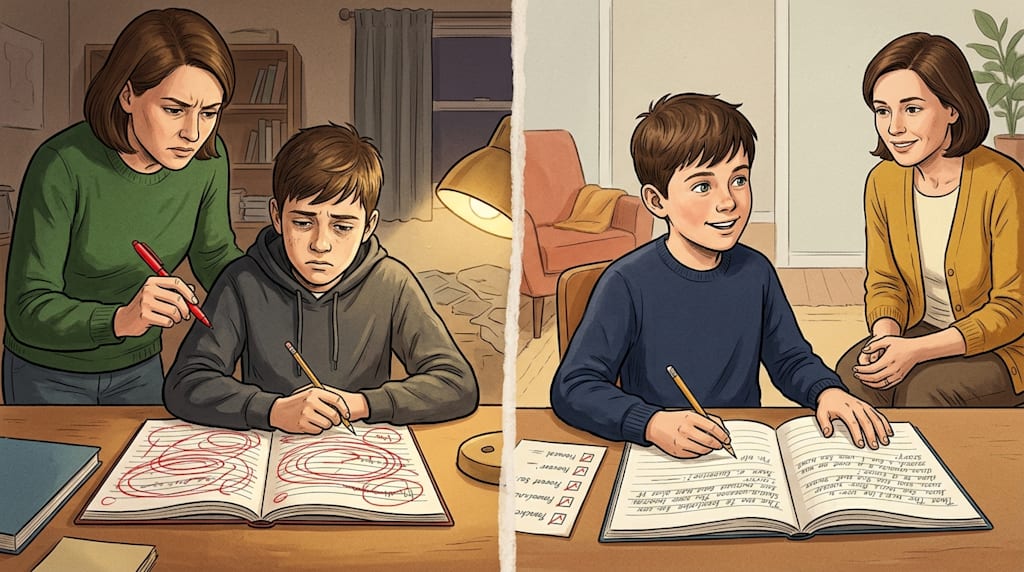
When Wenbo writes stories, his eyes light up.
He sits at his desk, pencil racing across the page, and laughs at his own jokes. His stories have elevators that talk, cats that steal time, and a kid who scores zero on a test but can fix a rocket. His mother picks up the notebook. Her first sentence is: “There are two typos in the third paragraph, and three punctuation mistakes.”
Wenbo closes the notebook and says, “I know.”
His mother is not unloving. She sits with him every night. The red pen stays within reach. She circles mistakes page by page, then pushes the notebook back: “These are all careless errors. In the question stem, the words ‘NOT correct.’ You didn’t see them?” Then she adds ten more problems of the same type and tells him to check his work three times. The same goes for writing. Typos, punctuation, awkward sentences. She picks them out one by one. The ideas? She doesn’t pick at the ideas. Ideas don’t lose points.
She has decided that carelessness is a serious problem. It has to be fixed, or his grades won’t improve.
That judgment is not wrong. Carelessness does lose points. But the way she uses it puts a magnifying glass in front of the child’s face and makes him stare at the holes too. Wenbo changes. He frowns when he gets a writing prompt. He writes two lines and stops: “Mom, I’m done,” though he is only halfway. When he does exercises, his pencil slides past the question stem and misses the words “NOT correct.” He loses points on easy questions. The more she reminds him to be careful, the more mistakes he makes. Before exams, his stomach hurts. Homework drags until ten at night.
His mother becomes more anxious. She circles more. She assigns more punishment.
Under the magnifying glass, the child learns “I have problems”
Many parents run on the same default mode: getting better means removing weaknesses. They hold a magnifying glass and search for mistakes.
This mode has two side effects.
First, the child’s default belief about himself becomes “I have a lot of problems. I am not good enough.” The long-term signal he receives is: my existence itself is not worth affirming. Only when I fix my weaknesses do I deserve acceptance. Wenbo’s eyes light up when he writes stories. He does it on his own. He learns it quickly. He finishes with a sense of accomplishment. But every time he finishes, his mother picks at typos and does not mention the ideas. Over time, when he gets a writing prompt, he stops asking what he wants to write. He starts asking where he will make a mistake. A child’s strength is dimmed, bit by bit, by correction-focused attention.
Second, internal drive is drained, and a defensive mindset forms. Correction-based feedback is mostly negative. The child slowly equates learning with being picked apart and blamed. To avoid criticism, he chooses the conservative, safe, mistake-free path. He dares not try. He dares not explore. This is the familiar pattern: fear of difficulty, fragility, procrastination, fear of failure. Wenbo starts delaying his exercises and panicking before exams. He did not suddenly become lazy. He has come to experience learning as a correction scene. Wanting to escape is normal.
The strengths lens does not mean “ignore the weakness”
The strengths lens means steadying the strength first, then setting low-cost rules for the weakness.
Wenbo’s mother later did three things.
First, she affirmed his strength in words. After Wenbo finished a new story, she read it and said, “I didn’t see that ending coming.” Wenbo looked up at her. She said, “Write as long as you want. We’ll look at typos at the end.” That day Wenbo wrote three pages. The typos were still there, but the story was full.
Second, she made checking his own business. She stopped requiring “check three times” and asked, “How are you going to check?” Wenbo said, “First I’ll look at the question stem and circle the key words.” She said, “Okay. Just that one step.” He still missed questions sometimes. After missing one, he said, “I’ll look again.” She did not add extra copying as punishment.
Third, she stopped making correction the whole focus. The typos were still in the notebook, but she no longer led with them. She asked, “Which part of this story do you most want to write?” Wenbo paused, then started talking. When he finished, he said, “I’ll revise the third paragraph.”
The carelessness did not disappear completely. Wenbo still occasionally misses the question stem. He still writes down the wrong number. But it no longer crushes him. His view of the questions and his approach to solving them open up. The carelessness fades, slowly, naturally.
Deficit-based parenting says: your weakness is your problem, and I will spend a great deal of energy fixing it. Strengths-based parenting says: your spark is precious. We protect it, and we find a gentle way to reduce the damage the weakness does.
Not every weakness can be covered by a strength
Taking strengths seriously does not mean ignoring bottom-line weaknesses.
If the weakness is simply “not good at it,” let the strength offset it. Wenbo’s careless reading of question stems can be reduced with a checklist and a small rule for high-frequency mistakes. That is enough.
If the weakness “hurts people or breaks rules,” a boundary must be set. If carelessness involves safety, honesty, harming others, or breaking rules, it cannot be waved away with “he is creative.” A boundary is a boundary. Strength cannot pay for a broken rule.
Parenting should not swing to an extreme either. Not pushing hard does not mean the parent does not guide, does not give resources, or lets the child go completely. Letting go is not the same as letting the child grow.
The internal drive, resilience, and independence we want children to have are not installed through lectures, arrangements, nagging, or reasoning. They grow through trial and error. They grow through feeling consequences. They grow through weighing choices.
Parents’ over-effort often quietly completes these steps for the child:
Thinking is done for the child, so the child does not form his own judgment.
Emotional consequences are carried for the child, so resilience has no soil to root in.
The effort contains distrust: I do not believe you can figure it out yourself.
Doing too much for the child means taking away his choice. It means making decisions for him, digesting emotions for him, bearing consequences for him. Good support means holding the safety line and the rule line, providing information and company, and returning choice, feeling, and responsibility to the child.
What Wenbo’s mother did later was return “How are you going to check?” to him. She returned the ease of “we’ll look at typos at the end.” She returned the consequence of “you missed the question, so look again.” She stopped being the corrector and started being the backstop.
Five questions to put on the fridge
What does this child repeatedly do on his own, learn quickly, and finish with a sense of accomplishment? Look for the stable talent first, not the hole that most needs filling.
Is this weakness “not good at it,” or “hurts people or breaks rules”? If it is not good at it, let the strength offset it. If it hurts people or breaks rules, set a boundary.
Is my effort protecting a strength, or is it a magnifying glass searching for holes?
Which thinking rights, choice rights, trial-and-error rights, and emotional consequences am I carrying for the child?
Can I accept that the weakness will not disappear completely, and aim only to reduce its negative impact?
Wenbo’s notebook still has typos. But when he writes stories, his eyes light up again. His mother sits beside him. She is not holding the red pen.
About the Creator
Jin
Writer of reamstories
https://reamstories.com/jin
Enjoyed the story? Support the Creator.
Subscribe for free to receive all their stories in your feed. You could also become a paid subscriber, letting them know you appreciate their work.
Comments
There are no comments for this story
Be the first to respond and start the conversation.