
The Pain a Band-Aid Can't Cover
My daughter taught me that a scrape is rarely just a scrape, and comfort is not a strip of adhesive.
Downstairs in our neighborhood, two children fell one after the other.
One scraped his knee. An adult ran over, blew on it, put on a Band-Aid. He brushed off the dirt and ran after the ball again.
The other just bumped himself lightly. He didn't break the skin, but he cried like it was the worst thing that had ever happened to him.
Someone nearby laughed. “One's tough, one's delicate.”
I stood nearby and said nothing. My younger daughter is the second kind.
No matter what she bumps into, even if it's just a little red mark and no blood, she insists on a Band-Aid. If she doesn't get one, she keeps crying. A Band-Aid has become her lifeline.
At first I was confused too. Clearly nothing's wrong. So why does she have to have one?
Later I understood. To her, a Band-Aid is not just a Band-Aid.
Once I was cooking and accidentally cut my hand while chopping vegetables. It bled. I panicked and blurted out, “Ouch, I cut my hand!”
Only my younger daughter was home. She heard me and ran over. When she saw the blood, she burst into tears. “Mommy, you're hurt! You're bleeding!”
Seeing her cry, I calmed down. If I kept panicking, she would only feel more helpless and scared. I said gently, “Sweetie, can you help Mommy get the antiseptic and cotton swabs? Let's take care of the cut.”
She was still crying, but at the thought of helping Mommy stop the bleeding, she ran to get them.
We always keep antiseptic at home. Grandma and Grandpa work in the fields all year round, so bumps and cuts are common, and we usually use it for small scrapes. One reminder: antiseptic is only for very shallow small wounds. If the wound is deep or the cut is large, you must go to the hospital. Don't just treat it yourself.
My younger daughter brought the things and helped me, imitating what I do. She usually watches me treat Grandma and Grandpa's wounds: pour out the antiseptic, dip a cotton swab, and wipe carefully. As she helped me wipe, she comforted me in her little voice. “Mommy, don't cry. Put this on and it won't hurt anymore.”
I told her, “With my sweetie caring about me, Mommy doesn't hurt as much.”
After the wound was treated, I said I still had to keep cooking and asked her to get me a Band-Aid. She quickly brought one. After peeling it open, she leaned in and gently blew on my cut. “Put on the Band-Aid and it won't hurt anymore.”
I immediately asked her, “How do you know that?”
My younger daughter said, “Yesterday afternoon, I went out to play with the little boy next door. While we were running, he fell and scraped his knee. He cried a lot. Grandma heard him and came over right away. She held him, blew on it, and put on a Band-Aid. The little boy stopped crying immediately. Grandma also told him: put on a Band-Aid and it won't hurt.”
So in her mind, a formula formed: Band-Aid equals pain gone.
She watched me put on the Band-Aid and stopped crying too. After that, she would keep an eye on my Band-Aid. If she saw it got wet, she would remind me to change it. Later, whenever she bumped herself, whether or not the skin was broken or bleeding, her first reaction was to ask for a Band-Aid. As long as it was on, she felt safe. She played when it was time to play, and ran when it was time to run.
She had turned the Band-Aid into her lovey. The security blanket or stuffed animal many children can't sleep without when they're little. As long as they hold it, they feel calm. A Band-Aid was the same for her. As long as it was on, she felt steady. The pain seemed to disappear.
But not every child calms down immediately after a Band-Aid.
Some children still cry after it's on. The physical pain hurts. The fear is there too. If their feelings aren't accepted, a Band-Aid can't solve the problem.
Many parents think, It's such a small thing. Just put on a Band-Aid. Some even rush to put one on when a child falls and cries, thinking that solves everything. But what a child wants is often not that Band-Aid.
He wants us to see: I fell. It hurts. I'm scared. I feel wronged. He wants someone to understand what he's feeling.
So never start with: “This little thing doesn't hurt. Just put on a Band-Aid.”
Those words make a child feel: my pain, my sadness, no one sees it. No one notices how I feel. As if all my feelings can be dismissed with a Band-Aid.
What you should do instead is acknowledge the feelings first, then treat the wound.
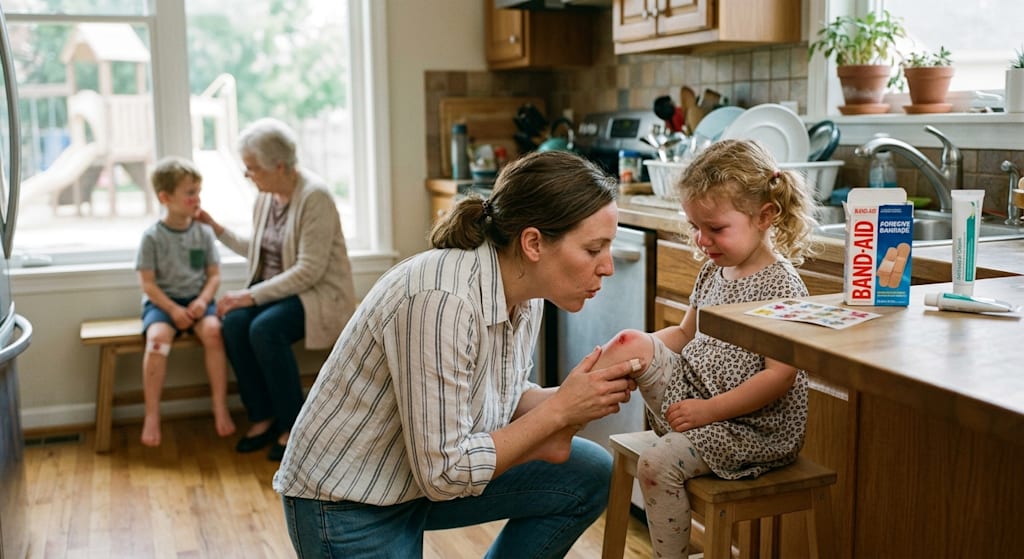
You can squat down and tell your child, “I know you fell and it hurts. That was a hard fall.”
See his feelings first. Let him cry. Crying itself is a release. When he calms down a little, then treat it: “Mommy will blow on it, clean it, and then we'll put on a Band-Aid.”
The children who calm down quickly after a Band-Aid and go back to playing aren't just helped by the Band-Aid. Every time they get hurt, an adult first hugs them, sees their pain, understands their fear, and immediately comforts them. “That was a hard fall, huh? It hurts Mommy to see it. You were so brave.” Then comes the Band-Aid.
The wound may not heal immediately, but the child's feelings are seen and accepted. He settles down.
When the skin isn't broken, I try to offer her an alternative. “Mommy blows on it, then hugs you for ten seconds, okay?” Sometimes she agrees, sometimes she doesn't. When she doesn't, I put on a cartoon Band-Aid. After all, the skin isn't broken, so it doesn't hurt to put one on. But I add, “This protects it. Mommy's here with you. The pain will get better slowly.”
I don't say, “Put it on and it won't hurt.” Because if it still hurts afterward, she'll be confused.
Now, sometimes when the skin isn't broken, she blows on her own hand and says, “Mommy just needs to blow on it,” then runs off to play. Sometimes she still asks for a Band-Aid. Both are fine.
Empathy doesn't mean ignoring the injury.
For minor bumps and scrapes, you can comfort a child this way: hug first, blow on it, clean it, put on a Band-Aid.
But if the wound is deep, bleeding heavily, or gaping, or if it was caused by rusty metal or an animal, or if the child keeps crying violently, or after a head bump has vomiting, drowsiness, or low energy, do not just slap on a Band-Aid and call it done. Take the child to the hospital promptly and let a doctor clean, treat, and bandage it.
A Band-Aid covers skin and flesh. A parent's empathy and acceptance reach the child's fear and pain. Both matter. Neither can replace professional care.
My younger daughter still asks for Band-Aids now. Sometimes I give her one. Sometimes I use a sticker instead. When she cries, I first squat down, look into her eyes, and say, “You fell and it hurts, huh? Mommy's here.”
She cries for a while, then reaches out for me to hold her. I pick her up. She lies on my shoulder and slowly stops crying.
The Band-Aids are still in the drawer. But she doesn't seem in such a hurry to ask for one anymore.
About the Creator
Jin
Writer of reamstories
https://reamstories.com/jin
Enjoyed the story? Support the Creator.
Subscribe for free to receive all their stories in your feed. You could also become a paid subscriber, letting them know you appreciate their work.
Comments
There are no comments for this story
Be the first to respond and start the conversation.