
The Night I Stopped Saying “I’m Afraid” to My Child
A sixty-three-point math test, a pair of glasses, and the difference between fear and fact
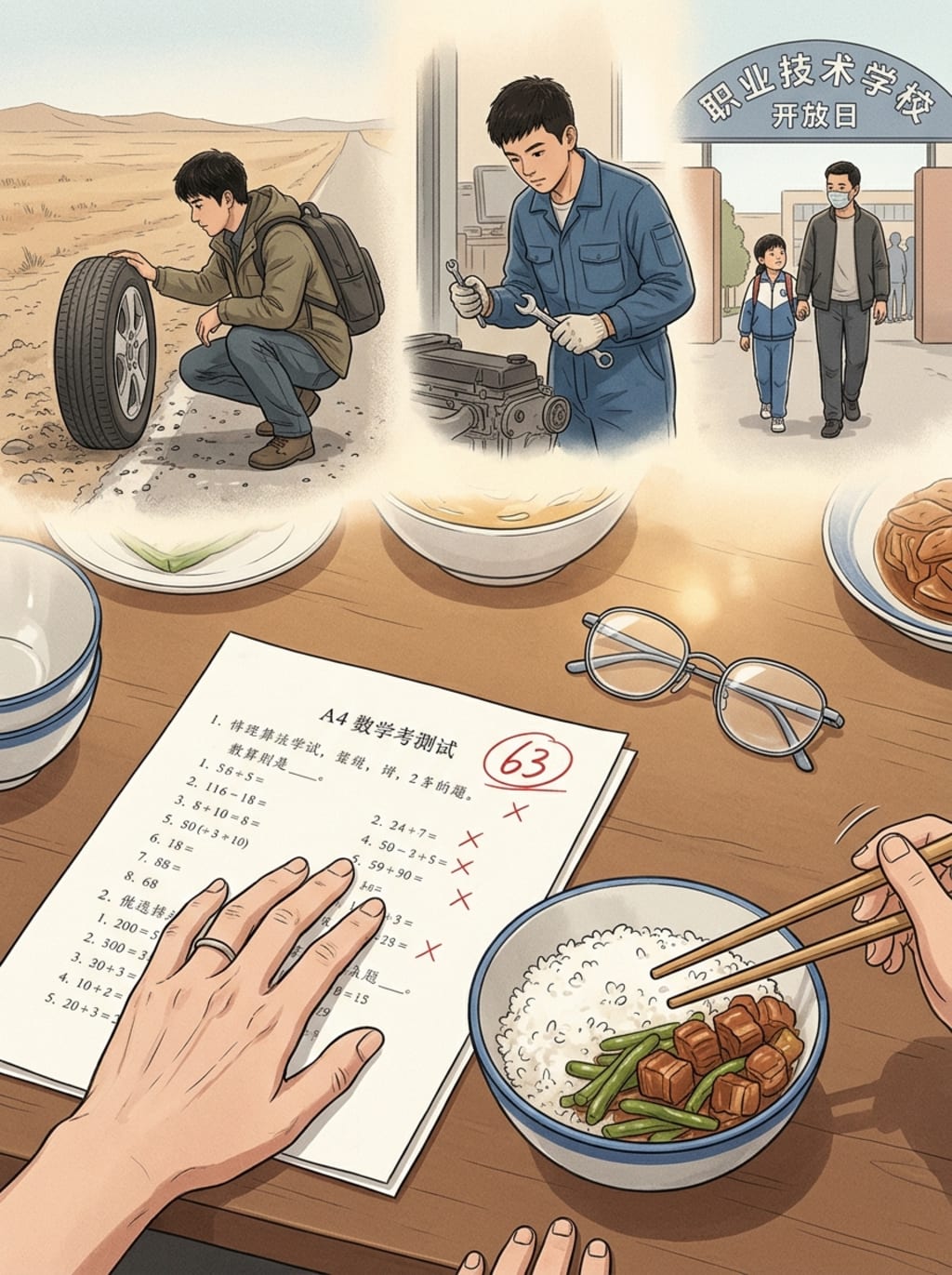
At dinner, a mother put down her chopsticks and said, “I’m afraid that if he goes on like this, he won’t even get into high school.”
Her son had just picked up a bite of food. His hand stopped in the air, then went back to his bowl. She did not see it. She was looking at the math paper on the table: sixty-three points, a blank space beside every wrong answer.
Later I asked her what she was afraid of. The sixty-three points, or the summer she herself failed to get into high school? She froze, then said nothing.
Parents say “I’m afraid,” “I’m worried,” “I think” all day long. The words are sincere. The problem is that fear dresses up as judgment. You are afraid he is lazy, so you call him lazy. You are afraid he has no future, so you say he is not on the right track. But the child is sitting across from you. Are you seeing him, or are you seeing the future you fear?
First, separate “not good at it” from “not seen”
Some children really are not good at traditional classroom learning. This is not an excuse. It is a fact you can observe.
He can play all day and not get tired. Sit him down with homework and within minutes he is drowsy, fiddling with an eraser, going to the bathroom, drinking water, one small routine after another. His standards for homework are low, sometimes extremely low: finished is enough; right or wrong does not matter. You have tried rewards, punishment, sitting beside him, hiring a tutor. None of it lasts more than three days. The child is not making things up. He knows he cannot sit still. He knows that when he sees a test paper, he feels irritated.
But there is a step many parents skip: before you decide “not good at schoolwork,” rule out problems you can actually fix. Vision, hearing, sleep, attention deficits, learning disabilities, emotional problems, trouble with classmates. All of these can look like “can’t sit still,” “doesn’t want to write,” “doesn’t care.”
I once saw a boy who slumped over the desk whenever he did homework. After three months of examinations, the problem turned out to be sleep apnea. Another girl kept failing math. Later her parents found out she could not see the blackboard clearly. She had been afraid to say so.
Do not turn a problem you can support into a character judgment. Look at the facts first. Then talk about paths.
Interest is not “I like it.” It is “I can keep going.”
One summer, I tried something with my own two children. Every day I gave them a chance to earn pocket money. My older son, in sixth grade, chose to read Guwen Guanzhi. My younger son, in second grade, chose to take out the trash.
The younger one did not choose to read a classical poem, which would have taken less than two minutes. He preferred running errands, even though it was tiring and took longer. I did not force him to read poetry. The older one absolutely refused to take out the trash. He thought reading Guwen Guanzhi was easy, and he was willing to accept that.
Every child has some sense of what he can handle. Doing the thing he is more willing to accept is easier, and it lasts longer.
But “interest” cannot stop at “I’m willing.” Look at three things. Will he practice it repeatedly? Does he keep going when it gets boring and he fails? What are the real thresholds, income structure, and career lifespan of this field?
If a child says he likes cooking, take him to try three times: follow one morning shift, prep ingredients once, calculate costs once. If he still wants to do it after three times, talk about going deeper. If he backs out twice in three times, it is not interest. It is imagination.
Two children who were “off the main track” and doing fine
In Shanghai, I rarely see young people “off the main track.” Shanghai parents have high demands for their children’s education. Even if a child is not good at school, there are routes: private schools, sending them abroad.
But I have met two children who were off the main track and still doing well.
One was a young car-rental boss I met while traveling. In the northwest, twenty years old, Mongolian. He came alone to deliver the car, inspect it, and complete the transaction. When he checked the car, he squatted down to look at the tires, took photos of the chassis with his phone, and warned the customer which spots had hidden pits and where not to drive too fast. He made quite a bit on that deal. This half-grown kid might earn more than many white-collar workers in Shanghai.
The other was a child in my partner’s relatives’ family. At the time, he refused to go to school and dropped out to learn livestreaming in another city. After a while, he found that this path looked easy to succeed in, but it wasn’t. Later he went into the Chinese herbal medicine business with relatives. To develop further, he now needs to upgrade his education. He took the initiative to prepare for the licensed pharmacist exam, which first requires at least a college diploma. No one has to urge him. No one has to scold him. He is making his own plans.
What do these two children show? Not that school is useless. Not that dropping out leads to success. Some children are not lacking ambition. Their ambition is simply not on the line you drew. They have to bump into the job market first before they know what they lack. That relative’s child later wanted a diploma because the work gave him feedback. That was more effective than a hundred scoldings from parents.
College graduates going back to technical school is not a joke
In recent years, a strange thing has happened: college graduates voluntarily going back to technical schools.
Learning a hard skill is “diploma plus skill” stacked together. Behind this wave is a mismatch in the job market: on one side, college graduates have trouble finding jobs; on the other, companies cannot find skilled workers who can actually do the work. The 2025 ordinary undergraduate employment rate is less than 70%, while the national skilled-talent gap exceeds 20 million. Advanced technicians and some shortage occupations are in high demand. Parents should check the original sources for these figures. Do not use macro numbers to replace the facts of your own child. But the trend matters: a diploma no longer automatically equals a job, and skills are no longer inferior.
Policy is moving too. In 2026, the Ministry of Human Resources and Social Security launched a skills-improvement training program for one million young people. Beijing, Guangdong, Zhejiang, Shandong, Anhui, and other provinces have issued policies encouraging technical colleges to open “technician classes for college students,” with some programs tuition-free and recommending employment upon graduation.
Rather than pushing a child desperately through school, only to have him return to technical school after college, why not take another path from the beginning? Of course, which major to choose, and whether it can connect with interest and policy, requires parents to pay attention and to take the child to learn and try more.
Education cannot be rigid. The path of “study, go to college, find a job” was viable in the past. Today it may no longer be as viable. In the future, those who like research go into research. Those who can apply go into application. Those who are good at skills compete on skills. Everyone has a place. That is a better way.
A Harvard graduate and long-time AI-plus-education creator also said that in the AI era, jobs involving complex physical contact are hard to replace, for example, various blue-collar technical jobs. This is not to say schooling is unimportant. It is to say that basic literacy still matters, but the path does not have to be only one.
Respect is not letting go
My suggestion is this: on the basis of fully understanding the child’s personality and interests, parents should lead the child to explore together how to plan and choose a path that does not go through academic schooling.
Parents can respect, but they must not blindly let go. Letting go too early is also irresponsible. Have confidence in the child, and also give guidance based on facts.
Specifically, how? Replace “I’m afraid” with “I see.”
“I noticed that three days this week you slumped over the desk while doing homework. Is it too hard, are you too tired, or do you not want to write?”
“You say you like cooking. Let’s try three times: follow one morning shift, prep ingredients once, calculate costs once. Then decide whether to go deeper.”
“If you choose a technical school or apprenticeship, let’s set a six-month review: attendance, skill progress, mentor’s evaluation, and how you feel.”
Respect does not mean defining the child too early. Basic literacy, reading, writing, arithmetic, communication, contract common sense, digital tools, is still the safety net for a craft path. Interest depends on sustained investment, reaction to setbacks, and whether it can be converted into skill, not just “I like it.” Respect for minors needs scaffolding: safety, law, minimum education, exit conditions, funding, and resource support.
That mother at the dinner table later told me she went home and did not mention the sixty-three points again. She asked the child: When you do homework, where do you get stuck? The child said: Math class has a new teacher, I don’t understand, and I’m afraid to ask. She took him to have his eyes checked and got him glasses. On the next test, he scored seventy-eight.
Not every child will become a seventy-eight. But at least she began to look at facts, not her own fear. The child is sitting across from you. You have to see him first before you can talk about the next step.
About the Creator
Jin
Writer of reamstories
https://reamstories.com/jin
Enjoyed the story? Support the Creator.
Subscribe for free to receive all their stories in your feed. You could also become a paid subscriber, letting them know you appreciate their work.
Comments
There are no comments for this story
Be the first to respond and start the conversation.