
The Magnifying Glass Habit That Slowly Erases a Child’s Confidence
A mother meant well. She circled every mistake her son made. What she almost lost was the thing that made him want to write at all.
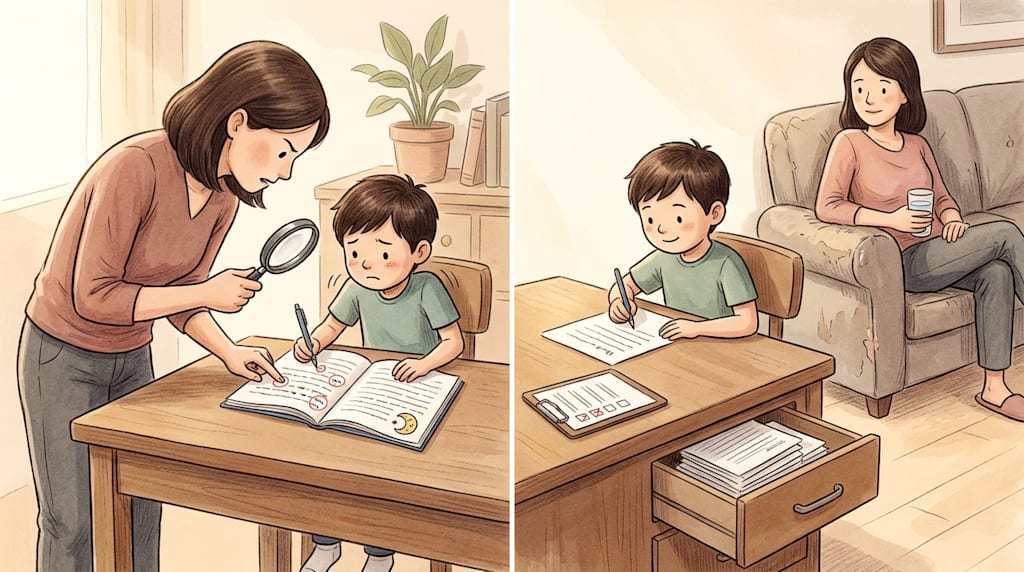
When Wenbo was writing an essay, his mother stood beside him and watched. He wrote a sentence: “The moon looks like a cookie with a bite taken out of it.” His mother said nothing. He kept writing. On the third line, he wrote the wrong particle. His mother reached out and tapped the character with her fingertip. Wenbo’s pen paused, then kept moving. Two lines later, he made a punctuation mistake. His mother said, “Here.” Wenbo put down his pen and said, “I’ll rewrite it.”
After that, every time he got an essay prompt, he asked first: “Mom, are you going to check today?”
His mother was dedicated. She supervised homework every day. As soon as test papers came back, she circled every careless mistake and went over it again and again. She added extra calculation drills and proofreading exercises, and required him to check every problem three times. The same went for writing: she did not praise the ideas first; she picked out typos and punctuation errors. She believed carelessness was a serious problem that had to be fixed, or his grades would never improve.
Wenbo’s enthusiasm for writing slowly faded. When he got a prompt, he tensed up first. He began to procrastinate on exercises. He felt anxious before every test. The more she reminded him to be careful, the more mistakes he made.
Later, his mother tried a different approach. Every week she gave him a block of free writing time. She did not check it; she only said, “That plot is interesting.” For essays, she set up a separate proofreading step that checked only three things: typos, punctuation, and whether the prompt was answered. For math, he used a “circle the key words plus one-minute self-check” method. She stopped checking three times for him and let him go through the checklist himself. If he made a mistake, he dealt with the natural consequence. The carelessness did not disappear completely, but Wenbo no longer tensed up at the mention of writing, and conflicts between mother and son decreased.
Behind these two approaches are two different logics.
Deficit-based parenting: Your weakness is your problem, and I will spend a great deal of effort fixing it.
Strengths-based parenting: Your spark is precious. We protect it, and at the same time find a gentle way to reduce the negative impact of your weak spots.
The underlying idea of strengths theory is simple: people are born with a relatively stable set of talents and strengths. Weak spots are hard to eradicate completely, and they do not all need to be fixed. When strengths are fully activated and used to the extreme, the strengths themselves offset the negative effects of the weak spots.
That sounds like chicken soup. What it means in practice is that parents cannot assume by default that “getting better equals eliminating weaknesses.” They cannot hold a magnifying glass and keep searching for holes, deficiencies, and mistakes. Many parents’ habitual way of trying hard works exactly like this: when the child writes well, they do not look first; when the child makes a mistake, they circle it immediately. When the child has an idea, they do not praise it first; when the punctuation is wrong, they correct it at once. The long-term signal the child receives is: I have many flaws; I am not good enough; my existence itself does not deserve affirmation; only when I correct my weaknesses do I deserve acceptance.
This brings two side effects.
The first is that the底色 of self-perception becomes “I am not good enough.” The child’s attention follows the parent’s and locks onto his own shortcomings. He cannot see what he is good at. Wenbo’s enthusiasm for writing faded not because he could not write, but because writing had been redefined: writing was no longer expression; it was waiting to be corrected.
The second is that inner motivation is consumed, and a defensive mindset forms. Correction-based feedback is mostly negative. The child slowly equates learning and growth with “being corrected and blamed.” To avoid being scolded, he prioritizes being conservative, safe, and mistake-free. Difficulty avoidance, fragility, procrastination, and fear of failure all come from this. At the moment Wenbo put down his pen and said “I’ll rewrite it,” he was not thinking about how to write better. He was thinking about how to make fewer mistakes.
Valuing strengths does not mean ignoring bottom-line weaknesses. Not every weak spot can be covered by a strength.
If a weak spot is merely “not being good at something,” it can be left to strengths to compensate for. Wenbo’s carelessness is a habit and process problem. Lightweight methods such as checklists, self-checks, and circling key words can reduce its impact. It does not need to be escalated into “you are a terrible person.” But if a weak spot is “harmful to others or breaks rules,” a boundary must be set. Hitting people, lying, disrespecting others, ignoring safety rules: these cannot be let slide just because the child has strengths. Strengths-based parenting is not permissiveness. It is distinguishing what should be protected from what should be limited.
Parenting should not go to extremes. Not trying hard does not mean parents should not guide, not give resources, or just let go. Letting go is not the same as letting the child grow. Inner drive, resilience, and independence are not taught through outside instruction, arrangement, urging, or lecturing. They come from the child’s trial and error, from what the child feels, and from what the child weighs and chooses.
Parents’ over-effort often quietly completes these steps for the child. They do the thinking for the child, so the child does not form his own judgment. They carry the emotional consequences for the child, so resilience has no soil to take root in. Their effort also hides a layer of distrust: I do not believe you can figure it out yourself.
Effort and holding-up are two different things. Over-effort means seizing the child’s right to choose, think, and make mistakes; making decisions for him; digesting emotions for him; and bearing consequences for him. Wise support means holding the safety line and the rule line, providing information and companionship, and returning choice, feeling, and responsibility to the child.
Back to Wenbo. The strengths-based approach can be specific.
Protect the strength and let the sense of achievement stabilize. Set aside fixed free-writing time every week. Do not correct; only give feedback such as “This idea is interesting” or “This plot has imagination.” Let the child first feel that his words have value and that his expression is seen.
Turn correction into a lightweight process, not a personal criticism. Set up a separate proofreading step for essays that checks only three things. For math, use “circle key words plus one-minute self-check.” Do not say “You are just careless.” Say “This step needs a checklist.” Let the weak spot be caught by the process, not amplified by emotion.
Set boundaries without personalizing them. If carelessness affects rules or safety, it still needs to be managed. Manage the behavior; do not label the child. Clear boundaries, gentle attitude.
Return responsibility to the child. The mother does not check three times for him; he goes through the checklist himself and bears the natural consequences. Parents provide only methods and companionship. The child feeling for himself that checking works is more effective than being urged a hundred times.
Later, Wenbo was writing an essay. At one point he wrote an opening: “My mom used to stand behind me and watch me write. Now she sits on the sofa and looks at her phone. I actually write a little faster.” His mother read it, said nothing, put down her phone, and went to the kitchen to pour a glass of water. Wenbo kept writing. When he reached the third line, his pen did not stop.
The carelessness did not completely disappear, but it no longer crushed him.
Strengths-based parenting does not ask parents to ignore weaknesses. It asks them to let confidence from strengths stabilize first, then use gentle, executable boundaries and processes to reduce the impact of weak spots. If a weak spot is “not being good at something,” let strengths offset it. If it is “harmful to others or breaks rules,” a boundary must be set. Parents should do less thinking for the child, less carrying of emotions, and less deciding for the child. They should hold the bottom line, provide information, and return responsibility. Only then can the child grow lasting inner drive and resilience.
The thing parents should fear most in raising a child is not that the child has weak spots. It is that parents put all their attention on those weak spots, until the child believes: I do not deserve affirmation unless I have no flaws.
The ending of Wenbo’s essay was: “The moon has been bitten, but it is still pretty bright.” This time his mother did not say, “You got that particle right.” She folded the essay paper and put it in a drawer. There were already more than a dozen sheets in the drawer.
About the Creator
Jin
Writer of reamstories
https://reamstories.com/jin
Enjoyed the story? Support the Creator.
Subscribe for free to receive all their stories in your feed. You could also become a paid subscriber, letting them know you appreciate their work.
Comments
There are no comments for this story
Be the first to respond and start the conversation.