
The First Thing My 17-Year-Old Does When She Gets Home Is Look for the Tablet
A 17,000-student phone study changed how I handle screens at home, but not in the way I expected.
I once asked a kid who got into the Hong Kong University of Science and Technology whether she liked looking at her phone. She said, “There’s nothing much to look at on a phone.”
That one sentence gave me a rough idea of her relationship with her phone. She wasn’t avoiding it. The phone just didn’t occupy a place in her mind.
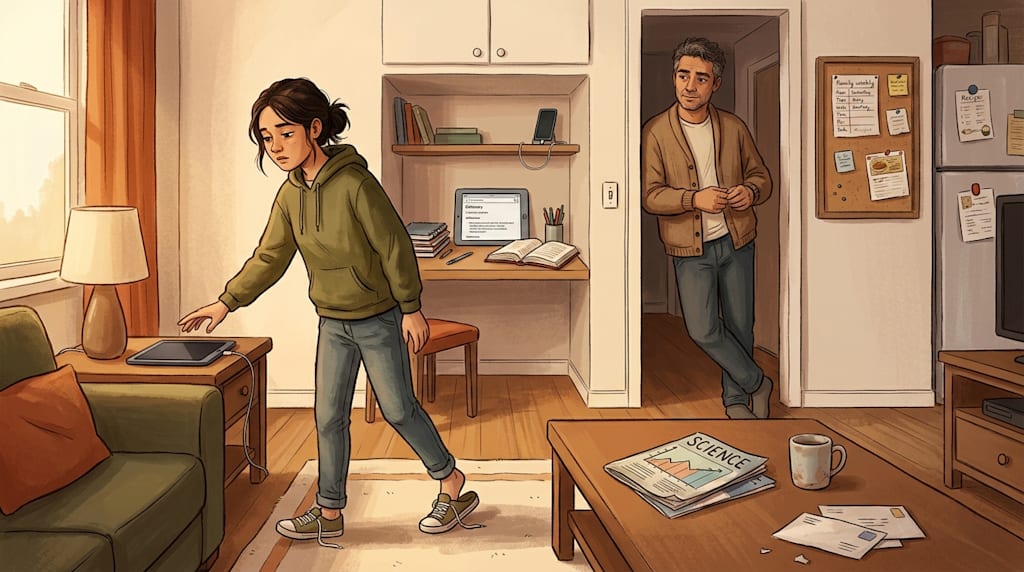
Our kid is different. She rarely takes her phone when she goes out, but she has a tablet. On weekends, before she has changed her shoes, she looks for the tablet. Anime, drawing, games, and a group chat full of friends waiting for her. The world is too exciting. I understand.
I used to think that as long as she didn’t play during study time, it was fine. Play a little after studying. What’s the problem? Then one time she closed her workbook, hadn’t put the cap back on her pen, and her hand was already reaching for the tablet. The movement was fast, like a reflex. I stood at the door and said nothing.
Later I paid attention. I asked her to bring in the clothes from the balcony. She stood there with her hand on the drying rack, eyes blank. The images from before hadn’t left her head. I asked her to pour water, and the water overflowed onto the counter before she snapped back. These gaps used to be for spacing out, walking around, looking into the distance. Now the tablet fills them. Tablets and phones are the same kind of thing. The stimulation is far stronger than drinking water or looking out a window. The brain can’t switch from high stimulation back to studying as fast as flipping a switch.
So my suggestion to her now is: she can play at noon, and in the evening when she doesn’t need to study. During study time, the tablet stays out of the study area.
This isn’t a total ban. She’s seventeen. If you tell her “phones are harmful,” she won’t believe you. She uses one herself. I recently saw a Science experiment covering about 17,000 college students at 10 universities in India. The experimental group had their phones collected during class for a whole semester. The control group carried phones as usual. Exams were unified and graded centrally. The group whose phones were collected showed a small, steady improvement in overall grades. Attendance didn’t increase, which means the effect came from improved focus in class. Students with weaker foundations and lower grades improved most. Students who were already self-disciplined and doing well showed almost no change.
This matches what I’ve seen. Phones are the strongest source of distraction. For kids who already get distracted easily and can’t keep up, taking phones out of the classroom will probably help. For kids who are self-disciplined and use phones to look up information or take online classes, a blanket confiscation has very low benefit and adds inconvenience.
So in our house we now have three rules.
First, physical separation during study. She can only use a study-only tablet, with only online classes, dictionary, and notes. No entertainment apps, or logged out. The rule depends on distance, not willpower. The thing is not within reach.
Second, talk more in daily life. I don’t go through her chat history, but I ask what anime she’s watching lately, which game character is strong, what the group chat is talking about. If I know what she’s exposed to, she’ll tell me when something happens.
Third, review together. Once a week, no judgment. I ask: What did you mainly use the tablet for this week? Which was relaxation, and which was scrolling even when you didn’t want to watch anymore? Hearing her say it herself is more useful than me judging for her.
She’s seventeen. Completely confiscating isn’t realistic, and completely letting go doesn’t feel safe. Now it’s more like signing a contract. The sleep bottom line is that the tablet leaves the bedroom one hour before bed. Study periods are separated. Weekend evenings can be more open. Rules set together give her a reason to follow them.
I don’t do it well every time either. Once she wanted to take the tablet into her room to look up a question. I said no. She stood there, looked at me for three seconds, and said, “Then I’ll use my phone.” I said no to the phone too. She didn’t argue. She turned and walked away. Later we added a dictionary app to the study-only tablet, and that’s how it got resolved.
The tablet is now charging in the living room. She goes into her room to do homework, glances at it as she passes, and doesn’t pick it up.
I’m still learning. Learning how to go from “I decide for her” to “she can decide for herself.” The goal is to teach her when to use it and how to stop when she’s done.
How do you manage it in your house? Tell me in the comments.
About the Creator
Jin
Writer of reamstories
https://reamstories.com/jin
Enjoyed the story? Support the Creator.
Subscribe for free to receive all their stories in your feed. You could also become a paid subscriber, letting them know you appreciate their work.
Comments
There are no comments for this story
Be the first to respond and start the conversation.