
The 10:30 phone standoff
A calm script for the night your child says she’s going to sleep with the phone still in her hand
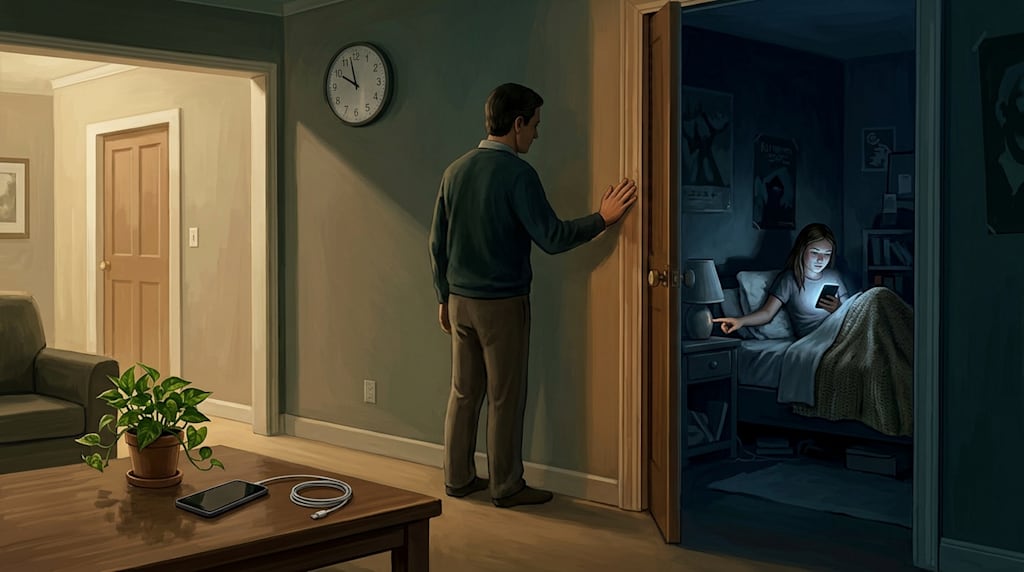
At 10:30, the clock in the living room chimed once.
You walk to your child’s door. It is not fully closed. There is a thin gap. The light is still on inside, and the phone screen glows against her face. She hears your footsteps, looks up, and smiles a little: “I’m going to sleep.” Her finger rests on the edge of the screen. She pulls the phone half an inch toward the blanket. Then she reaches over and flips the switch.
The room goes dark. The light in the gap disappears.
You stand at the door with your hand on the handle. The words are there in your throat, about the agreement, about self-discipline, about tomorrow morning. You swallow them. Not tonight. Tonight you do one thing: get the phone into the living room.
What she just did
You cannot be certain what she was thinking. But the sequence is easy to read. She did not put the phone away on time. She smiled and said she was going to sleep. She turned off the light. She wants to end the conversation and avoid a direct conflict. She knows the agreement. She does not want to hand the phone over now. Turning off the light is a nonverbal signal: the conversation is over, do not come in again. The smile is a buffer. “I’m sleepy” gives her a reasonable excuse without directly defying you.
This is a boundary test. She may be delaying out of instinct. What she is protecting may not be a phone. It may be “my things are mine to control” and “I don’t want to be managed down to this level of detail.” A child in the second year of middle school has a stronger sense of autonomy. If you take one step back, the rule loosens an inch. If the rule loosens an inch, she will test it the same way next time.
So yes, you can enforce it. But hold four lines.
First, enforce the rule, not a physical struggle. What you are enforcing is “the phone does not stay in the bedroom overnight,” not “I must wrest the phone out of your hand right now.” The first is a rule. The second becomes a personal contest.
Second, keep your emotions stable. Do not raise your voice. Do not insult. Do not label. Do not say “You’re just undisciplined,” “You’re always like this,” or “You’re such a disappointment.” Those words do not make the rule more effective. They shift her attention from “Should I hand over the phone?” to “What gives you the right to say that about me?”
Third, keep your words short. Enforce, do not educate. Save the teaching for a calm review the next day. Bedtime is not the time for a lecture. She is tired. You are tired. The more you say, the more it turns into a tug-of-war.
Fourth, if she grips the phone and will not let go, or her emotions escalate, stop. Do not pull. Do not block the door. Do not go through the phone. Do not humiliate her. Leaving the room does not mean the rule has failed. It means the consequence will take effect in another way.
What to do that night
You knock twice. You push the door open half a step and do not walk in.
“It’s 10:30. The phone goes in the living room.”
She stays lying down and smiles. “I’m sleepy.”
You repeat one sentence. “I know you’re sleepy, so the phone goes in the living room. Hand it to me, and I’ll turn off the light.”
She does not hand it over. The phone is still near the edge of the blanket. You keep your tone level.
“You hand it to me, or I take it to the living room. Which do you choose?”
If she hands it over, you take it and say, “Okay. Good night.” You close the door. No lecture. No long explanation. No old grievances. You take the phone to the living room, plug it in, and place it screen-down. You go back to your room. Done.
If she refuses but the phone is in plain sight, do not pull. You reach out and wait a few seconds. “I’m not going to grab it. I’ll count to three. If you don’t hand it over, I’ll take it, and we won’t discuss it again tonight.” When you finish counting, take it. Take only the phone. Do not look through it. Say one sentence: “The phone goes in the living room. Good night.” Then leave.
If she grips it tightly and her voice rises, stop immediately. “I’m not going to grab it. If you don’t hand over the phone tonight, then tomorrow the phone is off all day, or tomorrow night you hand it over at 9. Go to sleep first.” Then leave the room. Close the door. Turn off the hallway light. Do not stand outside the door. Do not pace. Do not push the door open again.
Leaving protects the rule by stopping the fight from growing. The consequence should be reasonable, enforceable, and stated in advance. A penalty added on the spot easily turns into punishment. The consequence should target the phone only. It should not cancel all entertainment, and it should never become a judgment about her character.
Why not lecture that night
Many parents make the same mistake at bedtime. They finally have a chance, so they try to explain everything. They go from “Why didn’t you keep your word?” to “If you’re this undisciplined now, what will happen later?” From the phone to schoolwork. From schoolwork to attitude. The child did not want to hand over the phone in the first place. After all that, she shuts her ears and talks back. The parent gets angrier. The voice gets louder. The conflict escalates.
Bedtime is not a teaching window. The child is tired. The emotional brain is in charge. Reasoning does not get through. The parent is tired too. The more they talk, the more worked up they get. A rule becomes credible through consistent enforcement, not through winning the argument that night. The shorter your words and the more restrained your actions, the more clearly she understands: this is not negotiable, and my parents are not trying to go to war with me.
When you take the phone, your fingers brush the charging cable by her blanket. The connector is still warm. In the living room, the pothos leaves hang down beside the outlet. You unplug the cable, loop it twice, and put it on the coffee table. The refrigerator hums. You go back to your room and turn off the light. These actions are clearer than a speech.
The next day
The next day after dinner, or after she finishes her homework, you sit down and say only a few sentences.
“Last night at 10:30 the phone wasn’t in the living room. I know you were sleepy and wanted to use sleep to get past it. From now on I’ll remind you once at 10:25. At 10:30 you put the phone in the living room to charge. If you don’t, the next night the phone comes in at 9:30. The rule doesn’t change: the phone does not stay in the bedroom overnight. Do you want the reminder to be a knock or a message?”
Talk about facts, not motives. Do not say “You were deliberately stalling” or “You were testing whether I’d insist.” You can say “I know you were sleepy and wanted to end the conversation.” Do not put a label on her.
Give limited choices. Keep the bottom line. The reminder method can be chosen. The handover time follows the agreement. “The phone does not stay in the bedroom overnight” does not change.
Make the consequence reasonable, enforceable, and stated in advance. “If you don’t hand it over, the next night it comes in at 9:30” is fine, but it is best agreed beforehand. A consequence added on the spot easily becomes punitive. The consequence targets the phone only. Do not suddenly escalate to “No phone for a week.” Do not drag in “Your attitude is the problem.”
The review is not a rehashing of old grievances. She nods and says “I know.” That is enough. You do not need to keep confirming “Are you convinced?” You clear the bowls from the table. She puts her chopsticks in the sink. The conversation is over.
Fix the original agreement
Many agreements are hard to enforce not because they fail at 10:30, but because the problems were planted at the beginning. The rule was announced by one parent. There was no consequence. There was no reminder mechanism. The parents expected the child to be self-disciplined. The parents did not model the behavior themselves. Set these in advance.
Who reminds. One parent is responsible, so one does not play good cop while the other plays bad cop.
When to remind. For example, remind once at 10:25 and enforce at 10:30.
How many times to remind. Once is enough. Repeated knocking turns into a tug-of-war.
What happens if she does not hand it over. Write the consequence clearly, state it in advance, and target the phone only.
How the parent exits when she refuses. Decide what sentence to say, where to go, and how to end discussion that night.
How to follow up the next day. Set the review time, the review script, and the next adjustment.
Whether the parents model it. Do the parents put their phones in the living room before bed? If the rule applies only to the child, it easily becomes “only controlling me.”
Write these into the agreement. If the first day does not work, that is okay. You only need the child to know that the rule exists consistently. You will not lose control because of one soft refusal. You will not give up the bottom line because of one conflict.
Do not turn enforcement into a contest
What the child is protecting may not be a phone. It may be “my things are mine to control” and “I don’t want to be managed down to this level of detail.” What you need to protect is not only the phone, but the bottom line: the phone does not stay in the bedroom overnight. The two do not necessarily conflict. The conflict usually comes from parents turning enforcement into a personal contest in the heat of the moment. You must hand it over now. If you don’t, you’re challenging me. If you don’t hand it over, I’ll show you who’s in charge.
Once it becomes that, the child shifts her attention from the rule to the confrontation. The more agitated you are, the more likely she is to use “I’m sleepy,” “turn off the light,” and “a smile” as a soft refusal. The more you lecture, the more she shuts her ears. The phone may end up collected. The relationship is damaged. The rule has not really taken hold.
So yes, you can enforce it. Control your emotions. No physical force. No verbal attack. No long lecture. During enforcement, keep your emotions steady, your movements restrained, and your words short. The child needs to know that this rule must be carried out. The rule should be firm. The attitude should be steady. The words should be short. The relationship should be left room to recover.
The next night at 10:30, the phone is charging in the living room, screen-down. There is a scuff on the corner of the green phone case. Her bedroom door is closed. There is no light under the gap. You walk past and do not stop. The clock in the living room ticks once. You turn off the hallway light and go back to your room.
About the Creator
Jin
Writer of reamstories
https://reamstories.com/jin
Enjoyed the story? Support the Creator.
Subscribe for free to receive all their stories in your feed. You could also become a paid subscriber, letting them know you appreciate their work.
Comments
There are no comments for this story
Be the first to respond and start the conversation.