
Taking the Scenic Route to the Point
Sometimes the unnecessary beginning is the most interesting part

My wife and I do not always take the same route through a conversation.
If I ask her a straightforward question, I generally expect a straightforward answer.
“Did you find what you wanted at the supermarket?”
To me, there are several perfectly acceptable responses:
“Yes.”
“No.”
“They had run out.”
My wife, however, may begin much earlier in the day.
She had intended to leave home at ten o’clock, but a telephone call delayed her. When she was finally ready, she could not find her keys. Then the car was slow to start. Traffic was heavier than expected, and when she reached the shopping centre, there were no convenient parking spaces.
Eventually, after circling the car park several times, she found a space — but it was a long way from the supermarket.
By this stage, I may have forgotten what I originally asked.
I know that somewhere at the end of this journey lies the answer. I simply have to remain patient while we travel towards it.
My wife is not avoiding the question. She is providing context. To her, the difficulty starting the car, the traffic and the search for parking are all part of the supermarket experience.
I want the destination.
She wants me to appreciate the journey.
A mathematical preference for directness
Perhaps my impatience comes from having spent most of my working life as a mathematics teacher.
In Euclidean geometry, the shortest distance between two points is a straight line. Pythagoras’ Theorem even allows us to calculate that distance.
I therefore tend to prefer explanations that travel directly from the question to the answer.
I encouraged my students to show their reasoning, but I wanted every step to serve a purpose. A solution that wandered through several unnecessary calculations before arriving at the answer made me uneasy.
Sometimes students would fill an entire page with algebra when three lines would have been sufficient. The fact that they eventually reached the correct answer did not make the journey elegant.
I sometimes felt the same way about explanations given by other teachers — and, if I am honest, by people in general.
Why take the scenic route when a straight road is available?
The metal before the knife
This difference occurred to me while watching knife-making videos on YouTube.
A blacksmith announces that he is going to make a knife. But before he begins, we must learn where the metal came from.
One blacksmith uses fifty razor blades.
Another begins with an old horseshoe.
Someone else finds a broken hammer that appears to have been lying forgotten in a shed for several decades.
The original object is displayed from several angles. It may be rusty, bent or almost unrecognisable. The blacksmith cleans it, cuts it into pieces and places it in the forge.
The metal is heated, hammered, folded or welded. In some videos, different pieces are combined until the original objects have been transformed beyond recognition.
Eventually, a knife emerges.
Part of me wonders why we needed to meet the horseshoe.
If the metal is going to be heated, hammered and reshaped, why not begin with material ready for forging and show us how the knife is made?
Would the finished knife cut differently if I had not been introduced to its previous life?
There may be a practical reason for identifying the metal. Different steels have different properties, and an experienced blacksmith needs to know what material is being used.
But that is not the only reason the old object is shown.
“Today I am making a knife” is a demonstration.
“Today I am turning fifty razor blades into a knife” is a story.
The razor blades give the video a beginning. The finished knife gives it an ending. The pleasure comes from seeing one become the other.
Survival needs an entrance
The same principle appears in television programs.
In Man vs Wild, Bear Grylls demonstrates how someone might survive in remote and dangerous places. He finds water, builds shelter, locates food and shows viewers how to escape difficult terrain.
In one episode, a helicopter carried him to the region where the demonstration would take place.
The helicopter could have landed safely. Bear Grylls could have stepped out, waved goodbye to the pilot and begun explaining the local dangers.
Instead, the helicopter hovered above a river.
He jumped into the water.
He was immediately surrounded by rushing water and had to struggle towards the bank before the survival lesson could properly begin.
It was certainly dramatic, but I could not help thinking that a genuinely stranded traveller would be unlikely to arrive in exactly that way.
If I became lost in the wilderness, it would probably be because I had taken a wrong turn, my car had broken down or I had wandered too far from a walking track.
I would not expect a helicopter to transport me there and throw me into a river first.
The jump was not necessary to explain survival in that environment. It created an additional danger that would not otherwise have existed.
Yet without it, the episode would have begun with a man standing safely beside a river, calmly addressing the camera.
That might have been more realistic, but it would not have been nearly as exciting.
The helicopter jump was the television equivalent of my wife’s search for a parking space. It told us how the main character arrived at the point where the story supposedly began.
Perhaps the point is not always the point
I began by believing that all these introductions were unnecessary.
Just tell me whether the supermarket had what you wanted.
Just show me how the knife is made.
Just begin the survival lesson.
But perhaps I was treating every conversation as though it were a mathematical problem: remove the unnecessary information, isolate the important facts and arrive at the answer by the shortest possible route.
Human beings do not always communicate that way.
Sometimes the surrounding details explain why an ordinary event mattered. My wife may not simply be telling me whether she bought something. She may be telling me that she was tired, rushed and frustrated before she even entered the shop.
The blacksmith is not merely producing a tool. He is giving a discarded object another life.
Bear Grylls is not merely teaching survival. He is creating an adventure.
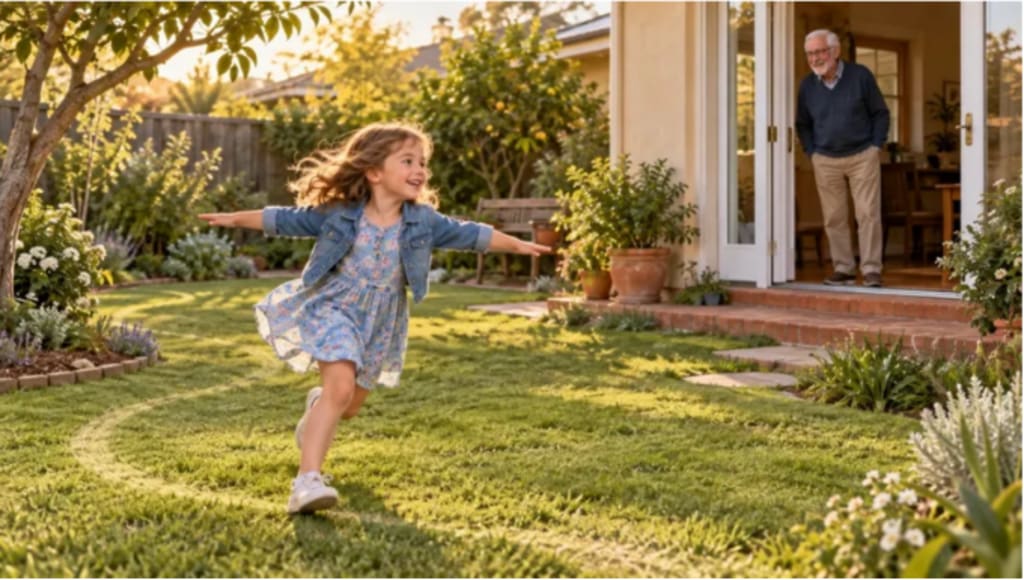
I began thinking about this again while watching my granddaughter playing in the backyard.
She was pretending to be an aeroplane, moving around the garden with her arms stretched out like wings and making convincing engine noises.
When she was called to come inside, the back door was only a short distance away. She could have travelled directly towards it and arrived within seconds.
But aeroplanes, apparently, do not proceed directly to back doors.
She turned away, circled part of the garden, changed direction, flew towards another corner and continued making engine noises. Eventually, after completing a flight path known only to her, she approached the house and landed safely at the door.
From an adult point of view, her route was completely inefficient.
From her point of view, efficiency had nothing to do with it.
She was not merely trying to reach the house. She was enjoying the flight.
She could have taken the shortest route, but the scenic route was much more fun.
When the longer road is better
We sometimes make the same choice deliberately when travelling.
If we need to reach a destination quickly, we take the highway. It is usually the shortest and most efficient route, but it may offer little more than traffic, road signs and an occasional service station.
When time is not important, some people leave the highway and follow the country roads.
The journey takes longer, but they pass through small towns, stop at unfamiliar shops, admire the countryside and discover places they would never have seen from the direct route.
In that situation, the extra distance is not wasted.
It is the reason for the journey.
Perhaps conversation works in the same way.
Sometimes we need the highway: a clear question, a direct answer and no unnecessary detours. At other times, the details that appear to delay the answer are the small towns along the road. They are where the character, humour and meaning are found.
The answer may be the destination, but the scenic route gives us something to see along the way.
Of course, this does not mean that every detail is essential. A scenic route can become so scenic that everyone forgets where they were going. There are still times when “yes” or “no” would be greatly appreciated.
Nevertheless, I now understand why my wife begins her supermarket story before she reaches the supermarket.
I began this reflection intending to make one simple point about answering questions directly.
Several hundred words, fifty razor blades, an old horseshoe, one helicopter jump, a tour through the countryside and my granddaughter’s circuit of the backyard later, I seem to have taken the scenic route myself!
About the Creator
George Dimitriadis
Retired mathematics teacher from Melbourne, Australia. I write humorous classroom stories featuring Jimmy, a student who questions mathematical conventions, as well as personal reflections on life, nostalgia and everyday absurdities.
Enjoyed the story? Support the Creator.
Subscribe for free to receive all their stories in your feed.
Comments
There are no comments for this story
Be the first to respond and start the conversation.