parents
The boundless love a parent has for their child is matched only by their capacity to embarrass them.
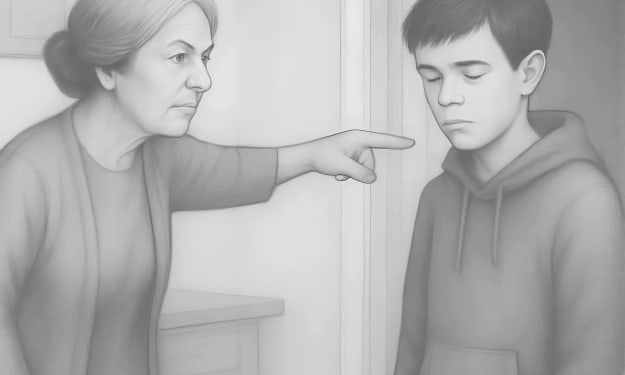
How to deal with children's complaints
Complaining is a common thing among children and can have different reasons, but many parents face difficulty in dealing with children’s complaining, so we show you in the following lines 4 ways to deal with children’s complaining
By Mohamed Abd Elrasheedabout a year ago in Families
The Sound of My Father’s Silence
We didn’t talk much in our house. My mother was always busy in the kitchen, humming old songs under her breath. My younger sister, Aleena, had a soft voice that barely broke the silence. And my father? He was a man made of stone and smoke. He spoke only when necessary — instructions, commands, or when things went wrong. Never casually. Never with warmth. As a child, I mistook his silence for anger. I thought maybe he didn’t love us. When I scored the highest marks in class three, he nodded once and said, “Good.” Just that — no hug, no smile. When I fell and broke my wrist, he drove me to the hospital without saying a word. I learned to live without his words. I tried to impress him, rebel against him, and eventually ignore him. But his silence followed me like a shadow. When I turned seventeen, my world cracked open. We were in the middle of dinner when my mother dropped her spoon and gasped. She held her chest, her face drained of color. My father sprang from his chair. For the first time in my life, I saw fear in his eyes. She survived the heart attack, but everything changed after that. My father took over the cooking. Badly. The chapatis were thick and uneven. The daal always had too much salt or none at all. But he cooked — every single day. He never complained. I’d wake up to find him already mopping the floor or ironing Aleena’s school uniform. He still didn’t talk much, but there was something louder in his actions now. Something I had never noticed before. One evening, I came home late. I’d been out with friends and forgot to call. My phone battery had died. I expected shouting. Maybe even a slap. But when I entered the house, my father just looked at me, quietly. His eyes were tired. “I waited,” he said. Just that. It hit harder than any punishment. Winter came fast that year. The nights grew longer, and the walls of our small house seemed to close in tighter. My mother was recovering slowly. Her medications were expensive. We stopped using the heater to save on bills. One night, I woke up thirsty and walked to the kitchen. I stopped when I saw my father at the stove, heating milk. He didn’t hear me come in. He poured two cups. One he placed near my mother’s bed. The other he held in both hands and stared into, lost in thought. I stood there in the dark, watching him — this silent man who had built his love in chores, in sacrifices, in sleepless nights. It was then I realized: my father had been speaking all along. I just hadn’t known how to listen. I started noticing the language of silence after that. When he left the last piece of bread for me at dinner. When he covered me with a blanket at night, thinking I was asleep. When he smiled — barely noticeable — as I told him I passed my final exams. They were all his words. His quiet, quiet words. Years passed. I left for university. Then a job in another city. I’d call home every week, mostly to speak to my mother, sometimes to Aleena. My father would come on the phone just to say, “You okay?” and then pass it back. It became our ritual. “You okay?” “Yeah.” “Hmm.” And then silence. But it was a warm silence now. One that didn’t scare me anymore. Last year, I received a call at 2:17 AM. “He’s in the hospital,” Aleena said. My heart dropped. I drove all night. He’d had a stroke. Partial paralysis. The doctors said it would affect his speech. He couldn’t talk anymore. But when I stood by his bed, he looked at me with tired eyes, and I understood everything he wanted to say. I held his hand. He squeezed it, ever so slightly. That was enough. Now, I sit beside him every weekend. We watch the news. Share tea. Sometimes I read to him. He can’t respond, but I know when he’s listening. I see it in the way his eyebrows twitch or his lips curve just a little. My father was never silent. He just spoke in a language I took too long to learn. Now, I’m fluent. Final Thought: Love doesn’t always come wrapped in words. Sometimes it’s in the way someone stands by you, fixes your broken chair, or saves the last slice of mango for you. My father taught me that love can be loud — even in complete silence. And that’s the language I’ll carry for life.
By Zain ul abidin about a year ago in Families
Raising Confident Kids? Here's Why Basketball Might Be the Best Start
Kids aren’t born with strong confidence. It's something they have to build. And what better way to lay that foundation than through sports? One of the most exciting and accessible sports for kids is basketball.
By Sarah Bakerabout a year ago in Families
The Little Jar of Happiness.
Once upon a time, in a quiet little village named Meadowbrook, people lived their lives in routine and silence. The villagers worked hard, but rarely smiled. Happiness seemed like a forgotten feeling, and even the children rarely laughed.
By USA daily update about a year ago in Families
A heart touching emotional story about love and loss.
It was a rainy afternoon when Emily found the last letter. The storm outside painted her small apartment in shades of gray, the rhythmic tapping of raindrops filling the silence. She sat on the edge of her bed, staring at the shoebox she had pulled from the back of her closet. It was old and dusty, marked simply: For Emily.
By USA daily update about a year ago in Families
The Unseen Cost of War
When the Dust Settles: A Child's Silent Cry from the Rubble The ground is cold. The air is filled with dust. The silence is deafening—broken only by the distant wail of a mother or the soft crumble of debris. Among the rubble lies a child. His eyes are open, but they carry a weight no child should ever bear. His face, smeared with dust, does not cry anymore. He has already cried too much. This is not just a photo. It is a haunting reminder of the devastating reality that war brings upon the most vulnerable—our children. A Story That’s Too Common Whether in Syria, Gaza, Ukraine, Yemen, or any other war-torn region, the faces of war are not only soldiers. They are small boys clutching their dead sisters. They are infants buried beneath collapsed ceilings. They are children who once played in streets now destroyed, who now lie silent beneath the smoke-filled skies. This particular image could be from any of these places. It shows us a child not as a fighter, not as a victim of his own doing, but as someone caught in the ruthless grip of decisions made far from his broken home. The Cost of Conflict While leaders argue behind conference tables, while borders are redrawn on maps, children pay the real price. According to UNICEF, in nearly every armed conflict in the world today, children are being targeted or exposed to attacks. They are recruited, killed, injured, orphaned, or left to survive on their own. This boy’s image does not ask for pity. It demands action. It forces us to look beyond headlines and statistics and recognize the human soul crushed beneath war’s weight. What We Don’t See What happened before this moment? Was he playing with a toy moments before a bomb fell? Was he calling out for his mother? Did he run for shelter that didn’t exist? And what happens after? Will someone come looking for him? Will this picture be the only proof that he ever lived? Most of the time, we never find out. Their names aren’t remembered. Their stories go untold. And that’s what makes this image so tragic—it speaks on behalf of the forgotten. Beyond Politics: The Human Responsibility Regardless of race, religion, or nationality, there is one truth we must accept: children are not enemies. They are not threats. They are not responsible. And they must never be casualties. The photograph shows us a child not much different from our own—same dreams, same laughter, same hunger for love. The only difference? He was born in a place where survival is a daily miracle. What Can We Do? We may feel powerless, but silence is not an option. Here are some ways we can help: 1. Raise Awareness – Share stories and images like this one. The world needs to see. 2. Support Relief Organizations – Groups like UNICEF, Save the Children, and Red Cross work directly in conflict zones. 3. Advocate for Peace – Push for leaders to protect civilians in war and work toward conflict resolution. 4. Educate Others – Especially children, about peace, compassion, and the importance of valuing every human life. The Unfinished Childhood This boy could have been anything—a doctor, a teacher, a poet, even a peacemaker. But now his future is either stolen or forever scarred. And this is not just a tragedy. It is a failure—of humanity, of systems, and of conscience. Let his image not fade with the news cycle. Let it stir your heart, your voice, and your action. Because when the dust settles, we are left with more than broken buildings—we are left with broken lives.
By Atif jamal about a year ago in Families
Motherhood Didn’t End My Dreams — It Fueled Them.
There was a time when I thought motherhood meant you couldn’t have it all. Especially in those early days — the nightly wake-ups, cluster feeding, the endless nappy changes. I grew up thinking that to be a good mother, you had to devote your entire life to your child.
By Diary Of A Modern Mummy about a year ago in Families