parents
The boundless love a parent has for their child is matched only by their capacity to embarrass them.
Valley Girl. Top Story - August 2025.
My mom used to call me a valley girl while I was growing up. Full disclosure, I never knew what that truly meant until today. Not truly. I had a vague idea of what it meant, like a ditz essentially. I knew it wasn't a compliment.
By Chloe Unfilteredabout a year ago in Families
"The News We Carry"
“It’s stage four,” he said. My brother-in-law, always blunt. No preamble, no softening. Just the facts, spat like gravel. When you hear something like that—news that punches its way into your chest, drags the breath from your lungs and leaves your jaw locked in a wordless scream—it’s as if time fractures. The world, once ordinary, suddenly tilts. A before and an after is born in a single sentence. “I’m sorry,” I stammered. “I didn’t realise she—” “–I need to tell your mum,” he cut in. Of course. My mother. Ninety-one. Frail. Still bright-eyed in moments, but drifting more and more into the blur of forgetting. Her days are soft repetitions now: tea, roses, sunlight, naps. She has no sense of future anymore—and tonight, the present is going to tear her apart. “I’ll come with you,” I said. The walk to her retirement apartment takes less than twenty minutes, but we barely speak. The sun is gone, the day fading into a heavy dusk. Street lamps flicker to life along the winding footpath, casting long shadows onto the hedges. In daylight, we might pause to admire the roses—lush, perfumed reds and golds from the recent plantings. But tonight, the flowers don’t matter. Tonight, we carry something heavier than silence. I glance at him as we walk. The news he holds is not just a medical update. It’s a sentence. My sister is dying. I’ve barely swallowed it myself, and now we are delivering it to our mother—who will lose her child. They say there’s no grief like it. Parents aren't meant to outlive their children. It breaks the natural order. I don’t know what that kind of pain feels like. I hope I never do. When we knock, she opens the door slowly. Her face brightens, lit with genuine delight. “What a surprise!” she beams. “You’re both here!” We smile back, pretending we’ve simply dropped in for tea. For a few moments, we live in her version of reality, where things are still warm and safe and familiar. We sit. We talk about the weather. She makes tea in her dainty floral cups with shaky hands and serves us shortbread from a tin she’s had for decades. She takes our hands, leads us to the small sitting room, and we settle into the ritual: sit, sip, chat. A lamp clicks on beside her. Its golden glow casts long, uncertain shadows. Still, no light is enough for what’s coming. I watch her face, lined by nearly a century of life. How do you prepare a mother to hear the worst? I glance at my brother-in-law. He gives the faintest nod. I nod back. He clears his throat, hands trembling just slightly as he sets down his untouched tea. “I have to tell you some very bad news,” he says. The teacup in her hand clinks hard against its saucer. Her smile fades. She looks from him to me and back again. The air shifts—heavier now. “What is it?” she asks, though I think some part of her already knows. Her hand finds mine. Cold. Taut as porcelain. She squeezes, hard. He says it as gently as he can. The words drop like stones into the stillness. She gasps. Not loudly. Not theatrically. Just a small, sharp sound, like the beginning of a sob she won’t allow. “No,” she whispers. Her grip on my hand tightens, nails pressing into my skin. “Not my girl. Not my baby.” We sit in that room for a long time. No one says much. The tea goes cold. Outside, the roses bloom unseen in the dark. Inside, three people try to exist around a hole that has just opened in the center of everything. Later, she will forget pieces of this night. Maybe even most of it. Her memory is a sieve now. But for tonight, in this unbearable moment, she remembers. Every word. Every silence. Every heartbeat. She remembers that her daughter is dying. And I will remember the sound of her hand on mine, the unspoken grief passing between skin and bone, mother and child. We carry this news, now. All of us.
By Israr khanabout a year ago in Families
Playground Static
The playground that stopped our joy. It still stands there, nestled between the crumbling school fence and the old maple trees. The same swing set, its chains slightly rusted. The monkey bars, chipped but deflated. The sandbox, half-filled, as if someone had intended to go back.
By Echoes of Lifeabout a year ago in Families
He Forgave Me When I Couldn't Forgive Myself. AI-Generated.
🌿 1. A Hidden Sin I was 16 when I did something I still regret. It was a cold evening, and my friends were planning to go out for a meal. I didn’t have any money. While walking past my father's room, I saw his wallet half open on the table. I paused. My heart beat faster. I looked around, trembling. Then, I slipped a few notes out quietly. That night, even though my friends were laughing and eating, my heart was heavy. I knew I had crossed a line. I had stolen from the man who raised me. --- 🌿 2. The Weight of Guilt Days passed, but the guilt stayed. Every time I saw my father, his eyes full of love, it felt like a dagger in my chest. I stopped talking to him properly. I avoided meals with the family. My prayers became hollow. I felt like a hypocrite standing before Allah with such a sin. I tried to return the money secretly but even that didn’t ease my heart. I couldn’t forgive myself. I thought, “If my father ever finds out, he’ll never look at me the same way again.” --- 🌿 3. The Moment of Truth One day, my father called me to sit with him. He smiled gently and said, “Is everything okay, son?” I hesitated but remained silent. He placed his hand on mine and said, “Beta, I know what you did. I saw the wallet... and I saw you.” I froze. My heart stopped. Shame washed over me like a storm. I burst into tears. “I’m sorry, Baba… I don’t know why I did it. I’m a bad son... I’m not even worthy of your love.” --- 🌿 4. The Unexpected Reaction But then, something unexpected happened. My father pulled me into his arms. He whispered, “You made a mistake. But that doesn’t make you a bad son. It makes you human. I forgive you — not because I’m perfect, but because I love you.” That moment shook my soul. His love, his calmness, his ability to forgive — it was more powerful than any punishment. I had expected anger, maybe silence… but instead, I was held with love. --- 🌿 5. Return to Faith That night, I cried in sujood. For the first time in months, my heart truly turned to Allah. I realized: If a human father can forgive with such softness, then how Merciful is my Lord? I began praying with meaning again. I started reading the Qur’an. I apologized to my father properly and promised I would never hide anything again. I also began helping at the masjid. I talked to the youth, reminding them that one mistake doesn’t define who you are — what matters is what you do after it. --- 🌿 6. The Deeper Lesson Years later, I asked my father why he forgave me so easily. He smiled and said, “Because I remembered the Prophet ﷺ — how he forgave the people of Ta’if, who had stoned him. If he can forgive, then who am I to hold on to anger?” That reply still echoes in my heart. My father’s forgiveness brought me back to faith. And it reminded me: Sometimes the greatest da’wah is not in words, but in love. --- 🌿 7. Moral Reflection
By Kaleem Ullahabout a year ago in Families
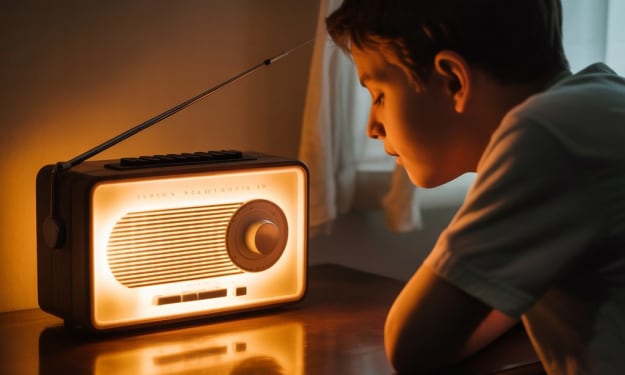
My Father’s Voice Inside the Broken Radio
The old radio had been sitting in our attic for years—dusty, broken, and forgotten. It belonged to my father, who passed away when I was only twelve. I remember how he used to tune in every evening, smiling as the soft crackle of old jazz filled the room. After he died, the radio went silent. So did our home.
By Musawir Shahabout a year ago in Families
The Year My Father Became a Stranger
The Year My Father Became a Stranger I used to know my father like I knew my own heartbeat. There was a rhythm to us, once. In the way he’d toss me a soccer ball on Sunday mornings, or how we’d listen to Motown in the car without saying much, both of us humming along. We weren’t talkers—we were doers. Our love was built on shared silence, gentle nods, and the kind of quiet comfort you only find when you truly belong somewhere.
By waseem khanabout a year ago in Families