immediate family
Blood makes you related, loyalty makes you family.
A Bond Beyond Time
George had always been a quiet man, the sort whose presence filled a room without the need for many words. He wasn’t wealthy, nor did he have great education, but he carried within him a wealth of determination. His life had been difficult long before his daughter came into it, but the day Maisie was born, everything changed.
By Article Writing Masterabout a year ago in Families
The Lion’s Pride
In the vast golden stretches of the African savannah, where the tall grass swayed with the whispers of the wind and the horizon burned each evening with the fire of the setting sun, lived a mighty lion named Shiran. He was not just another lion wandering the wild; he was the king, the protector, and the living legend of that endless land. His mane glistened like flames in daylight, and when he roared, the sound rolled across valleys and rivers like thunder, commanding both respect and fear. To every creature—whether it was the proud antelope, the playful monkey, or the quiet tortoise—Shiran was the very symbol of strength and authority. Yet, in the quiet hours beneath the starry sky, when he returned to his cave, Shiran was not just a king. He was a father. And it was in those tender moments that his heart softened. No roar, no sharp tooth, and no terrifying glare could hide the warmth in his eyes as he gazed at his little cub, Rudaan. The First Lessons Between Father and Son Rudaan was small, his paws clumsy, his mane just a faint shadow of fur. Yet his eyes sparkled with endless curiosity. He would often playfully tumble on the soft earth, chasing butterflies or trying to roar like his father, only to end up coughing or squeaking. But what he lacked in size and strength, he made up for with a spirit full of dreams. One evening, as the orange sun dipped low and the savannah sang with the voices of birds returning home, Rudaan looked up at his father and asked, “Father, will I, too, one day become the king of this land, just like you?” Shiran lowered his great head, his golden mane brushing against his cub, and spoke in a calm yet powerful voice: “My son, the crown of a king is not lifted by strength alone. It rests on the honesty of the heart and the courage in action. Strength without kindness is nothing but tyranny, and power without unity crumbles like dry grass before the fire.” These words sank deep into Rudaan’s young heart. He did not yet have the thunderous roar of his father, nor the sharp fangs that could bring down prey. But something invisible had begun to grow within him—the seed of true courage. The First Test of Courage Not long after, destiny tested him. Along the quiet riverbank, where water shimmered beneath the moonlight, a young deer had fallen into a cruel hunter’s trap. The wire bit deep into its leg, and its cries of pain echoed through the night. Many animals stood hidden in the bushes, too afraid to approach. The metallic scent of the trap carried danger; everyone feared being caught themselves. But Rudaan’s heart pounded with something stronger than fear. He remembered his father’s words and felt a pull inside him, like an unseen voice urging him forward. His paws trembled, his steps were unsure, but he did not stop. He pushed against the sharp wire, scratched his paw until it bled, and stumbled more than once. Still, he pressed on until the trap loosened and the deer leapt free, vanishing into the safety of the jungle. From a distance, Shiran had been watching silently. His chest swelled with pride as he saw the small cub, not yet strong in body, but already strong in spirit. It was the first spark of bravery, shining like a hidden flame. The Challenge of the Jungle But life in the savannah was never peaceful for long. Soon, a greater challenge arose. A pack of cunning jackals, hungry and merciless, began raiding food from every corner of the jungle. They stole from antelopes, monkeys, even from the leopards. Fear spread like a shadow across the land. Shiran, though still respected, was growing older. His strength was no longer what it once had been. The creatures of the jungle whispered among themselves: Who will lead us now? It was then that Rudaan, though still young, felt the weight of his father’s teachings settle upon him. He remembered: “A king is made not by power, but by the honesty of his heart.” Rising upon the highest rock, his voice trembling but determined, he called out to the animals of the jungle: “If we stand together, nothing can defeat us! Alone we are weak, but united we are stronger than any enemy.” The birds shrieked in agreement, the monkeys swung from trees and cried out, the antelopes stamped the earth, and even the leopards growled in unity. For the first time, the jungle moved as one under Rudaan’s leadership. The jackals, expecting fear and chaos, instead met a wall of courage. Overwhelmed by the strength of unity, they turned tail and fled, never to trouble the savannah again. A Father’s Pride Fulfilled Hidden nearby, Shiran watched with tears glistening in his proud eyes. Slowly, he stepped forward, his powerful frame still commanding awe, and looked at his son. His voice, deep but trembling with emotion, broke the silence: “My son, today you have proven that the true crown rests not upon teeth or strength, but upon unity, honesty, and bravery. You have shown me, and all creatures of this land, that you are ready to lead. I know now that you will be the true king of this savannah.” Rudaan bowed his head, not with arrogance, but with humility. His heart was not swollen with pride but filled with love for his fellow creatures. From that day on, his story spread across rivers, valleys, and plains. Every creature—from the smallest bird to the tallest giraffe—carried the tale of Rudaan and Shiran: the father who taught wisdom and the son who proved it true. And in every whisper of the wind, in every echo of the savannah, their story reminded all:
By Riaz Hamkarabout a year ago in Families
National Days To Celebrate Relatives
There are unofficial national days for almost everything. They are not just days marked on the calendars. Instead, they are days to pause, reflect, and honor whatever has been designated as a national day. It is amazing how many days have been set aside to recognize and honor relatives.
By Margaret Minnicksabout a year ago in Families
Grandchildren Spending The Night
Okay, so it isn't them now in the photo above. However, it wasn't that long ago - maybe almost a year or even two years ago at Halloween. Yesterday was dress like a boy (Adam Sandler) day. Paxton wasn't going for it. He wore a Vikings Jersey with a Hoodie and sweatpants. I guess that is a boy's look.
By Denise E Lindquistabout a year ago in Families
To Mother
Alone in the dark, a young boy begins to cry. “Mother! MOTHER!” he calls out in desperation. Why does he scream so urgently? Why, in the midst of all that frightens us, do we often call for our mothers? One could deduce that perhaps it is due to the womb being our first place of memory for some, and for others a distant dream in the subconscious. Either way, this warm, dark, peace is our first experience of existence prior to birth across the board. We hear our mother’s heartbeat from within, alone in the dark. We are fed from her placenta through our umbilical cords. She literally gives us life. It makes sense to call for our creator when we feel threatened. However, the meaning of the word, “mother,” is far more complex than simply a female that has a child. Sometimes a birth mother passes, or they find themselves unable to care for a child who must be given to a close relative or perhaps adopted out. There are even some without a formal family. Nevertheless, most people will claim to have at least one motherly figure in their lives. How is this so if a mother is limited to the woman who gave birth to you? It isn’t. “Mother,” is not just a noun; it is also a verb. A mother is more than a woman who has given birth to or adopted a child, she is also a lifelong support system, protector, and guide to the world for anyone whom she chooses to mother.
By Lolly Vieiraabout a year ago in Families
Screts to better sleep
Translate was the transcriptionist, and Ivana Korom was the TED Reviewer. It's perfectly normal for everyone to have a bad night's sleep. But how can we try to improve both the quantity and quality of our sleep? [Sleeping with Science] (Music) Here are six scientifically grounded tips for better sleep. Regularity is the first suggestion. Make sure you go to bed and wake up at the same time. No matter what day of the week or weekend it is—even if you had a bad night's sleep—regularity will actually anchor your sleep and improve both quantity and quality. And this is because you actually have a master 24-hour clock deep within your brain. It expects regularity and works best under conditions of regularity, including the control of your sleep-wake schedule. While most of us use an alarm to wake up, very few of us use a to-bed alarm, which can be beneficial. Temperature is the next point. Keep it cool. It turns out that in order to fall asleep and stay asleep, both your brain and body need to lower their core temperatures by about two to three degrees Fahrenheit. And this is the reason that you will always find it easier to fall asleep in a room that's too cold than too hot. So, the current recommendation is to aim for a bedroom temperature of around about 65 degrees Fahrenheit, or a little over 18 degrees Celsius. It sounds cold but cold it must be. The next tip is darkness. We are a dark-deprived society and, in fact, we need darkness specifically in the evening to trigger the release of a hormone called melatonin. And melatonin helps regulate the healthy timing of our sleep. In the last hour before bed, try to stay away from all of those computer screens and tablets and phones. Dim down half the lights in your house. You wouldn't believe how sleepy that can make you, in fact. If you'd like, you can wear an eye mask or you can have blackout shades and that will help best regulate that critical sleep hormone of melatonin. Walk it out is the next tip. Avoid staying awake for an extended period of time in bed. And the general rule of thumb is if you've been trying to fall asleep and it's been 25 minutes or so, or you've woken up and you can't get back to sleep after 25 minutes, the recommendation is to get out of bed and go and do something different. And the reason is because your brain is an incredibly associative device. The brain has learned the association that the bed is this trigger of wakefulness, and we need to break that association. And by getting out of bed, you can go and do something else. Only return to bed when you're sleepy. As a result, your brain will gradually reestablish the connection that your bed is a place where you sleep soundly and consistently. The fifth tip is something that we've actually already spoken about in detail in this series, which is the impact of alcohol and caffeine. So, a good rule of thumb here is to try to stay away from caffeine in the afternoon and in the evening and certainly try not to go to bed too tipsy. The final tip: have a wind-down routine. I think many of us in the modern world, we expect to be able to dive into bed at night, switch off the light, and we think that sleep is also just like a light switch, that we should immediately be able to fall asleep. Well, unfortunately, sleep isn't quite like that for most of us. Sleep, as a physiological process, is much more similar to landing a plane. It takes time for your brain to gradually descend down onto the firm bedrock of good sleep. In the last 20 minutes before bed or the last half an hour, even the last hour, disengage from your computer and your phone and try to do something relaxing. Find out whatever works for you and when you have found it, stick to that routine. The last thing I should note is that if you are suffering from a sleep disorder, for example, from insomnia or sleep apnea, then these tips aren't necessarily going to help you. If I were your sports coach, I could give you all of these suggestions to boost your performance, but if you have a broken ankle, it won't matter. We have to treat the broken ankle first before we can get back to improving the quality of your performance. And it's the same way with sleep. So, if you think you have a sleep disorder, just go and speak with your doctor. That's the best piece of advice. Where do we stand, then, in all of this conversation about sleep? Well, I think the evidence is clear. We can think of sleep almost like a life-support system. In fact, some may even call sleep a super power.
By Ibrahim dayyababout a year ago in Families
Homework With Mom: The Day 1 + 1 Became 6
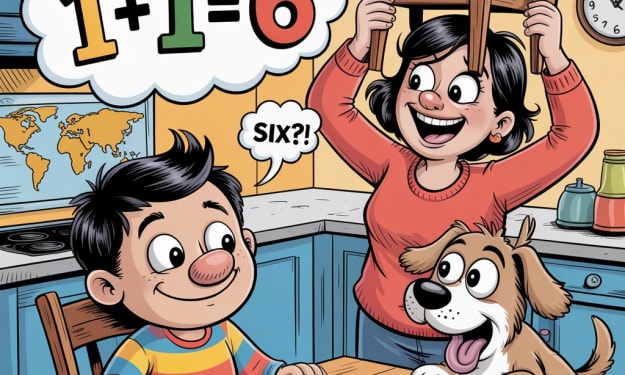
Homework is supposed to be simple. A quiet kitchen table, a child doing sums, a mother sipping coffee nearby. That’s how it looks in the movies. But in real life? Homework time is a circus act, a battlefield, and sometimes a full-on comedy show that makes the neighbors wonder if they should sell tickets.
By Life Hopesabout a year ago in Families