humanity
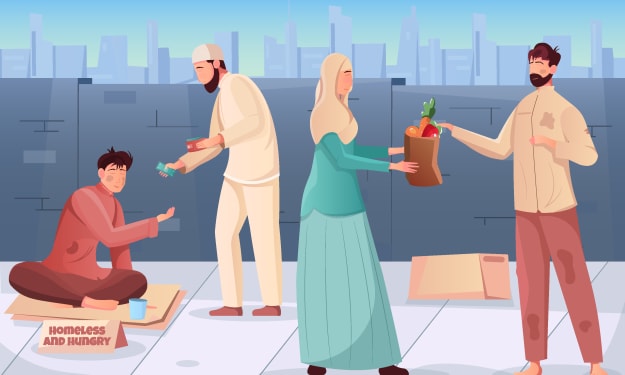
Humanity begins at home.
How to Calculate Zakat on Gold: A Comprehensive Guide
Zakat is one of the five pillars of Islam, an obligatory act of charity that is required of Muslims who meet specific criteria. It serves to purify wealth and assist those in need. Zakat is due on various types of wealth, including gold, which is one of the most common forms of savings and investment in many Muslim communities.
By CalculatorAll Pakistan2 years ago in Families
Meet Your Padre: i want to meet your padre
Starting a journey to reconnect with family can change your life. Especially when you meet your partner's parents, especially the father. Wanting to meet your partner's parents is a big step in any relationship. It's important to do it with care and respect.
By Sophia Wilson2 years ago in Families
Memories of Floyd Avenue
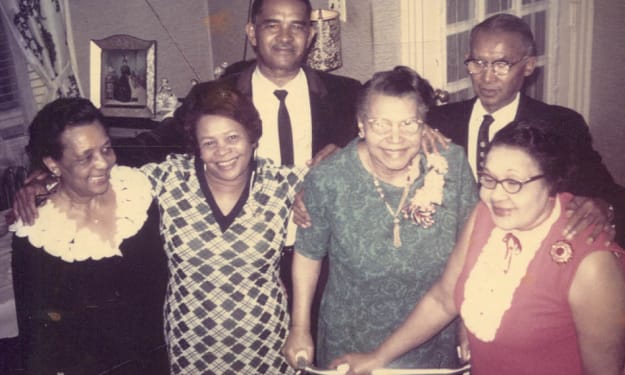
Humbleness: not proud or arrogant; modest courteously respectful When I think back to Christmas, the season of giving, there are a few specific memories that cloud my brain, and it kind of gets all hazy when I try to think on it, so I’m basically going to give you bits and pieces of what I know. First, I want to start by talking about Christmas, but instead, it will end talking about the idea of the word: “humbleness”, and in due time, you will understand what it all means...
By Slgtlyscatt3red2 years ago in Families
The Importance of Nursing Care at Home for Seniors
Caring for an aging parent or elderly loved one is one of the most meaningful things you can do—but let’s be honest, it’s not always easy. Between managing medications, doctor’s appointments, and making sure they’re safe and comfortable, it can feel overwhelming. The good news? You don’t have to do it all on your own.
By Emily Marcel2 years ago in Families
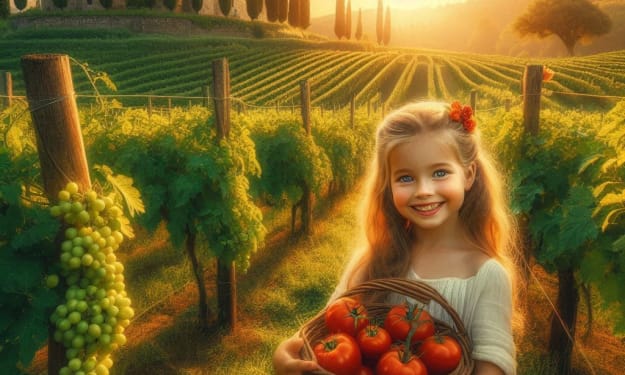
Love for tomato. AI-Generated.
In the small village of San Gimignano, nestled in the rolling hills of Tuscany, there lived a young girl named Sophia. Sophia was the daughter of a tomato farmer, and she spent her summers helping her father tend to their vine-ripened tomatoes. Sophia loved everything about tomatoes: the way they smelled, the way they tasted, and the way they made people smile. She would spend hours in the fields, watching the tomatoes grow from tiny green orbs to plump, juicy red fruits. As a child, Sophia would spend hours exploring the farm, watching in wonder as the tomatoes grew from tiny green orbs to plump, juicy red fruits. She loved helping her father in the fields, learning the intricacies of tomato farming and the secrets of the soil. One summer, a severe drought hit the region, and the tomatoes began to wither and die. Sophia's father was devastated, and Sophia felt helpless as she watched their crop shrivel away. But Sophia's idyllic childhood was not without its challenges. The village was facing a severe drought, because the tomatoes were beginning to wither and die. Sophia's father did not know what to do or where to get help because all solutions that were applied were not walking out, and Sophia felt helpless as she watched their crop shrivel away. But Sophia was determined to save the tomatoes. She spent every waking moment researching ways to conserve water and protect the plants from the scorching sun. She read books, talked to the other farmers, and even consulted with the village elder, who was known for his wisdom. Little did Sophia know, her quest would take her on a path of discovery, growth, and transformation, one that would change not only her own life but also the lives of those around her. One day, while exploring the village, Sophia stumbled upon an old, forgotten garden hidden behind a stone wall. The garden was filled with ancient, gnarled trees and a variety of strange, exotic plants that Sophia had never seen before. As she explored the garden, Sophia noticed that the plants seemed to be thriving, despite the drought. She realized that the garden's unique combination of plants and trees was creating a microclimate that allowed them to survive the harsh conditions. Inspired by her discovery, Sophia decided to recreate the garden's microclimate in her father's tomato field. She spent hours transplanting the exotic plants and trees, and carefully arranging them to create a similar environment. To her amazement, the tomatoes began to flourish once again. The plants grew strong and healthy, and the tomatoes ripened to perfection. Sophia's father was overjoyed, and the villagers were amazed by Sophia's ingenuity. From that day on, Sophia was known as the "Tomato Whisperer," and people would come from all over to taste her father's delicious, vine-ripened tomatoes. As the summer drew to a close, Sophia realized that she had learned something much more valuable than just how to save a crop. She had learned about the importance of perseverance, creativity, and community. She had also discovered a newfound passion for gardening and sustainability. Sophia decided that she wanted to continue studying and learning about these topics, so that she could help others in her community. Sophia's father, seeing her passion and dedication, decided to expand their farm to include more sustainable practices. Together, they began to explore new ways to conserve water, reduce waste, and promote biodiversity. As the years passed, Sophia's family farm became a model for sustainable farming practices in the region. People would come from all over to learn from Sophia and her father, and to taste the delicious fruits of their labor. Sophia's love for tomatoes had started it all but it was her determination, creativity, and passion for sustainability that had truly made the difference. And so, Sophia's story serves as a reminder that even in the darkest of times, there is always hope and that with perseverance, creativity, and a commitment to sustainability, we can overcome even the greatest challenges
By Henry Lucy2 years ago in Families
Are Pumpkin Seeds safe for daily use
0 Comments The Nutritional Profile of Pumpkin Seeds Pumpkin seeds, also known as pepitas, are small, green seeds that pack a powerful nutritional punch. These seeds have been consumed for centuries and are known for their numerous health benefits. They are an excellent source of protein, healthy fats, fiber, and a variety of vitamins and minerals. In this article, we will delve into the nutritional profile of pumpkin seeds and explore their benefits.
By Ariga Foods2 years ago in Families
Origins of the Qarsherskiyan People: Triracial Isolates, The history of the Ethnic Qarsherskiyan Tribe
The history of the Ethnic Qarsherskiyan Tribe is traced by some to the late 1400s during the era of Christopher Columbus, while others trace it back to the founding of Jamestown. Many trace it back to the first Muslims in North America. Starting around 1513, Spanish colonizers began bringing enslaved African Muslims to what is now Florida, Mississippi, Alabama, Louisiana, Texas, New Mexico, and other parts of the USA that were formerly controlled by the Spanish empire. Mustafa Azemmouri, often called Estevanico, was sold into slavery in 1522 by the Portuguese. Spanish conquistador Andrés Dorantes de Carranza ended up keeping Estevanico enslaved, and Estevanico became one of the first Africans to step foot on North American soil. He explored Florida, the Gulf Coast, and even the American Southwestern deserts. The USA didn't even exist back then. Not even Jamestown had been founded yet. Estevanico would end up forming amazing relationships with Native American tribes in Texas, becoming a Medicine man, and even traveled so far as to see the Pacific Ocean, all before Jamestown had ever existed or been founded. An African Muslim man did all this and more long before the American ideology of manifest destiny carried Anglo-American settlers to the Pacific coast, as they hadn't even arrived to successfully colonize what would become USA. Islam has been part of the religious make-up of America since the first colonial settlers arrived in North America. African Muslims played key roles in the founding of the United States, mapping it's borders and fighting against British rule. Around 1 in 5 of all African people brought to the USA via the transatlantic slave trade were adherentd to Islam, and nearly all Black Americans who live today are descended from one of these African Muslims. One famous Black Muslim slave was Abdul Rahman Ibrahima. Abdul Rahman Ibrahima ibn Sori was a Fulani man born in West Africa in 1762. Ibrahima left Futa in 1774 to study in Timbuktu, Mali. He was kidnapped at the age of 26 in 1788 and sold to British slave traders stationed on the River Gambia. Ibrahima was eventually sold to Thomas Foster in Natchez, Mississippi, becoming first a field hand, then rose to become the plantation overseer. He was known as the “Prince among the Slaves.” As a young man, Ibrahima was a Prince and a captain of his father’s army. In 1794, Abdur Rahman married a woman named Isabella, having a large family, nine children, 5 sons and 4 daughters. Ibrahima was known for being a knowledgeable and devout Muslim. In 1828 Ibrahima raised 3,500 dollars touring the northeast and Cincinnati to free his family. In February 1829, Ibrahima and his wife sailed to Africa. Shortly after arriving in Liberia Abdur-Rahman got cholera and died six weeks later. The following year, Thomas Foster also died and his heirs sold 2 of Rahman’s children and 5 of his grandchildren to the American Colonization Society, which in turn reunited them with Isabella in Liberia. Ibrahima’s sons Lee, Simon, Simon’s wife Hannah, and their 5 children, Simon, Susan, Cresy, Nancy, and Hester all made it to Liberia. Omar Ibn Said was a Black Muslim and was born around 1770 in Futa Toro by the River Senegal. He was raised by his uncle after his father died when he was only 5 years old. He became a devout Muslim and made the Hajj pilgrimage to Mekkah. He went there on foot! Omar Ibn Said married and had a son before being abducted and sold into slavery in America when he was about 40 years old. Omar was enslaved for 56 years and wrote at least 15 surviving texts in Arabic, including letters, Islamic verses, and his autobiography. He died in 1864 and he was subsequently buried in Bladen County, North Carolina, USA during the time of the Confederate States. Omar Ibn Said became famous for writing in Arabic on the walls of his jail cell, which contradicted the belief that enslaved Africans were illiterate. His autobiography is the only known surviving American slave narrative written in Arabic by an African while he was still enslaved in what would become the USA. Although it is said that ibn Said converted to Christianity on December 3, 1820, his conversion to Christianity was a cover-up, and there were devotional praises to Muhammad written in his Bible, and also a card dated 1857 on which he wrote Surat An-Nasr, a short surah (chapter in the Quran) which refers to the conversion of non-Muslims to Islam 'in multitudes.' The back of this card contains another person's handwriting in English misidentifying the surah as the Lord's Prayer and attesting to Omar's status as a "good Christian". While others writing on Omar's behalf identified him as a being a Christian, his autobiography and other writings offer more of an ambiguous position. In the autobiography, he still praises Muhammad; he references "Jesus the Messiah", the same way as the Quran's descriptions of Jesus (who is called المسيح 'the Messiah' 11 times in the Quran), and describing Jesus as 'our master' (سيدنا sayyidunā) employ the typical Islamic honorific for prophets and is not to be confused with Lord (ربّ rabb); description of Jesus as 'bringing grace and truth' (a reference to John 1:14) is equally appropriate to the conception of Jesus in Islam. It was most likely that he stayed a Muslim his whole life but was believed to have converted to Christianity by people at the time when he simply loved Jesus since he was considered a prophet in Islam. This was stated in his auto-biography. African Muslims helped the British and their colonies militarily expand West from the East Coast. During the a war called the French And Indian War, with "Indian" being a term referring to Indigenous Americans, the British and their American colonies had a war with New France, the French colonies in North America. The British succeeding in gaining control of territory the French formerly held, with different Native American tribes aligning with different sides. British Major-General Edward Braddock was defeated in 1755 at Fort Duquesne. The British had to retreat to the East, building a line of forts running North to South along the new battleground in what is now Huntington County, Pennsylvania. One of these forts, called Fort Shirley, had to be quickly abandoned. It wasn't abandoned before a Blacksmith made a small circular charm with the phrase "there is no God except Allah" on it in Arabic. This proves that Muslims served in the British military during the French And Indian War. Impressively, during the 1730s, Ayuba Suleiman Diallo wrote multiple copies of the Quran, which he had completely memorized, and wrote from memory! He used these for devotion and education. Ayuba was purchased by Mr Tolsey from Kent Island, Maryland. Ayuba was put to work in tobacco fields but was found to be unsuitable for such work. He was then placed in charge of livestock. While in enslaved in America, Ayuba used to go into the woods to pray. However, one day he was humiliated by a child while praying and ran away in 1731, and was captured and imprisoned at the Kent County Courthouse. Unfortunately, Ayuba's reason for escape was not understood until an African translator was located. Able to communicate his needs, Ayuba's owner set aside a special area for him to offer undisturbed prayers to Allah upon his return to being a slave. It was at the courthouse that he was discovered by lawyer and Anglican priest Thomas Bluett, of the Society for the Propagation of the Gospel, travelling for business purposes. Thomas was impressed by Ayuba's ability to write in Arabic. Bluett wrote the following: "Upon our Talking and making Signs to him, he wrote a Line or two before us, and when he read it, pronounced the Words Allah and Mahommed; by which, and his refusing a Glass of Wine we offered him, we perceived he was a Mahometan, but could not imagine of what Country he was, or how he got thither; for by his affable Carriage, and the easy Composure of his Countenance, we could perceive he was no common Slave." When another African who spoke the language called Wolof, of a neighbouring African ethnic group, translated for him, it was discovered that he was of aristocratic blood. Encouraged by the circumstances, Tolsey allowed Ayuba to write a letter in Arabic to West Africa to send to his father. Eventually, the letter reached the office of James Oglethorpe, Director of the Royal African Company. After having the letter authenticated by John Gagnier, the Laudian Chair of Arabic at the University of Oxford, Oglethorpe purchased Ayuba for £45. Muslims also fought on both sides of the Revolutionary War, with many Islamic names appearing on the military muster roles. Patriots such as Bampett Muhamed, Joseph Saba, and Joseph Benhaley, also known as Yusuf Bin Ali, the progenitor of the Krioturks / Sumter Turks tribe of Sweetgum Kriyul people. These men often distinguished themselves on the battlefield and earned high ranking and honorable positions. During the Civil War, union captain Moses Osman became the highest ranking known Muslim in that conflict. At the first African Church in Savannah, Georgia, USA, some African Americans secretly practiced Islam, while outwardly identifying as Christians and practicing a syncretic blend of the two religions that most White Christians just saw as Black Christians. Surah Al-Nas was etched into a pew at that church. Surah Al-Nas is a verse from the Quran. This final chapter of the Quran is used for protection, in this case it was used by early Black Americans as protection against their enslavers. Interviews done in the 1930s and 1940s with formerly enslaved people and their descendants are filled with references to Islamic religious practices. One common account told time and time again is about prayer beads, called tasbih, and prayer mats. Katie Brown, great granddaughter of Belali Mohamet, who was enslaved on the island of Sapelo in coastal Georgia on the Gullah Geechee coast, recalls quote: "Belali and his wife, Phoebe, pray on the bead. They bow to(wards) the sun and have a little mat to kneel on. The bead is on a long string. Belali, he'd pull bead, and he say 'belambi hakabara Muhamadu.' Phoebe, she'd say, 'ameen... ameen.' " The Kaaba, the direction in which Muslims pray towards, would have been East of West Africa, and is East - Northeast of the US East Coast. While facing the Qiblah, the direction of Mekkah, which all Muslims face whilst praying, the Fajr prayer would have occurred before sunrise, with enslaved Muslims facing East towards the growing light pre-dawn. Muslims may have been able to pray in USA in secret, but when caught, may face humiliation. Ayuba Suleiman Diallo was pelted with dirt by a White boy in Kent Island, Maryland. That is the humiliating event which caused him to run away. An unknown Moorish person enslaved in Louisiana confirmed this hardship in 1822, when they, quote: "lamented that is situation as a slave in America prevents him from obeying the dictates of his religion." Salih Belali and Belali Mohamet and other enslaved Muslims on the coastal barrier islands between Virginia Beach and Amelia Island, Florida have passed down through generations the Islamic Sufi practice of Zikr. Black American Christians, especially from the Gullah Geechee community, practice Ring Shout, a devotional form of religious dancing involving rotating in counterclockwise circles, like Hajj pilgrims do around the Kaaba in Mekkah, and clapping their hands and singing rhythmically. Aliyite Muslims from the Ethnic Qarsherskiyan Tribe also have a similar practice of standing in a ring or circle as a group, swaying side to side while singing devotional poetry, and walking or running in counterclockwise circles while stomping the feet, clapping the hands, and singing to a rhythm, often going into a trance and experiencing an ecstatic state. The WPA narratives also contain references of rice cakes called Sarakah. The name comes from the Arabic term Sadaqah, which means to give charity. Muslims often would give such rice cakes back in Africa to poor people during Ramadhan as a charitable donation. Early blues singers, like those recorded by ethnomusicologist Alan Lomax in "Levee Camp Holler," employed singing Styles reminiscent of the Islamic call to prayer called the Azaan. Ring Shout has the word Shout, which has been theorized to have actually come from Arabic "Shāwt" which means to walk a single walk about. The traces of African Muslims in early America remain today with all of the previously mentioned knowledge and history. The Qarsherskiyans descended from the Black Muslims brought to the Americas for slavery, with one in every 5 Black people brought to the USA being a Muslim. Over many generations, interracial relationships between these Black people and poor White people and Native Americans have created what would become the Ethnic Qarsherskiyan Tribe. The earliest Black ancestors of the Qarsherskiyans lived, not in the 1700s, but as early as 1619 in the Tidewater colonies. By the time they met with the first settlers in Ohio and what is now West Virginia, the Qarsherskiyan community was already more than a hundred years old. Qarsherskiyans are not originally the offspring of White plantation owners and Black females slaves, although many people who are the product of these relationships did marry into the Qarsherskiyan community later on. The original African ancestors of Qarsherskiyan were never slaves, but former Black servants freed from indentured servitude just like White servants, usually before 1720. Other African ancestors of the Qarsherskiyans either purchased their freedom from slavery or were freed upon the deaths of their White owners. But the original ethnogenisis population of the Black ancestors of the Qarsherskiyans were free by 1720. Most often, they married White women in Virginia and other southern colonies. Understanding the status of the African ancestors of Qarsherskiyans throughout different time periods is critical to understanding Qarsherskiyan people's history.
By William Penn Kurdskiy2 years ago in Families
Flutter & Frame: The Butterfly Haircut with Curtain Bangs You’ll Love
The butterfly haircut with curtain bangs is the ultimate hairstyle combo for 2024, blending soft, feathered layers with face-framing bangs for a look that’s both trendy and timeless. Whether you have straight, wavy, curly, or coily hair, this versatile style can be tailored to suit your hair type, face shape, and length. In this guide, we’ll explore everything you need to know about the butterfly haircut with curtain bangs, including styling tips, maintenance, and how to make it work for you. Let’s dive in!
By Muhammad Okasha2 years ago in Families
The Benefits of Cashews for Skin and Hair Care
Cashews, often celebrated for their delicious taste and versatility in culinary applications, are also packed with numerous benefits for skin and hair care. Rich in essential nutrients like vitamins, minerals, and healthy fats, cashews can contribute to a radiant complexion and lustrous hair. Ariga Foods offers a variety of flavorful cashews that not only enhance your diet but also provide significant beauty benefits. Let's explore these advantages in detail and discover some delightful recipes featuring Ariga Foods' premium cashews.
By Ariga Foods2 years ago in Families