humanity
Humanity begins at home.
At Papa’s Funeral, I Learned That Some Legacies Can’t Be Buried
I can’t tell if the yowling’s for the dead or the heat. It’s cicada hiss and lawn mower growl hot—so hot, it’s disrespectful. But as Dad shovels dirt over Papa, I’m cold. I can't cry, and it feels like sin. “It's alright to grieve,” Aunt June whispers. “Ain't no shame in it.” She fans herself with a program as tears drip below her sunglasses. She means it's shameful not to cry, especially for your own. But I can't put on grief like wide-brimmed hats and pearls and black dresses. Can't wear it if I don't mean it. “Who’s catering?” I say. “I'm starved.” “Lawd!” June scowls and whacks my shoulder with the program. Bone-white laurels punch through the dirt like defiant little fists. My uncle stomps over their petals, a banjolele slung over his shoulder. A stringed thing torn between a banjo and ukulele, mourning and joy. He stops beside the gravediggers and smiles. “For Papa,” he says, and strums. The bluegrass starts low but swings lighter, too cheery. Feet thump against dirt. A few hips sway. The song almost turns Papa’s funeral into a shindig, like we can't decide whether to celebrate or sob. At least, I can't. I don’t hate Papa. Just never knew how to like him. War, whiskey, and whatever else made him mean. A monster most days. But human, somehow, when he told stories. The man could lie like a Craigslist landlord. But a few of his tales were true, like how his Pops made him wait outside town shops, too ashamed of the darkness of his own son's skin. He also told war stories. Well, started them. They ended like his altar boy stories, in a grunt, silence, and another bottle. Last time I saw Papa, a few months before he died, he slumped in that ugly olive recliner, its guts spilling out the side. Cancer made him thinner, weaker, but no less angry. “He still flies off the handle over nothin’,” June muttered. She told me Papa had been phoning friends and bragging to the neighbors about how his grandkid got into college—akin to an Olympic gold medal in our small Appalachian town. So he hugged me when he saw me and stuck a cigar in my palm, even though he always said smokes weren't for girls. We rocked on the porch and talked, smoking as the sky turned from gold to dusky purple. Fireflies sparked in the weeds. Papa slapped his knee when I told him how I aced my first exam, and asked all about school more than he'd ever asked me about anything. Dad and his siblings didn't make it through high school, and my cousins spent more time behind bars than out 'cause they couldn't keep away from dope. Papa didn't get boys to brag on. He got me. “There's a spirit in these woods,” Papa said. He told me the legend of a lost soul who whistles past the willows, only in summer, near graves. He carries the bones of his father in a sack over his shoulder. “He just keeps walkin’, bones clackin’ like ice in a cup, lookin’ for a place to lay it down. But never does.” “Why not?” I asked. Papa scratched his beard. “Some things can’t be put away, no matter how hard ya try.” He went quiet for a moment, then shouted at June to bring him a beer. She took too long. When she finally handed it over, he tossed it at her and shattered it against the brick, just shy of her head. June still kept his meds organized, drove him to appointments, even helped bathe him when his legs started to give. She looked after him, and that's how he thanked her. Papa asked if I’d come back soon. I said maybe, but lied. To him, women were maids and half-brains. But even my half a brain knew to get out before he made me into June. Now, past the freshly buried casket and teary crowd, willow trees line the graveyard. They're bent and mournful. A brief gust makes the boughs drift slow and ghost-like as Papa’s voice echoes in my head: “Only in summer, by the graves. He carries a sack of his father’s bones. Looks for a spot to bury ‘em. Never finds one. Can’t let go.” But I don't see a spirit by the willows. Just Dad standing stiff, shoulders tight. No ghostly whistle, only sniffles and wailing from the people Papa hurt most. As if he didn't flick his family away like a cigarette out of a car window. Dad stares at me and marches over. I see that tiny patch of dark skin on his left arm, still there from when Papa stuck a lighter to him after he “stole” a pack of gum as a toddler. Dad waves a hand in front of my face. “It's hotter than the hinges of hell out here. Y’alright?” I nod. It's not a lie. Papa’s gone, and I'm fine. Cold. And that feels worse than being sad. Makes me feel like a beast, like I belong out in the woods on all fours more than in a dress and heels. Finally, everyone shuffles back through the grass, to a narrow path leading to the church. It's a white stoned building, sticking out of our godforsaken town like a diamond in dirt. I’m glad it’s almost done—the wails, the fake condolences, the platitudes. They say Papa lit up every room, but don't say how. They don't admit he doused it in gasoline and struck a match—just say he had a nice smile. Like most of his stories, his eulogy’s a tall tale. One I'm tired of hearing. We step past a wrought-iron gate screaming at the joints. A heavy silence makes my body tense. Even the birds hush. I walk beside Dad, no noise except the crunch of gravel beneath our feet. June stops at the open church doors, dabbing her eyes, and waves us over. But Dad doesn't follow the crowd inside. He nods to the parking lot and I follow, until we plop onto his truck bed. The metal sears through cotton into my thighs. I don't move. Dad doesn’t say anything as he passes me a steaming water bottle buried under a towel, hands shaking a little. Mine shake too. I want to ask if he’s glad Papa’s gone, but the question feels wicked. Does Dad feel the same? Is he…relieved? Ashamed? Done with this funeral, too? “Think you'll miss him?” Dad doesn't answer right away. Doesn't look at me when he does. “I’ll miss who he coulda been.” I nod and squeeze my hands together tight. “I'm proud of you, you know that?” Dad says. “Hell, you’re the only good thing about me.” I force a smile. Dad’s never been good with feelings. Neither have I. But if I’d been raised by Papa—never told I was loved, hit instead of held—I’d be worse. At least I got more than he did. I got scraps, but Dad got starved. And I know Dad cares. I see it in his eyes, and in the way he calls on my breaks to ask if I’ll come visit. He looks like he wants to say more, but sighs and picks at a hangnail. I want to ask if Papa ever told Dad he was proud, but I already know. Dad yanks out a cigarette and marches toward the tree line. He leans against a trunk, folds his arms, and whistles. A tear burns down my cheek, and I'm relieved. Maybe flesh beats behind my chest instead of granite after all. But I don’t cry for Papa. I cry for Dad. Just ‘cause you bury a man doesn’t mean the hurt goes down with him. Maybe Papa learned that from his Pops, Dad learned it from Papa, and I learned it from Dad. I pray mine won't learn it from me. If Papa were here, what story would he tell? I’ll never know—and maybe that’s best. As Dad finishes his smoke, I head for the church. Sun whips my skin. My tears are already dry as I walk on, quietly carrying his bones.
By DigitalAddiabout a year ago in Families
“My Father’s Hidden Letter Revealed the Truth That Changed My Life Forever”
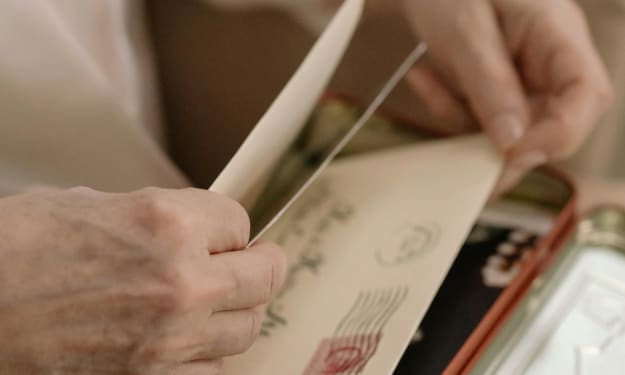
I knew everything about my father. He was a quiet, disciplined man who spent most of his life working hard for our family. He was never one to share much about his past, and I never questioned it. For me, he was simply “Dad”—the man who fixed broken toys, paid the bills, and gave me advice in short, firm sentences. But everything changed on the day I found his hidden letter. It happened six months after his death. My mother asked me to clean out the old wooden desk in his study. The drawers were full of receipts, old photographs, and notebooks filled with his neat handwriting. At first, I thought I was just doing routine cleaning, but then I noticed a false bottom in the lowest drawer. Curious, I pressed gently and found a thin envelope tucked inside. My father’s handwriting was on the front, and it was addressed to me. My heart began to race. Why would my father leave a letter hidden away where no one would find it? With trembling hands, I tore it open. Inside, my father confessed something I never imagined. He wrote about a time in his youth, long before he met my mother. He had fallen in love with a woman he could never marry due to family pressure and cultural expectations. They were deeply in love, but circumstances forced them apart. A year later, he discovered she had given birth to a son—his first child. The words blurred before my eyes as I read. My father had another son. I had a brother I never knew about. The letter went on to explain how he had tried to stay in touch, but her family moved to another country. My father eventually lost all contact. He confessed that for years he carried guilt and sorrow, never telling my mother or anyone else. He had hidden this truth from the entire family. At first, I was overwhelmed. My father, the man I admired for his honesty and integrity, had kept this enormous secret from us. I felt anger, confusion, and even betrayal. But as I read further, his words softened my heart. He wrote: “I never stopped thinking about him. I often wondered if he was happy, if he was safe, if he knew he was loved by a father who couldn’t be there for him. If you ever read this letter, I want you to know that my silence was not weakness, but fear. Fear of hurting the family I built later. Fear of losing the respect of those I loved. Please forgive me.” The last lines shook me to my core: “If you wish, find him. If you don’t, let this secret die with me. But know that a part of me always belonged to him, and that does not change how much I loved you.” I sat in silence for hours, the letter clutched in my hands. My father was gone, yet his words had changed everything I thought I knew about him. I was no longer just his only child—I had a brother somewhere in the world. In the weeks that followed, I debated whether to tell my mother. I imagined her pain, her questions, and her disbelief. But in the end, I decided she had already carried enough grief after losing him. This was a burden I would keep to myself, at least for now. Instead, I started searching quietly. I went through old documents, traced names, and even reached out to distant relatives. Each step felt like uncovering another layer of my father’s hidden past. Though I haven’t found my brother yet, one thing has become clear: my father’s secret did not destroy my love for him. If anything, it made me realize he was human—flawed, vulnerable, and burdened by choices he could never undo. That hidden letter didn’t just reveal a family secret. It revealed the depth of my father’s heart and the complexity of his life. It taught me that even those we think we know completely can hold stories we may never imagine. And perhaps one day, when I find my brother, I will show him this letter. Because the truth that my father kept hidden for so long is now the truth that has changed my life forever.
By Shahab Khanabout a year ago in Families
She Left a Note on the Coffee Table—Three Words That Broke Me
I still remember the way the light filtered through the curtains that morning. It was one of those soft, golden mornings that should have promised peace. But instead, it delivered heartbreak. The coffee was still warm in the pot. The silence of the apartment was heavy, unnatural. And there, in the center of the living room, was a note.
By Engr. Mansoor Ahmadabout a year ago in Families
What We Can Learn from Our Children
Photo by Vitaly Gariev on Unsplash Having children comes with responsibility and patience and somewhere along the line of parenting we forget that we were once children. We were the ones who tested boundaries, threw tantrums of epic proportions, and caused our parents endless worry and feelings from the entire spectrum of emotions.
By Elizabeth Woodsabout a year ago in Families
Unconditional Love
Lena had never imagined her world would shrink to just the two of them — her and her little brother, Max. When their parents passed away suddenly, the weight of the world fell on her shoulders. At only twenty-two, Lena was still figuring out her own life, but now she had to be both sister and guardian.
By Hakeem Khan about a year ago in Families
The Last Letter in the Rain . AI-Generated.
The rain had been falling for hours, the kind that didn’t just wet the skin, but seeped into the soul. A young man named Ayaan sat on the wooden bench outside the old post office, holding a crumpled letter in his trembling hands.
By Sigma writes about a year ago in Families
“Life of Lower-Class People”
In every society, there are people who live unseen by the mainstream — those whose daily battles rarely make the headlines but whose lives are a testament to human endurance. These are individuals and families who survive on the margins, facing economic hardship, social exclusion, and limited opportunities. Yet, even in these shadows, there exists a remarkable blend of resilience and hope that refuses to be extinguished.
By Muhammad Asadabout a year ago in Families
A Baby’s Fight for Life — Before She Was Even Born
The first time she heard the diagnosis, the mother felt the air leave her lungs. She was just over halfway through her pregnancy, dreaming of nursery colors and baby names, when the doctor’s face shifted from calm to concerned. The ultrasound showed something no expectant parent ever wants to hear: a large tumor was growing at the base of her unborn child’s spine. It had a complicated name — sacrococcygeal teratoma — but the reality was simple and terrifying. The tumor was stealing blood from her baby’s tiny heart. Without intervention, the child might not survive to birth. It wasn’t just the baby’s life on the line. The pregnancy itself had now become high-risk. Every day was a gamble. A Risk Few Would Dare to Take Her doctors explained there was one option — a surgery so rare and so risky that only a handful of teams in the world had attempted it. The baby would need to be partially delivered from the womb, the tumor removed, and then placed back inside to continue growing until birth. The mother’s eyes filled with tears as she listened. The idea seemed impossible. But then they introduced her to the man who could make it happen: Dr. Oluyinka Olutoye. Calm, steady-voiced, and carrying himself with quiet confidence, Dr. Olutoye explained every step. He didn’t sugarcoat the risks, but he also didn’t flinch when describing what they would try to do. His team had performed miracles before — and this, he said, was worth the fight. The Day Everything Stopped The operating room was a world of controlled chaos. Twenty-one medical professionals stood ready — each one with a role, each one aware that a single misstep could cost two lives. The mother was placed under anesthesia. A careful incision exposed the uterus, and under bright surgical lights, the womb was opened just enough for the surgeons to reach the tiny patient inside. For a brief moment, the baby’s body emerged — so impossibly small, her skin almost translucent. Her heart still beating, she was suspended between two worlds: not yet born, but no longer fully inside. Every movement was precise. The surgeons worked swiftly, carefully removing as much of the tumor as they could without harming the delicate nerves and tissues that would one day allow her to walk, run, and play. The room was silent except for the steady beeps of the monitors — a reminder that the line between life and loss was razor-thin. Back Into the Safety of the Womb When the tumor was finally gone, the team gently placed the baby back inside her mother’s womb. The uterus was closed, and the mother’s body became once again the safest place for her child. But the surgery was only the first battle. Over the next 13 weeks, every appointment, every scan was a test of hope. Would the baby’s heart stay strong? Would the surgery hold? The mother lived in a strange mix of fear and gratitude — counting down the days, each kick and movement inside her belly a quiet promise: I’m still here. The Day She Arrived At 36 weeks, the day finally came. The delivery room was tense but hopeful. And then — a cry. Strong, clear, alive. The baby they had once feared would never take a breath was here, healthy, and tumor-free. The room, once tense with focus, now filled with smiles and tears. Nurses cradled her, doctors exhaled in relief, and the mother held her daughter for the very first time. The Man Behind the Miracle For Dr. Olutoye, this was more than another case. Born and raised in Nigeria, he had dreamed of becoming a doctor since childhood. His journey took him across continents — from graduating at the top of his class at Obafemi Awolowo University, to advanced training in the United States, to eventually becoming Surgeon-in-Chief at Nationwide Children’s Hospital. His path was not easy, but every challenge sharpened his skill and deepened his resolve. Over the years, he became known not just for surgical brilliance, but for the way he carried hope into rooms where it was in short supply.
By DigitalAddiabout a year ago in Families
Gentle Parenting is Not Permissive
Gentle parenting is a parenting technique that focuses on empathy, respect, and positive relationships between parents and children. It falls under the firm but kind authoritarian parenting style: aiming to teach children skills like emotional regulation, communication, and confidence. Due to its opposition to harsh punishment and its emphasis on consent and autonomy, gentle parenting is often assumed to be permissive. Parents who practice this parenting style are often met with judgement. Even some who practice gentle parenting are unaware of what it truly entails, contributing to its misconceptions.
By choreomaniasabout a year ago in Families