grief
Losing a family member is one of the most traumatic life events; Families must support one another to endure the five stages of grief and get through it together.
When Motherhood Dies.
When Motherhood Dies: The Tragedy of Cruelty and the Loss of Humanity. Have you ever wondered: Can a mother really kill her own child? Not by accident. Not out of desperation. But by a cold, conscious decision. If the question alone moves you, the answer will haunt you. This is not fiction. It is not an exaggerated drama. It is a true story set in a lush, green village in one of Africa's most vibrant and contrasting countries, where the beauty of nature often masks the brutality of the people. A story in which motherhood was not celebrated, but rather suppressed.
By Sayed Zewayedabout a year ago in Families
Crumbs of Courage
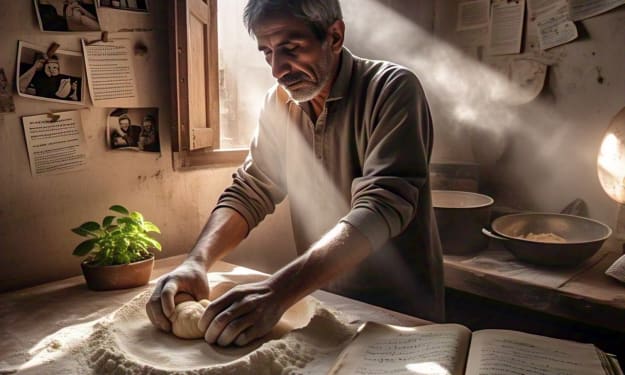
The first time Amir baked bread in the new country, his hands trembled. Not from the cold—though the small, tiled kitchen in the shelter was icy that morning—but from memory. The flour on his fingers reminded him of home: of sunlit mornings, of his wife humming as she rolled dough, of the faint smell of cumin and rosewater drifting through open windows. Now, everything smelled like sterilized metal and worry. Back in Aleppo, Amir had owned a small but beloved bakery named Khobz wa Salaam—Bread and Peace. His baklava was legendary. Locals said his hands were guided by angels, that his sweet dough could mend broken hearts. Then the war came. Missiles replaced music. He buried his wife beneath rubble and fled with nothing but a tin box of recipe cards, most smudged by blood or soot. His son, barely nine, held his hand as they crossed borders, nights filled with hunger, silence, and fear. When they finally reached Europe, the camp was crowded and gray, but it offered a roof, food, and school for his boy. That should’ve been enough. But something was missing. It wasn’t until the camp coordinator mentioned a community kitchen project that Amir offered, hesitantly, to bake. That first morning, he shaped the dough carefully, hands remembering what the heart had tried to forget. He baked small, soft flatbreads—khubz taboon—brushed with oil and scattered with thyme. He placed them on a tray, heart pounding. When the other refugees tasted them, something shifted. Eyes widened. A woman began to cry. A teenage boy whispered, “This tastes like my grandmother’s house.” People lined up not just for bread, but for something they had forgotten they craved: connection. Word spread. The shelter gave him a corner of the kitchen and old ingredients nobody wanted. He worked magic with them—cardamom buns, date cookies, fragrant rice-stuffed flatbreads. Every bite told a story. Every spice whispered of a lost city, a loved one, a street that no longer existed. And then, one day, he began writing again. He took out his old recipe cards, rewritten now in three languages—Arabic, English, and French. On each card, beneath the ingredients, he added a story. A memory. “My wife, Leila, made this when I asked her to marry me.” “My son laughed so hard, he dropped the whole tray of these.” “My bakery was bombed the day after I made these for the town festival.” People didn’t just eat. They read. And wept. And hugged him. And stayed. Months passed. His son began smiling again. Local volunteers noticed. One of them, an elderly French chef named Bernard, asked Amir to teach a weekly class. At first, Amir refused. He didn’t want to speak. But Bernard insisted: “People need to taste your story.” The class became a sensation. Every Thursday, Amir taught a new dish and shared the memory behind it. Students weren’t just refugees—they were locals, too: curious, kind, hungry to understand. One girl asked, “How do you bake when you feel broken?” Amir paused, then said, “I bake because I’m broken. The dough listens better than most people.” They wrote that on the chalkboard and never erased it. Soon, Amir’s recipes were compiled into a small, illustrated book titled Crumbs of Courage. Each chapter was a dish, each dish a moment of his life. The last page had no recipe—just a photograph of Amir and his son planting mint in a clay pot by their shelter window. “Fresh things can grow,” the caption read. “Even in foreign soil.” Years later, his son would run a café called Khobz wa Salaam in a sunlit corner of the city. Tourists came for the baklava, but stayed for the walls—covered in Amir’s recipes, written in his careful script, each signed with a simple line: “Made with memory.” By then, Amir no longer trembled when he baked. He stood tall in the kitchen, his apron dusty, his heart light. For in every crumb he left behind, there lived a quiet kind of courage. The kind that survives bombs, borders, and language barriers. The kind that says: “I am still here. And I am still feeding hope.”
By Syed Kashif about a year ago in Families
The Man Who Claimed to Be My Father Had Proof--But I Knew It Was a Lie
Not because I thought it was funny. But because it was so absurd it seemed like something from a movie. He looked nothing like me. He was tall, pale, wiry, with sharp cheekbones and dark eyes that felt too cold.
By MALIK Saadabout a year ago in Families
The Silent Pact. Content Warning.
The bruise bloomed across my back like how a robin's underbelly looks bright against its dark feathers. I could see in the mirror the dark and ominous red against my pale skin. At eleven years old I studied it in the bathroom mirror, twisting awkwardly to see the full scope. The bruise, only half a day old, was beginning to evolve from a bright red to a dulled purple-blue. It was almost like art, I recalled. I couldn't look at my legs, which still stung. How do they look? I wondered while resisting the urge to look down. This was not the first time nor would it be the last but this one changed something fundamental inside me.
By G. A. Boteroabout a year ago in Families
My Daughter’s DNA Test Exposed a Secret My Husband Took to His Grave
It started as a harmless birthday gift. Our daughter, Lily, had just turned 16. She’s always been fascinated with stories—myths, history, family lore. So I bought her one of those ancestry DNA kits. “Let’s see if you’ve got Viking blood,” I joked as she swabbed her cheek and sealed the envelope.
By Noman Khan about a year ago in Families
Healing, Hope, and New Beginnings Await at "Permission To" Day 2025
Azal Lockett An Empowering Event to Help You Move Forward with Peace, Purpose, and Joy The WHY: On December 15, 2020, Dr. Portia Lockett received a call that no mother ever wants to get: her beloved son, Azal Benne’ Lockett, had died. Initially reported as a car accident, it was later revealed that Azal had been shot and, in a desperate attempt to seek help, crashed into an EMT truck.
By Dr. Pam Perryabout a year ago in Families
Behind the Smile. Content Warning.
She went to school every day with a huge smile on her face, chatted with friends, participated in class, and got good grades. Even made people jealous. "How the heck did she get a perfect score in Math? I wish I was her," she hears a whisper from behind her. It was Linda. Linda got a 75, but Linda has plans to go out with her family tonight, and Linda has a father she proudly calls 'Dad', and Linda has a Mom who comforts her when she's upset, and Linda has a sister who's her best friend. So, who exactly is the winner here? It's Linda, because the real winners in life and always people like Linda.
By AdharaWritesabout a year ago in Families
The Silent Light of a Mother's Love
The Silent Light of a Mother's Love There was once a woman named Ayesha, a mother whose world had been plunged into darkness long before she could even understand the weight of the word. Born with perfect vision, Ayesha had once admired the beauty of the world around her. But life had a different plan, and at the age of 20, she lost her sight to a rare disease. Her world became black, silent, and empty. But Ayesha was strong. Her love for her son, Imran, was the one thing that still lit up her life. Imran was born a year after her blindness, and he became her eyes, her guide, and her reason for living. He was her light in the dark. Every day, Ayesha would hold him close, feel his warmth, and listen to his laughter that echoed through the walls of their humble home. Imran grew up under her care. He was a brilliant child, gifted with intelligence that surpassed that of his peers. Ayesha, though blind, could sense his potential. She would tell him, "Imran, you are destined for greatness. The world will one day know your name." She would encourage him to study, to dream big, and to never let his circumstances define him. Ayesha’s sacrifice for her son was boundless. She never once complained about her blindness, for her focus was always on him—her hope for a brighter future. Imran, in his childhood, adored his mother. He would never leave her side, guiding her through the house, ensuring she had everything she needed. But as he grew older, a shift began to take place. He became more focused on his studies and ambitions, leaving less time for his mother. His friends, his social circle, and the allure of the world outside began to take over his life. Years passed, and Imran succeeded. He got accepted into one of the best universities in the country, something Ayesha had always dreamed of for him. With each step of his academic journey, she stood by, unseen but always there. She would listen to him talk about his achievements, his plans, and his dreams, though she could never see his face light up with joy. It was during his final year in university that Imran began to feel the weight of his success. He had become a respected young man in his field, his name starting to gain recognition. Yet, something inside him grew uncomfortable. Despite all his achievements, a deep sense of shame began to settle within him. His friends had no idea about his mother’s blindness, her sacrifice, or the reality of his humble beginnings. Imran began to distance himself from Ayesha. He would spend hours in his room, making excuses not to visit her as often. He started attending more social gatherings, where the topic of family came up. His mother’s blindness, her sacrifices, felt like a stain on the perfect life he had built for himself. He began to hide the truth about her, feeling that his friends would look down on him if they knew. "What would they think of me?" he would wonder. One evening, after a particularly glamorous event, Imran found himself standing at the threshold of his mother’s room, guilt consuming him. Ayesha was sitting by the window, feeling the cool evening breeze, her sightless eyes closed as if she could sense him approaching. She smiled, sensing his presence. “Imran, how was the event? Did you shine like the star I always knew you would?” Her voice was full of warmth, as it always had been. Imran could barely meet her gaze. His mind was clouded with shame and embarrassment. “It was great, Mom. Really great,” he said, his voice lacking the usual enthusiasm. Ayesha, ever perceptive, noticed the change in his tone. “Is something wrong, my son?” she asked gently, her hand reaching out to touch his. “You seem distant.” Imran stood there, conflicted. He opened his mouth to speak but hesitated. He wanted to tell her everything, to confess the weight of his shame, but the words wouldn’t come out. Instead, he left her room in silence, a tear escaping his eye as he closed the door behind him. That night, something changed within him. As he lay in bed, images of his mother flooded his mind. He remembered how, as a child, she had made every effort to ensure he never felt the absence of sight, how she had devoted every moment of her life to him. She had been his rock, his foundation, while he, in turn, had started to build his own life—one without her. The following morning, Imran couldn’t shake the weight of his actions. He rushed back to his mother’s room. Ayesha was sitting there, her face lit up by the soft morning light, her hands folded in her lap. Imran knelt before her, his heart heavy with regret. “Mom,” he whispered, his voice breaking, “I’ve failed you. I’ve hidden you. I’ve been ashamed of you when I should have been proud of you. I’m so sorry.” Ayesha’s heart swelled with a mixture of sorrow and forgiveness. She gently cupped his face, her fingers trembling. “Imran, my son,” she whispered, “I never wanted you to feel burdened by my blindness. You are the light of my life, and I have always been proud of you. I don’t need the world to see me, as long as you see me.” Tears streamed down Imran’s face as he realized the depth of his mother’s unconditional love. In that moment, he understood that the love she had shown him, despite all her suffering, was the true light of his life.
By Noman Afridiabout a year ago in Families
Practice Self-Care
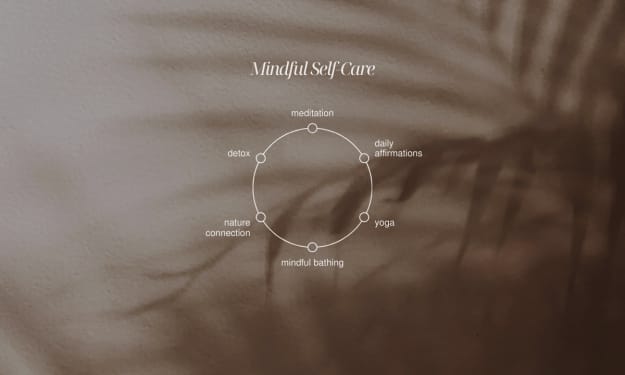
And all these things need to be done on the base of the Foundation of Healing—Caring for oneself. Healing is more than just what takes place when you’re ill or feeling poorly. It’s about creating the conditions that allow for well-being to flourish in all aspects of your life — emotionally, physically, mentally and spiritually. Self-care is the heart of recovery from traumatization because it helps us find our balance, resilience and soul-health. It requires intention, presence, and intention.
By Laila Sadiaabout a year ago in Families