extended family
All about how to stay connected, strengthen ties and talk politics with your big, happy extended family.
Saudi Arabia Sees Surge in Early Divorces: Sociologists Reveal the Hidden Causes
Saudi Arabia, a country where traditional family values are held in high regard, is facing an unexpected and rising social challenge — the increasing rate of early divorces, often just weeks or months after lavish wedding celebrations. Despite promises of love and commitment, many couples in the Kingdom are separating before even completing their first year together. According to the 2025 report issued by the Saudi Ministry of Justice and the General Authority for Statistics, an average of 157 divorce cases are registered daily across the country. That’s roughly one divorce every 9 minutes. More alarmingly, divorces now account for 12.6% of all marriages in Saudi Arabia, a trend that experts say is both socially and psychologically concerning. Al-Baha Tops the Divorce Charts The report further reveals that the Al-Baha region, located in the southwestern part of Saudi Arabia, recorded the highest divorce rate in the country — with 36% of marriages ending in separation. Following closely are Riyadh with 21.7% and Hail with 19.2%. One particularly eye-opening statistic is that 65% of all divorces occurred within the first year of marriage. This finding strongly suggests that many couples lack compatibility from the start, or are unprepared for the realities of married life. Real-Life Cases: Love Turned Cold Take, for instance, the cases of Fahad Al-Otaibi and Reem Al-Qahtani, whose marriages lasted less than six weeks. Both unions ended over misunderstandings, lack of shared responsibilities, and poor communication. In another case, Ahmed Al-Raythi’s honeymoon became a turning point, not for joy, but for separation. His wife expected a luxurious and highly curated lifestyle, while Ahmed desired a simpler, more grounded life. Their differences, which seemed manageable during courtship, became insurmountable after marriage. These are not isolated stories — they reflect a growing number of couples who enter marriage with unrealistic expectations, often shaped by social media, peer pressure, and idealized romantic fantasies. Sociologist Insights: The Root Causes Prominent Saudi sociologist Dr. Ahmed Al-Najjar has weighed in on the alarming trend. He attributes the rise in divorces to a combination of social, economic, and psychological factors: 1. Excessive Wedding Expenses: Lavish weddings often leave couples (or their families) in significant debt. Once the celebrations are over, financial strain takes a toll on the relationship. 2. Immature Decision-Making: Many young couples rush into marriage without understanding the long-term responsibilities that come with it. Dr. Al-Najjar warns that emotional impulsivity is replacing thoughtful compatibility assessments. 3. Superficial Relationships: Pre-marital interactions, often limited or virtual, don’t provide a deep understanding of the partner’s personality, values, or expectations. 4. Over-involvement of Families: In many cases, extended family interference exacerbates even minor disagreements, especially in traditional households where parents may try to control the marriage. 5. Unrealistic Expectations: A marriage is more than just a celebration. It demands emotional intelligence, communication skills, and mutual respect — qualities that Dr. Al-Najjar says are often underdeveloped. > “Marriage is not just an event; it’s a lifetime partnership,” says Dr. Al-Najjar. “Without conscious effort, patience, and maturity, even the grandest wedding won’t survive the realities of everyday life.” Culture Shift: From Romance to Reality While arranged marriages still exist in Saudi Arabia, there has been a growing trend toward love marriages and self-selected partners, particularly in urban centers like Riyadh and Jeddah. However, this shift has not necessarily decreased divorce rates. In fact, romantic relationships formed without deep understanding may inflate emotional expectations, which later clash with the practical demands of cohabitation. Another emerging challenge is the influence of social media culture. Instagram-perfect weddings, filtered photos of couple goals, and viral videos promoting luxury lifestyles have created false ideals. When real life fails to live up to those illusions, disappointment sets in fast. Legal Developments and Women's Rights Interestingly, Saudi Arabia has also made strides in women’s legal empowerment in recent years, including reforms that now allow women to be notified via SMS when they are officially divorced. This transparency has encouraged many women to stand up for their rights, but it has also contributed to a spike in mutual or initiated divorces by women, particularly when the marriage lacks respect or compatibility. The Ministry of Justice reported over 350,000 divorce cases in one year alone, indicating that the issue is national in scale, not just regional. What Can Be Done? Experts suggest several long-term strategies to address this growing crisis: Pre-marital counseling programs to educate couples on marital roles and expectations. Promoting simpler wedding ceremonies to reduce financial pressure. Encouraging family boundaries, ensuring that newlyweds have space to build their own dynamic. Public awareness campaigns on mental and emotional maturity in marriage. Legal initiatives to streamline conflict resolution and post-divorce counseling for both men and women. Final Thoughts The rising divorce rate in Saudi Arabia, particularly among young couples and newlyweds, is a wake-up call for both individuals and society. It highlights the urgent need for a cultural shift in how marriage is viewed — not as a social milestone or display of wealth, but as a meaningful, lifelong commitment. As sociologists, religious leaders, and policymakers debate the root causes, one truth remains clear: a wedding can last one night, but a marriage demands a lifetime of patience, understanding, and effort.
By Ikram Ullahabout a year ago in Families
The Day the Internet Broke — And We Actually Talked to Each Other
The Day the Internet Broke — And We Actually Talked to Each Other By HUZAIFA DZINE It began like any other Monday. Caffeine-deprived zombies stumbled into kitchens, smartphones glued to palms, scrolling through morning emails, memes, and the latest updates from people they hadn’t spoken to since high school. Across the world, people asked Alexa the weather, Google told us what was wrong with our throats, and YouTube suggested ten ways to fold a T-shirt in under five seconds.
By Huzaifa Dzineabout a year ago in Families
The Sound of Empty Rooms. AI-Generated.
The key turns stiffly in the lock, one last time. I push open the door, and it groans in protest—just as it always did, like a grumpy guardian that never quite warmed to strangers. The scent of dust and old wood clings to the air, mingling with something fainter—familiar, elusive—like the ghost of cinnamon toast on Sunday mornings or my mother’s lavender soap.
By Muhammad Nasirabout a year ago in Families
Your Complete Pregnancy Roadmap: . AI-Generated.
Pregnancy is a remarkable journey filled with physical, emotional, and developmental changes. Whether you're a first-time mom or experienced in motherhood, understanding what happens each week can help you feel more prepared and confident. This comprehensive guide walks you through pregnancy week by week, covering fetal development, maternal changes, symptoms, and essential tips for a healthy pregnancy.
By let's motivate yourselfabout a year ago in Families
About Me Someone Destroyed Me Somehow — But Saved My Sanity
Let me start this off by saying: I love my love. I love my golden retriever, Milo, more than I ever thought possible. He’s sweet, funny, smart (when he wants to be) and unquestionably loyal. But if you’ve ever lived with a high-energy dog — especially a young one — you’ll know what I mean when he can bring chaos into the house like a hurricane.
By Echoes of Lifeabout a year ago in Families
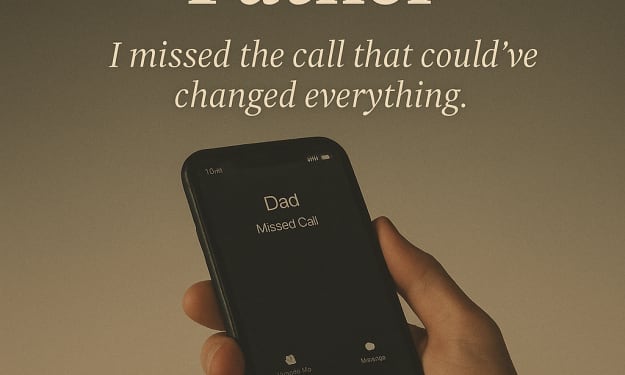
The Last Call from My Father
The Last Call from My Father By Tariq Shah The last time my father called me, I didn’t answer. I was sitting in a glass-walled meeting room on the 18th floor of a corporate tower. PowerPoint slides, spreadsheets, quarterly targets—those seemed important at the time. My phone buzzed in my pocket. I glanced at it. “Dad.” I hit “silence” and told myself I’d call him back later. He passed away that night. They said it was peaceful. A heart attack in his sleep. He didn’t suffer. But no one told me what it does to a man—to see a missed call from his father sitting on his lock screen. Unanswered. Unopened. Unforgiven. For days, I stared at that call log, replaying every memory, every word we hadn’t spoken. He had been trying to reach me. For what? A goodbye? A final “I’m proud of you”? Or maybe something more ordinary. Maybe he just wanted to ask about my day. And I was too busy building a life to answer the one who gave me life. The guilt came like waves. One moment I’d be drinking coffee, the next I’d be drowning in thoughts of him. He wasn't a perfect man. He had a temper. He worked too much when I was little. But he also fixed every flat tire I had, showed up to every graduation, and taught me to keep promises—even when they hurt. After his funeral, I went back to my apartment, still dressed in black. His voice felt like it was still floating in the room, hiding in corners. My phone was silent now, almost in protest. I finally opened his last voicemail. My hands were shaking. > “Hey son, I know you’re probably in a meeting. Just wanted to say I was thinking about you today. That’s all. No reason, really. Just... proud of the man you’ve become. I miss you. Call me when you can, alright?” That was it. Twenty-two seconds. I must’ve listened to that message a hundred times. Not because of what he said, but because of what he didn’t get to say. Because of what I’ll never get to say back. For weeks, I couldn’t sleep. I walked the city at night, passing strangers and wondering how many of them had missed their last chance too. One morning, I found myself outside his old house. The garden was still untrimmed, just like he used to leave it, saying “Nature should look like nature.” His old rocking chair still sat on the porch, quietly swaying in the wind. I sat down in it and cried for the first time since his death. Not a silent, controlled cry. A loud, messy one. And something happened. I forgave myself. It didn’t come with fanfare or music. Just a quiet, internal voice whispering, “He knew.” He knew I loved him. Even if I didn’t always say it. He knew I was busy, trying to make something of myself. And knowing him, he wouldn’t have wanted me to carry this guilt like a stone around my neck. That day, I deleted the voicemail. Not because I wanted to forget, but because I had finally heard it enough to remember it forever. Since then, I answer every call from my mother. I text my sister back, even if it’s just an emoji. I’ve stopped waiting for “later.” Because later might not call back. And now, when I leave voicemails, I say the things that matter. “I love you.” “I’m proud of you.” “You’re not alone.” “Call me when you can, alright?” --- Author Note: If you’ve lost someone with words left unsaid, know this—you’re not alone. Guilt is heavy, but love is stronger. Forgive yourself. Speak your heart today. Don’t wait for the “right time.” Sometimes, the right time is now.
By Tariq Shahabout a year ago in Families