extended family
All about how to stay connected, strengthen ties and talk politics with your big, happy extended family.
When the Lake Spoke My Father’s Name
I hadn't been back to my father's house in months. After the funeral, I told myself I needed time, space, anything that didn't remind me of hospital rooms and legal documents. So I avoided the place altogether, even though he'd lived there for twenty-seven years, and even though every good childhood memory I had was tied to the lake behind it.
By iftikhar Ahmad10 months ago in Families
A Multitude of Blessings
Today was Thanksgiving here in the United States. I am nestled in tonight in a warm home with heat, two adorable children who got to spend the day with their Mommy, and my boyfriend. I have had a lot of things lately that I am not exactly thankful for, but I wanted to take a moment to count my blessings.
By Adora Hooper10 months ago in Families
From Poverty to Prosperity: Evan’s Unexpected Journey. AI-Generated.
Evan lived with his mother in a small village just outside a noisy, fast-growing city. Their home was a tiny room built from old bricks and a patched metal roof that rattled every time the wind blew. Money was never enough. Some nights, Evan went to sleep hungry, pretending he was full so his mother wouldn’t worry.
By StoryVerse10 months ago in Families
Touchy Topics Not to Talk About at Family Gatherings
It is good for families to get together at special times of the year to see one another and to celebrate the occasion. It is customary for families to be in one central location on holidays, birthdays, anniversaries, weddings, and funerals. When large groups of relatives get together, some tend to say things that are not pleasing to others.
By Margaret Minnicks11 months ago in Families
Nick Cannon's Daughter Wasn't Throwing Shade
Monroe "Roe" Cannon, daughter of Nick Cannon and pop singer/ "Queen of Christmas music" Mariah Carey posted on Instagram addressing about her siblings from her father. The 14-year-old took to Instagram sharing on her story about claiming her twin sibling as her only sibling and as the rest of her younger half siblings as half’s.
By Gladys W. Muturi11 months ago in Families
Should’ve, Could’ve, Would’ve:
Should’ve, Could’ve, Would’ve: Lessons from the Cage There’s a stage in life I call the “should’ve, could’ve, would’ve” stage. It’s not a place you visit once—it’s a recurring room in the mind, a cage of hindsight and reflection. I’ve spent years pacing that cage, looking back at choices I made and the ones I didn’t. It’s the mental space where regret meets realization, where you ask yourself: “What if I had done things differently?” It’s the place where I should have been thinking, “I should, I could, I would.” But I wasn’t.
By Ceaser Greer Jr11 months ago in Families
Fate or Fluke? You Decide.
Let me ask you something straight up: Do you believe in coincidences, or do you feel like everything in life is somehow arranged? For those of you who lean toward the idea that things just happen by random chance, I’ve pulled together five strange, real-life examples that might just make you rethink everything.
By Areeba Umair11 months ago in Families
The Sacred Bond: A Journey Through Marriage in Islam
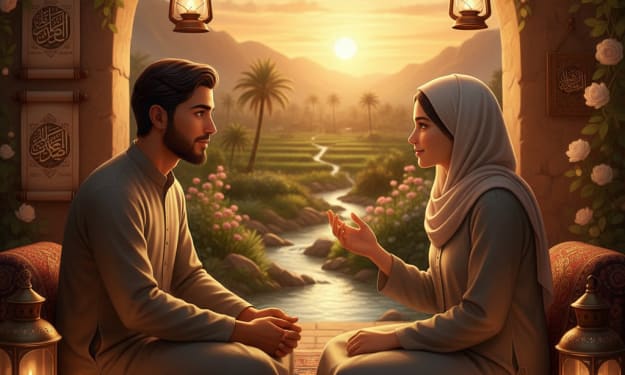
The Beginning: The Foundation of Love and Purpose Marriage — a word that holds the essence of life, love, responsibility, and completion. In the world’s eyes, marriage is merely a contract between two people. But in Islam, it is far more than that — it is an act of worship, a Sunnah of the beloved Prophet Muhammad ﷺ, and a sacred bond designed by Allah Himself. From the very beginning of creation, Allah made it clear that man is not complete without woman, and woman is not complete without man. When Allah created Adam (A.S.), He saw him alone in Jannah. To fill that loneliness, Allah created Hawwa (Eve) — not from the soil of the earth, but from Adam’s own rib, to signify closeness, compassion, and unity. This shows that companionship is not just a human desire; it is a divine design. --- Nikah — The Sacred Contract Nikah is the foundation of marriage in Islam. It is not just a social custom, but a spiritual commitment. Through Nikah, two souls enter into a covenant with Allah — promising loyalty, kindness, and righteousness. The Qur’an says: > “And among His signs is that He created for you spouses from among yourselves, so that you may find tranquility in them; and He placed between you affection and mercy.” (Surah Ar-Rum, 30:21) Nikah is an act of obedience to Allah. It protects faith, preserves modesty, and completes half of one’s religion. The Prophet ﷺ said: > “When a man marries, he has fulfilled half of his religion; so let him fear Allah regarding the remaining half.” --- Why Marriage Is Necessary Marriage is not just a choice — it is a necessity for a balanced and peaceful society. Without marriage, chaos takes over hearts and homes. Lust replaces love, selfishness replaces sacrifice, and humanity loses its direction. 1. Protection of Faith and Modesty Marriage guards both men and women from falling into sin. It channels human desires into a lawful, blessed path. 2. Emotional Stability A man finds peace in the love of his wife, and a woman finds comfort in the protection of her husband. Allah designed this relationship so that both could rely on one another in times of joy and hardship. 3. Continuation of Humanity Marriage ensures the continuation of generations through lawful means. Children born within marriage grow up in a stable, nurturing environment, learning morality, respect, and faith. 4. Strength of Society When families are strong, societies prosper. Marriage builds responsibility and teaches cooperation, forgiveness, and mercy. --- If People Stop Marrying… If people stop marrying, society begins to collapse. Without marriage, immorality spreads, children grow up without identity, and loneliness becomes the disease of humanity. Men lose purpose, women lose protection, and both become slaves to temporary pleasures instead of eternal values. The world may advance in technology, but it will decay in morality. The Prophet ﷺ warned us against such times, saying that fitnah (temptation) will increase, and people will prefer desires over decency. --- Marriage Is Not a Burden — It Is a Blessing Many today think marriage is difficult — too many responsibilities, expenses, and expectations. But Islam made marriage simple, not complicated. A Nikah can be performed with a few witnesses, a small dowry (Mahr), and pure intentions. The true beauty of marriage lies not in gold or grand ceremonies, but in faith, trust, and kindness. The Prophet ﷺ said: > “The best marriage is the one with the least burden.” Marriage is not about wealth; it is about willingness to love, protect, and grow together for Allah’s sake. --- The Role of Man and Woman in Marriage The Man’s Role A husband is a protector, provider, and leader — not a ruler. He must treat his wife with mercy and respect. The Prophet ﷺ said: > “The best of you are those who are best to their wives.” He must earn Halal sustenance, provide for his family, and be emotionally supportive. His strength should be a shield for his wife, not a sword against her. The Woman’s Role A wife is a companion, comfort, and heart of the home. She nurtures love, peace, and faith within the walls of the house. Her gentleness is her strength; her loyalty, her beauty. When a woman fulfills her role with sincerity, she becomes the queen of her husband’s heart and the mother of a nation. --- The True Purpose of Marriage The true goal of marriage in Islam is not just to live together — but to help each other reach Jannah (Paradise). Each prayer made together, each difficulty faced with patience, becomes a step toward eternal happiness. Marriage is a journey of two souls walking toward Allah side by side. --- Why Allah Made Marriage Part of the System Allah created everything in pairs — night and day, land and sea, male and female — to maintain balance. Marriage continues this harmony. It unites two different beings so they can complement each other, not compete. Through marriage, love becomes worship, and companionship becomes a form of gratitude to Allah. --- What Happens When Society Abandons Marriage When societies neglect marriage: Family systems collapse Children lose identity Respect for women diminishes Men become restless and irresponsible Mental health problems rise Marriage is the shield that protects us from all these evils. It brings structure, purpose, and peace. --- Conclusion: The Light of Nikah Marriage is not just a social tradition — it is a divine command. It completes half of one’s faith, brings tranquility to hearts, and builds strong families that form the foundation of a righteous Ummah. Without marriage, humanity drifts into darkness. With marriage, hearts unite, souls grow, and the mercy of Allah descends. So, whenever you think about marriage, don’t see it as a worldly duty — see it as a spiritual journey. It is the path that leads from love to peace, from peace to faith, and from faith to Jannah. --- Final Reflection Question > If marriage brings love, peace, and completion of faith — then why do we delay what Allah has made the door to His mercy?
By Anees Khan11 months ago in Families
Our Old Blue Blanket
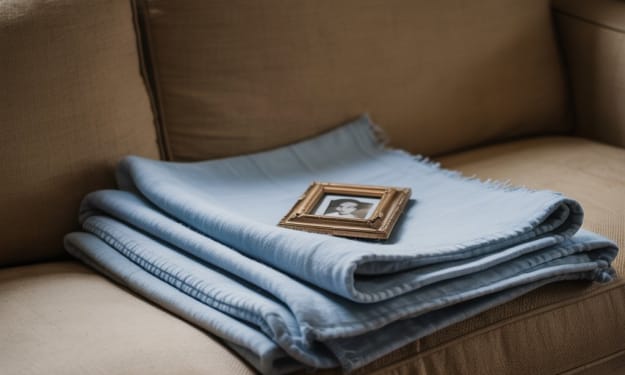
The blanket wasn’t much to look at. It was the kind of faded blue that came from years of sun, washing machines, and being dragged around by small hands that didn’t yet know what “delicate” meant. Its edges were frayed. The fabric had thinned in the middle, worn down from the hundreds of nights somebody pulled it close. But in our family, that old blue blanket held a place no expensive quilt or store-bought comforter ever could. My mother used to say it appeared the week I did. An aunt brought it to the hospital as a last-minute gift, a simple thing she grabbed on the way, not knowing it would become the most important object in our home for the next two decades. Mom tucked it around me for the first time on the car ride home. She said I didn’t cry once. Growing up, the blanket followed me everywhere. It was rolled up in the corner of my crib, draped over my lap when I learned to read, wrapped around my shoulders when the winters made our old house creak. My siblings joked that the blanket had traveled more than they had. It went on road trips, camping weekends, even to two of my first sleepovers, where I had pretended it was no big deal to bring it along, even though I checked the bag three times before leaving the house. Over time, the blanket took on a kind of personality — the quiet, steady type. It didn’t ask for anything, but it showed up for everything. When elementary-school heartbreak hit because someone didn’t invite me to their birthday party, I hid under it until I felt like the world made sense again. When I came home after getting cut from the soccer team, the blanket was the first thing I reached for, as if it could smooth over the sting of disappointment. But it didn’t just belong to me. Families have a way of sharing comfort without asking permission. My little brother borrowed it every time he got sick, curled up on the couch with flushed cheeks and a glass of ginger ale. My sister used it during thunderstorms, convinced the static in the air couldn’t reach her if the blanket was on her lap. Even my dad used it once, the night he came home from a long shift and fell asleep on the recliner. We woke up to see him snoring quietly, wrapped up like he had borrowed courage from it. There was a summer when everything in our family felt like it was changing. I was about to leave for college, the kind of shift that slowly rearranged a household. Mom started giving me extra hugs. Dad kept offering unnecessary life advice, like how to check tire pressure. My siblings had mixed reactions — a little excitement, a little sadness, and a lot of jokes about getting my room. During that last summer at home, I found myself using the blanket more than I had in years. I’d sit underneath it late at night while packing boxes, feeling the weight of goodbye settle on me. Every time I folded it, I realized I wasn’t just packing fabric — I was packing years of our life. Every messy moment. Every quiet victory. Every small disaster we had gotten through. A few nights before I left, my mom walked into my room with a laundry basket. She saw the blanket folded on my bed and shook her head gently. “You’re not taking that,” she said. I laughed at first. “It’s mine.” She smiled the way mothers do when they know something you don’t. “It was yours. But now it belongs to all of us.” I didn’t understand what she meant until she added, “It’s the blanket we’ve all leaned on. And we still will. Let it stay home.” I didn’t argue. I just let the thought settle inside me the way I used to settle under the blanket itself. Maybe some things weren’t meant to travel. Maybe some things were anchors. I left for college without it. That fall was chaotic — new people, new classes, new kinds of quiet. I learned how to warm up a small apartment with music and cheap lamps instead of memories. But every time I called home, I could hear the blanket in the background of the stories. My brother used it during a fever. My dad sat with it over his legs while doing a puzzle. My sister kept stealing it during movie nights. It felt strangely comforting knowing a part of me was still present in the house even though I wasn’t. A year later, during winter break, I walked through the front door after a long bus ride home. The house smelled like cinnamon and laundry detergent. My mom hugged me so tightly that I felt my spine pop. And there, folded neatly on the couch, was the old blue blanket. Worn. Faded. Frayed. Still holding our family’s quiet history inside its threads. I sat down and pulled it over my lap. It wasn’t quite as warm as I remembered, or maybe I had simply grown. But the feeling was the same — a gentle reminder that no matter how far I wandered, this was the place I would always return to. Some families keep photo albums. Some keep heirlooms. We had a blanket. And maybe that’s enough — one simple object that held the weight of every season we survived, every moment we softened, and every quiet way we loved each other. Our old blue blanket didn’t change the world. It didn’t need to. It simply held us together.
By Jhon smith11 months ago in Families