children
Children: Our most valuable natural resource.
My Grandmother Spoke a Language That No Longer Exists
When I was a child, my grandmother used to mutter under her breath in a language that no one else in the family understood. She never taught it to us. Sometimes, when she was tired or when something slipped out in frustration, words would fall from her lips like fragments of a broken spell. We would ask her what she said, and she would shrug it off. “Old words,” she’d say. “No use anymore.”
By Masih Ullahabout a year ago in Families
"Top Collagen Peptide Supplements Recommended by Nutrition Experts"
Collagen is the most abundant protein in the human body. It plays a crucial role in maintaining healthy skin, joints, hair, nails, and bones. As we age, our natural collagen production begins to decline, often leading to wrinkles, joint discomfort, and weaker connective tissue. That’s where collagen supplements—especially collagen peptides—come into play.
By Md. Ashraful Azadabout a year ago in Families
Face to Face at Last
In one of the most remarkable medical feats of our time, a team of doctors in Brazil has made history by successfully separating conjoined twins who had been fused at the head since birth. The 23-hour operation, which took place in Rio de Janeiro, has not only pushed the boundaries of modern medicine but has also given two young boys a chance at life — and identity — on their own terms. Arthur and Bernardo Lima were born in 2018 in the northern Brazilian state of Roraima. But their story was unlike most. The twin boys were craniopagus twins, meaning they were conjoined at the cranium — one of the rarest and most complex forms of conjoined twinning. This condition occurs in approximately one in 2.5 million births, and separation, when attempted, carries enormous medical risks. For nearly four years, the twins lived physically bound together, lying side by side, sharing not only parts of their skulls but also vital blood vessels and brain tissue. Despite their close proximity, they had never been able to look into each other's eyes. Every moment of their lives, they moved, played, and slept in coordination — yet in separation. Their parents, determined to give their sons the best possible life, entrusted them to a dedicated team at the Instituto Estadual do Cérebro Paulo Niemeyer in Rio. Under the leadership of renowned pediatric neurosurgeon Dr. Gabriel Mufarrej and with international collaboration from UK-based charity Gemini Untwined, a plan was set in motion — one that would take years of preparation, cutting-edge technology, and an extraordinary level of precision. What made this surgery so revolutionary wasn’t just its duration — though 23 hours in the operating room is astonishing by any measure — but the methods used to ensure its success. Surgeons employed virtual reality (VR) simulations to rehearse the procedure. Using detailed scans of the twins’ shared anatomy, teams were able to “practice” each step in a 3D virtual model. It was the first time VR had been used to such an extent in a craniopagus separation surgery. Over a series of nine procedures, each building upon the last, doctors gradually separated key areas of the brain and vascular systems. Every incision, every movement had to be meticulously choreographed. Any mistake could result in brain damage, neurological deficits, or worse. Then came the final, marathon operation — nearly a full day under anesthesia, involving more than 100 medical specialists including neurosurgeons, anesthesiologists, nurses, and support staff. The operating room became a theater of hope and science, where human skill met technological innovation at the highest level. And finally, it was done. For the first time, Arthur and Bernardo were placed in separate beds. No longer bound by bone and tissue, they were free to turn their heads, free to look around — and most importantly, free to look at each other. That moment, captured in quiet stillness, held the weight of a thousand emotions. Two brothers, who had only known the world through a shared experience, were now individuals. And when their eyes met for the very first time, the room — full of weary but ecstatic medical staff — stood in silent awe. It was more than just a medical victory. It was a human one. The path ahead is still long. Both boys will need continued therapy and support as they adjust to their new physical realities. There may be developmental hurdles to overcome, and the psychological adjustment will take time. But their survival — and the promise of independent futures — is nothing short of miraculous. Dr. Mufarrej described the experience as “the most challenging moment of my career, but also the most rewarding.” The successful separation, he emphasized, is proof of what medicine can achieve when it embraces collaboration, compassion, and courage. What Arthur and Bernardo’s story reminds us is that behind every extraordinary surgery are ordinary dreams — of playing, laughing, exploring, and simply being. In a world where miracles often feel rare, this one unfolded quietly, determinedly, and without spectacle — just two little boys, granted the simple wonder of meeting each other face to face. It’s not just a triumph of scalpels and science, but of willpower, hope, and the boundless human spirit. The world watched a 23-hour surgery. But for Arthur and Bernardo, it was the first day of a lifetime — together, but apart at last.
By DigitalAddiabout a year ago in Families
A Good Morning I’ll Never Forget
A Good Morning I’ll Never Forget It was a cold winter morning, the kind where silence hugs the streets and even the birds seem to sleep longer. I had just moved into a new apartment in a sleepy corner of the city, still unpacking my life one box at a time. The chill in the air made me crave warmth—not just of the body, but of the heart.
By Ali Asad Ullahabout a year ago in Families
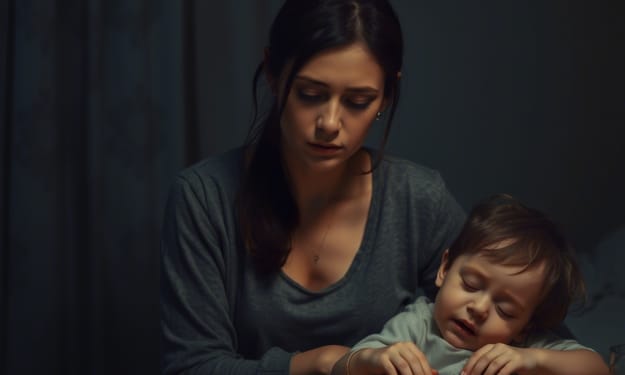
The Day His Mother Slept Hungry So He Could Eat
> It was just another ordinary night in their small, dimly lit home. The boy laughed, his belly full after a rare warm meal. But behind that smile, his mother sat in silence—her stomach empty, her eyes quietly watching him with love and hunger dancing together. She had lied. She said she had already eaten. But she hadn’t. And he didn’t know… not yet.
By Atif jamal about a year ago in Families
“Through Mom’s Eyes: The Story of Our Forever Bond”
Sarah stood by the nursery window, gazing down at the tiny bundle resting in the crib. The room was quiet except for the soft sound of the ceiling fan. In that serene moment, she felt like the world stopped just for them — for this new chapter of her life as a mother. The tiny boy, wrapped in a soft blue blanket, was Noah. Her son. The miracle she had been dreaming of for so long.
By Abdullah khanabout a year ago in Families
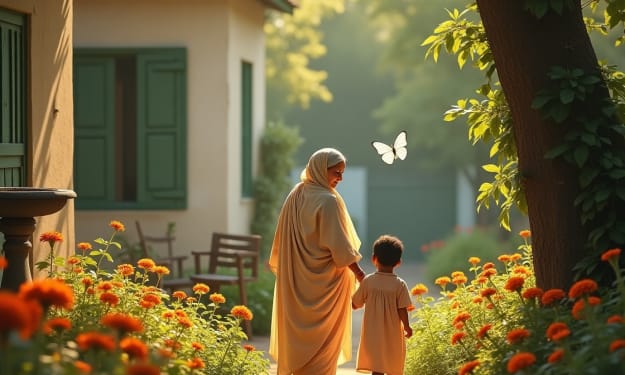
The Garden Where My Grandmother Waits
The summer sun always felt softer in my grandmother’s garden. Not cooler just gentler, as if it understood that the flowers blooming below deserved warmth without cruelty. I must have been seven or eight when I first noticed this strange magic, but the garden had been there long before me, a secret sanctuary tucked behind the old white house with green shutters and creaking steps.
By Ahmad shahabout a year ago in Families
Kids' and teens' mental health issues are lessened by exercise.
A lot of kids and teens are having mental health issues. The prevalence of anxiety and sadness is on the rise. Parents are seeking assistance, but not everyone responds well to conventional therapies. Exercise is currently being investigated as a useful strategy to enhance kids' mental health.
By Francis Damiabout a year ago in Families
Why We Always Choose Experience Over Souvenirs
We live in a world where you can buy almost anything — except the things that actually matter. Strangely, we travel thousands of miles, collect boarding passes, snap photos, and then line up at the souvenir shop before we even know how the place smells in the morning or sounds at night.
By Boris Lozinskyabout a year ago in Families