book reviews
Reviews of books that explore the complexities of family throughout history and across cultures.
I Found a Lost Phone at a Café. AI-Generated.
It was a rainy Tuesday afternoon. I had stopped by my usual café on 3rd Street—The Brew House, a quiet spot where I often went to write, clear my mind, or just get away from the noise of everyday life. I grabbed my coffee, sat by the window, and pulled out my laptop.
By Rameez Khanabout a year ago in Families
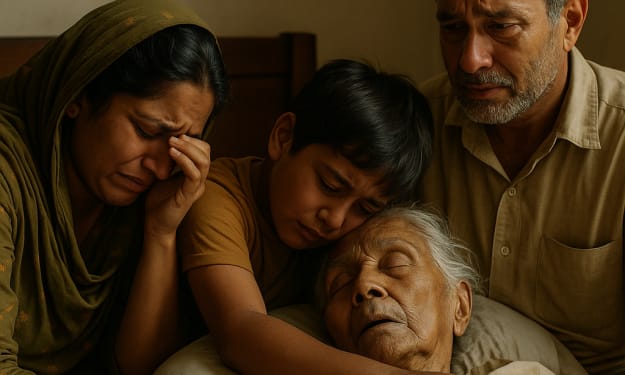
A Summer of Silence – When the Heat Took Away Our Nana Jaan
When the intense summer heat gripped the city, a change came into our lives that would stay etched in our hearts forever. It was a season in which we learned a lot, and its intensity taught us lessons that we had never thought we would have to learn. Our Nana Jaan, who had always been a symbol of love for us, appeared completely different during this summer. Her smile, which used to light up our faces, had now faded. Her body, which always felt like a strong pillar, now seemed tired. At first, we didn’t pay much attention to it, as none of us wanted to acknowledge the toll her age might be taking on her body. But soon, it became clear that it wasn’t just old age; the heat had also taken a toll on her health. The change in Nana Jaan’s condition was sudden one day. She began complaining of dehydration and started sleeping throughout the day. Sweat marks appeared on her body, and we never thought that such intense heat could endanger her life. We always assumed that the physical health of the elderly was simply a result of their age, but we didn’t realize that seasonal factors could be just as severe. One day, when we noticed that Nana Jaan’s condition had worsened, we rushed her to the doctor. But by then, it was too late. The doctor told us that her body had become weak due to the heat, and she was suffering from severe dehydration. Hearing this felt like the ground had slipped from under our feet. We had always thought that her staying healthy was a constant reality for us, but that day we learned that life is never predictable. The doctor informed us that had we taken better care of Nana Jaan earlier, she might have been able to recover. But now, it was too late. We asked the doctor if anything could still be done, but his response was simple: “It’s a matter of time, and we must accept the natural course of things.” Nana Jaan’s passing was a deep blow for us. After her departure, the whole house fell silent, as if someone had taken away the light from our world. For the first time after that moment, we thought about how we had neglected the importance of spending time with our elderly. We realized that it wasn’t enough to just spend time with them; we had to take practical steps for their health and well-being. I remember a moment when Nana Jaan’s face was radiant, and we all thought of her as an inseparable part of our lives, imagining she would be with us forever. But now we had to accept the reality that her body had grown tired, and the heat had deeply affected her. After Nana Jaan’s passing, we realized that this season was not just about heat; it was a test. A test that was teaching us how to take better care of our elderly. Everything that happened was a lesson, and we had to learn from it, taking the necessary precautions for our loved ones’ health. From that day on, we made a commitment that whenever there is intense heat, we will pay special attention to our elderly. We decided that we would take all necessary precautions, from keeping them hydrated to ensuring they stay in the shade, and providing them with proper nutrition. We also decided not to let them spend too much time in the sun and to be cautious in their daily activities so as not to put any strain on their bodies. This season taught us that the summer is not just a natural change; it’s an opportunity for us to take care of our elderly family members. Their bodies are more sensitive, and we must adopt precautionary measures to ensure they remain healthy and happy. Nana Jaan’s memories will always live on in our hearts, and her untimely death taught us to appreciate every moment of life. We took this lesson to heart, knowing that it will not only be a reminder for us but for the generations to come. Now, whenever we step outside in the summer or spend time with our elderly loved ones, we are more cautious about their health. This commitment is a tribute to Nana Jaan, who always taught us how to nurture and care for others with love. We vowed never to forget her teachings and to always follow her principles۔
By Noman Afridiabout a year ago in Families
From the Darkness of Poverty to the Light of Success: A Parents’ Sacrifice and Their Son’s Triumph
In the dusty lanes of a small village in Pakistan, lived a humble couple—Rafiq and Naseem—who had nothing but a small mud house, big dreams, and a deep love for their only son, Ahsan. Life had never been kind to them. Rafiq worked as a laborer, carrying heavy loads at the local market for meager daily wages. Naseem stitched clothes at home to earn a few extra rupees. Most days, they struggled to put even two meals on the table. But one thing they never let poverty take from them was hope. From a very early age, Ahsan showed signs of brilliance. He would often fix broken toys and open old radios just to see what was inside. His curiosity and intelligence didn’t go unnoticed by his teachers, who constantly praised his potential. However, the family’s poverty loomed large over his dreams. When Ahsan topped his middle school exams, his father was filled with both pride and fear. He knew his son deserved to study further, but where would the money come from? High school tuition, books, transport—it all seemed impossible. That night, Rafiq sat in silence under the dim light of a lantern, staring at his calloused hands. “If I can carry bricks all day under the sun,” he thought, “I can carry the weight of my son’s dreams.” The next day, he took on extra work—two shifts instead of one. Naseem stopped buying even the smallest luxuries for herself. Together, they made silent sacrifices every day. Ahsan, aware of his parents’ struggle, studied harder than ever. He knew failure was not an option. While his friends played outside, Ahsan sat with his books late into the night. With his parents’ unwavering support and his own determination, he passed his high school exams with distinction and won a partial scholarship for a top engineering university in the city. Leaving his village was bittersweet. Ahsan had never been to a big city before. He didn’t own a smartphone or even proper shoes. But what he did have was something more powerful—his parents’ prayers and his unshakable will. City life was tough. The lectures were in English, the technology was advanced, and most of his classmates came from privileged backgrounds. But Ahsan didn’t let inferiority defeat him. He learned English by reading library books, watched online tutorials in borrowed computer labs, and worked part-time jobs at night to cover his expenses. Four years later, Ahsan graduated with honors in Electrical Engineering. His final-year project—a low-cost solar power system for rural homes—won national acclaim. A multinational company offered him a job with a salary that once seemed like a fantasy to his family. When Ahsan returned to his village in a crisp shirt, with a small car and tears in his eyes, the entire neighborhood gathered to welcome him. His parents stood silently, emotions caught between disbelief and gratitude. That same mud house, once filled with the sighs of struggle, now echoed with laughter and pride. With his first salary, Ahsan renovated their home, bought his mother a sewing machine she had always dreamed of, and took his father to a doctor for long-ignored back pain. But he didn’t stop there. He began mentoring village students, started a small education fund, and even helped build a solar-powered library in the local school. What changed? Nothing—and everything. Rafiq and Naseem were still the same simple people, and Ahsan remained the humble boy they had raised. But their belief in the power of education, hard work, and sacrifice changed the course of not just one life, but many. Today, Ahsan is a respected engineer, but more than that, he is a symbol of hope. His story reminds us that even the deepest darkness of poverty can be overcome—with the light of dreams, the flame of sacrifice, and the power of love. --- Moral: True success is not measured by wealth, but by the courage to rise, the strength to persevere, and the heart to give back.
By Muhammad musababout a year ago in Families
A True Story of Dignity Amid Despair: One Man's Battle Against Crushing Debt. AI-Generated.
In a world that often glorifies success, achievement, and prosperity, there exist untold stories—hidden in silence—about the unseen battles people fight every day. This is the true story of a man, once a pillar in his community, who now finds himself grappling with the weight of overwhelming debt, emotional isolation, and a system that seems indifferent to his collapse. Despite it all, he clings to one unshakable value: dignity.
By KingFree MaNabout a year ago in Families
My Daughter's Favorite Books: Part 2 . Top Story - June 2025.
About two years ago I sat in a tire place interviewing my eight year old daughter to pass the time. I wanted to know about her favorite books. Back in those days, Judy Moody and Calvin and Hobbes were among her favorites. Since then, she has grown and the world around her has changed. I thought it was about time to check in and see what stories are capturing her imagination as an older and wiser preteen.
By Leslie Writesabout a year ago in Families
Give More, Expect Less: The Secret to a Fulfilling Life
In a world where everyone seems to be asking, “What’s in it for me?”—the idea of giving more and expecting less feels radical. Yet, it is one of the most powerful principles of inner peace, strong relationships, and lasting happiness. When you give sincerely, without expecting anything in return, you free yourself from disappointment, resentment, and ego. You become a source of light in a world often darkened by selfishness.
By Muhammad Suliman khanabout a year ago in Families
Stand Tall: It Does Not Matter What People Say
In every phase of life, we face criticism, judgment, and opinions from others. Some are helpful, others hurtful—but the truth remains: you cannot live a meaningful life while being controlled by what people say. If your confidence, dreams, and sense of worth depend on public approval, you’ll always feel like a prisoner. Real strength lies in knowing your purpose, staying true to your values, and trusting your journey—even when others don’t understand it.
By Muhammad Suliman khanabout a year ago in Families
The Miracle of the Loaves and Fishes: A Bible Story of Faith and Abundance. AI-Generated.
In the rolling hills near the Sea of Galilee, during a time when Jesus walked the earth, a great crowd gathered to hear His teachings. The sun hung low in the sky, casting golden rays over the grassy slopes where men, women, and children sat, their eyes fixed on the gentle man who spoke of love, hope, and the Kingdom of God. This is the story of one of Jesus’ most beloved miracles—the feeding of the five thousand—a tale of faith, generosity, and divine abundance that continues to inspire hearts even today.
By David Andrewsabout a year ago in Families
Men Only Want One Thing and It’s Disgusting
You’ve heard it a million times. Men are simple. Men are selfish. There is only one thing that men desire. Hold on though because what if everything youve been told is false? What if the reality of what men desire is more sinister profound and disturbing than anyone has ever dared to acknowledge? Its not a fairy tale. This isnt a tirade.
By Olivia Chastityabout a year ago in Families
Silent Exit: When They Stay in the Marriage But Leave the Love.
Not all relationships end with a scream. Some end in silence, slow, suffocating, calculated silence. Sometimes, the person you're with doesn't hate you. They don’t even dislike you. They just don’t love you… and perhaps never truly did.
By Sayed Zewayedabout a year ago in Families