
No Social Savvy, Low EQ, and Autism: Three Labels, One Messy Overlap
Autistic people get called cold or clueless. The real story is more specific: social cue recognition, alexithymia, cognitive empathy, and skills nobody taught.
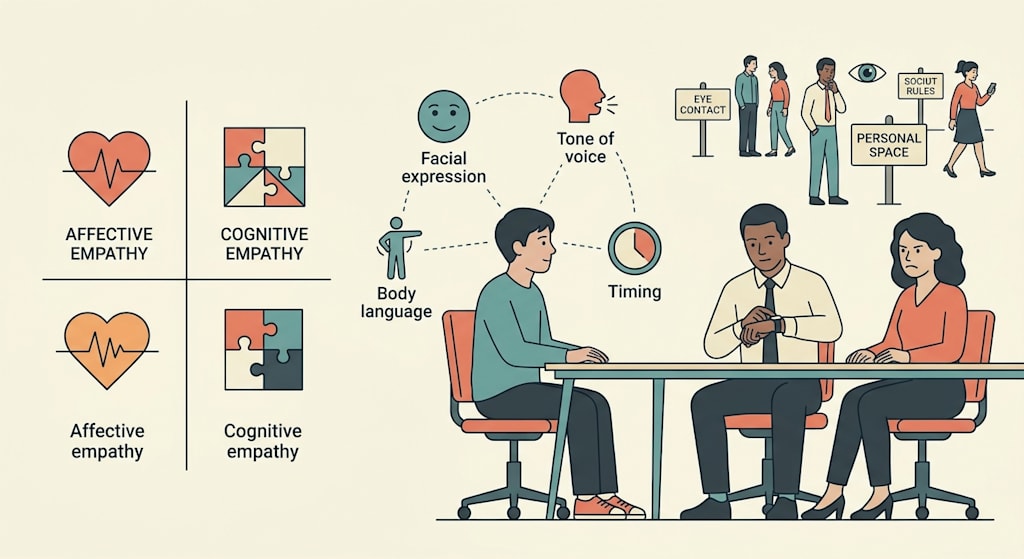
A person misses a frown. Someone checks a watch in a meeting, and he keeps talking. A friend says “some other time,” and he proposes next week. Soon the labels arrive: no social savvy, low EQ, maybe worse. When the person is autistic, those labels can harden into a story about coldness or selfishness.
That story is wrong. “No social savvy” and “low EQ” are everyday phrases, not clinical diagnoses. ASD is a developmental condition, not a personality defect. The overlap is real, but it is narrower and stranger than the insults suggest.
First, separate the two phrases
“No social savvy” usually means missing social cues. Someone frowns, purses their lips, or changes the subject, and he does not catch it. A meeting has gone quiet, and he does not notice. A friend is being polite rather than literal, and he takes the words at face value. Sometimes he senses that the room has turned, but he does not know what to do. So he goes silent, changes the subject, or says something worse.
“Low EQ” is broader. It can mean missing cues. It can mean seeing them and responding badly. It can mean not understanding what another person is worried about or where a boundary sits. A person might see that someone is upset and respond with a lecture. Another might never think to ask what the other person needs.
Neither phrase describes one ability. Neither is a moral verdict. Missing a cue does not mean not caring. Responding badly does not mean being cruel. Before ASD enters the picture, that distinction has to stay on the table.
What ASD actually requires
DSM-5 describes two major domains. The first is social communication and social interaction. All three items must be present: social-emotional reciprocity; nonverbal communicative behaviors used in social interaction; and developing, maintaining, and understanding relationships. The second domain is restricted, repetitive patterns of behavior, interests, or activities. At least two manifestations are required, such as repetitive movements or speech, insistence on sameness, highly restricted interests, or unusual responses to sensory input. Symptoms must appear early and cause functional impairment.
Two corrections matter. Social impairment is not a checklist where any few items will do; DSM-5 requires all three social communication items. Asperger’s syndrome is no longer a separate DSM-5 diagnosis; it sits inside ASD. Other systems, including ICD-10, handle it differently, so name the diagnostic system when you write about it.
ASD also varies enormously. One autistic person may struggle with facial expressions. Another may read faces fine and still miss office politics. Another may speak fluently and freeze when a conversation turns indirect. Another may learn enough compensation to look “fine” while paying a heavy internal cost. Diagnostic criteria describe group-level features. They do not hand every autistic person the same face.
Layer one: reading faces, voices, and bodies
The first layer of social savvy is nonverbal information: facial expression, tone, gaze, posture, distance, timing. ASD’s diagnostic criteria include deficits in nonverbal communicative behavior. Some autistic people do have trouble reading and using these signals.
Two mistakes follow. First, not every autistic person has obvious facial-recognition trouble. Group averages differ; individuals vary. Someone can score well on static face tests and still struggle in a fast, noisy room with six cues at once. Second, “nonverbal communicative behavior deficit” does not mean “will fail a facial emotion recognition test.” It also covers eye contact, gestures, the coordination of expression, and matching tone to context. Sensory overload, anxiety, attention, and processing speed all change the performance.
Mild difficulty can be taught. Explain that a frown may mean confusion or impatience. Say who in the meeting is waiting for an answer. Write down the social script. “Be more savvy” teaches nothing. A concrete rule teaches something.
Layer two: alexithymia
The second layer is alexithymia. It is not an ASD diagnostic criterion, but it shows up often alongside ASD. Its core is difficulty identifying, describing, and distinguishing emotions. That applies to one’s own emotions and often to other people’s.
Empathy starts with perceiving emotion. If a person cannot tell “am I anxious or angry?” or “is she disappointed or exhausted?”, the next step gets harder. Affective empathy has less to work with. The response lands badly.
Write the numbers carefully. Studies, scales, and samples disagree. Alexithymia is often reported in roughly 40% to 65% of autistic people. In the general population, it is not a fixed 5%; depending on the instrument, it is closer to 10%. Two facts matter more than one exact number. Alexithymia is more common in ASD. Not every autistic person has it. A substantial number of autistic people identify emotions in themselves and others, and they show strong affective empathy.
Some research links reduced emotion-related facial expression to alexithymia more than to ASD itself. That distinction keeps the blame in the right place. Do not attribute every emotion-recognition problem to ASD. Do not turn ASD into “no emotions.”
Alexithymia causes two kinds of trouble. Not feeling others’ emotions accurately makes affective empathy harder. The everyday result looks like “no social savvy.” Not feeling and naming one’s own emotions makes regulation, help-seeking, and self-protection harder. A person who cannot tell “uncomfortable” from “afraid” from “resentful” cannot handle the problem in time. Many autistic people have been scolded for this since childhood. Few were taught what to do.
Layer three: skills and expression rules
The third layer is skill. Some people read the room correctly and still do not know how to answer. They see the tension. They know the joke landed wrong. They do not know how to interrupt, apologize, change the subject, or leave. Then someone calls them clueless.
That is not a perception failure. It is a performance failure. Listening, paraphrasing, confirming, expressing concern, and setting boundaries can all be learned. Executive function, processing speed, anxiety, sensory overload, attention, and cultural rules affect the performance too. A person who seems lost in a loud party may be fine in a written thread with clear rules.
“No social savvy” can describe some autistic people. It can describe neurotypical people too. It is not a required ASD trait, and it is not a moral defect.
Low EQ: separate cognitive empathy from affective empathy
The “low EQ” bundle includes three things: missing cues, seeing them and responding badly, and not understanding another person’s intentions. The first two are above. The third belongs to cognitive empathy.
Empathy is not one block. Affective empathy is feeling the other person’s emotion and producing a matching response. It includes emotional contagion and sympathy. Cognitive empathy is inferring what the other person believes, wants, intends, knows, and sees. It includes theory of mind and perspective taking.
ASD more often involves cognitive empathy difficulty. Perspective taking, reading subtext, and inferring “why did he say that?” can be hard. Affective empathy is not automatically impaired. Many autistic people feel others’ emotions strongly. They care. They freeze because they cannot infer the right move or express it in the expected way. Alexithymia can block the first step of affective empathy, but alexithymia is not all of ASD.
Coldness, lack of conscience, and lack of remorse point to a different profile. They are not the cognitive empathy difficulty in ASD. Autistic people often care intensely and still get the response wrong. That is not the same as manipulation or cruelty.
“Low EQ in basically all autistic people” is too broad. A better claim: on average, autistic people are more likely to struggle with the implicit rules, fast multi-cue inference, and expected expression that traditional EQ tests reward. EQ has many dimensions. Some autistic people do well in structured settings, written communication, clear rules, and deep interest areas. Some mask well enough to look “high EQ” and pay for it later. Looking capable is not the same as finding it easy.
Social failure is also two-way. Autistic people struggle to read neurotypical people. Neurotypical people struggle to read autistic people. Blaming the autistic person’s “low EQ” hides the environment, the unspoken rules, and the mismatch in interpretation. Make the rules explicit. That is fairer than demanding that one side guess better.
Neurotypical people miss cues too
These problems are common outside ASD. Some neurotypical people have alexithymia, roughly one in ten depending on the measure. They know the same frustration.
Social behavior is also learned. Culture, class, occasion, gender norms, and power shape it. In East Asia, avoiding eye contact can signal respect. In parts of Europe and the United States, the same behavior can read as disrespect. Politeness in one country becomes rudeness in another. Social savvy and high EQ depend on emotion recognition, cognitive empathy, expression rules, scripts, and occasion judgment. Everyone has to learn them. Autistic people are not the only students in the room.
Understanding difficulty does not excuse harm. ASD is not a free pass, and it is not a romantic “pure innocence.” The better rule: provide clear rules and support for neurocognitive differences. Keep basic expectations for boundaries, respect, and repair. Support and responsibility can coexist.
What to keep
“No social savvy” can appear in some autistic people. It often involves alexithymia, nonverbal recognition difficulty, implicit-rule learning, or missing expression skills. It is not a required ASD trait, and it is common among neurotypical people too.
“Low EQ” in the traditional sense of implicit social inference and fast response puts autistic people at an average disadvantage. Individual differences are huge. Not every EQ dimension is low. Cognitive empathy difficulty is more common. Affective empathy is not automatically impaired. Alexithymia needs its own discussion.
ASD is not “no empathy” or “cold-blooded.” It is a mismatch between social communication style and neurotypical norms. Separate affective empathy, cognitive empathy, alexithymia, social skill, and cultural rules. Many abilities improve with explicit teaching, environmental accommodation, and two-way understanding. Diagnosis belongs with a professional assessment, not an online quiz.
Good writing can do one useful thing here: make the hidden rules visible, untangle the labels, and replace “be more normal” with “here is what actually happened and what to do next.” If social communication problems significantly affect daily life, seek a professional assessment. This article is not a diagnostic tool.
About the Creator
Jin
Writer of reamstories
https://reamstories.com/jin
Enjoyed the story? Support the Creator.
Subscribe for free to receive all their stories in your feed. You could also become a paid subscriber, letting them know you appreciate their work.
Comments
There are no comments for this story
Be the first to respond and start the conversation.