
No One Remembers It That Way
For sixty years, I remembered the man who pushed me. My step-brother remembered the man who ran.
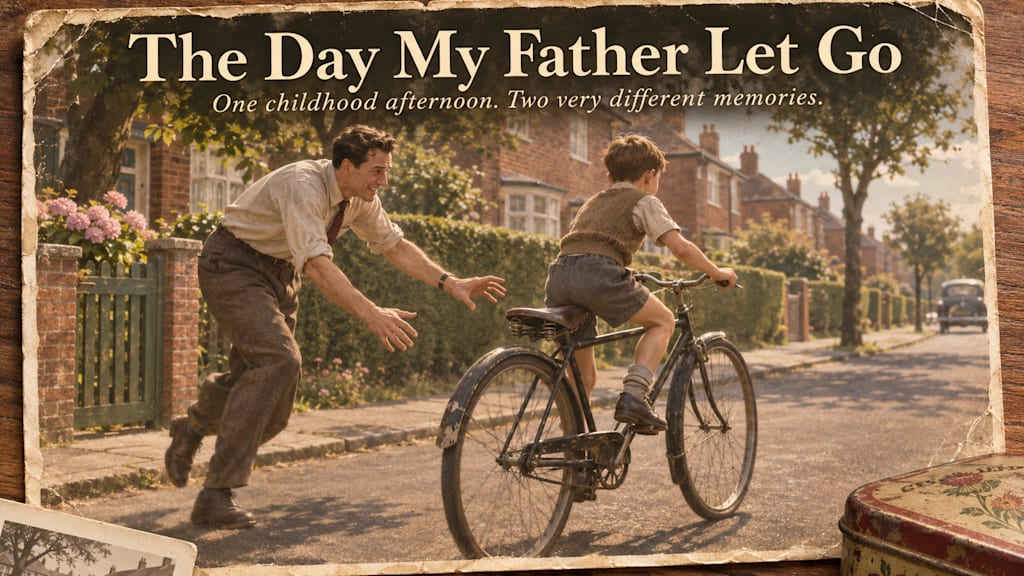
The argument began with a biscuit tin, which seemed an unnecessarily small thing to overturn sixty years of certainty.
My step-brother had brought it over with a bag of old photographs. We were supposed to be choosing pictures for his grandson’s school project about family history, although most of our history appeared to be going to school on a trolley bus and paying one old penny.
Then he found the photograph of my bicycle. “There you are,” he said. “The day Dad taught you to ride.”
I knew the picture immediately. My socks were falling down, someone with more enthusiasm than judgement had cut my fringe, and I was gripping the handlebars of a bicycle much too large for me.
Dad stood behind the saddle. Even in that small, faded photograph, I could see his hand. “The day he pushed me down the hill,” I said.
Barrie looked up. “He didn’t push you down a hill.” “He let go, and you went straight into the hedge.”
I laughed because he sounded so certain, but he did not laugh back.
For most of my life, I had told that story whenever the conversation turned to fathers. Other people remembered cricket in the garden or bedtime stories, and I remembered the steady hand disappearing from the back of a bicycle.
I was eight. Dad had brought the bicycle home from someone at work, and it was black except where the paint had rubbed away to silver. There was a bell that worked only if you struck it with your thumb at precisely the correct angle.
The road beyond our house sloped towards a bend. In my memory, it was a proper hill, steep enough to carry a frightened boy towards a disaster he could already picture.
I remembered asking Dad to keep hold. I remembered his answer. “I’ve got you.”
Then the bicycle gathered speed, the handlebars began to wobble, and I realised he was no longer there. I shouted, hit the kerb and disappeared into the hedge.
There was blood on my knee. There was laughter behind me.
Afterwards, Dad said, “You were doing all right until you looked back.”
I had disliked that sentence for sixty years. It seemed a remarkably convenient way of making the accident my fault.
Barrie turned the photograph over, although there was nothing written on the back.
“You were desperate for him to let go,” he said. “You kept shouting at him because he wouldn’t.”
“That was afterwards, when I wanted to prove I could do it.”
“No, it wasn’t. You said the other boys would see.”
I reached for the photograph. “You were only eleven.”
“And you were only eight,” he said. “Neither of us was taking minutes.”
I put it down between us.
According to Barrie, the afternoon had been bright, almost hot. In my version, the sky was grey and there was a cold wind blowing up the road.
He remembered Dad removing his jacket and hanging it over the gate. I remembered him wearing it, a brown thing with leather patches at the elbows.
“That was his gardening jacket,” he said. “He didn’t have that one yet.”
This irritated me more than it should have. I could have accepted being wrong about the weather, but not about his jacket.
Barrie said Dad had run behind me for much longer than he needed to. He remembered him bent awkwardly over the bicycle, his tie tucked inside his shirt, while I complained that his hand on the saddle was pulling me sideways.
Then he let go.
“You went nearly to the corner,” he said. “He was running alongside you, but you weren’t looking at him.”
“In that case, why did I fall?”
“Because you turned round to see whether he was still holding on.”
We sat quietly for a while. In the kitchen, my wife moved a cup across the draining board, and the ordinary little noise made our silence feel foolish.
“What about the laughter?” I asked.
Barrie rubbed the edge of the photograph with her thumb.
“That was me,” he said. “I sorry about that.”
I looked at him.“You came out of the hedge with leaves in your hair. I thought you looked funny, and then I saw your knee.”
“You’ve never told me that.” “You’ve never asked who was laughing.”
I wanted to find a flaw in his version. He had always been better at arguments, not because he was necessarily right, but because he could remain calm while I became so involved in defending myself that I forgot the original subject.
“Dad didn’t even come to help,” I said.
“Yes, he did. You told him to leave you alone.”
There was a movement in my memory then, small and unwelcome. A hand reaching towards me, perhaps, and my own arm knocking it away.
I could not tell whether I remembered it or had just pictured what Barrie described.
He went back through the photographs. I watched him sort holidays, weddings and Christmases into little piles, until he found another picture from the same packet.
This one was blurred. I was on the bicycle, several yards from the camera, and Dad was behind me with one foot lifted.
Both his hands were empty.
I held the picture close to the window. He looked absurd, caught halfway through a stride, his mouth open as though he was calling something.
“There,” Barrie said. “He was running.”
Still, I kept looking at his raised foot.
Dad had not been a man who ran. He walked to work, walked to the shops and walked round the garden carrying things that needed putting somewhere else. By the time I was old enough to notice him properly, he moved carefully and complained about his knees.
In the photograph he was young enough to look ridiculous, and nobody had told me to remember him that way.
“I was frightened,” I said.
“I know you were.”
“He said he had me.”
Barrie nodded. “Perhaps he meant he was close enough.”
For years, I had used that afternoon to explain other things about him. The way he stood outside my bedroom door after an argument instead of coming in. The way he checked my car tyres before a long journey but never asked whether I was happy.
I had made the bicycle story evidence. Once I knew what sort of father he was, everything else fitted.
“I wish he’d said something afterwards,” I told him.
“So do I,” he said. “He wasn’t much good at that.”
It was a relief to hear him admit it. I did not want a perfect father suddenly installed in place of the difficult one I had known.
Before Barrie left, he asked which photograph her grandson should use.
I gave him the clear one, with Dad holding the saddle. I kept the blurred picture.
That evening, I showed it to my wife. She had heard the hedge story often enough to recognise the bicycle without asking.
“What happened there?” she said.
“Dad was teaching me to ride.”
I nearly added the familiar next sentence. Instead, I looked again at the distance between his hand and the saddle, and at the foot that had not yet touched the ground.
“I thought he’d gone,” I said. “Apparently, he was just behind me.”
About the Creator
Alan Spencer
Have been an author and writer for over 20 years. Have been a journalist, editor, proofreader, and a designer and presenter of training courses. Have written over 100 articles, two books, and around 20 training courses.
Enjoyed the story? Support the Creator.
Subscribe for free to receive all their stories in your feed. You could also become a paid subscriber, letting them know you appreciate their work.
Comments
There are no comments for this story
Be the first to respond and start the conversation.