
My Son Reached for Another Dad. Here’s What I Learned About the “Psychological Dad.”
When a father is absent, a child still needs a reliable man in his corner. Moms can build that circle without forcing a replacement.
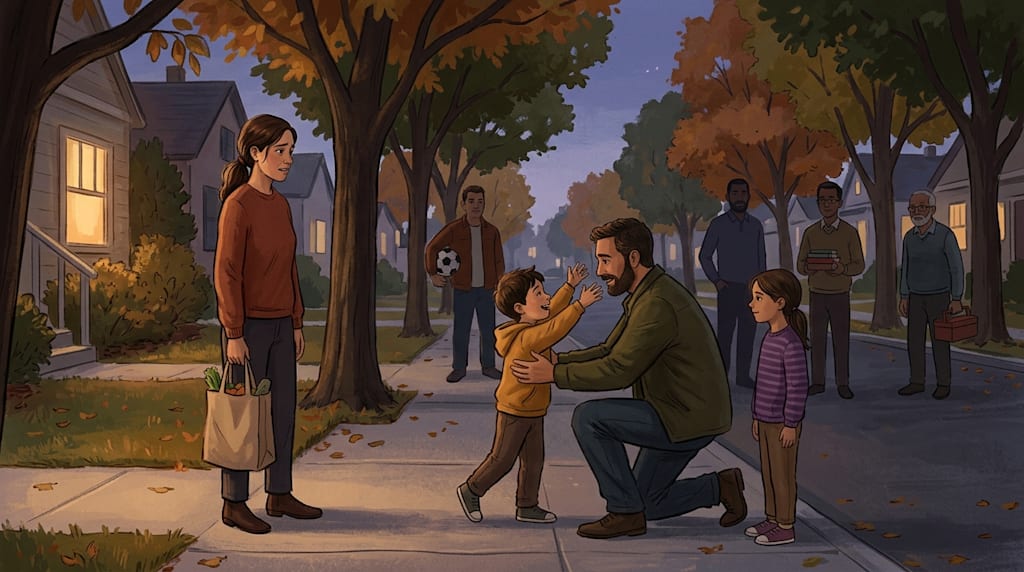
One autumn evening, I stood outside with groceries while other parents came home from work. A neighbor father saw the kids playing, bent down, and scooped up his child. The boy wrapped his arms around his father’s neck and laughed.
My son was a little over two then. He knew his own father would not be home that day. He still walked toward that neighbor father and raised his arms.
I said quietly, “Don’t do that.”
The neighbor father knew our situation. He smiled and said, “It’s fine. The child wants a dad. Today I’ll be a stand-in. I’ll pretend to be your dad.”
My son laughed in his arms. That happiness was not something I could give him by holding him myself.
The neighbor’s daughter was the same age as my son. She was not angry. She stood nearby and waited. Years later, I still feel grateful to that family.
That evening taught me something I did not want to admit. A child’s longing for a father does not disappear because his mother loves him hard. Some support comes from other relationships.
I do not call the “psychological dad” the best choice. When a father is absent for a long time, or emotionally unable to carry the father role, a steady and trustworthy man can protect a child. That man needs clear boundaries and a caring manner. He does not need a title. He does not need a godfather ceremony. He needs to see the child and support him for a stretch of the road.
The term comes from the Jungian psychologist James Hollis. In The Male Dilemma, he writes about the “psychological father.” The problem is not only a child losing a father. Some fathers are physically absent because of work, divorce, or long trips. More often, the father is emotionally absent. He is home, but silent and numb. He cannot love well or respond to the child.
A child needs more than the label “father.” He needs a male figure he can trust. That person is reliable and willing to spend time. He gives support, encouragement, and a sense of direction. The child does not have to please him or carry his emotions.
A psychological dad does not compete with the biological father. He does not make the child forget his dad. He does not ask the mother to deny the past. He fills a gap that hurts. A safe male relationship can help the child carry that pain.
A psychological dad is not a stepfather. A stepfather is first the mother’s partner. A psychological dad may be an uncle, a great-uncle, a cousin’s husband, a grandfather, a male teacher, a coach, a neighbor, or a respected man in the community.
The child does not need a formal name for him. The child only needs to know, “This person is reliable.”
Hollis gives two reasons for the missing father.
The first is the break in the father-son relationship. Fathers and sons once worked together and passed down skills. Boys grew up beside their fathers and watched how men handled trouble. Now many fathers leave early and return late. Children go to school. Fathers go to work. They rarely finish a task together. The father role loses its place in the child’s inner world.
The second is functional absence. Many fathers are home, but distant. They may be trapped in their own version of the male dilemma. They do not express emotion well. They do not know how to comfort a child. When conflict comes, they go silent or get angry. They are not unloving. They do not know how to love. They are not unwilling to come close. They become clumsy and pull away.
The child then sees a man who lives at home but gives little emotional response. He has authority but no warmth. He is present but cannot serve as a model. The place called “Dad” in the child’s heart stays empty.
Hollis says that when this longing is not met, boys turn to other routes.
One route is material success. A boy without paternal guidance may worship wealth, power, and status. He uses what he owns to fill the emptiness of who sees him.
Another route is the search for a spiritual mentor. He looks for a wise elder who can point the way. That person may be a teacher, a coach, a boss, a friend’s father, or a character in a book. He may not be the biological father.
Mothers should hear this clearly. A child with food, clothes, and no obvious trouble is not automatically fine. He will look for male templates. If he cannot find one at home, he will look outside. The person he finds may be good. There may also be risk.
A mother cannot keep the child under her wing forever. She also cannot push a very young child out and tell him to find a dad alone. She can build the bridge and guard the gate. She creates chances for the child to meet reliable men. She watches, screens, and keeps boundaries. Then she lets the child move closer at his own pace.
Many mothers try to compensate. They play with the child, soothe him, invite the father’s friends over, and join every activity. None of this is wrong. It may not be all the child wants.
The child wants a male figure who is warm and strong enough to matter. That man loves the child, supports him, encourages him, and stays for part of the journey.
A mother does not need to pretend she is both parents. She does not need to overwork herself to fill the gap. She can start with a list of trustworthy men around the child. Look at uncles, great-uncles, cousins’ husbands, and grandfathers. Look at male teachers, coaches, neighbors, and community elders. Do not ask only whether the man is successful. Ask whether he respects the child, whether he is patient, whether he is steady, and whether he keeps boundaries.
Start with small tasks. Fix a bicycle. Play soccer. Cook a meal. Hike. Read a book. Build something. Relationships grow through shared activity, not through a title.
Watch three things.
Does he respect the child’s wishes? When the child does not want to be held or does not want to talk, can he stop?
Does he keep his word? If he says he will come next week, does he come? Steady presence matters more than loud affection.
Are his boundaries clear? He does not make the child carry his emotions. He does not speak badly about the mother. He does not use gifts to buy obedience.
Keep the pressure low. Do not make the child change what he calls the man. Do not rush a godfather relationship. Do not force closeness. The child can watch, come closer, or step back. Let him build trust at his own speed.
Keep contact regular. A psychological dad does not need to appear every day. Once a week, once every two weeks, or once a month can work. The key is reliability. When the child knows that Uncle will come play ball next Saturday, that certainty becomes security.
The mother should step back, but she should keep safety boundaries. Let them have space. Make sure the space is safe, public, and easy to explain. You do not need to monitor every sentence. You do need to know who the child is with, where they are, and what they are doing.
A child’s psychological dad will change as he grows. In kindergarten, the psychological dad may be a gentle male teacher who squats down to listen. In primary or middle school, the child may need someone stronger or more capable, someone who can talk about a bigger world.
This is normal. A psychological dad is not a contract. The child does not have to stay loyal to one man forever. The relationship is more like a bridge. The child walks on it when he needs it. After he crosses, the bridge stays in memory.
Do not make the relationship grand. Do not tell the child, “You have recognized a dad, so you must be loyal.” Do not tell the man, “You are replacing someone.” Keep regular contact. Let the relationship begin and change naturally.
When the child is small, the psychological dad may be someone who plays with him. In adolescence, the child needs someone he can talk to. That person must be trusted and easy to reach. He may not solve every problem. He can listen without judging, without running to the mother, and without forcing his values on the child.
This matters for the mother. Teenagers may not tell her everything. Some things need an adult from outside. A psychological dad can be that adult if he respects privacy and the mother’s bottom line. The mother can prepare the ground without monitoring every conversation. She can say, “If there is something you do not want to tell me, you can talk to Uncle. If you are in danger, you must tell me.” That is trust and protection.
As the child grows, he must accept that he does not have a father, or that his father cannot carry the father role. Acceptance does not mean resignation. It means grief, then support.
The mother can be honest in an age-appropriate way. She can say, “Dad cannot take care of you right now. This is not your fault.” She should not say, “Your father is a jerk.” She should not say, “Your father loves you very much; he just cannot manage.” The first passes adult anger to the child. The second confuses him. If his father loves him, why is he not there?
Let the child grieve. Let him be angry. Let him accept. Then tell him, “You can still have other adults who love you.”
I would not casually suggest that a mother find a stepfather for her child. If a man truly loves the child, that can be considered. Do not enter a relationship to fill a father slot. A stepfather is first the mother’s partner. Whether he loves the child and can carry the father role takes time to verify. A relationship started to fill a father slot will likely disappoint.
A psychological dad can be a stepfather. A stepfather does not have to become a psychological dad right away. The relationship must grow slowly.
That autumn, when the neighbor father picked up my son, my heart ached. I also learned something. A child does not need a perfect mother who pretends to be a father. He needs a real network of relationships.
A mother does not need to blame herself and say, “I did not hold him enough.” Some support comes from other relationships.
She can avoid keeping the child under her wing forever. She can avoid pushing him out. She builds the bridge. She keeps the safety boundaries. She tells him, “This is not your fault.” The child builds his own trust.
The place called “Dad” in a child’s heart does not have to be filled by the biological father. An uncle may sit there for a while. A teacher may sit there. A neighbor may sit there. A mentor may sit there for years. The child needs to know that the place is not empty. He needs to know that someone sees him and will walk with him for a stretch.
A mother does not need to be perfect. She needs to be there when he turns around.
About the Creator
Jin
Writer of reamstories
https://reamstories.com/jin
Enjoyed the story? Support the Creator.
Subscribe for free to receive all their stories in your feed. You could also become a paid subscriber, letting them know you appreciate their work.
Comments
There are no comments for this story
Be the first to respond and start the conversation.