
My Grandmother Made Do for 60 Years. I Won’t.
A funeral, a wedding cake, and the marriage contract my generation is still learning to write.
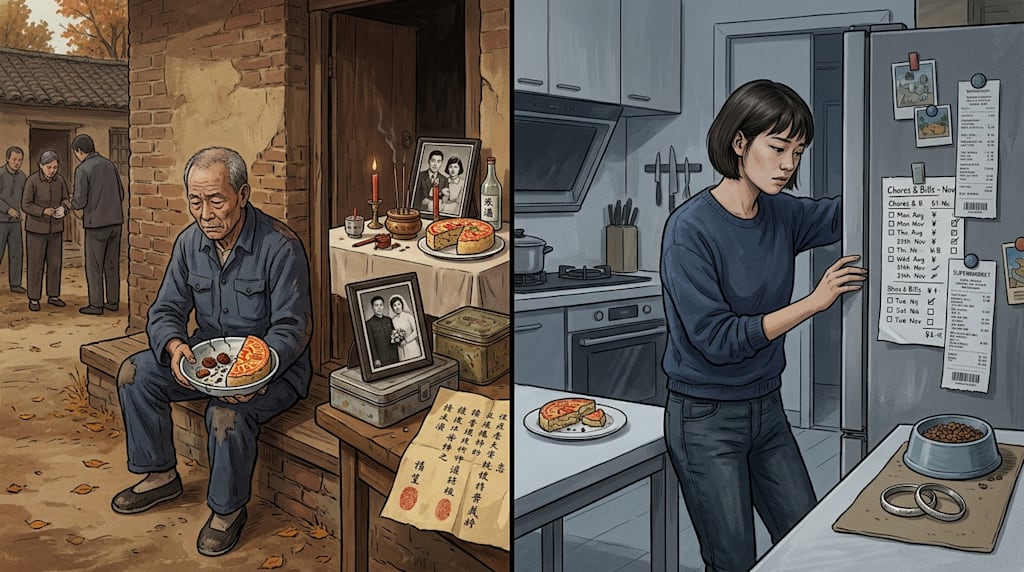
The last woman in the village who knew how to make traditional wedding cakes had died. At her funeral, her eighty-two-year-old husband sat on the threshold of the main room. He did not cry. He broke one cake in half, put one half into his mouth, and set the other on the offering table in front of her coffin. Someone behind me whispered, “They made do together for a lifetime. Such deep feeling.” The phrase “made do” landed with the same solid thud as a hoe snapping after fifty years. I stood at the back and thought: the year she married him, did anyone ask if she wanted to?
I. Wedding cakes and hoes
When the older generation talks about marriage, two words come up often: making do and getting by. Both have a utilitarian bluntness, as if two people were opening a shop together. What the shop sells does not matter. The shop must not collapse. My grandmother’s generation called the husband “the one who runs the household” and the wife “the one inside the house.” There was no romance in those terms, but there was a clear division. The one who ran the household earned work points outside, borrowed grain, and argued with the production team leader. The one inside the house fed the pigs, mended clothes, and mixed dried sweet potato into the rice so the family could eat its fill. They were like the two ends of a carrying pole. Neither could do without the other, but neither had time to ask whether the other was tired.
This marriage ran on survival. In an era of material scarcity and weak social security, life alone was too hard. A man living alone easily became a “bare-branch household”: no one to mend his clothes, no one to leave him a meal, no one to know if he fell ill. A woman living alone was worse off. Without a husband and sons to give her standing, she had little authority even when speaking in the village. No one helped with the heavy field work. No one stood up for her in a dispute. Marriage was not emotional consumption. It was a production unit, a pension unit, a unit of reproductive legitimacy, and a unit of social identity. Two people making do together meant one more pair of hands, one more household registration, one more roof, one more way out.
I once saw a rural household-division document from the 1970s. It read: the eldest son gets one water vat, two benches, one sickle. The second son gets one iron pot, one hoe, two hens. Beside it, in pencil, someone had added in crooked handwriting: “Mother rotates meals, half a month at each household.” There was not a single word for love on that paper, but the entire function of marriage was visible: dividing property, supporting the elderly, organizing labor. This is the original face of making do together. It is a contract full of obligations. Affection was a bonus outside the contract. Best if it was there. If not, the contract could still be performed.
So when the older generation says that making do together is happiness, they often mean the security that comes after a contract has been fulfilled. The fields were planted. The pigs were fattened. The children were raised. The house was built. The tasks were done. The two of them sat in the doorway sunning themselves, feeling steady inside. That steadiness is real, but it is not the same thing young people mean by happiness. It is closer to a farmer standing on the ridge after the autumn harvest, looking at a full granary and saying, “This year was all right.” That is an affirmation of survival. It is not an affirmation of intimacy.
II. Exchange marriages, widows, and the invisible ledger
This contract was not fair to everyone. My maternal grandmother once told me a story. When she was a child, there was a household in the village that used its daughter to exchange for a wife for its son. The daughter married into the other family and only then discovered that the man was lame and fifteen years older than she was. She ran back to her natal family and cried. Her father squatted on the threshold smoking tobacco. After one pipe, he said, “Your sister-in-law has already moved in. If you run back, what will your brother do?” That night the daughter drank half a bottle of DDVP. She was saved, and after that she never ran again. Later she bore three children. At sixty, she was diagnosed with stomach cancer. Before she died, she said to her daughter, “In this life, the one thing I hate is your grandfather’s pipe.”
There is no burial sacrifice in this story, but there is a more everyday form of accompanying burial: a woman exchanged as a resource. Her wishes were not on the ledger. Her resistance was calculated as a cost and then judged “not worth it.” In traditional marriage, women’s property rights, inheritance rights, divorce rights, and remarriage rights were all heavily restricted. “Before marriage obey the father, after marriage obey the husband, after the husband’s death obey the son” was not an empty phrase. It was a script of dependence. Property in households without male heirs was easily seized by the clan. The so-called “eating the extinct household” did exist in some places and circumstances. Widow chastity was honored, and remarriage was stigmatized, imposing real institutional pressure. Many women were not willing to make do together. Their choices were simply extremely narrow. They were not choosing between marriage and single happiness. They were choosing between marrying and finding it even harder to survive.
To define “a man takes a wife and a woman is given in marriage” directly as “a disguised system of burial sacrifice” is sharp as a metaphor. It reveals the side of traditional marriage in which women were treated as resources, bound, and required to sacrifice their labor and fertility to the family. As a strict historical judgment, it is too strong. Funerary sacrifice was mainly an institution of particular periods and particular social strata. One cannot equate folk marriage as a whole with burial sacrifice. A more precise claim is this: for women, traditional marriage was often a survival arrangement with high coercion, low exit, and strong dependence. It was not a romance story. It was not simple mutual consent. It was a system that bound survival, sex, and reproduction together.
Ancient women certainly had agency. Running away from marriage, returning to the natal family, litigation, remarriage, and earning a living through labor all existed. They were simply extremely costly. The woman in my grandmother’s village who drank DDVP did not run again after being saved, but she learned to hide private money. Every year she saved money from selling eggs and stuffed it into a crack in the wall. She saved for twenty years and had a pair of silver bracelets made for her daughter. That was the way out she left for herself in the cracks of the contract. The traditional system oppressed women and also oppressed lower-class men, but women bore the additional double costs of reproduction, chastity, and dependence. Without that point, traditional marriage turns into a nostalgic myth that the older generation was all happy.
III. The stories that were never told
Within the older generation’s happiness in making do, there is a thick layer of survivor bias. Those who can sit at the dinner table and say, “We made do back then and still lived a whole life together,” are usually the ones who made it through. Those who were worn down in marriage, subjected to domestic violence, cold violence, crushed by mother-in-law conflicts, or depleted by childbirth often had no chance to tell their stories. If they told them, no one listened.
My paternal grandmother had a younger sister who married into a neighboring village. Her husband drank heavily and beat her when drunk. She ran back to her natal family, and they said, “Bear it and it will pass. Which family’s man doesn’t beat his wife?” She endured for twenty years. At forty, she drank pesticide and died. At the funeral, her husband cried loudly, and the villagers said, “This man still has a conscience.” My grandmother rarely mentioned this sister afterward. Only on Qingming, when burning paper offerings, would she burn an extra stack and murmur, “Live on your own over there. Don’t make do with anyone anymore.”
This story is not part of the narrative that the older generation was all quite happy. It existed. Those silent unhappy people do not appear in Lunar New Year family photos. They do not say “back then we…” at the dinner table. Their stories are covered by the phrase making do together, a phrase that sounds solid but is in fact rough.
Beyond survivor bias, there is another layer: memory beautification. When people recall the past, they tend to remember the lively Spring Festivals, the laughter of children, the firecrackers on the day the roof beam was raised, and forget the daily grievances, quarrels, and helplessness. This is not lying. It is the natural filtering of memory. In his later years, my paternal grandfather often told me that he and my grandmother had “never once reddened their faces in a lifetime.” My father remembered clearly that one New Year, because Grandfather had lent the money for New Year goods to his gambling younger brother, Grandmother dumped an entire pot of dumplings into the pig trough, and the two did not speak for half a month. Grandfather told the version in his memory. My father told the version in his. Both versions were true. Only the mesh of the sieve was a different size.
There is also a layer of rationalization after institutional adaptation. In the traditional marriage script, the husband outside and wife inside division, although unequal, reduced daily negotiation. Who managed the money, who cooked, who cared for the children, who visited relatives, all had default answers. The default answers were not necessarily fair, but they lowered the cost of communication. The older generation did not lack conflict. Conflict was simply pressed down by the institution. When a person has no exit option, she often develops a psychological mechanism: rationalizing the existing life, interpreting endurance as virtue, and interpreting making do as happiness. This is not hypocrisy. It is how people preserve dignity within constraints.
IV. That cup of tea at the matchmaking table
Last year my younger female cousin went on a blind date. The man was a county civil servant with an apartment and a car. In the matchmaker’s words, his conditions were “something you could search for with a lantern and still not find.” They met at a milk tea shop in the mall and talked for forty minutes. The man said: after marriage, you’d better quit your job. My mother is in poor health and needs someone to care for her, and the child will need someone to raise. My cousin asked: What about you? The man said: I go to work. My salary is enough to support the family. My cousin said: My salary is enough to support myself. The man said: That’s different. A woman should always put family first.
When my cousin came back and told me about it, she was not angry. She even laughed. She said, “Cousin, it’s not that I’m unwilling to care for the elderly or raise children. What I can’t stand is that he said it as if it were as natural as the sun rising in the east.” She did not finish her milk tea. As she left, the man even said, “Pack it up, don’t waste it.” She said, “Take it back for your mother to drink,” and then deleted him from WeChat.
There was no domestic violence in this story, no affair, no astronomical bride price. The man’s conditions were even considered good. What my cousin rejected was the thing inside that “quite good”: before a person even enters marriage, her role has already been assigned. Her wishes do not need to be asked because the script has already been written. She rejected low-quality, high-risk, unequal making do.
When young people today face marriage, they are calculating a ledger completely different from that of their parents’ generation. Economic costs are rising: housing prices, bride price, weddings, childcare, education, healthcare, elderly care. Every item is real money. Opportunity costs are rising, especially for women. The career penalty of childbirth and the inequality of housework and emotional labor are invisible bills. Relational costs are rising: both families of origin, property and debt, mother-in-law conflicts, the risks of domestic violence and infidelity, and the cost of divorce all make entering marriage a high-risk decision. Psychological costs are rising as well. Marriage has changed from getting by to requiring communication, respect, and mutual growth, with an unprecedented density of negotiation.
Alternatives are increasing. A person can get by on a salary, social insurance, market services, a network of friends, and hobbies. Being single no longer automatically equals failure. Urbanization has weakened the pressure of acquaintances’ gossip. Divorce no longer means social death as it once did. Women’s economic independence has increased their ability to exit and made unequal making do harder to accept.
My cousin later bought her own apartment, sixty square meters. She has a cat and goes hiking on weekends. Her mother was frantic and said, “What will you do when you’re old?” She said, “Mom, if I have to serve a man I don’t love for a lifetime just so someone will hand me water when I’m old, which one is really the better deal?” Her mother said nothing, but she stopped pushing her to go on blind dates.
V. Marriage no longer responsible for keeping you alive
Many people say young people’s expectations of marriage are too high, and that is why they cannot marry. That is only half right. Expectations have indeed risen, but they did not rise out of thin air. The function of marriage has changed.
In traditional society, marriage was a survival cooperative. You did not need to discuss emotional value with your partner because the first task was to survive together. Today, the survival function of marriage has been partially stripped away. Economically, social insurance and market services allow a person to live alone. Sex, reproduction, and elderly care no longer have to be obtained through marriage. Urbanization has pushed acquaintance gossip off the stage. Women’s economic independence has made “marry a man, marry a man, for clothing and food” no longer the only path. Marriage has changed from must to option, from survival unit to emotional community plus life partnership contract.
When marriage is no longer responsible for keeping you alive, it must be responsible for making your life better. Otherwise, why enter it?
This is the logic behind rising expectations. Since marriage is no longer a necessity for survival, it must provide something beyond survival: respect, companionship, equality, communication, mutual growth, emotional support. If none of these are present, and there is only one more person to serve, a pile of relatives to deal with, and a mortgage to pay, then of course young people will find it a bad deal.
High expectations are not wrong. What is wrong is that many people demand young people enter marriage using the traditional script while failing to provide the stable benefits that traditional marriage once offered. You cannot simultaneously want young people to endure like the older generation and to be independent like modern people. You cannot want women to be economically independent and to bear traditional housework. You cannot want men to participate in childcare and to maintain traditional authority. This half-traditional, half-modern marriage script is precisely what suffocates young people.
VI. The note on the refrigerator
To say young people completely reject making do together is also inaccurate. Young people still date, cohabit, marry, and raise children. They have simply changed their definition of making do together.
I know a young couple who have been married for three years. They did not hold a wedding. They each paid half of the down payment, and both names are on the deed. On their refrigerator is a note: “This week’s housework: Monday, Wednesday, Friday, I wash dishes, you mop. Tuesday, Thursday, you wash dishes, I mop. Weekends: rock-paper-scissors. Whoever goes out takes the trash. Your mother comes for dinner Wednesday. I cook, you keep her company. Next time my mother comes, you cook, I keep her company.” Under the note, held by a magnet, is a supermarket receipt. On the back it says: “This month’s joint account expenses: mortgage, utilities, cat food, your father’s medicine, my sister’s birthday gift.” On the other side: “Personal accounts: each manages their own, no checking each other’s.”
I went to their home for dinner. The man cooked, and the woman stood beside him peeling garlic. They argued briefly about whether to add Sichuan pepper. In the end the man compromised, fished the peppercorns out and put them in a small dish, saying, “If you want it, dip it yourself.” The woman rolled her eyes, but during dinner she put the largest rib into his bowl. There was no confession, no romantic line, but that action of fishing out the pepper and that rib were more solid than many wedding vows.
They want making do with an exit mechanism. They can live together, but property is clear. They can raise children together, but housework is shared. They can care for each other’s parents, but do not accept boundaryless interference. They can compromise, but do not accept domestic violence or infidelity. There need not be grand romance, but there must be basic respect. They do not reject intimate relationships. They reject intimate relationships that sacrifice the self.
VII. Back to that piece of wedding cake
After the funeral, I helped the old man sort through her belongings. Beside her bed was a tin box containing needles and thread, a thimble, a few grain coupons, and a black-and-white wedding photo. In the photo the two of them sat side by side, half a foot apart, both with serious expressions, as if posing for an ID photo. At the bottom of the box was a piece of paper folded into a small square. I opened it. It was a handwritten household division agreement, dated 1978. It read: “Today, Wang Xiulan and Li Degui agree to make do together. Major family matters will be discussed together. Minor matters each manage their own. Grain will be accounted for separately and settled at the end of the year. If one falls ill, the other is responsible for care and must not shirk. Oral promises are no proof. This document is made as evidence.” Below were two thumbprints.
I handed the paper to the old man’s son. He glanced at it and laughed: “These two old people, lived a whole life together and still kept separate accounts.” He folded the paper and put it in his pocket.
I do not know whether that paper will eventually be thrown away or kept. It is far more honest than the word happiness. It is a contract. It states obligations, boundaries, and ways of exit. There is no love in the contract, but there is something more fundamental: two people agreed on how to survive together, and neither treated the other as a burial sacrifice.
Young people’s marriages are moving in this direction, only more earnestly. They no longer accept vague oral promises. They no longer accept the advice “just bear it and it will pass.” They no longer accept the justification “everyone lives this way.” They want to stick the note on the refrigerator, keep the accounts in the open, and write the exit mechanism into a prenuptial agreement. This may not look romantic, but it may be a fairer starting point.
The twilight of making do marks the end of the old contract. It does not mark the end of intimacy. The new contract is still being written. It may not be easier, but at least it should be fairer. Fair enough that two people together are better than one. Fair enough that no one has to be a burial sacrifice for anyone else. Fair enough that when a piece of wedding cake is broken in half, both people can eat it with peace of mind.
The old man finished his half of the wedding cake, stood up, patted the crumbs off his trousers, walked into the kitchen, and took the other half from the offering table as well. His son said, “Dad, that was for Mom.” He said, “Your mother didn’t like sweet things. I’ll eat it for her.” Then he put the empty plate back in the cupboard, turned on the tap, and began to wash the dishes.
About the Creator
Jin
Writer of reamstories
https://reamstories.com/jin
Enjoyed the story? Support the Creator.
Subscribe for free to receive all their stories in your feed. You could also become a paid subscriber, letting them know you appreciate their work.
Comments
There are no comments for this story
Be the first to respond and start the conversation.