
My Daughter's Best Friend Has a Mother Who Cleans Offices
Three parents in my group chat told me to "keep it in mind." Here's why I decided to teach my daughter the opposite.
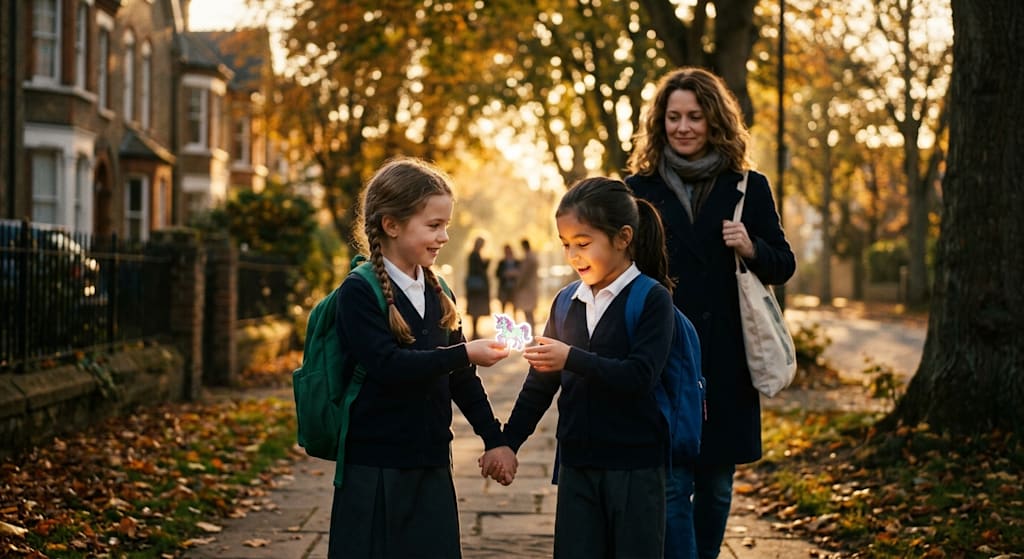
My daughter first mentioned that classmate on a Thursday evening. She was holding her rice bowl, lifted her eyes from the rim, and said, "Mum, she draws really beautifully." She stressed the word she, as if the name had been sitting in her mouth for days and she'd finally decided to let it out.
"She has a whole book of stickers. All sparkly. Princesses, unicorns, and ones that change colour. She's willing to trade with me." She lowered her head and went back to eating, but the tips of her ears turned red. Not shyness—a small, barely contained pride. She'd found someone who would swap good things with her.
Something stirred in my chest. My daughter is in second grade, introverted by nature. Her teacher says she's "well-behaved, but not very outgoing." She rarely speaks of anyone with that hint of boastfulness. For a moment, I felt almost grateful to the little girl I'd never met—she'd used a sticker book to open my daughter's tightly shut mouth.
Over the next few days, they started walking home together after school. I trailed a few steps behind, watching two small heads huddle close—one rummaging through her backpack, the other peering in, chattering like two sparrows sharing the same grain of rice. My daughter's voice was louder than usual. Her steps were lighter. Sometimes they'd double over laughing mid-sentence, her backpack strap sliding off her shoulder without her even noticing.
Watching that silhouette, I thought: this is what childhood should look like—giving your whole heart away over a sticker, asking no questions, counting no costs.
But that full, settled feeling cracked in the parent group chat a few days later.
A parent sent me a private message, very polite: "Has your daughter been walking with XXX lately? Her mother works as a cleaner in the office building nearby. They rent a place. They're from out of town." A pause. "I don't mean anything by it. I just think you should keep it in the back of your mind."
I didn't reply. Then, during two casual chats at school pick-up, two other parents echoed similar sentiments. One of them put it more elegantly—and more sharply: "The social circle in primary school affects where you get your information from. Your daughter wants to get into a good middle school later, right? You know that."
None of them said, "Don't let her play with that girl." They simply placed the words cleaner, rental, out-of-towner in front of me, then stepped back quietly, waiting for me to make the "sensible" choice. They never bore the burden of being unkind—they'd already passed their judgment.
That night I sat on the sofa, my phone screen dimming and brightening, dimming and brightening. I wavered.
I'm not naïve. I've never believed cleaning is a lowly job. But those words seeped into my mind like water into a wall crack. Involuntarily, I started thinking: What if she picks up bad habits from that girl? What if her study pace slows down? Who are other people's kids playing with? Am I being too "undiscriminating"?
Those thoughts stopped me cold. Because I realised I was using occupation, household registration, and rent—three labels—to trim down a second-grade friendship. And my daughter, beside me, was flipping through her picture book, oblivious. All she knew was that the little girl drew well, had plenty of stickers, and was willing to trade. She fell asleep with a smile at the corner of her mouth—probably still trading stickers in her dreams.
I lay awake that night. I kept asking myself the same question: What am I actually afraid of? That the cleaning mother can't offer my daughter "useful" connections? That the out-of-towner girl will pass on "bad" habits? But then—
I remembered what my daughter used to be like. Quiet. Well-behaved. Never caused trouble. But also rarely excited. She was a pool of still water. And in the past two weeks, she'd become a pond with a pebble dropped in—ripples spreading in every direction, the surface covered in broken light. What that little girl had achieved with one sticker book was something I, her own mother, had failed to do with all my cajoling: make my daughter speak up, reach out, and say, "I want to walk with her."
I also thought of that cleaning mother. I'd never met her, but I knew she spent her days mopping floors, wiping glass, and taking out rubbish in an office building, earning a clean living with her own hands. Her daughter—the one with the whole book of sparkly stickers—was willing to give away her treasures to someone else. That's not what a deprived child does. A deprived child clutches her stickers tight and never lets go. A child who can share has been filled up with love.
A child filled with love won't spoil my daughter. A mother who works with her hands doesn't need me to "keep it in the back of my mind" on her behalf.
The next morning, while putting on her shoes, my daughter turned and asked, "Mum, can I take this new pack of stickers to school today? I want to give her one. She gave me a unicorn one last time."
I said, "Sure. Pick whichever one you want."
She crouched on the floor, picking through the stickers for a long time. Finally, she chose one with a rainbow background and a line of tiny text printed on it. She couldn't read, so she looked up and asked, "Mum, what does it say?"
I crouched beside her, read the line—"You are my best friend"—and felt my nose sting. I tousled her hair and said, "It says, 'This sticker is very pretty.'"
She happily tucked it into her pencil case, slung her backpack on, and skipped out the door. I followed a few steps behind, and ahead I saw another small figure running toward her. The two tiny silhouettes met in the morning light, their backpacks bumping with a soft clack, and then they both burst out laughing.
That morning, I thought: the adult world is already complicated enough. Let's not use those invisible social rulers to measure a second-grader's happiness. If we must talk about "circles" and "information," then in the most formative years of my daughter's life, the most important piece of information I hope she receives is this—
More precious than a house or a household registration is the moment someone is willing to give you their favourite sticker. No calculation. No "keeping things in the back of your mind." Just one child saying to another: Here. It's yours.
And the way my daughter responded was to dig through her entire pencil case and pick out a sticker that said, "You are my best friend." She couldn't read the words, but she chose it anyway. I don't know if that's instinct—a child, in a language she doesn't understand, saying what she already knows.
That afternoon I went to pick her up. She ran out clutching a new sticker. "Mum, look, she gave me another one. She said it's her favourite. She only had one, but she gave it to me."
She opened her palm. A small, glittery unicorn sticker lay there, its horn catching the last of the afternoon light.
I crouched down, studied it for a long time, and said, "Then keep it safe. That's what best friends give."
She nodded, tucked the sticker into the last page of her picture book, closed the cover, and patted it gently, as if afraid it might run away.
On the way home, she walked ahead, her backpack bobbing. I followed behind, and all the anxiety, hesitation, and self-doubt that had churned inside me slowly receded. Only a thin, damp film of leftover feeling remained on the ground, catching the evening light.
I remembered a line I'd read somewhere—I can't recall the exact words—but the gist was: children don't need us to sort the world for them. They need us to walk beside them without blocking their light.
That little girl is her light right now. Light has no class.
I'm not going to reply to those private messages. I'm not going to offer any "moderate guidance." The next time my daughter asks, "Mum, can I bring extra snacks to share with her?" I'll say one word:
"Yes. Bring a little more."
About the Creator
Jin
Writer of reamstories
https://reamstories.com/jin
Enjoyed the story? Support the Creator.
Subscribe for free to receive all their stories in your feed. You could also become a paid subscriber, letting them know you appreciate their work.
Comments
There are no comments for this story
Be the first to respond and start the conversation.