
Love, Hope, and Surrogacy: A Quadriplegic Mother’s Journey to Parenthood
Written by: Marci Hughes Published: April 12, 2025

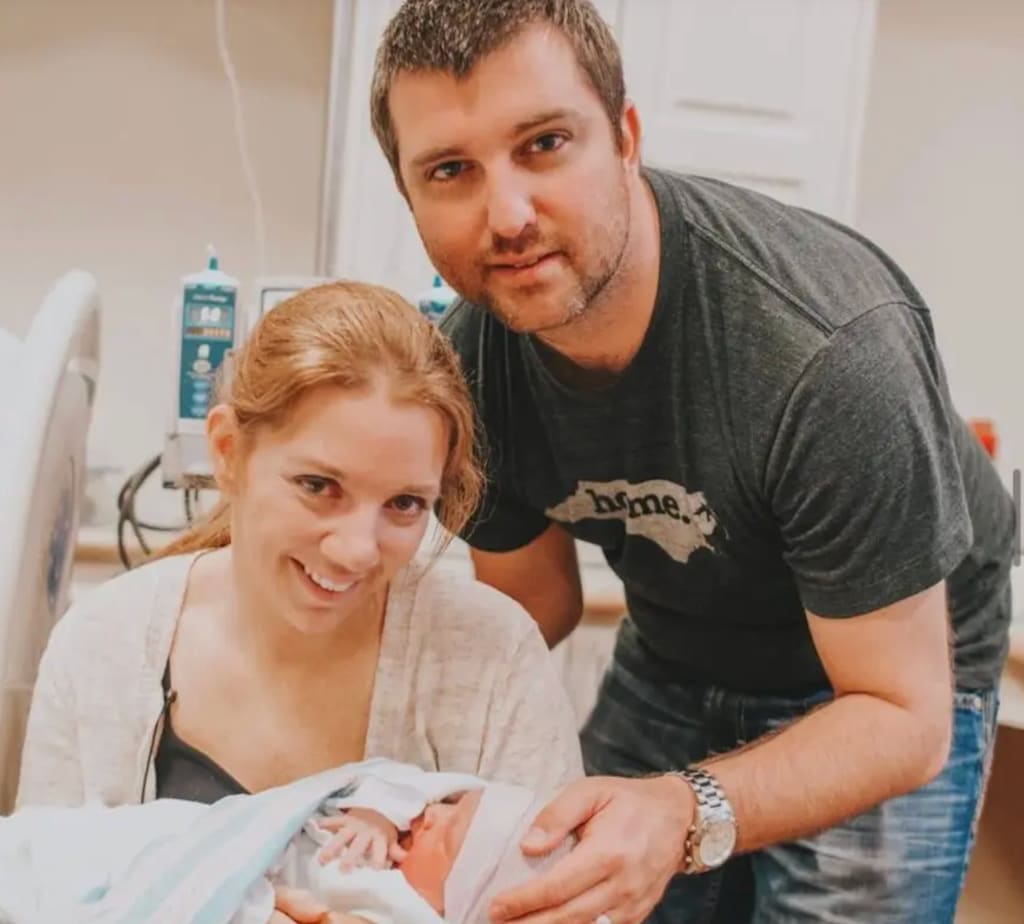
As Told by Rachelle Chapman, Intended Mother
Rachelle Chapman is the embodiment of resilience and empowerment. In 2010, a spinal cord injury changed her life. Instead of letting it define her, it propelled her forward. As a wife, mother, influencer, and advocate, she’s breaking barriers and inspiring over 350,000 followers with her journey to motherhood through surrogacy. Featured on The Today Show and PEOPLE, Rachelle uses her platform to educate and uplift others. As she considers expanding her family, she continues to challenge misconceptions and prove that with determination and support, anything is possible.
Hear Rachelle’s full story on the All Things Conceivable podcast
NF: You are such an inspiration, Rachelle. Tell us about your journey.
RC: In 2010 I was engaged, graduated college, bought a house, and was working my dream job running a senior center. Life was exciting!
Our wedding was set for June. In May, I had my bachelorette party in Virginia Beach while my fiancé went camping. After a fun night out, my friends and I decided on a late-night swim. As I hesitated at the pool’s edge, a friend playfully pushed me. I lost my balance and dove headfirst into the shallow end. The impact broke my neck, damaging my spinal cord and instantly paralyzing me. In that moment, my life changed forever.
NF: How did you cope with your new reality, and navigate the challenges that followed?
RC: After my injury, I remembered watching a film called Murderball in college. It is a documentary about the Paralympic wheelchair rugby team. I had the same injury and function as those athletes, and seeing them thrive left a lasting impression. They were playing an incredible sport and fully embracing life. While I wasn’t completely prepared, their perspective gave me insight into what was possible. It motivated me to get stronger and use humor to navigate those challenging first months.
In those early days, I wasn’t thinking long-term. I wasn’t asking myself what my life would look like in a year or two. I was just focused on making it to the next day. That made things easier to process. If I had a bad day, I’d sleep it off and try not to carry it into the next. That doesn’t mean I didn’t struggle. I definitely had tough days. I cried. I missed dancing, which was something I absolutely loved but knew I wouldn’t be able to do the same way again. That was really hard.
Taking things one day at a time, reminding myself that I could still have a good life, and leaning on my support system really helped me through it. That’s the advice I’d give to anyone going through something traumatic or difficult — thinking too far ahead can be overwhelming. Instead, focus on getting through today and making it the best you can.
NF: How does your injury affect you?
RC: I’m a quadriplegic, meaning I have impairments in all four limbs. Many assume this means complete paralysis, but that’s only with very high neck injuries. I broke my C6 vertebra which left me with strong shoulders, biceps, and wrists. However I have limited mobility in my triceps and no finger function.
To grip objects, I use tenodesis — lifting my wrist back to curl my fingers. I’m paralyzed from the chest down, so I don’t have core muscles or abdominal control. I can’t sit up unassisted at the edge of a bed, for example.
I do need some help, and I’m really grateful to have my mom around as well as Chris. I can get dressed on my own, but sometimes I have to decide: do I want to be completely independent today, or do I want to have more time for other things? Time is a big factor since everything takes longer for us. While I do get help with some things, there’s still a lot I can do on my own.
NF: You also had to delay your wedding by a year. How did the two of you navigate that over the course of the year?
RC: Chris always says that when the accident happened, his first thought wasn’t, “What am I going to do?” but rather, “What are we going to do?” Neither of us ever questioned staying together.
People have asked if I told him he could leave since he “didn’t sign up for this,” but I never did. If the roles were reversed and he had said that to me, I would’ve been offended. I love him too much to even consider leaving. I knew he felt the same way.
I’m really lucky because we both are obsessed with each other. We love each other so much, and we both bring something to the relationship that the other person has a really hard time with. He’s a really big support system for me and physically really helpful. For him, he has a lot of anxiety and I’m a very calm, chill person. I balance him out in that way. We’re really good for each other and I definitely wouldn’t be where I am without him. Neither of us thought that the injury would be the end of us.
If we had been completely on our own without outside help, it would have been ten times harder. Having my mom and family really eased the burden for both of us. Unfortunately, many relationships don’t survive after an accident like this. I think it’s because people panic in those first few months, assuming life will always be as hard as it is in the beginning at the hospital. Things get easier over time, you have to ride out the storm and see what life is like after that huge wave of trauma, because it might be different.
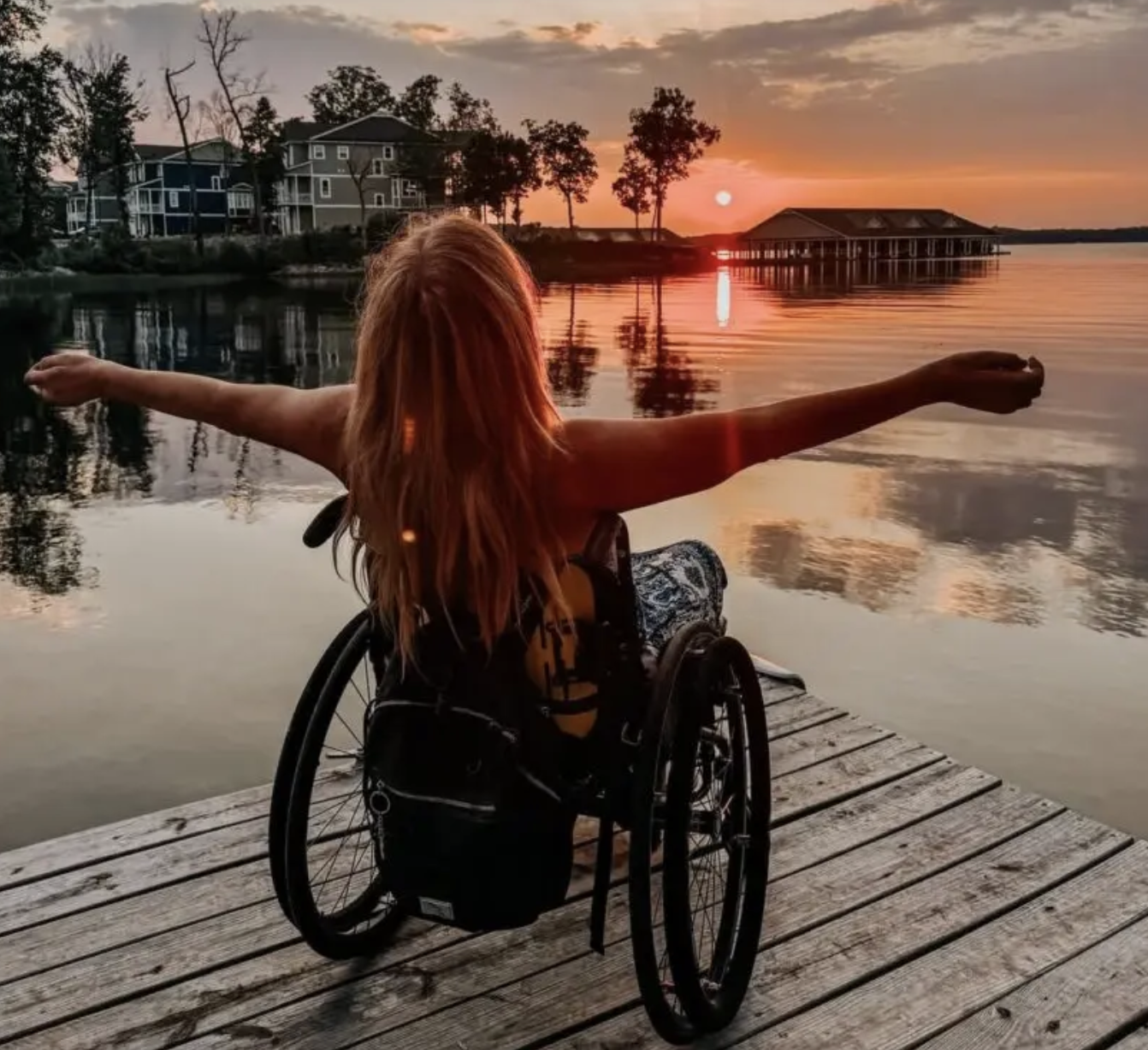
NF: Can you share your journey to parenthood and how you came to surrogacy?
RC: A few years after my injury, we were in a more stable place. We were married and starting to think about having kids. I had considered carrying a pregnancy myself since my fertility doctor confirmed that paralysis doesn’t affect the reproductive system. Many people with spinal cord injuries carry pregnancies.
However, my injury affected my blood pressure, which was dangerously low. I needed medication to keep it stable, but doctors told me that medication would be unsafe during pregnancy. Without the medication I would pass out constantly. It was a catch-22, making pregnancy impossible for me.
After realizing surrogacy was my best option, I wrote a blog about my desire to be a mom. Amazingly, a friend from college whom I had known briefly reached out. She had always wanted to be a surrogate and offered to carry our baby. She lived just four hours away. We met, talked, and decided to move forward. I was incredibly lucky to have her as my surrogate.
We are so very grateful for her. She was inspired to become a surrogate because her husband was a sperm donor for a couple, and she wanted to help a family as well. The fact that she saw my blog and wanted to help us is a huge miracle and blessing.
NF: How did your relationship with your surrogate grow throughout the surrogacy journey?
RC: During the surrogacy I went to all the doctors appointments. My surrogate and I had dinners together, would hang out, and we just clicked. She and her husband are similar to me and Chris. Her family and husband rallied around her with support, and that really helped our relationship. We still have a great relationship and visit them often.
NF: What do you think people misunderstand the most about surrogacy, especially for individuals with disabilities?
RC: The biggest surrogacy misconception I hear is, “Is the baby biologically yours?” Many assume she isn’t, because I didn’t give birth to her. People don’t realize that it was my egg and Chris’s sperm that created the embryo, which was then transferred to the surrogate. Our daughter is 100% genetically ours.
Another common concern is the surrogate’s role. People often ask, “How can the surrogate just give up the baby?” Surrogates go into this journey knowing they are helping another family, and that it is not their child. They do this out of love and generosity, and they find joy in seeing the family they helped create. It’s a beautiful relationship that people don’t always fully understand.
Another opinion I’ve heard is that I was selfish for pursuing surrogacy when there’s kids who needed a home that I could adopt or foster. There are many challenges with that path to parenthood. I tell people that there are multiple ways to make a baby. You can do it naturally if you’re lucky enough, you can adopt, use IVF, surrogacy, and more. The important thing is you have a family.
NF: What other kinds of reactions did you get from your online audience?
RC: Most people were supportive, but I received some negative comments too. Some called me selfish, and doubted if I could be a good mom. They believed that my disability would prevent my child from having a good life. I would actually reply to the comments saying, “Hey, it’s me!” That definitely caught people off guard. A lot of people assumed I couldn’t move at all, or had no clue about my incredible support system. Parenting is a team effort, but somehow, people acted like my disability made it impossible. Parenthood isn’t just about one person, it’s about a village. If Chris were a single dad, no one would question whether he could raise a child. So why does including me in that equation suddenly make it more difficult? If anything, it makes things easier because of all the things I can do. A lot of it just came down to education.
NF: How is parenthood different for you than somebody else?
RC: The hardest part of my daughter’s childhood was when she was crawling but couldn’t stand yet. I couldn’t lean over, wrap my arms around her, and pick her off the ground. Thankfully we had a custom accessible crib made by a furniture builder. We told him what we needed, and he built it using the crib my surrogate had for her child. He added legs to the crib so I could roll underneath. I could have the crib right at my lap, pick her up, put her to bed, and snuggle with her. It was a game-changer.
As she became more independent, things got much easier. She learned to pull herself up using my wheelchair, grabbing the wheels or the bar on the back. She actually learned to walk by holding onto my chair while I rolled slowly. There’s a video of that on YouTube!
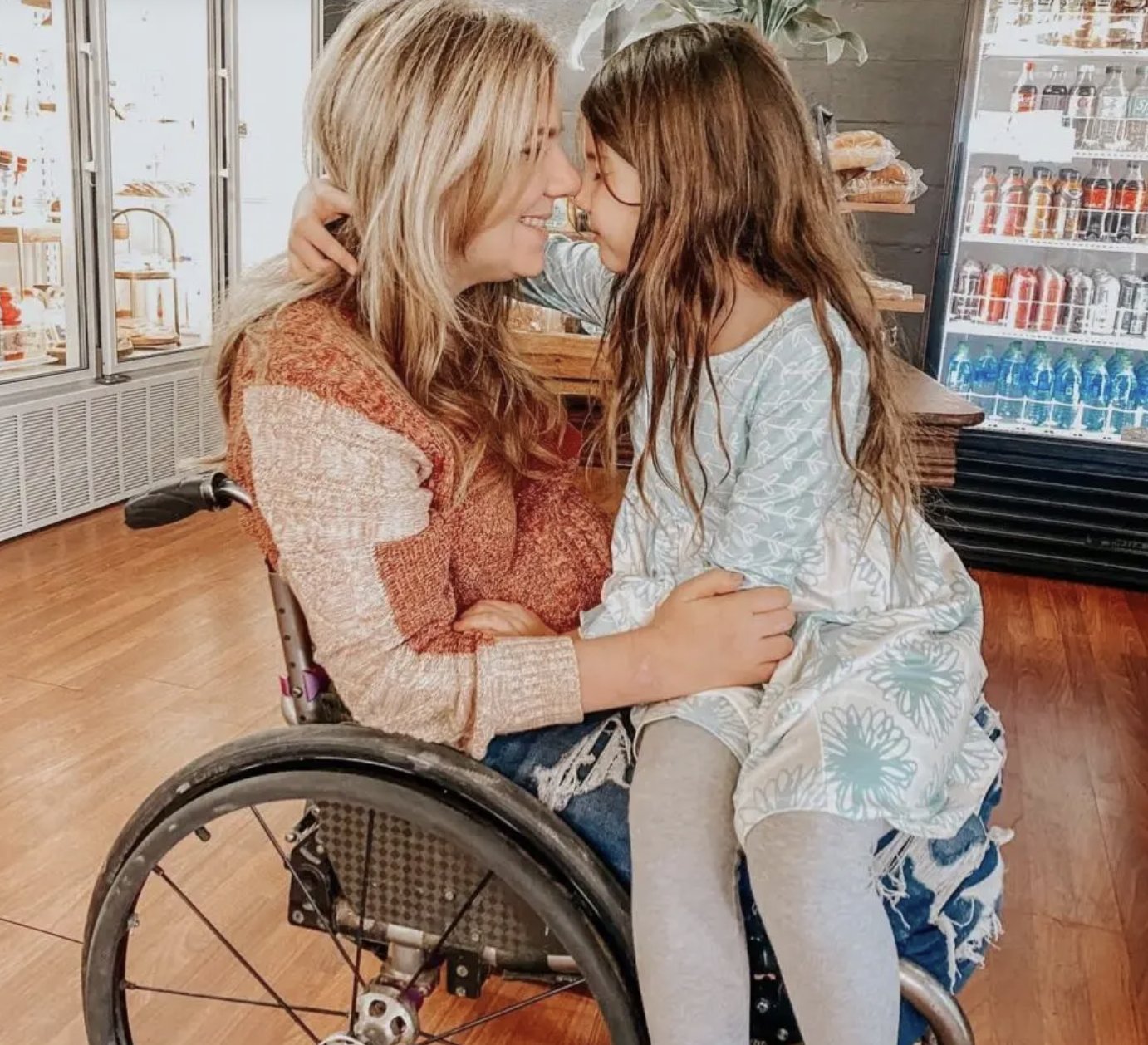
Motherhood overall has been amazing. There have been challenges. But I have Chris, my mom, and an incredible support system. My daughter loves that I use a wheelchair, she thinks it’s the coolest thing ever. When kids on the playground ask questions, she’s excited to answer. She also loves riding on my lap, she never has to walk anywhere! She’s almost 10 now and still getting rides. At some point that’ll change.
NF: How do you use your story to empower other women every day?
RC: I love empowering others. I first started out on Facebook back in 2010 before Instagram even existed. I quickly gained a large following. What I discovered from that following was that while I was inspiring many women, I was especially reaching women with disabilities. At the time, there weren’t many visible examples of people who had been injured and still lived a full, normal life. If someone experienced an injury, they didn’t have many role models to look to for hope.
I think I was able to provide hope, particularly for those who were injured after me. Many physical therapists, doctors, and nurses knew my story and would direct patients to my page. One moment that really stuck with me was with a mother whose young daughter had been paralyzed at just 10 years old. As a mom, she worried about her daughter’s future. She told me: “In seeing you as a mother, a wife, and an active person in sports; I know that kind of life is possible for my daughter. Because of you, I feel at peace with her future.” That meant so much to me.
In sharing my life, my happiness, and my travels, I hope to show others that you can overcome challenges to live a full and joyful life.
NF: What do you hope your daughter is learning from you?
RC: I hope she’s learned compassion. The truth is, I know she already has and always will. I love that part of her. She’s going to grow up and change the world; helping others and bringing smiles wherever she goes. My situation and the wheelchair have only deepened her empathy and kindness, adding so much to her life. I can’t wait to see all she accomplishes as she gets older.
NF: What advice would you give to someone in the disability community who’s considering building a family through surrogacy?
RC: Be open, be hopeful, and don’t settle. Find a surrogate that you really connect with and that fits well with you in your life. Know that there are other moms and dads who are wheelchair users. They are thriving, loving parenthood, and living great lives with their kids. There’s truly nothing to worry about when it comes to your abilities, especially if you have a strong support system. My advice would be to go for it! Being a parent is the best thing ever!
NF: What’s next for you?
RC: Because I did surrogacy, I went through IVF and had embryos created. We still have a few embryos left. I really wanted to have another baby, and initially explored the surrogacy route again. I’ve come to realize that I’m a lot healthier now than I was when I had my daughter. My blood pressure has stabilized, and I no longer need daily medication. I’ve started thinking that maybe I want to experience pregnancy myself. I’ve decided to move forward with IVF and try to get pregnant on my own — we’ll see how it goes!
NF: What parting message would you like to share?
RC: Live life and don’t stress over the little things. Going through something big has taught me not to sweat the small stuff. Stay positive, and remember it’s okay to have a bad day. If the little things do get to you, it doesn’t mean you’re a bad person. Everyone has tough days. Try to leave it behind, wake up the next morning, and start fresh with a positive mindset.
About the Creator
ConceiveAbilities Egg Donor and Surrogacy Agency
ConceiveAbilities is a leading egg donor and surrogacy agency that has helped build families for over 30 years. Learn more about becoming a surrogate, egg donation, the surrogacy process and modern family building.
Enjoyed the story? Support the Creator.
Subscribe for free to receive all their stories in your feed.
Comments
There are no comments for this story
Be the first to respond and start the conversation.