
I Used to Think Parents Didn’t Need to Learn Parenting. Then I Read These 3 Stories.
Love is instinct. Raising a child is a skill. The difference shows up in ways no one can ignore.
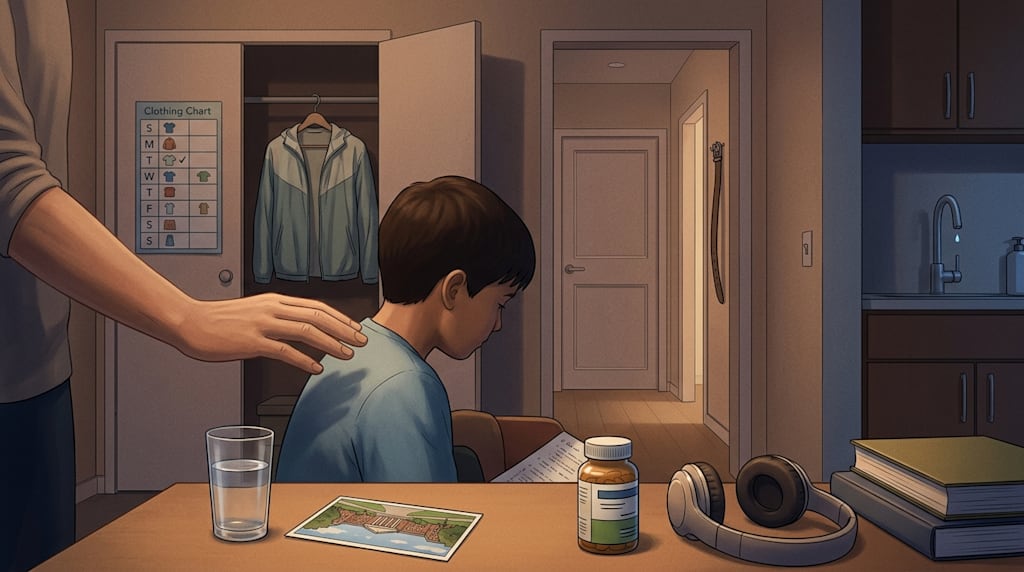
Start with three old stories.
The first happened to a university student.
His mother numbered all his clothes in advance and wrote down which piece to wear on which day. Inside the wardrobe door was a printed chart: Monday to Sunday, tops, pants, jackets, numbered from 1 to 21.
One day the weather turned cold. He wore clothes according to his mother’s numbers. That day’s number was a thin windbreaker. At noon he began sneezing. By evening he had a fever.
He called his mother and demanded, “Why did you make me wear this today?”
His mother said apologetically, “I’m sorry. I didn’t know it would turn cold.”
He did not say, “I could have changed by myself.” He said, “Why didn’t you check the weather forecast?”
The second happened to a girl after the college entrance examination.
She missed Peking University by a few points. On her desk was a postcard of Peking University, taped with clear tape to the base of her desk lamp. After dinner every day, her father asked, “What’s your rank today?” Her mother said, “Our daughter is our everything, and our daughter’s everything is Peking University.”
She shut herself in her room all day and said nothing.
One evening, she wore a white dress and held a lotus flower, sitting on a park bench. When the sun set, she swallowed sleeping pills. A patrolling person found her.
After it happened, her parents found many diagnoses in the hidden compartment of her schoolbag, from different hospitals, all with the same symptoms: headache, insomnia. She had saved the sleeping pills little by little from different hospitals and kept them in a vitamin bottle.
The third happened in the home of a pair of senior engineers.
They watched their son strictly and rarely gave him freedom. When he was in university, he met a girl whose family background was not very good. When the mother found out, she blocked the girl at the school gate, cursed at her, and humiliated her.
Later, the son strangled his mother and father one after the other with a belt. The belt was his father’s: black, with a brass buckle.
During the trial, the boy told the judge, “All my life, I have been begging like a dog, asking for charity. I have never had human dignity.”
There is also a fourth category. No specific case, but it is everywhere: parents say, “I don’t interfere,” the child locks the door, plays games at three in the morning, and no one asks.
Laissez-faire and control sit at two ends. Bewildered parents stand in the middle.
Ten years later, looking back at these stories, they still make one uncomfortable.
The discomfort comes from something else: parents love their children and still do not know what they are doing.
Love is instinct; education is ability. A hen can love her chicks. Humans can do better at understanding how to raise the next generation.
I. A Child’s Problem Is Often a Relationship Problem
A child is urged to study every day.
At first he says, “I know.” Later he closes the door. Later he puts on headphones. Later he skips class.
The parents find it incomprehensible: I have sacrificed so much for you. Why are you so inconsiderate?
From the child’s side, he is running from a life that is arranged, controlled, and denied. Studying is just the surface.
Learning was originally his own business. Later it became his parents’ business. Growing up was originally his own path. Later it became his parents’ project.
When a person lacks a sense of autonomy for a long time, sooner or later he will take back the steering wheel in some way. The method may be clumsy. The cost may be high.
What adults call “rebellion” is often a declaration of growth: I want to become myself.
If parents cannot understand this sentence and only take it as a challenge to authority, they will press harder. The tighter the pressure, the stronger the rebound.
Parents think they are educating. The child only feels controlled.
II. “My Parents Didn’t Learn It, and Didn’t I Turn Out Fine?”
This statement has some validity. It cannot prove that parenting education is unnecessary.
You see the people standing in front of you.
Those who were controlled into depression, rebellion, running away, crime, or a lifetime of unhappiness will not stand in front of you and say, “My parents didn’t learn it.”
Extreme bad cases are a minority. Mild control, denial, and neglect exist in large numbers.
Many people are merely “still holding on.”
The times are different too.
In the past, family clans, neighbors, schools, and work units all participated in education. Children had more space to move, more peers, and pressure was dispersed.
Now there are small families, urbanization, competition starting earlier, and a complex internet. The challenges parents face are different from those of the previous generation.
Even if parents did not “formally learn,” they were influenced by the previous generation, social culture, and life experience. This counts as implicit learning.
This learning is often unconscious, half right and half wrong.
Children’s innate temperaments differ too.
Some children are like dandelions: throw them anywhere and they grow. Some are like orchids, extremely sensitive to their environment.
You cannot take one “I turned out fine” case and generalize to all children.
When you look at large samples, parents who have studied parenting tend to have better parent-child relationships, healthier children, and calmer homes.
Not learning does not guarantee harm. Learning makes detours less likely.
III. What Does Parenting Education Teach?
The point is to see the child and yourself.
First, learn the laws of growth.
Young children need a sense of security. School-age children need habits and a sense of competence. Adolescents need autonomy and respect.
Using methods for managing elementary school students on high school students, or coaxing adolescents the way you coax young children, will cause problems.
Second, learn self-awareness.
Many parents are anxious about their own fears: the child falling behind, losing face, losing control, not being a good parent.
Distinguishing “Is this the child’s need, or my anxiety?” is an important lesson.
To be specific: when the mother wants to lose her temper, she first touches the keys in her pocket. The keys are cold. She pauses for three seconds.
Third, learn communication and boundaries.
High warmth, high expectations.
Gentle but firm: I understand you, but the rule is here. I love you, but you cannot hurt others. You can say no, but we need to discuss it together.
Less commanding, more listening. Less shaming, more empathy. Less threatening, more negotiating.
Fourth, learn emotional stability.
Parents’ emotional stability is the child’s greatest sense of security.
The father swallows “Why are you so stupid?” and says, “Eat first.”
This sentence is more useful than a hundred sentences of “I’m doing this for your own good.”
Fifth, learn relationship repair.
No parent never makes mistakes.
After conflict, they can apologize and reconnect.
A single “I’m sorry, I was too anxious just now” is more powerful than a hundred explanations.
Sixth, learn prevention.
Don’t wait until the child has a problem to wake up.
It’s like physical health: understanding the patterns when you are not sick, and treating minor illnesses promptly, is always better than emergency rescue when the illness is severe.
Seventh, learn to be an example.
You scroll on your phone, but ask your child to read. You are irritable, but ask your child to be gentle. You avoid things, but ask your child to be brave.
This is hard.
Children learn from how you live.
IV. Don’t Turn Parenting Education into a New Anxiety
Emphasizing the importance of parenting education is not about pushing all responsibility onto parents.
Children are also influenced by genes, peers, school, society, and chance.
Parents do not need to be perfect. They need to be “good enough”: able to see the child, respect the child, respond steadily, and apologize and adjust when necessary.
We should also be wary of turning parenting education into a new anxiety industry.
More courses do not make you a better parent. Raising a child by the book is not more correct. Not every problem can be blamed on the family of origin.
Learning parenting must ultimately land in practice, reflection, and relationships.
If the more you learn, the more anxious you become, the more controlling you become, and the more you feel your child has a problem, then you have gone off track.
V. What Can You Do Tonight
Your child is doing homework. You hold back from urging him.
He writes until ten o’clock. You bring a glass of water, put it on the corner of the desk, and do not ask whether he has finished.
He looks up at you.
You say, “Go to bed early.”
Close the door.
You turn around and turn off the living room light.
The kitchen faucet is not tightly closed. Drip. Drip.
You reach out and tighten it.
The room falls quiet.
About the Creator
Jin
Writer of reamstories
https://reamstories.com/jin
Enjoyed the story? Support the Creator.
Subscribe for free to receive all their stories in your feed. You could also become a paid subscriber, letting them know you appreciate their work.
Comments
There are no comments for this story
Be the first to respond and start the conversation.